ICD-10 Code Y76.0: Diagnostic obstetric and gynecological devices
ICD-10 Code Y76.0: Definition and billable status ICD-10 Code Y76.0 is a valid, ...

Last Updated: Oct 23, 2026
Billable Code Specific Code
T32.61 is the billable ICD-10-CM code for corrosions involving 60-69% of body surface with 10-19% third degree corrosion.
The code sits in Chapter 19, which covers injury, poisoning, and certain other consequences of external causes. Within that chapter it belongs to the T30-T32 block, where burns and corrosions are classified by the extent of body surface involved.
Coders meet T32.61 at burn centers, in emergency departments, and on trauma billing teams. It describes extensive chemical injury covering more than half of the body surface.
Let Pabau's smart automation suggest the right codes, reduce claim denials, and keep your practice compliant—effortlessly.
Automate repetitive tasks and focus on what matters most—your patients.
Reduce coding errors and ensure compliance with the latest regulations.
Clean claims, fewer denials, and faster reimbursements.
Powerful insights and reporting to help your practice thrive.
HIPAA compliant SOC 2 certified GDPR-compliant Trusted by 4,000+ clinics worldwide

ICD-10 Code T32.61 is a billable FY2026 code for corrosions covering 60-69% of body surface with 10-19% third degree corrosion.
Corrosions are caused by chemicals rather than heat, so ICD-10-CM codes them in the T32 series instead of the T31 burn series.
T32.6 is a non-billable header code, so the fifth digit is what takes the claim to a billable level.
T32.61 needs a companion external cause code, using X40-X49 for accidental chemical exposure or X86-X90 for an assault.
Practice management software like Pabau checks code combinations before submission, so a corrosion claim leaves the practice complete.
Two percentages govern T32.61. The first is the total extent of the corrosion, and the second is how much of it reaches third degree. Get either one wrong and the claim lands in the wrong subcategory. A chart recording 40-49% total surface with under 10% third degree codes to T32.40 instead.
Raise the third degree share on that same 40-49% total to 10-19%, and T32.41 is the code. It shares the same 10-19% third degree band as T32.61, so only the total surface figure separates them.
Total body surface area, or TBSA (60-69%): The first dimension records how much of the body the corrosion covers, regardless of depth. Clinicians calculate it with the Rule of Nines, which assigns a percentage to each region:
The Lund-Browder chart is the alternative, and it gives more precise age-adjusted estimates for pediatric patients. A patient coded T32.61 has chemical injury across at least 60% of the body surface, but no more than 69%. That is catastrophic injury, and it belongs in a specialized burn center.
Third degree corrosion (10-19%): The second dimension records what share of the total corrosion is full thickness. Third degree corrosion destroys every layer of the skin, including the dermis, and it can reach the tissue underneath.
In T32.61, between 10% and 19% of the total body surface has that depth of damage. The remaining 41% to 59% may be first degree, second degree, or a mix of both. Only the third degree share drives subcode selection inside T32.6.
The CDC/NCHS ICD-10-CM web tool confirms this hierarchy and carries the official tabular definitions for the T32 series. Use it as the primary reference when you check a code description or an annual update.
ICD-10-CM draws a firm line between burns and corrosions. Conflating them is the most common coding error in this code family, and it routinely triggers claim rejections. The cause has to be coded separately from the extent and the depth.
The documentation has to identify the causative agent as a chemical or a corrosive substance, not a heat source. If the chart says “acid splash” or “chemical exposure,” T32.61 applies once the extent and depth criteria are met.
If the chart says “steam burn” or “contact with hot surface,” the T31 series applies instead. Never infer the cause from the depth of the injury.
T32.61 is a fifth-character code, and the four levels above it set what it can describe. Reading the hierarchy from the top is the quickest way to confirm you have reached the right level of specificity.
T32.6 itself is not billable. It is a header category, and it needs a fifth digit to reach the billable level. A claim submitted with T32.6 instead of T32.61 comes back as an invalid code.
The CMS ICD-10 codes page hosts the annual tabular list. That list confirms billable status for every code in the T32 series.
All ten subcodes inside T32.6 share the same total body surface area range of 60-69%. The fifth digit is what separates them, and it records the share of that total involving third degree corrosion.
T32.60 vs. T32.61: T32.60 covers 0-9% third degree involvement, which includes a chart documenting none at all. T32.61 needs explicit documentation that 10% to 19% of the total body surface is full thickness. Query the attending physician when the documentation is unclear, rather than defaulting to T32.60.
Three guideline rules decide whether a T32.61 claim holds up. They cover sequencing, documentation, and external cause reporting. Applying all three also cuts the medical billing denial codes that follow incomplete injury coding.
Sequencing: The ICD-10-CM Official Guidelines for Coding and Reporting are maintained jointly by CMS and NCHS. Under them, a T32 extent code is an additional code, reported alongside the site-specific corrosion codes from T20-T28. The T32 code carries the extent, and the T20-T28 code carries the anatomic site. Neither replaces the other.
Documentation requirements: Two figures have to be in the record before T32.61 can be assigned. The first is the total TBSA affected by corrosion, confirmed at 60-69%. The second is the TBSA involving third degree corrosion, confirmed at 10-19%. A physician query is appropriate when either figure is missing.
Burn units with strong medical billing compliance processes build that query into the documentation workflow, so the coder is not chasing it after discharge.
Rule of Nines application: The Rule of Nines is the standard estimation tool for adults, and the Lund-Browder chart adjusts for age in pediatric patients. ICD-10-CM does not specify which method to use. It does require the result, and the chart used, to be recorded clearly.
The AAPC ICD-10-CM lookup tool gives hierarchical navigation through the T32 structure. That helps when you confirm subcode selection during coding review.
Document the total TBSA and the third-degree TBSA as separate figures in every corrosion chart note. Coders cannot split one combined percentage across two fields. The note has to state each figure on its own, so build both as required fields in your burn assessment form.
T32.61 does not stand alone on a claim. ICD-10-CM guidelines ask for an external cause code beside the corrosion extent code, to capture the substance and the circumstances of the exposure.
Intent decides which external cause block applies. X86-X90 are assault codes only, so none of them describes an accident. An accidental corrosive exposure is coded from the X40-X49 range instead.
Payer requirements for external cause coding vary. CMS recommends the codes but does not mandate them for reimbursement on most hospital claims. Many commercial payers and state Medicaid programs do require them, and trauma registries mandate them universally.
Apply the most specific external cause code the documentation supports. T32.61 with no external cause code is acceptable for Medicare, but it can trigger a denial elsewhere. Check payer-specific requirements before you finalize the claim.
Two questions settle the choice inside T32.6. Is the total TBSA between 60% and 69%? Is the third-degree portion between 10% and 19%? A no to either question rules T32.61 out, and the decision path below runs the checks in order.
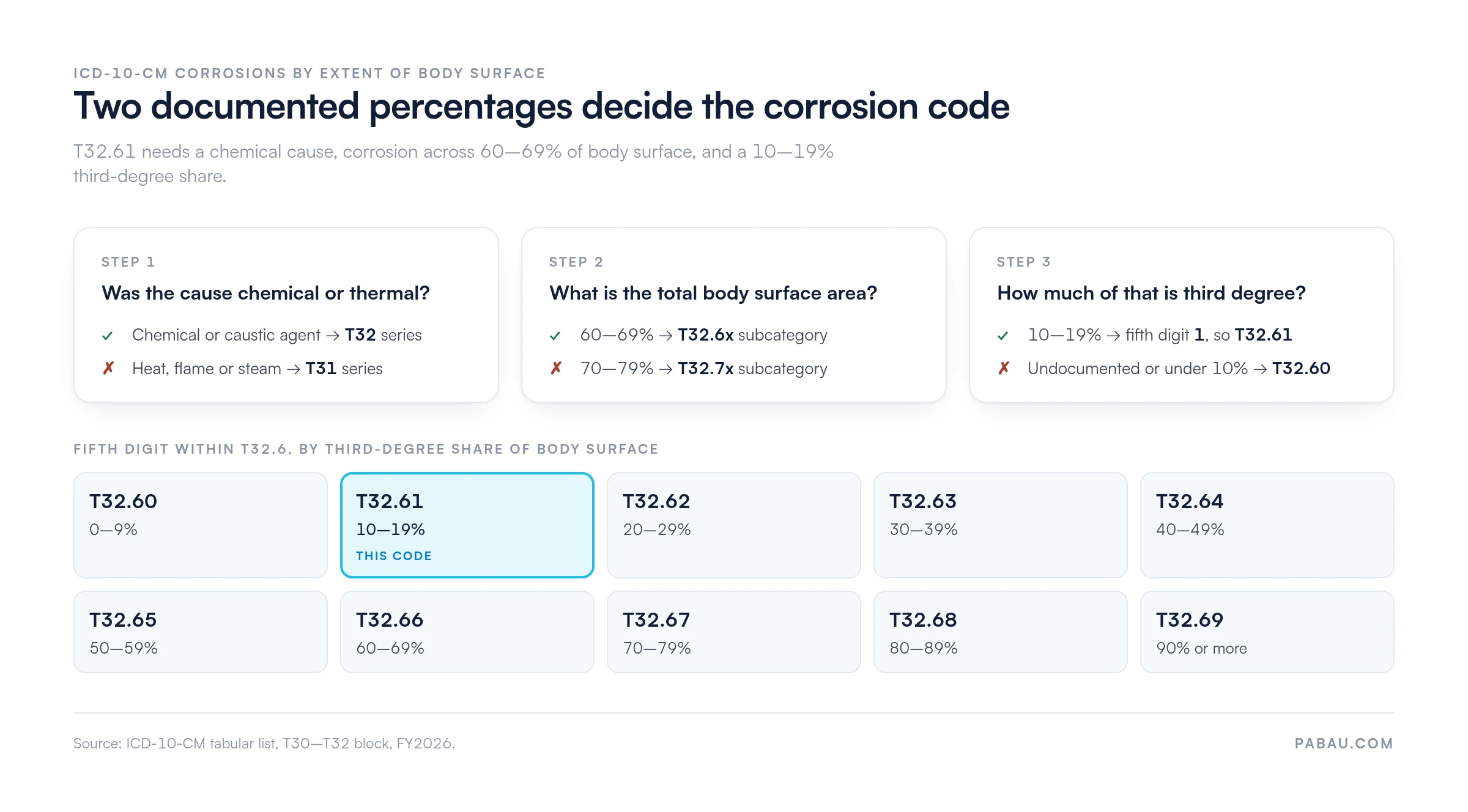
The common audit finding here is T32.61 assigned when the third degree percentage was never documented. T32.60 is the correct code in that situation. Reaching for a higher-specificity subcode with no documentation behind it is a compliance violation, so build the physician query into coding review before submission.
When third degree documentation is ambiguous, query the attending rather than defaulting to T32.61. T32.60 is defensible when the documentation is absent. Assigning T32.61 without a clear third-degree percentage creates an audit liability. Query first, code second.
T32.61 appears almost exclusively on inpatient hospital claims for burn center admissions. The diagnosis usually pairs with a burn DRG in the 927-929 range, depending on whether there was an OR procedure or a major complication.
Coding at this level of specificity feeds DRG assignment directly, so it moves the reimbursement weight on the claim.
Claims for extensive corrosion also carry procedure codes for debridement, grafting, and wound management. Confirm that T32.61 is sequenced correctly against the site-specific T20-T28 codes and any procedure codes.
Claims software for coders validates ICD-10 combinations before submission, so pairing errors surface while the claim is still editable.

Getting the pairing right before release matters more on these claims than on routine ones. A burn center admission is high value, and a rejection restarts the whole cycle.
In most burn billing teams, the coding work and the submission work live in separate systems. A coder assigns T32.61 in the abstracting tool, and someone rekeys the claim afterward. The eligibility check then happens on a payer portal in a third tab.
Pabau keeps the record, the codes, and the claim in one place. Its claims management tools hold an ICD-10 catalog, run real-time eligibility checks, and submit electronically through the Claim.MD clearinghouse. The codes a coder enters are the codes that go out.
On a multi-code claim like a T32.61 admission, that removes the rekeying step where digits get transposed. It also means a coverage problem shows up before the claim is released, rather than three weeks later on a remittance.

Pabau’s claims management tools keep your ICD-10 catalog, eligibility checks, and electronic submission in one place. Burn and corrosion claims leave the practice complete the first time.

T32.61 is straightforward once the chart carries both percentages. It turns into guesswork when the chart carries neither. So the work belongs on the burn assessment form, well before anyone opens the claim.
Make the total TBSA and the third-degree share separate required fields on that form. Then pair T32.61 with its site-specific T20-T28 codes and with the external cause code the documentation supports.
Book a demo to see how Pabau validates ICD-10 combinations and checks eligibility before a burn claim leaves your practice.

Need to understand how clearinghouse submission works for complex codes? Our medical claims clearinghouse guide explains how electronic claim routing handles multi-code submissions like T32.61 encounters.
Want a reference for electronic remittance after burn claims are paid? Electronic remittance advice (ERA) explained covers how 835 files map payment back to individual claim lines.
Coding corrosion claims and need to verify eligibility first? Insurance eligibility verification covers how real-time eligibility checks reduce burn and corrosion claim rejections before submission.
ICD-10 Code T32.61 is a billable diagnosis code for corrosions involving 60-69% of body surface with 10-19% third degree corrosion. It describes extensive chemical injury where corrosive substances have affected 60% to 69% of the total body surface. Of that total, full-thickness damage accounts for 10% to 19%.
Yes, T32.61 is a billable and valid ICD-10-CM code for FY2026. Its parent category T32.6 is not billable. The fifth digit is required to reach billable specificity, so submitting T32.6 on its own produces an invalid code rejection.
Burns come from thermal sources such as heat, flame, electricity, and radiation, and they are coded in the T20-T31 series. Corrosions come from chemical or caustic substances. They are coded in T20-T28 by site and in T32 by extent. The documentation must identify the cause as chemical for T32.61 to apply.
Use T32.61 when the documentation states that 10-19% of the total body surface has sustained third degree chemical injury, with total corrosion at 60-69%. Use T32.60 when the third degree share is 0-9%, which includes a chart documenting none at all. Never assign T32.61 without a documented third degree percentage.
Report T32.61 alongside the site-specific corrosion codes from T20-T28, which identify where on the body the injury sits. Add an external cause code too, using X40-X49 for accidental chemical exposure or X86-X90 for an assault. Payer requirements for external cause coding vary.
T32.61 falls under Chapter 19, which covers injury, poisoning, and certain other consequences of external causes (S00-T88). Inside that chapter it sits in the T30-T32 block, covering burns and corrosions classified by extent of body surface involved.