

ICD-10 code S61.201A: Open wound of left index finger without nail damage
ICD-10 code S61.201A covers a left index finger wound of unstated type ICD-10 co...

Last Updated: Oct 16, 2026
Billable Code Specific Code
T32.40 is the billable ICD-10-CM code for corrosions involving 40-49% of body surface with 0% to 9% third degree corrosion. Put simply, a chemical injury covers close to half the body, yet less than a tenth of it is full thickness.
The fact that matters most is that T32.40 is complete at five characters and never takes a 7th character. It leads the claim only when the corrosion site is unspecified. Otherwise, it follows the T20-T25 site codes. Getting that order and the third-degree share right keeps the claim from bouncing back. Next come the checks that separate it from its siblings, the sequencing rules and a pre-submission checklist.
Let Pabau's smart automation suggest the right codes, reduce claim denials, and keep your practice compliant—effortlessly.
Automate repetitive tasks and focus on what matters most—your patients.
Reduce coding errors and ensure compliance with the latest regulations.
Clean claims, fewer denials, and faster reimbursements.
Powerful insights and reporting to help your practice thrive.
HIPAA compliant SOC 2 certified GDPR-compliant Trusted by 4,000+ clinics worldwide

ICD-10 code T32.40 is a billable, complete five-character code for corrosions of 40-49% of body surface with 0% to 9% third degree.
T32.40 takes no 7th character, so T32.40XA is an invalid code that fails claim validation.
T32.41 through T32.44 share the same 40-49% total and differ only by the documented third-degree share.
When the chart names the corroded sites, the T20-T25 site codes go first and T32.40 follows as a supplementary code.
T32 is for chemical injuries only, so thermal burns of the same extent belong in T31.
ICD-10 code T32.40 records corrosions involving 40-49% of body surface with 0% to 9% third degree corrosion.
In plain terms, a chemical injury covers close to half the body, but less than a tenth of the body surface is full thickness. It’s a billable, specific code, and it’s complete at five characters.
The code sits in category T32 (Corrosions classified according to extent of body surface involved), inside the S00-T88 Injury chapter. The CDC/NCHS ICD-10-CM web tool lists it as valid for the 2025 and 2026 fiscal years. It has no active revisions.
The hierarchy runs from chapter to code. S00-T88 contains the T20-T32 burns and corrosions block. Within it, T30-T32 covers multiple and unspecified body regions, and T32 sorts corrosions by extent. T32.4 is the 40-49% subcategory, and T32.40 is one of its five billable codes.
Once you know the digit pattern, you can read any T32 code at a glance. The first digit after the decimal gives the total body surface in 10-point bands. It runs from 0 (under 10%) to 9 (90% or more). The second digit gives the third-degree share in the same steps, so T32.40 reads as “40-49% total, 0-9% third degree.”
All five T32.4 codes share the same 40-49% total, and none is more specific than the others. The coder simply matches the documented third-degree share to the right sibling.
The chart below runs through the four checks in order, from the chemical cause to where T32.40 sits on the claim.
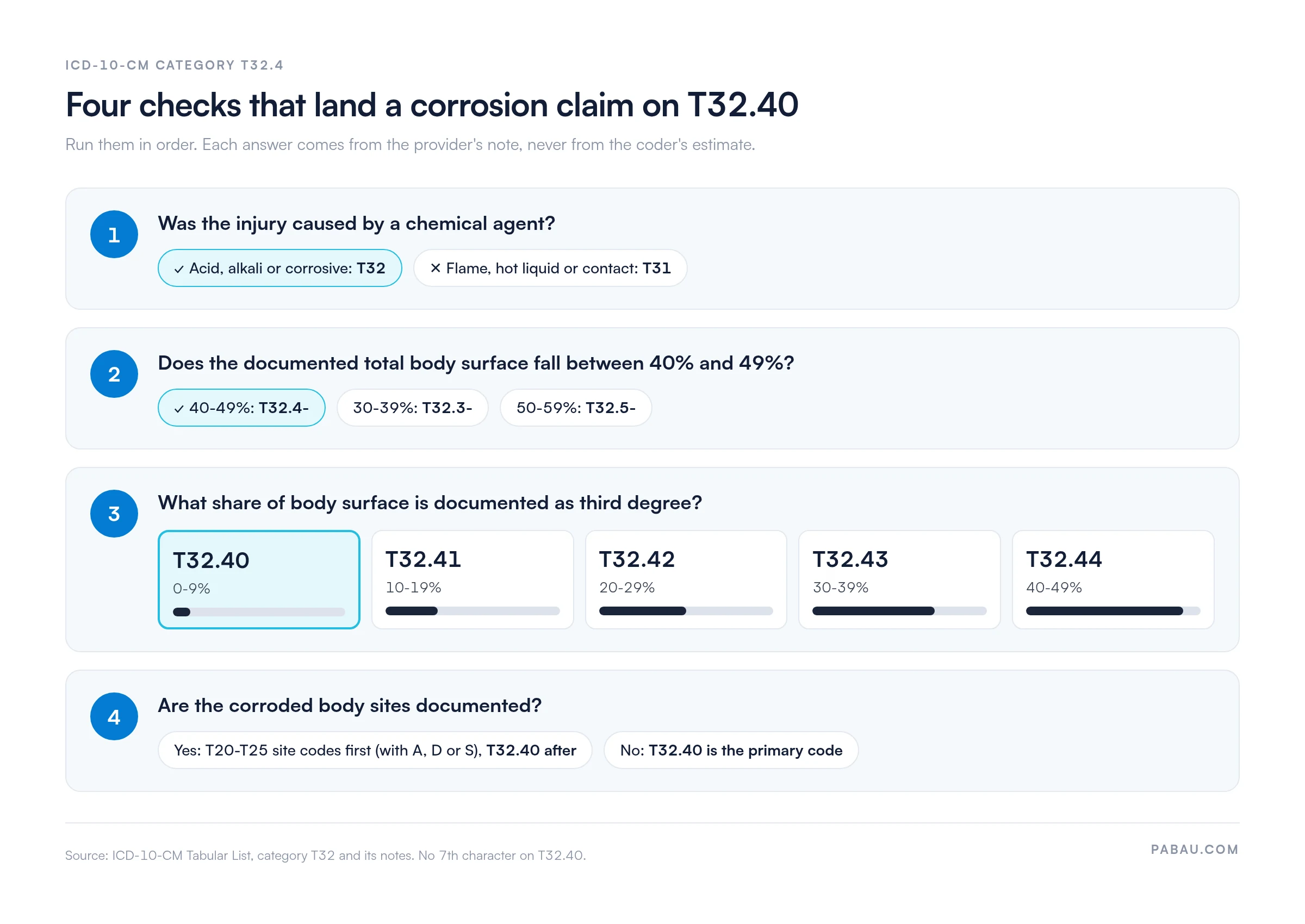
Here’s how that plays out on a chart. Say the provider documents “45% TBSA acid corrosion, 20% full thickness.”
The total lands in T32.4, and the 20% third-degree share points to T32.42, not T32.40. If the note gives a total but no depth, don’t assume the share is under 10%. Query the provider instead.
The cause of the injury decides the category. T32 covers corrosions from chemical agents such as acids, alkalis and other corrosive substances. T31 covers thermal burns from flame, hot liquids, hot objects or radiation.
Both categories use the same extent and third-degree axes, which is why the codes look so alike.
In practice, the provider’s wording usually settles it. A few quick calls:
A wrong category rarely travels alone, because the T20-T25 site codes also split burns from corrosions. The CMS ICD-10 codes page hosts the annual ICD-10-CM Official Guidelines for Coding and Reporting. Section I.C.19.d sets out the burn and corrosion rules.
The provider calculates total body surface area (TBSA), and the coder reports it. ICD-10-CM guidelines base T31 and T32 on the Rule of Nines. They also let providers adjust the percentages for infants and children, and the Lund-Browder chart is the usual age-adjusted alternative.
Coders shouldn’t work out TBSA from clinical notes on their own. If the record says “approximately 45% TBSA involved, all partial thickness,” the code is T32.40. A TBSA figure with no depth data is a documentation deficiency, and it calls for a provider query.
Once the total reaches 50%, the claim leaves T32.4 for the T32.5 block. With 10-19% third-degree involvement documented there, the billable code is T32.51.
Flag any burn or corrosion encounter where the provider note lacks an explicit TBSA percentage. A T32.4 code built on an estimate the provider never documented invites a medical necessity denial. Add a documentation prompt to your intake workflow so providers record TBSA and third-degree share at every burn or corrosion visit.
Payers reviewing a T32.40 claim look for six elements in the record. Miss one, and a routine payment can turn into a slow appeal. AAPC’s ICD-10-CM code lookup lists the full T32 range if you want to cross-check the code.
These prompts work best at the point of care, before the note is closed. With claims management software, you can build them into the clinical workflow. Providers then record TBSA and depth during the visit, so fewer claims stall on a query.
T32.40 takes no 7th character. The ICD-10-CM Tabular List gives the A, D and S extensions to the site categories, T20-T25. The extent categories T31 and T32 have none. Add one, as in “T32.40XA,” and you’ve created a code that doesn’t exist, so the claim fails validation.
The encounter type still matters, though. It’s recorded on the T20-T25 site codes reported alongside T32.40, as this chest wall example shows.
On those site codes, A (initial encounter) covers active treatment, such as surgical debridement, grafting and dressing changes. D applies once the patient is healing and receives routine care. S applies when a late effect, such as a contracture or scar, is treated.
When the chart names the corroded sites, the site codes go first and T32.40 follows. The Tabular List note for T32 makes it the primary code only when the site is unspecified.
Otherwise, T32 is a supplementary code used with T20-T25. The category carries no Includes note, and no Excludes1 note bars it from appearing with T31.
Take an initial visit for second-degree acid corrosions, including the chest wall, that total 45% TBSA with no full-thickness areas. The claim lines up like this:
The WHO ICD-10 browser shows the international version of these categories. US claims, however, follow ICD-10-CM and its Official Guidelines.
T32.40 denials tend to repeat the same five mistakes. Each one is visible on the claim before it goes out, so a quick review now saves an appeal later.
When a denial does arrive, the remittance advice tells you which of these went wrong. Our guide to medical billing denial codes explains the CARC and RARC codes that usually come back on these claims.
Audit your T32 claims from the past 90 days. First, filter for any T32.4x code sent with a 7th character, since those claims will have failed validation. Next, filter for T32.40 claims where the provider documented 10% or more third degree. Both groups are quick recovery opportunities.
Payer rules for T32.40 mostly bite on the procedures it supports. Medicare Administrative Contractors (MACs) may publish Local Coverage Determinations (LCDs) for burn procedures, and commercial payers often follow CMS.
Prior authorization may apply to burn unit admission, surgical debridement or skin grafting. Rules vary by payer and plan year, so check coverage before scheduling elective procedures.
These CPT codes often appear alongside a T32.4 diagnosis:
A two-minute check before submission catches the errors above. Work through this list on every T32.40 claim:
Each of those checks maps to a rule of clean claim submission. A claim that passes them reaches the payer with valid codes, the right characters and a diagnosis that supports the procedure.
Burn and wound care teams often code corrosion cases from scattered notes. The errors surface only when a rejection comes back, weeks after the visit.
Practice management software like Pabau pre-fills the claim form from the patient record, so the recorded ICD-10 codes land in the diagnosis slots. Built-in ICD-10-CM lookup libraries help coders confirm T32.40 and its site codes. Required claim fields are checked before the claim can be sent.
In the US, claims go out through Pabau’s Claim.MD integration, with eligibility checks, claim-status tracking and electronic remittance advice (ERA) posting. Your billing team sees each T32.40 outcome in one place and can resubmit a corrected claim quickly.

Pabau pre-fills claims from the patient record and sends them through Claim.MD. T32.40 claims go out with every recorded code, and their outcomes come back to one workspace.

T32.40 is a narrow code, and that works in your favor. The note has to prove a chemical cause, a 40-49% total and a third-degree share under 10%. Once it does, the code goes on the claim exactly as written, after any documented site codes.
The trade-off sits with documentation. Prompting providers for total extent, third-degree share and sites at every visit adds a minute per chart. In return, your team skips the queries, resubmissions and appeals that follow a vague note.
If you’d like to see how Pabau carries those details from the chart into a clean T32.40 claim, book a demo with our team.

Want claim edits to catch code errors before the payer does? Pabau’s Claim.MD clearinghouse guide explains how clearinghouse validation works before a claim is submitted.
Seeing the same corrosion claim denied more than once? Denial management in healthcare sets out a process for tracking and fixing repeat denials.
Worried a coding error could lead to an audit? Medical billing compliance covers the documentation standards payers expect to see.
Need faster answers on adjudicated claims? Electronic remittance advice explains how ERAs report payments and adjustments back to your team.
Want to see where coding fits in the wider billing process? What is revenue cycle management follows a claim from scheduling to final payment.
No. T32.40 measures corrosion of the external body surface only. Corrosions confined to the eye and adnexa use T26. The respiratory tract uses T27, and other internal organs use T28. A patient with both kinds of injury can need codes from each category.
The GEMs map T32.40 back to ICD-9-CM 948.40. That code covered burns of 40-49% of body surface with less than 10% or unspecified third degree. ICD-9 used one category for thermal and chemical burns alike. So when you convert an old record, check the cause before choosing T31.40 or T32.40.
No. WHO’s ICD-10 stops at four characters for this category, so international coders report T32.4 for corrosions of 40-49% of body surface. The fifth character for the third-degree share exists only in ICD-10-CM, the US clinical modification.
Not by national rule. ICD-10-CM encourages external cause codes for place (Y92), activity (Y93) and status (Y99). Reporting them is voluntary unless a state or payer requires it, so check the payer’s rules for workplace chemical injuries.



