ICD-10 code T87.52: Necrosis of amputation stump, left upper extremity
ICD-10 code T87.52 at a glance: Left arm, not left leg ICD-10 code T87.52 is the...

Last Updated: Oct 26, 2026
Billable Code Specific Code
T32.42 is the billable ICD-10-CM code for corrosions involving 40-49% of body surface with 20-29% third degree corrosion. It applies when a chemical or caustic agent, such as an acid or alkali, caused the injury.
T31.42 covers the same figures for thermal, electrical and radiation burns, so confirm the agent first. A T32.42 claim also needs the T51-T65 toxic effect code sequenced ahead of it and both TBSA percentages charted.
Let Pabau's smart automation suggest the right codes, reduce claim denials, and keep your practice compliant—effortlessly.
Automate repetitive tasks and focus on what matters most—your patients.
Reduce coding errors and ensure compliance with the latest regulations.
Clean claims, fewer denials, and faster reimbursements.
Powerful insights and reporting to help your practice thrive.
HIPAA compliant SOC 2 certified GDPR-compliant Trusted by 4,000+ clinics worldwide

T32.42 records two figures for a chemical injury: 40-49% of the body surface corroded (4th character) and 20-29% with third-degree corrosion (5th character).
T32.42 covers corrosions from acids, alkalis and other caustic agents. A thermal, electrical or radiation burn with the same figures takes T31.42 instead.
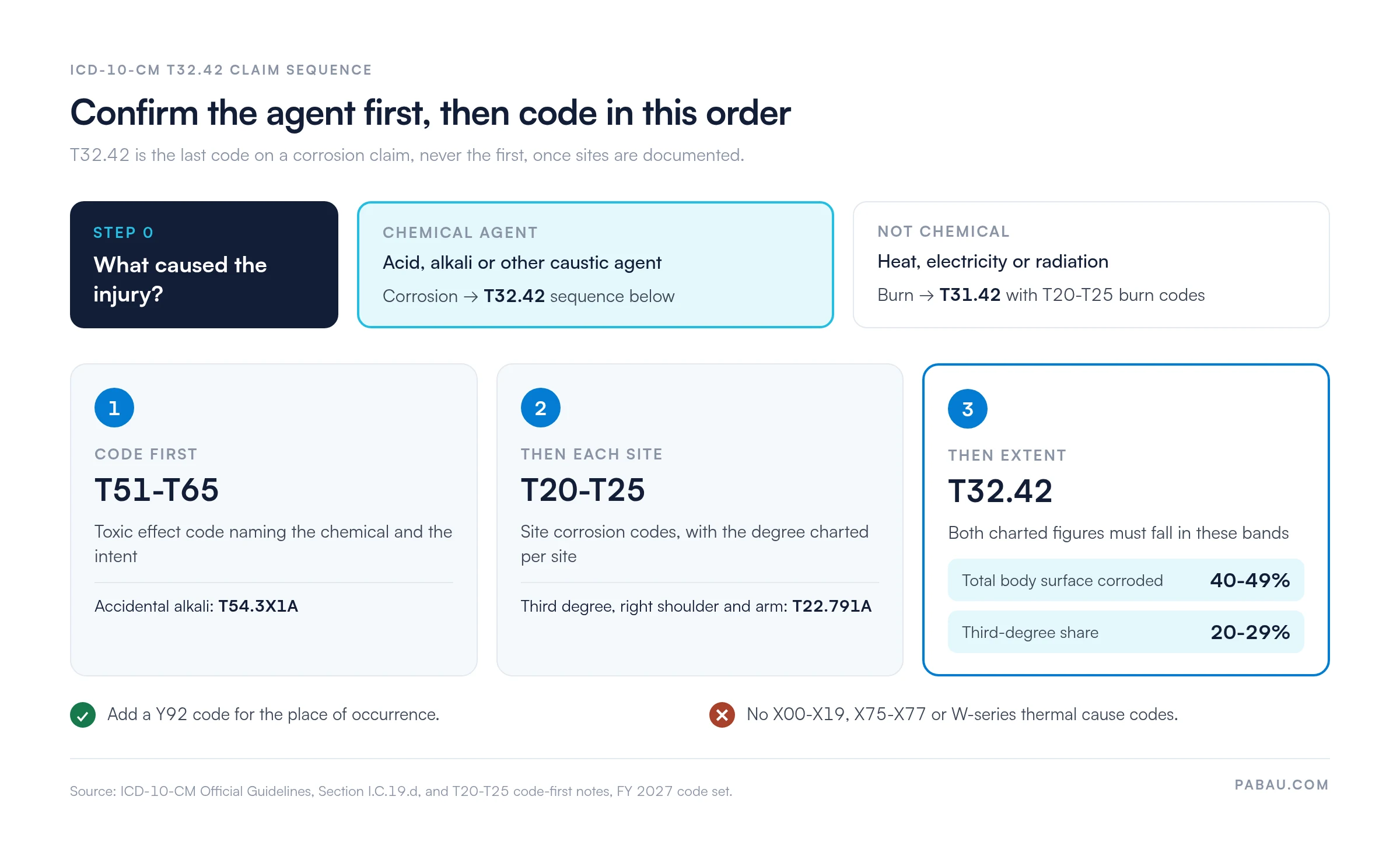
Code first the T51-T65 toxic effect code for the chemical and intent, then the T20-T25 site corrosion codes, then T32.42 for extent.
Category T32 is the primary code only when the corrosion site is unspecified. Documentation must state both the total TBSA and the third-degree TBSA.
Pabau’s claims management software flags missing supporting codes and incomplete code combinations before submission, reducing T32.42 denials.
ICD-10 Code T32.42 sits in Chapter 19 of ICD-10-CM (Injury, poisoning and certain other consequences of external causes). Its category, T32, classifies corrosions by the extent of body surface involved rather than by anatomical site. The table below gives the reference data a coder needs before assigning it.
T32.42 is a valid code in the FY 2027 ICD-10-CM code set, effective October 1, 2026. CMS publishes each year’s code files on its ICD-10 codes page.
T32.42 packs two body surface percentages into one five-character code. Knowing what each position encodes answers the most common coder question: Why does one corrosion code carry two percentage figures?
The fourth character runs from 0 to 9, each digit a 10-point TBSA band (0 = less than 10%, through 9 = 90% or more). The fifth character uses the same bands for the third-degree (full-thickness) share of the body surface. It can never exceed the fourth character’s band, so subcategory T32.4 stops at T32.44.
For T32.42 to apply, the injury must meet both thresholds. A patient with 45% of the body surface corroded and 25% full-thickness fits. The same patient with only 15% full-thickness maps to T32.41 instead.
Full-thickness corrosion drives resource use. It often needs excision and skin grafting, prolonged wound care and a longer inpatient stay. Alkalis in particular can keep penetrating tissue after contact, so the documented depth may change over the first hours.
Getting the fifth character wrong is a compliance risk as well as a billing accuracy problem. Never default it to zero (T32.40) when the chart documents a larger full-thickness area.
The Rule of Nines is the standard way to estimate TBSA in adults, and it works the same for chemical injuries as for thermal ones. It divides the adult body into regions worth about 9%, or a multiple of 9%, of total body surface area.
To reach 40-49%, a patient splashed with an industrial alkali might have corrosion of the posterior trunk (18%), one leg (18%) and one arm (9%). That totals 45%. The clinician then repeats the estimate for the full-thickness areas only, and that figure must fall between 20% and 29%.
The Rule of Nines is calibrated for adults. For children, the Lund-Browder chart adjusts for a proportionally larger head and smaller legs. Confirm the clinician used an age-appropriate method before assigning any T32 code to a pediatric patient.
Both methods are standard in burn care. For coding, the chart should name the method used, not just the final percentage.
T31 and T32 are parallel categories with identical character structures. The difference is the agent, not the extent. T31 covers burns from heat, electricity and radiation, while T32 covers corrosions from chemicals.
Two patients with the same body surface figures get different codes if one was scalded and the other splashed with acid.
Guideline I.C.19.d applies the same rules to burns and corrosions. T31 and T32 are the primary code only when the site is not specified. When sites are documented, they serve as additional codes that supply extent data.
The guidelines also call for a T31 or T32 code whenever third-degree involvement reaches 20% or more, which T32.42 always does.
T32.42 itself carries no Excludes1 note. The instructions that matter sit on its category, its block and the site codes it supplements. Review them before finalizing the claim.
Category T32 carries one note: Use it as the primary code only when the corrosion site is unspecified. When the site is known, it supplements codes from T20-T25. The burns and corrosions block (T20-T32) also has an Excludes2 note for sunburn (L55.-) and other radiation-related skin disorders (L55-L59).
Per guideline I.C.19.d, burns come from heat, electricity or radiation, while corrosions are burns due to chemicals. T32.42 applies to corrosions only. A thermal, electrical or radiation burn of the same extent takes T31.42, with burn site codes from T20-T25.
Every T20-T25 corrosion code carries a code-first note for T51-T65, which identifies the chemical and the intent. A corrosion claim therefore starts with the toxic effect code, then the site codes, then T32.42. Corrosive agents usually fall under T54: T54.1- for organic compounds, T54.2- for acids, T54.3- for alkalis and T54.9- when unspecified.
Because T51-T65 codes already capture intent, a corrosion claim does not take the X00-X19, X75-X77 or W-series codes used for thermal burns. The site codes also call for a Y92 code to identify the place of occurrence.
Activity (Y93) and status (Y99) codes follow payer or state reporting rules. The diagram below puts the agent check and the full code order side by side.
Sequencing rules for T32.42 differ between inpatient and outpatient encounters. The code-first note for corrosions also changes the order coders know from thermal burns.
For inpatient admissions, the code-first convention puts the T51-T65 toxic effect code ahead of the site corrosion codes. An accidental alkali injury of the right shoulder and arm codes as T54.3X1A first. T22.791A follows for third-degree corrosion of multiple sites of the right shoulder and upper limb, then T32.42 for extent.
Sequencing drives DRG assignment, so run every corrosion claim through your grouper rather than assuming a burn DRG. In MS-DRG v44, T32.42 is grouped within DRGs 927 and 933, the extensive burn groups with ventilation over 96 hours. Verify current DRG logic against the fiscal-year CMS IPPS final rule tables, because it changes annually.
In outpatient settings, the first-listed diagnosis reflects the reason for the visit. For a follow-up wound care visit, report the toxic effect and site corrosion codes with 7th character D (subsequent encounter), such as T54.3X1D. T32.42 follows as a supplemental extent code. Outpatient claims do not use DRG grouping, so T32.42 mainly supports medical necessity here.
Corrosion sequela coding applies when a patient returns for a residual condition, such as scarring or contracture, after the original injury has healed. The sequencing differs from acute corrosion visits.
For sequela encounters, pair the residual condition code with a site corrosion code carrying the 7th character S. T32.42 takes no 7th character at all. Adding an S suffix to it creates an invalid code string that will reject at the clearinghouse.
T32.42 claims fail for a predictable set of reasons. Most start in the chart, where a percentage, an agent or a site went unrecorded. The checklist below maps each denial type to its root cause and the fix.
Pabau’s claims management software applies pre-submission edits that catch missing supporting codes and incomplete code combinations. Pairing those edits with set denial management workflows catches corrosion coding errors before a payer sees them.
When a T32.42 claim does come back, read the denial codes on the remittance advice first. They usually point to the exact chart item that was missing, such as the third-degree percentage or the toxic effect code.

Accurate assignment of T32.42 depends on what the clinician documents. A coder cannot assign the 4th or 5th character correctly without explicit numbers in the chart.
Coders can improve documentation by giving burn teams a structured chemical injury assessment template that prompts for all six data points on admission.
Review Pabau’s guidance on medical billing compliance for documentation standards that apply to high-acuity injury codes. When documentation is complete at the point of care, clean claim submission follows without coder queries or clinician addenda that delay billing cycles.
Add a chemical injury prompt to your EHR admission note template. Require four values: total TBSA corroded (%), third-degree TBSA (%), body regions involved, and the agent with intent. These four values drive every character in T32.42 and its supporting codes. A structured prompt reduces coder queries and cuts documentation-related denials.
Checked by hand, a corrosion claim with a missing toxic effect code or a T31/T32 mix-up goes out unchanged. The error surfaces weeks later as a denial, and payment on a high-value inpatient claim waits with it.
Pabau submits claims electronically through its Claim.MD integration, supporting 837P and CMS-1500 formats. Built-in ICD-10 catalogs let coders check the whole chain before the claim leaves the practice.
That chain runs from the toxic effect code through the site codes to T32.42. Our guide to medical billing fundamentals explains how payer rules shape that sequencing.
The result is fewer rejections on claims where a single character decides whether the payer sees a chemical injury or a thermal one.

Pabau’s claims management tools flag missing supporting codes and incomplete code combinations before submission, so T32.42 claims reach payers clean the first time.

T32.42 rewards coders who confirm the agent before the numbers. The 40-49% and 20-29% figures only point to T32.42 once the chart names a chemical cause. A thermal injury with identical figures belongs under T31.42. From there, a clean claim depends on the code-first chain and two explicitly charted percentages.
Build the agent, intent and both TBSA figures into your admission template, and let pre-submission edits catch the rest. To see how Pabau’s claims management tools handle corrosion coding alongside your clinical documentation, book a demo.

Need a foundation in injury claim workflows? Revenue cycle management fundamentals covers how diagnosis code accuracy feeds the wider RCM process, from charge capture through payment posting.
Submitting corrosion claims electronically? 837 file format guide details how ICD-10 codes sit within the 837P transaction set, which matters for any practice submitting T32.42 electronically.
ICD-10 Code T32.42 is the billable diagnosis code for corrosions involving 40-49% of total body surface area, with 20-29% showing third-degree (full-thickness) corrosion. Corrosions are chemical burns from acids, alkalis or other caustic agents. The T32 category classifies them by extent rather than by anatomical site.
Yes, T32.42 is a valid, billable ICD-10-CM code at the five-character level. Category T32 is the primary code only when the corrosion site is unspecified. When sites are documented, T32.42 follows the T51-T65 toxic effect code and the T20-T25 site corrosion codes as an additional code.
Both codes share the same extent figures: 40-49% of body surface, with 20-29% third degree. T31.42 is for burns from heat, electricity or radiation. T32.42 is for corrosions from chemicals. The agent documented in the chart decides which one applies.
Use the Rule of Nines for adults: head and neck 9%, each arm 9%, anterior trunk 18%, posterior trunk 18%, each leg 18%, perineum 1%. Add the percentages of all affected regions to reach total TBSA. For children, use the Lund-Browder chart, which adjusts for age-related proportions. Document the method and both resulting percentages in the clinical note.
No. T32.42 applies only to corrosions caused by chemical or caustic agents. A flame, scald, electrical or radiation burn of the same extent takes T31.42. Submitting T32.42 for a thermal burn conflicts with the burn site codes and external cause codes on the same claim.
Without explicit TBSA percentages in the record, the coder cannot assign the 4th or 5th character of T32.42. Query the treating clinician for an addendum documenting total TBSA and third-degree TBSA before submitting the claim. Defaulting to T32.40 when full-thickness corrosion is documented is inaccurate coding and creates audit exposure.