ICD-10 Code Y76.0: Diagnostic obstetric and gynecological devices
ICD-10 Code Y76.0: Definition and billable status ICD-10 Code Y76.0 is a valid, ...

Last Updated: Oct 23, 2026
Billable Code Specific Code
T32.60 is the billable ICD-10-CM code for corrosions involving 60-69% of body surface with 0% to 9% third degree corrosion. It records how much of the body a chemical burn covers, and separate site codes record where the damage is.
The fact that decides most of these claims is the mechanism. An acid, alkali, or other caustic agent points to T32, while a heat burn of the same extent belongs in T31.60. The sections below cover the fifth character, companion codes, sequencing, and pre-submission checks.
Let Pabau's smart automation suggest the right codes, reduce claim denials, and keep your practice compliant—effortlessly.
Automate repetitive tasks and focus on what matters most—your patients.
Reduce coding errors and ensure compliance with the latest regulations.
Clean claims, fewer denials, and faster reimbursements.
Powerful insights and reporting to help your practice thrive.
HIPAA compliant SOC 2 certified GDPR-compliant Trusted by 4,000+ clinics worldwide

T32.60 reports corrosions (chemical burns) covering 60-69% of body surface, with 0% to 9% of the body surface third degree.
Switch to T32.61 through T32.66 once the provider documents 10% or more of the body surface as third-degree corrosion.
When the site is documented, T32.60 is a supplementary code listed after the T51-T65 toxic-effect code and the T20-T25 site codes.
T32.60 is complete at six characters, so the A, D, or S seventh character belongs on the codes around it.
Practice management software like Pabau checks that required claim fields are complete before submission, while the code choice stays with your coder.
ICD-10 code T32.60 is the billable ICD-10-CM code for corrosions involving 60-69% of body surface with 0% to 9% third degree corrosion. Put simply, a chemical agent has damaged 60% to 69% of the patient’s skin. Under 10% of the body surface is full thickness.
It’s an extent code. It tells the payer how much of the body is involved, and separate site codes say where. Here’s the quick reference before we get into code selection and sequencing.
Check the code in the CDC/NCHS ICD-10-CM web tool before each October 1 update. Descriptors and validity can change with the annual release.
T32 is the corrosion category, so the agent must be chemical. ICD-10-CM uses corrosion for burns caused by acids, alkalis, and other caustic substances. Burns from heat, flame, or radiation go to T31 instead, or to the burn codes in T20-T25.
The fourth character, 6, puts the total extent at 60-69% of body surface. The fifth character, 0, means 0% to 9% of the body surface is third degree. That also covers a chart that documents no full-thickness areas at all.
The T32.6 subcategory holds seven codes, T32.60 through T32.66. All of them share the 60-69% total. The fifth character tracks how much of the body surface is third degree, in 10-point steps.
Here’s how it plays out on a chart. A provider documents a 64% TBSA alkali corrosion with 12% full thickness. That’s T32.61, because the third-degree share has passed 10%. If the same note gave 7% full thickness, T32.60 would be correct.
Coding T32.60 when the notes support a higher tier understates severity. ICD-10-CM asks for the most specific code the documentation supports, so this error can prompt a clinical documentation integrity (CDI) query or an audit finding.
T31.60 and T32.60 share the same extent and depth values. The cause of injury is what separates them, so the parent category is where most mix-ups start.
When the record says “burn” but never names the mechanism, query the provider before you settle on T31. Workplace injuries and self-harm cases often involve chemicals. The ED report may also name the agent when the progress notes don’t.
The TBSA percentage behind T32.60 comes from the provider’s burn assessment. Two tools produce it, and knowing which one was used helps when you need to send a query.
The Rule of Nines gives each adult body region a fixed share of the total:
Try a quick check. Both legs (36%), the front of the trunk (18%), and one arm (9%) add up to 63%. That lands inside T32.6. Swap the arm for the back of the trunk, and the total reaches 72%, which belongs in T32.7.
The Rule of Nines is built for adults. It underestimates a child’s head and overestimates the legs, so pediatric units use a different chart.
The Lund-Browder chart adjusts each region’s share for age. Burn units prefer it for children and for adults whose body shape skews the Rule of Nines. When the note cites a Lund-Browder total, code from that figure. The code itself doesn’t change with the patient’s age.
If the provider documents a range that stays inside 60-69%, such as ‘approximately 60-65%’, T32.6x is supported. If the range crosses a category line, such as 55-65%, query the provider rather than choosing a tier yourself.
ICD-10-CM Official Guidelines section I.C.19.d.9 says an external cause code should be used with burns and corrosions. On a corrosion, two kinds of code share that job.
A Chapter 19 toxic effect code from T51-T65 is coded first and names the chemical and the intent. The Chapter 20 external cause codes, Y92, Y93, and Y99, then record place, activity, and status.
The graphic below shows the full set in sequence order, along with which codes carry a seventh character.
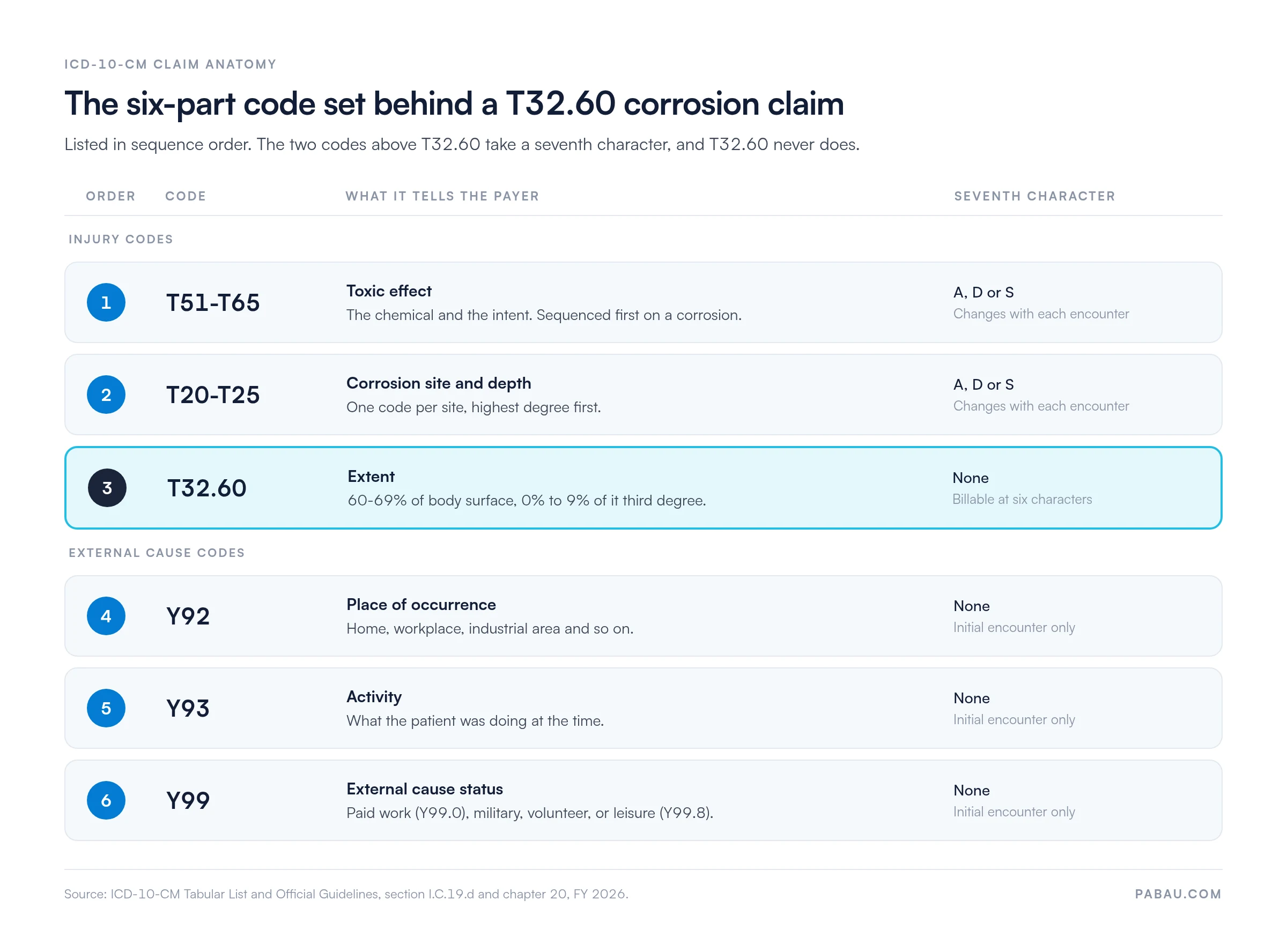
Y92, Y93, and Y99 are reported once, at the initial encounter. The toxic effect code and the site codes stay on later claims, with an updated seventh character, D or S, on those visits. External cause codes are never the principal or first-listed diagnosis. You’ll find the current code files on the CMS ICD-10 codes page.
ICD-10-CM Official Guidelines section I.C.19.d governs the coding of burns and corrosions. For a T32.60 case, three rules settle the order.
The corrosion site codes carry a “code first” note for T51-T65, so the toxic effect code goes at the top. The T20-T25 site codes come next. T32.60 follows as a supplementary code that records total extent. The tabular note lets T32 act as the primary corrosion code only when no site is documented.
When corrosions reach several body sites, sequence the site code with the highest degree first. Code every documented site. T32.60 then captures the combined extent across all of them.
T32.60 has no seventh character, so it reads the same on every claim that reports it. The T20-T25 site codes and the T51-T65 code carry the character instead. Use A for active treatment, D for routine healing care, and S for sequela such as scarring or contracture.
Confirm the encounter purpose before you assign the character. Auditors compare it against the visit note, so a dressing change billed with A stands out quickly.
Auditors reviewing a T32.60 claim look for six elements in the record. When one is missing, expect a CDI query before billing or a take-back after payment.
T32.60 denials usually trace back to documentation. Here are the patterns to watch, along with the fix for each one. If a remittance shows a code you don’t recognize, look it up in our guide to denial codes before you appeal.
Run through these before a T32.60 claim leaves the practice:
A T32.60 claim can carry six codes, and each one comes from a different part of the chart. Keying them into a claim form by hand is where missing fields and typos creep in.
Practice management software like Pabau pre-fills the claim from the patient record, so codes already attached to the visit land on the form. Coders can search a built-in ICD-10-CM library instead of a separate browser tab.
Before the claim goes out, Pabau’s claims management software checks that required fields, such as membership numbers and authorization codes, are complete.
In the US, claims then go through the Claim.MD integration, with real-time eligibility checks and electronic remittance posting. Your coder still picks the tier and the sequence.

Pabau’s claims management tools support real-time eligibility verification and clearinghouse submission for burn and corrosion encounters. See how practices send complete claims on high-complexity diagnoses.

T32.60 is rarely the hard part of a chemical burn claim. The hard part is the note behind it: a named agent, a stated total, and a third-degree figure under 10%.
So put the effort upstream. Agree a TBSA and mechanism template with your burn providers, and query as soon as a figure is missing. A query at coding time takes minutes, while reworking a denied six-code claim can take weeks.
To see how Pabau pre-fills and checks complex injury claims before they go out, book a demo.

Need a full reference on medical billing clearinghouses? Medical claims clearinghouse guide explains how electronic claim routing works and what clearinghouse edits catch before adjudication.
Want to reduce electronic remittance reconciliation time? Electronic remittance advice (ERA) overview covers 835 transaction processing and ERA-to-payment posting workflows.
Looking for guidance on insurance eligibility verification? Insurance eligibility verification outlines real-time 270/271 transaction checking and how it prevents avoidable denials on complex diagnoses.
Want a repeatable process for burn and corrosion denials? Denial management in healthcare walks through tracking, root-cause review, and appeals.
Aiming for first-pass acceptance on multi-code claims? What a clean claim is lists the fields and checks payers expect before adjudication.
No. T32.60 is billable and complete at six characters. The A, D, or S seventh character goes on the T20-T25 site codes and the T51-T65 toxic effect code reported with it.
Only rarely. The tabular note under T32 allows it as the primary corrosion code when no site is documented. Even then, the T51-T65 toxic effect code is sequenced ahead of it.
No, T32.60 stays the same. Intent lives in the T51-T65 code, which has options for accidental, intentional self-harm, assault, and undetermined. When the record doesn’t state intent, code it as accidental. Use undetermined only when the provider documents that intent can’t be determined.
On a CMS-1500, list it in box 21, which holds up to 12 diagnosis codes in lettered slots. Set the ICD indicator to 0, then point each service line to the codes that support it. On a UB-04, external cause codes have their own fields in form locator 72.