ICD-10 Code S53.013D: Anterior subluxation of unspecified radial head
ICD-10 Code S53.013D: Quick reference summary Use the table below as your first ...

Last Updated: Nov 6, 2026
Billable Code Specific Code
T32.50 is the billable ICD-10-CM code for corrosions involving 50-59% of body surface with 0% to 9% third degree corrosion. It covers chemical injuries only. Thermal burns of the same extent are coded T31.50.
The code carries two measurements: the total body surface area (TBSA) corroded and the share of the whole body corroded to third degree. It is usually reported after a T51-T65 code naming the chemical and the T20-T25 site codes. It takes no 7th character.
Let Pabau's smart automation suggest the right codes, reduce claim denials, and keep your practice compliant—effortlessly.
Automate repetitive tasks and focus on what matters most—your patients.
Reduce coding errors and ensure compliance with the latest regulations.
Clean claims, fewer denials, and faster reimbursements.
Powerful insights and reporting to help your practice thrive.
HIPAA compliant SOC 2 certified GDPR-compliant Trusted by 4,000+ clinics worldwide

T32.50 is a billable ICD-10-CM code for chemical corrosions covering 50-59% of the body, with 0% to 9% of the body corroded to third degree.
Category T32 covers corrosions only, so a thermal burn of the same extent is coded T31.50. The documented mechanism decides the category, whatever the degree documentation shows.
T32.50 takes no 7th character, although the site corrosion codes and the T51-T65 toxic-effect code reported with it do.
Under guideline I.C.19.d, T32.50 is an additional code beside T20-T25 site codes, and it is listed first only when no site is documented.
A clean T32.50 claim rests on four documented facts: total TBSA, third-degree TBSA, the corrosive agent and every injured site.
ICD-10 code T32.50 is the billable ICD-10-CM code for corrosions involving 50-59% of body surface with 0% to 9% third degree corrosion.
A corrosion is a chemical burn, caused by an acid, an alkali or another caustic agent. Thermal burns from heat, flame, steam or hot liquid are never coded here — they belong in category T31.
The code records how much of the body the chemical injured, not where. According to the CDC/NCHS ICD-10-CM browser tool, T32.50 has been valid since ICD-10-CM took effect on October 1, 2015. It is a complete five-character code, so it is reported exactly as written.
Every code in category T32 carries two separate measurements. Reading them as one figure is the most common way coders land on the wrong subcategory.
The 4th character: total TBSA. The “5” in T32.50 places the total body surface area (TBSA) corroded at 50-59%. That figure counts every degree of injury together. The physician has to record it as a percentage, not as “extensive” or “both legs and trunk.”
The 5th character: third-degree TBSA. The “0” in T32.50 means 0% to 9% of the whole body is corroded to third degree. A patient with 55% total TBSA and 8% third-degree corrosion fits T32.50. The same patient with 15% third-degree corrosion moves to T32.51.
T31.50 and T32.50 are mirror codes. Both describe 50-59% total TBSA with 0% to 9% third-degree involvement, and both use the same two axes. The only question that separates them is what caused the injury.
Pick the category from the mechanism the provider documents. If the record says “chemical burn” or names a caustic agent, the injury is a corrosion and belongs in T32. Missing degree documentation never moves a corrosion into T31.
ICD-10-CM bases categories T31 and T32 on the Rule of Nines. Coders do not calculate TBSA themselves; they read both percentages from the provider’s record.
The Official Guidelines assign these standard percentages to each body region:
The guidelines let providers change these assignments for infants and children, whose heads are proportionally larger. They also allow it for patients with large buttocks, thighs or abdomen. Burn centers often use the Lund-Browder chart for children, and the record should say which method was used.
Once total TBSA is known, the provider records how much of the whole body is corroded to third degree. That second figure is a share of total body surface, not a share of the injured area. A patient with 55% total TBSA and 20% third-degree corrosion is coded T32.52, not T32.50.
Section I.C.19.d of the ICD-10-CM Official Guidelines covers burns and corrosions. The CMS ICD-10 page publishes the current guidelines each fiscal year. Four rules shape how T32.50 sits on a claim.
T32.50 itself takes no 7th character. The site codes and the T51-T65 code do, so the A, D or S that marks the encounter goes on those codes only. Adding a 7th character to T32.50 creates a code that does not exist. Put together, a complete claim lists its codes in three steps.
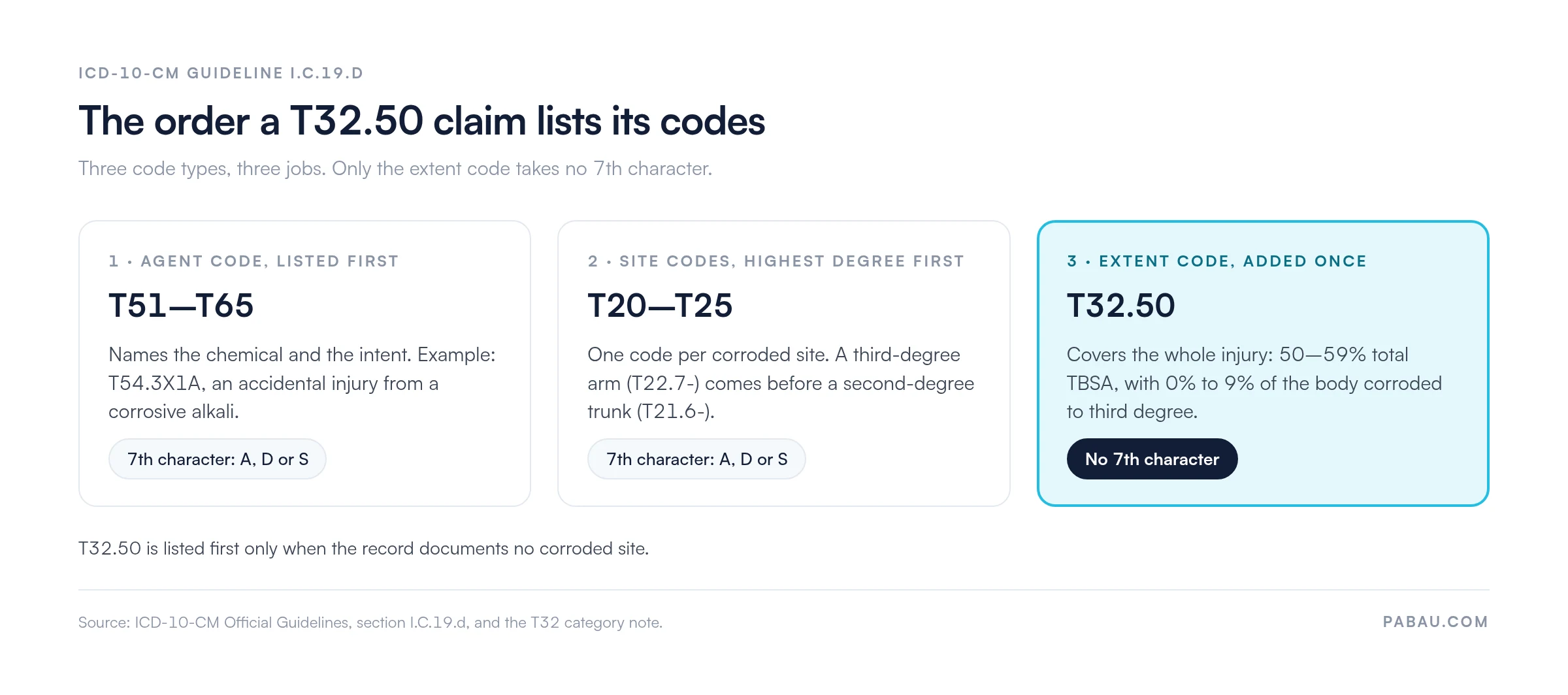
Knowing what surrounds T32.50 prevents both over-coding and under-coding. The AAPC ICD-10-CM code lookup lists the full T32 range with its notes.
Corrosions covering 50-59% of the body are uncommon, and they are usually treated in a burn center as an inpatient stay. Payer scrutiny is higher at this severity, and commercial plans often require authorization for the admission or transfer. Requirements vary by plan and by Medicare Administrative Contractor (MAC), so confirm them with each payer.
Run these checks before assigning the code, not after a denial arrives. Each one maps to a fact the code, its companion codes or the payer depends on.
Most T32.50 problems are code-pairing errors that a pre-submission review can catch. Strong denial management workflows start with knowing where these claims break.
Medical billing denial codes seen on these remittances include CO-11 and CO-50. CO-11 means the diagnosis is inconsistent with the procedure, and CO-50 means the payer found no medical necessity. Both are won on clinical documentation, not on a corrected code alone.
Before a T32.50 claim leaves the queue, read the code set top to bottom: T51-T65 agent code, corrosion site codes by degree, then T32.50. If the agent code is missing or a site code is from a thermal subcategory, stop and query the provider.
Billing major corrosion care often means juggling three systems: the clinical record, a spreadsheet of authorizations and a clearinghouse portal. Each hand-off is a chance for a missing figure or a mismatched code to slip through.
Pabau, the practice management platform we build, keeps the record, the claim and the payment in one system. Its claims management software turns invoices into CMS-1500 claims and validates each one for missing or invalid details before it leaves. Claims go out through Claim.MD, Pabau’s US clearinghouse partner, which also runs real-time insurance eligibility verification before the visit.

After submission, Pabau tracks each claim’s status and flags rejected claims as “Needs action,” with a link to the field to fix. Electronic remittance advice comes back into Pabau, so payments post against the right claim. The result is fewer resubmissions and a clearer view of which corrosion claims still need work.

Pabau’s claims management software validates every claim for missing or invalid details before it reaches Claim.MD. Real-time eligibility checks and claim status tracking keep T32.50 claims moving.

T32.50 is a narrow code: chemical corrosions, 50-59% of the body, under 10% of it third degree. Most errors come from treating it as a general burn code, so the first check on any claim is the mechanism. If the record describes heat, the code is T31.50.
The second check is the code set around it. A T51-T65 agent code leads, the corrosion site codes follow by degree, and T32.50 closes with no 7th character. Practices that hold every claim to that order will spend far less time on rework and appeals.
Accurate claims start with a billing system that flags a missing TBSA figure or agent code before the payer sees the claim. Book a demo to see how Pabau validates, submits and tracks insurance claims for your practice.

Need to understand how clearinghouse submission works? Claim.MD clearinghouse overview explains how electronic claim validation and ERA processing reduce denial rates for inpatient claims.
Working through a denied corrosion claim? Electronic remittance advice (ERA) guide covers how to read ERA files, identify CARC denial codes, and prioritize appeals.
Need a broader billing workflow reference? Revenue cycle management overview maps the end-to-end billing process from patient encounter to payment posting.
T32.50 is the billable ICD-10-CM code for corrosions involving 50-59% of body surface with 0% to 9% third degree corrosion. The 4th character records total TBSA, and the 5th character records how much of the whole body is corroded to third degree.
T32.50 is a corrosion code. Category T32 covers chemical injuries only, while category T31 covers thermal burns. A thermal burn of the same extent is coded T31.50.
Both codes describe 50-59% total TBSA with 0% to 9% third-degree involvement. T31.50 is for thermal burns and T32.50 is for chemical corrosions. Choose between them by the documented mechanism, not by how well the degree is documented.
No. T32.50 is complete at five characters, and adding A, D or S makes it invalid. The T20-T25 corrosion site codes and the T51-T65 toxic-effect code reported with it do take a 7th character.
Under guideline I.C.19.d and the T32 category note, T32.50 is listed first only when the site of the corrosion is not specified. When sites are documented, it is an additional code after the T51-T65 agent code and the T20-T25 site codes.
Categories T31 and T32 are based on the Rule of Nines, and providers may adjust it for children and larger body habitus. The provider must record total TBSA and third-degree TBSA as two separate percentages for T32.50 to be supported.