

ICD-10 code S61.201A: Open wound of left index finger without nail damage
ICD-10 code S61.201A covers a left index finger wound of unstated type ICD-10 co...

Last Updated: Oct 16, 2026
Billable Code Specific Code
T32.51 is the billable ICD-10-CM code for corrosions involving 50-59% of body surface with 10-19% third degree corrosion. It is a complete five-character code with no seventh character, used as the primary code only when the corrosion site is unspecified.
When the site is documented, T32.51 is reported as a supplementary extent code alongside the site-specific corrosion codes from T20-T25. Those site codes carry the A, D, or S seventh character. So does the toxic effect code (T51-T65), which is coded first to identify the chemical and intent.
Let Pabau's smart automation suggest the right codes, reduce claim denials, and keep your practice compliant—effortlessly.
Automate repetitive tasks and focus on what matters most—your patients.
Reduce coding errors and ensure compliance with the latest regulations.
Clean claims, fewer denials, and faster reimbursements.
Powerful insights and reporting to help your practice thrive.
HIPAA compliant SOC 2 certified GDPR-compliant Trusted by 4,000+ clinics worldwide

T32.51 codes chemical corrosions covering 50-59% of body surface, with 10-19% of body surface at third-degree depth.
T32.51 is a complete, billable five-character code with no seventh character, so T32.51XA and similar variants do not exist.
T32 is the primary code only when the corrosion site is unspecified. Otherwise it supplements the T20-T25 site codes.
Code the toxic effect (T51-T65) first to identify the chemical and intent, and add Y92 for the place of occurrence.
T32 codes are not used for sequelae, which take the site-specific corrosion code with seventh character S.
Practice management software like Pabau keeps corrosion documentation, TBSA figures, and claim tracking in one patient record.
ICD-10 Code T32.51 is the billable ICD-10-CM code for corrosions involving 50-59% of body surface with 10-19% third degree corrosion. A corrosion is a burn caused by a chemical, such as an acid or an alkali.
The code sits in category T32, which classifies corrosions by the extent of body surface involved rather than by site. The fourth character (5) sets the total extent at 50-59%. The fifth character (1) sets third-degree involvement at 10-19% of body surface. The breakdown below shows what each character records.
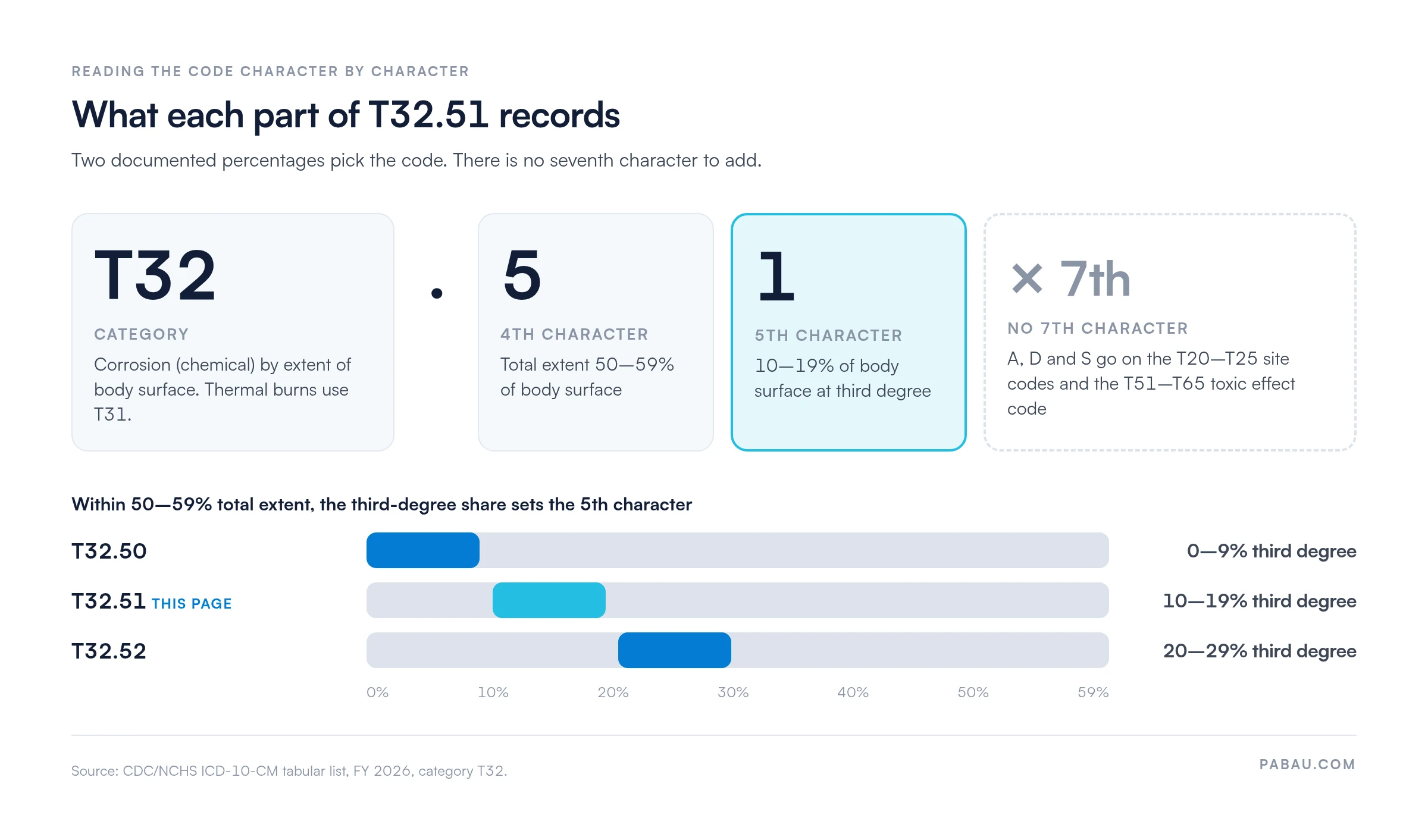
T32.51 is complete at five characters. Category T32 carries no seventh-character instruction, so the code is reported exactly as T32.51. It takes no placeholder X and no seventh character. The code is valid for FY 2026 in the CDC/NCHS ICD-10-CM browser tool.
Categories T31 and T32 are based on the rule of nines, per ICD-10-CM Official Guidelines Section I.C.19.d.6. The rule assigns a fixed percentage to each body region, so the provider can total the affected area.
When the documented total lands between 50% and 59%, the fourth character is 5. The fifth character then depends on how much of the body surface is third degree. A third-degree share of 10-19% gives T32.51, while 20-29% moves the code to T32.52.
The same guideline lets providers adjust these percentages for infants and children, whose heads are proportionately larger. Many burn teams use a Lund-Browder chart for that reason. Either way, the code follows the provider’s documented figures, and a coder never swaps in an estimate of their own.
A corrosion is a burn caused by a chemical, such as an acid, an alkali, or another caustic substance. A thermal burn comes from heat, flame, hot liquids, electricity, radiation, or friction. The Official Guidelines apply the same rules to both, but the agent decides between T31 and T32.
If the record documents sulfuric acid, lye, or a caustic cleaning product, the injury is a corrosion and T32 applies. Reporting T31.51 for a chemical injury misclassifies it. The extent code would then contradict the toxic effect code on the same claim.
The T32 category note sets the rule. T32 is the primary code only when the site of the corrosion is unspecified. It may be used as a supplementary code with categories T20-T25 when the site is specified.
When the record names the affected sites, the coder assigns a separate T20-T25 code for each one, per Section I.C.19.d.5. The T20-T25 block then instructs an additional code from T31 or T32 to identify the extent.
Seventh characters sit on the companion codes, not on T32.51. Every code in the site-specific categories takes A, D, or S, including T21.7- for third-degree corrosion of the trunk. The toxic effect codes in T51-T65 take one as well.
Adding a seventh character to T32.51 creates a code that does not exist in the tabular list. Claim scrubbers flag T32.51XA as an invalid code, and payers reject it.
Take an accidental alkali splash at a factory. The patient has third-degree corrosion of the trunk and second-degree corrosion of both legs. The provider documents a total extent of 54%, with 15% third degree.
The site codes appear as subcategories because the full code depends on the exact site and laterality in the record. Among the corrosion codes, the site with the highest degree is sequenced first, per Section I.C.19.d.1.
Section I.C.19.d.6 states that codes from T31 and T32 should not be used for sequelae of burns or corrosions. A visit for a scar or contracture after healing is coded with the late-effect condition. The site-specific corrosion code with seventh character S follows it, and T32.51 stays off that claim.
Upper limb sites work the same way. A residual scar from third-degree corrosion of the right elbow is coded T22.721S.
T32.51 sits between T32.50 and T32.52 in the tabular list, with T31.51 as its thermal-burn counterpart. Picking the wrong fifth character or the wrong category is the usual way this code goes wrong on a claim.
When the documented total sits near 49% or 50%, the provider’s recorded figure controls the code. Coders must not round up on their own. If the record is ambiguous, query the treating provider rather than assuming the higher extent.
Payers and auditors expect the medical record to support each element of ICD-10 Code T32.51 and its companion codes. A missing element can lead to a denial or a request for records.
Each of these points has to come from the provider’s documentation. When an element is missing, query the provider rather than choosing a less specific code.
Section I.C.19.d.9 says an external cause code should be used with burns and corrosions to identify the source, intent, and place. For corrosions, a toxic effect code from T51-T65 captures the chemical and intent. The corrosion site codes instruct you to code it first and to add a Y92 code for the place.
External cause reporting has no national mandate. Section I.C.20 makes Chapter 20 codes required only under a state reporting mandate or a specific payer’s rule. Otherwise, providers are encouraged to report them voluntarily.
Chapter 20 codes are never sequenced first or as the principal diagnosis. Some payers and clearinghouses run their own injury-claim edits, so check each payer’s companion guide.
For a workplace chemical injury, record exactly where it happened and whether the patient was working for pay. A Y92.6- code covers industrial and construction areas, and Y99.0 flags civilian work for income. Workers’ compensation carriers use these details to confirm the claim belongs to them.
Medicare, Medicaid, and commercial payers accept T32.51 as a valid diagnosis code for corrosion care. A corrosion this extensive usually means inpatient burn treatment, and authorization rules for grafting vary by payer and setting. Confirm them with the payer before a scheduled graft.
A pre-bill checklist for corrosion claims should confirm the code order, the seventh characters on companion codes, and the TBSA documentation. Proactive denial management in healthcare starts there. Reviewing remittance advice then shows which errors recur, so the fix happens upstream.
Treatment at this extent often combines burn dressings or debridement with excision and grafting. The CPT codes below appear on many corrosion claims. Confirm each one against current CPT and NCCI edits before billing.
NCCI edits are updated quarterly, so check the CMS NCCI edits page before billing debridement and grafting on the same date. A clean claim for these episodes also carries the right modifier when an NCCI edit allows an override.
Coding T32.51 correctly depends on details spread across the chart: the chemical, each site and its depth, the TBSA total, and the encounter status. When those sit in separate notes, a coder has to chase them before the claim can go out.
Practice management software like Pabau keeps treatment notes, digital forms, and invoices in one patient record. A treatment-specific form can ask for the chemical, the TBSA total, and the third-degree share at every visit. The figures a coder needs are then on file before coding starts.
When the claim is ready, Pabau’s claims management software pulls the data already on the record into the claim and submits it. US practices submit through the Claim.MD clearinghouse, and rejections come back into the same system to be corrected and resubmitted.

Pabau keeps treatment notes, TBSA documentation, and claim tracking in one patient record, so your billing team codes from a complete chart.

T32.51 is one of the simpler codes on a corrosion claim, because it takes no seventh character and records only the extent. The work that decides whether the claim gets paid sits around it. That means the toxic effect code, a site code for each area, and the Y92 place code.
Practices that treat chemical injuries get cleaner claims when the chart captures the agent, sites, depth, and TBSA at the point of care. To see how Pabau keeps that documentation and the claim in one record, book a demo with our team.

Need help managing claim denials systematically? Denial codes in medical billing covers the most common CARC denial codes and how to respond to each one.
Want to understand the clearinghouse process end to end? 837 file guide explains how electronic claims are structured and transmitted through clearinghouses for ICD-10 diagnosis codes.
Reviewing payer credentialing alongside your coding setup? How to get credentialed with insurance companies walks through the payer enrollment process that determines which claims you can submit.
Want fewer corrosion claims bounced on the first pass? What is a clean claim lists the elements a claim needs to be paid without rework.
Tracking which injury-claim errors keep coming back? Electronic remittance advice explains how to read the ERA your payers send after each claim.
ICD-10 Code T32.51 is the diagnosis code for corrosions (chemical burns) involving 50-59% of body surface, with 10-19% of body surface at third-degree depth. It is a billable ICD-10-CM code valid for FY 2026 and takes no seventh character.
Yes. T32.51 is a billable and specific ICD-10-CM code valid for FY 2026. It is submitted exactly as T32.51, with no placeholder X and no seventh character.
No. T32.51 is a complete five-character code, and category T32 carries no seventh-character instruction. The A, D, and S characters belong on the companion site codes (T20-T25) and toxic effect codes (T51-T65), so T32.51XA is not a valid code.
Code first a toxic effect code from T51-T65 to identify the chemical and intent. Add a T20-T25 code for each documented site, then T32.51 for the extent and a Y92 code for the place. Section I.C.20 requires external cause codes only under a state mandate or a payer rule.
TBSA is estimated with the rule of nines. The head and neck and each arm count as 9%. Each leg and each side of the trunk count as 18%, and the genitalia as 1%. Providers may adjust these for children, often with a Lund-Browder chart. A documented total of 50-59% with 10-19% third degree selects T32.51.



