ICD-10 Code Y76.0: Diagnostic obstetric and gynecological devices
ICD-10 Code Y76.0: Definition and billable status ICD-10 Code Y76.0 is a valid, ...

Last Updated: Oct 23, 2026
Billable Code Specific Code
T31.51 is the billable ICD-10-CM code for burns involving 50-59% of body surface with 10-19% third degree burns.
It sits within the T31 category, which classifies burns by extent rather than anatomical site. The fifth-character subcode records that 10-19% of the body surface has third-degree burns. Claims need physician-documented total body surface area (TBSA) percentages and the matching site-specific T20-T25 codes.
Let Pabau's smart automation suggest the right codes, reduce claim denials, and keep your practice compliant—effortlessly.
Automate repetitive tasks and focus on what matters most—your patients.
Reduce coding errors and ensure compliance with the latest regulations.
Clean claims, fewer denials, and faster reimbursements.
Powerful insights and reporting to help your practice thrive.
HIPAA compliant SOC 2 certified GDPR-compliant Trusted by 4,000+ clinics worldwide

ICD-10 Code T31.51 classifies burns covering 50-59% of body surface with 10-19% third-degree burns. It codes burn extent, not anatomical site.
T31.51 is a complete five-character code with no seventh character. The A, D or S character belongs on the T20-T25 site codes.
When the burn site is documented, the T20-T25 code leads and T31.51 is added. T31 leads only when the site is unspecified.
Physicians must document the total TBSA percentage and the third-degree percentage explicitly. Coders cannot calculate or estimate either figure.
Selecting T31.50 when 10-19% third-degree involvement is documented is undercoding and can trigger an audit finding.
ICD-10 Code T31.51 is a valid, billable ICD-10-CM code in the current code set. The official descriptor, as published in the CMS ICD-10-CM Tabular List, reads: Burns involving 50-59% of body surface with 10-19% third degree burns. The code belongs to category T31 (Burns classified according to extent of body surface involved), subcategory T31.5 (Burns involving 50-59% of body surface).
The T31.5x subrange contains six subcodes, each set by the share of body surface with full-thickness (third-degree) burns. Selecting the wrong subcode can trigger an audit finding, because DRG grouping and medical necessity review both depend on the third-degree percentage.
T31.51 is a complete, billable five-character code; it takes no seventh-character extension. The site-specific T20-T25 companion codes do. The breakdown below shows what each character of T31.51 records.
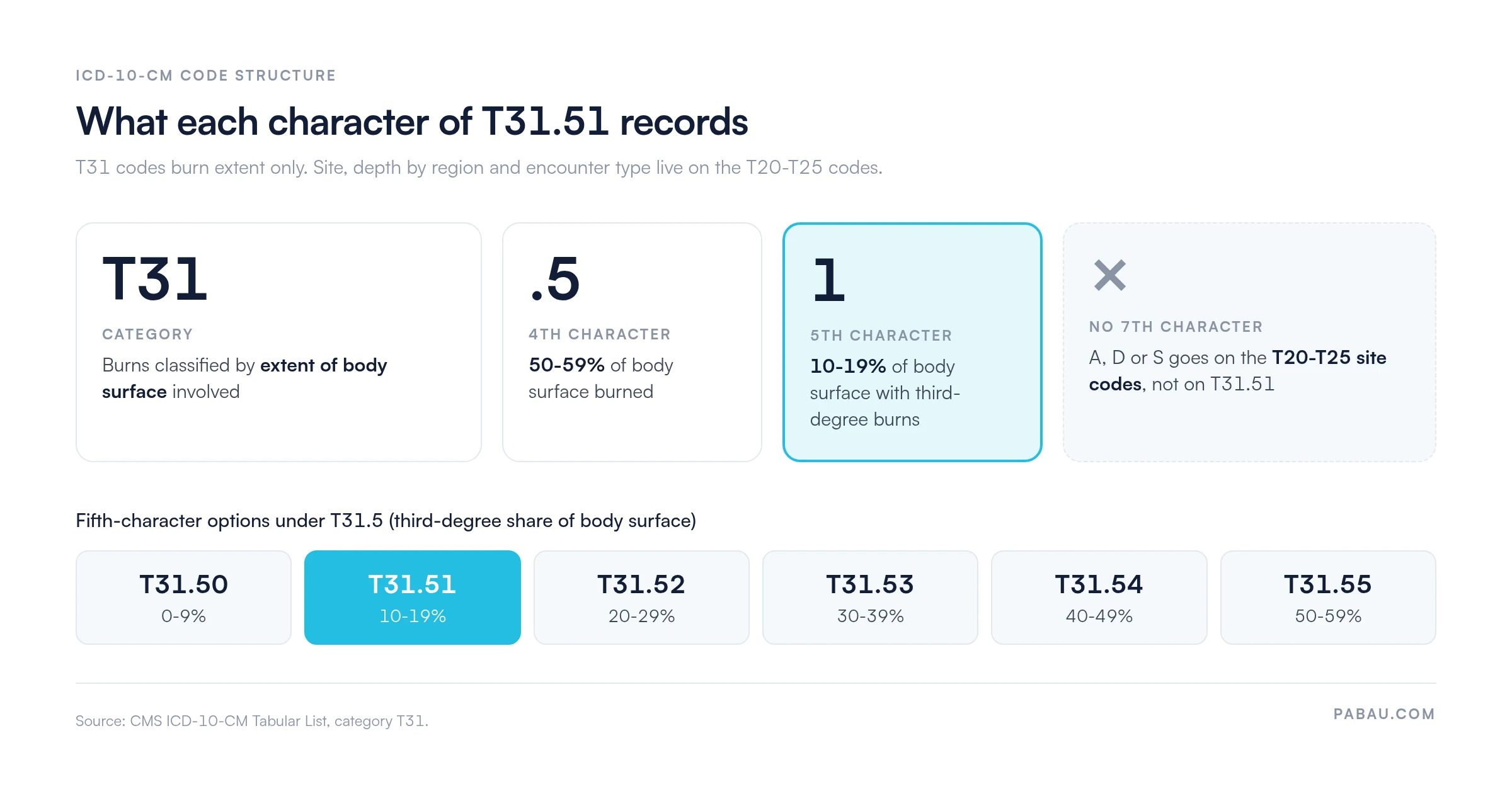
The T31 category classifies burns by total body surface area (TBSA) involved, not by anatomical site or burn depth. That rule is why T31 codes travel with companion codes. A burn covering 55% of the body, with 15% classified as full-thickness, is coded T31.51 regardless of which body regions are affected. The affected sites, however, must still be coded separately.
Per ICD-10-CM Official Guidelines Section I.C.19.d, T31 codes are used as additional codes when the site of the burn is specified. T31 is primary only when the burn site is unspecified; when the site is documented, the T20-T25 code leads and T31.51 is added. The table below shows how the fourth and fifth characters build every T31 code.
TBSA for burn coding purposes is always physician-documented. Coders do not calculate or estimate TBSA themselves, which is a firm boundary in ICD-10-CM coding practice. Physicians reach the figures that coders apply with two clinical tools: the Rule of Nines (adult standard) and the Lund-Browder chart (pediatric and precision work).
The Wallace Rule of Nines divides the adult body into regions worth about 9% of total body surface area, or multiples of 9%. Physicians use it to estimate TBSA burned at the bedside.
The Lund-Browder chart adjusts head and lower-limb proportions by age, because infants have proportionally larger heads and smaller legs than adults. An infant’s head accounts for about 19% of TBSA (17% at age 1, 13% at age 5), against 9% in adults. Applying the adult Rule of Nines to a child produces an inaccurate TBSA estimate that selects the wrong T31 code. The physician’s documented chart is the source of record, and coders use that figure exactly as documented.
Flag any burn encounter where the physician note states a TBSA percentage without the third-degree component. Query the physician before coding T31.51, because the exact third-degree percentage decides the subcode. An unanswered query can leave you on T31.50, which is undercoding if depth data exists in the clinical record.
T31.51 captures burn extent only. It does not code anatomical site, burn mechanism, or burn depth across individual body regions. That is why T31.51 is normally reported alongside site-specific codes rather than on its own.
T31.51 never takes a seventh character. The A, D and S characters belong on the site-specific T20-T25 burn codes reported with it. A marks active treatment, D marks routine healing-phase care, and S marks sequela such as scarring or contracture.
“Initial encounter” does not mean the first time a patient sees any provider. It means the patient is still receiving active treatment for the burn. A patient transferred to a burn center on day five still takes A on the T20-T25 codes while active treatment continues.
T20-T25 site codes are the standard companions. External cause, place (Y92) and activity (Y93, Y99) codes are reported at the initial encounter when payer or state rules require them. Per the AAPC ICD-10-CM coding reference, these companion codes document the clinical picture that T31.51 cannot capture on its own.
Take an initial inpatient encounter after a flame burn to the trunk and both lower extremities, with 55% TBSA, 15% third-degree and smoke inhalation. The sample code set is T31.51, T21.30XA and T24.301A and T24.302A, X03.0XXA, J70.5, a Y92 place code and an appropriate Y93 activity code. Because the burn sites are documented, the T21 and T24 codes are sequenced ahead of T31.51 on the claim.
The sequencing rule for T31.51 depends on whether the burn site is documented, not on whether the encounter is inpatient or outpatient. The same logic applies in both settings.
The site-specific T20-T25 code is sequenced first, and T31.51 is assigned as an additional code to capture the full extent. Where several sites are burned, the guidelines sequence the code for the highest degree of burn first.
The T31 tabular note allows T31.51 to be reported as the primary code only when the burn site is unspecified. Physician documentation that names the burned regions moves the claim back to the site-first order above.
Medicare groups major burn admissions to MS-DRGs 927-929 (extensive or full-thickness burns with skin graft, or inhalation injury) and 933-935 (without skin graft). The DRG depends on grafting, inhalation injury, and CC/MCC (complication or comorbidity) status. Sound medical billing compliance habits keep the documentation behind each of those factors ready for claim review.
Confusion tends to arise within the T31.5x subrange and between T31.51 and the neighboring TBSA bands. Each mix-up carries a different audit risk.
The T31.50 vs T31.51 error deserves specific attention. Selecting T31.50 when the physician has documented 10-19% third-degree involvement within a 50-59% TBSA burn is undercoding. It reduces the DRG weight, understates severity, and leaves the claim out of step with the medical record. Checking the subcode against ICD code lookup references before submission is a simple prevention step.
Supporting T31.51 on a claim requires specific physician documentation. The coder cannot infer missing elements, so they must be queried before the claim is submitted. Incomplete burn documentation can cause both denials and post-payment audit findings.
A structured burn documentation checklist, completed at the point of care, cuts the query volume and rework that follow incomplete records. This is also where clean claim submission begins, before the coder touches the chart.
Claims using ICD-10 Code T31.51 depend on a precise code set and on physician documentation that states both burn percentages. Effective denial management workflows start with knowing which failure points to target.
Practices billing for major burn encounters should review the medical billing denial codes their payers return on Chapter 19 claims. Claim adjustment reason codes (CARCs) and remittance advice remark codes (RARCs) show exactly why a T31.51 claim was rejected.
Run a monthly audit of all T31.51 claims submitted in the prior 90 days. Pull the subset where a denial code was received. For each denial, identify whether the root cause was a missing companion code, incomplete documentation, or a wrong subcode. Sorting denials by root cause shows which process fix removes the most rework.
ICD-10 Code T31.51 on a claim tells the payer it is dealing with a major burn. American Burn Association (ABA) referral criteria (for example, partial-thickness burns over 10% TBSA, or any full-thickness burn) guide transfer to a burn center. Payer authorization rules vary by plan, and emergency admissions are generally exempt. A planned admission or transfer for a 50-59% TBSA burn may still need authorization, so check each plan before the patient moves.
A major burn claim carries a long code set. It includes a site code for every burned region, the T31 extent code, and often external cause and inhalation codes. When one field is missing, the problem usually surfaces days later as a clearinghouse rejection.
Pabau, the practice management platform we build, checks that work before the claim leaves. Its claims software for practices scrubs every claim for missing or invalid details. Pabau’s Claim.MD integration provides real-time eligibility checks and claim status tracking, and insurer payments settle straight from electronic remittance advice files.
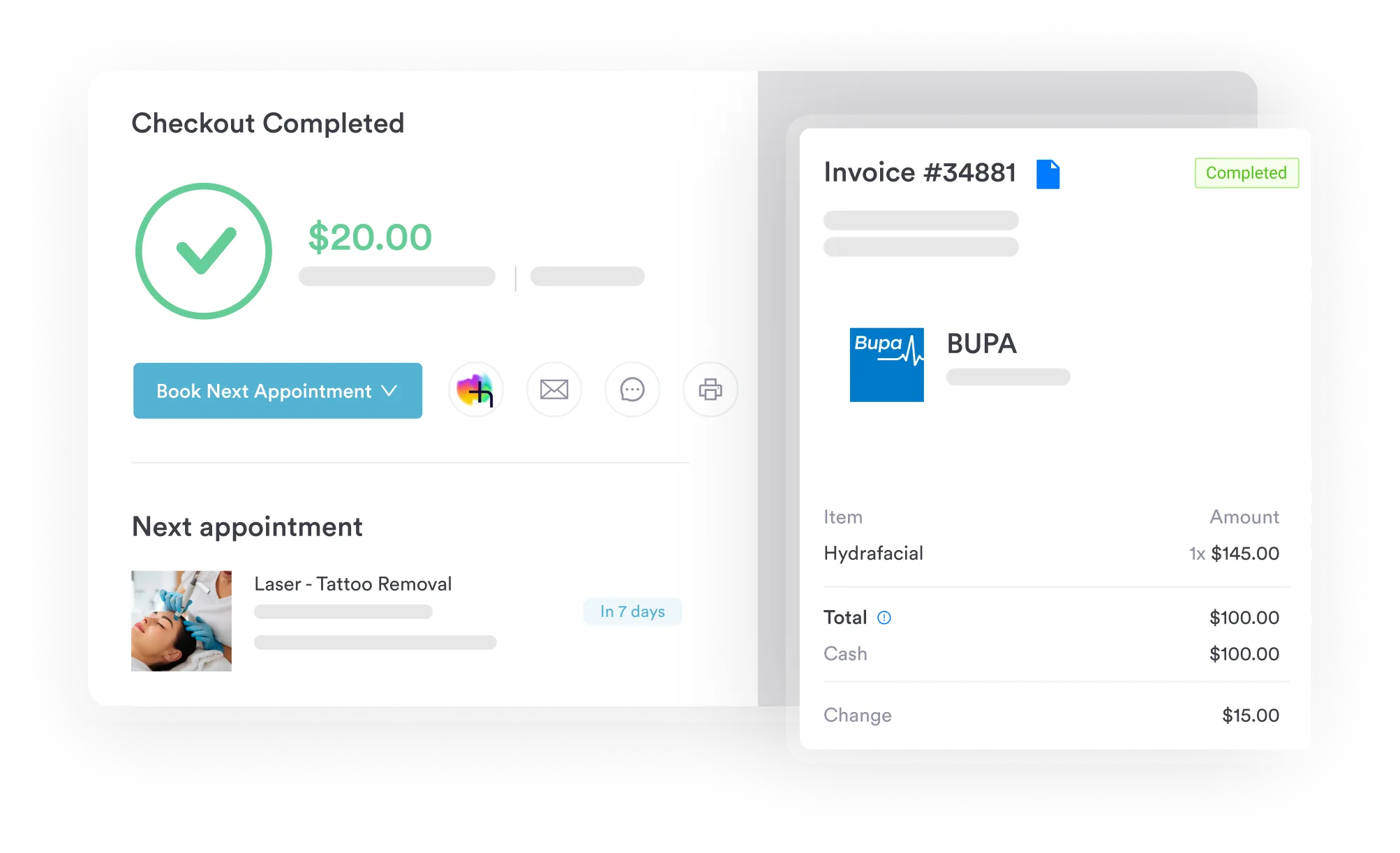
Rejected claims land on the claims dashboard flagged “Needs action”, with a link to the field that needs correcting. Prior authorizations sit on the patient as cases, so approved grafting or wound care sessions stay visible next to each claim.

Pabau’s claim validation checks every claim for missing or invalid details before it leaves the system. Long burn code sets reach the payer complete, and rejections come back flagged with the field to fix.

ICD-10 Code T31.51 is a precision code. It demands an exact TBSA range, an exact third-degree percentage range, and the right site-specific companion codes.
The practical fix starts in the note, not at the billing desk. A burn documentation template that asks for total TBSA, the third-degree percentage and every burned site settles the T31.50 versus T31.51 question before anyone codes.
The trade-off is a few extra fields at the bedside, against a held claim and a physician query later. Book a demo to see how Pabau checks burn claims for missing details before they reach the payer.

Need to understand how clearinghouse claims validation works? Our Claim.MD clearinghouse guide explains how electronic claims reach payers and what validation at submission catches.
Want to reduce denial rates across your billing team? What is revenue cycle management covers the end-to-end billing workflow and where burn encounter coding fits within it.
Submitting burn claims and need the 837 file format explained? The 837 file guide explains how ICD-10 diagnosis codes like T31.51 are structured inside the electronic transaction.
ICD-10 Code T31.51 is the billable diagnosis code for burns involving 50 to 59 percent of body surface. Within that, 10 to 19 percent of body surface has third-degree burns. It belongs to the T31 category, which classifies burns by extent rather than anatomical site. It is normally reported as an additional code with the site-specific T20-T25 codes.
Yes, T31.51 is a billable ICD-10-CM code and is reported as T31.51 with no seventh character. The companion T20-T25 burn codes carry A, D or S.
Burn depth describes the tissue layers involved (first, second, or third degree) and is captured in the site-specific T20-T25 codes. Burn extent describes the total percentage of body surface burned and the share with third-degree burns. That is what T31.51 captures. A complete burn claim usually carries both: the T31 extent code and depth-coded site codes from T20-T25.
The Rule of Nines is the clinical tool physicians use to estimate total body surface area burned at the bedside. It assigns 9% to the head and 9% to each arm. The anterior and posterior trunk get 18% each, each leg gets 18%, and the perineum 1%. Coders apply the physician-documented TBSA percentage to select the T31 code and never calculate TBSA themselves. For pediatric patients, the Lund-Browder chart is used instead because it adjusts for age-related body proportions.
Common denial triggers are missing T20-T25 site codes, a missing external cause code where the payer requires one, and an undocumented TBSA percentage. A wrong subcode (T31.50 when 10-19% third-degree burns are documented) and unsupported medical necessity also cause denials. Many of these trace back to a note that does not state both the total TBSA percentage and the third-degree percentage.
Only when the burn site is unspecified, per the T31 tabular note. When the site is documented, the T20-T25 code is sequenced first, in any setting.