ICD-10 Code Y76.0: Diagnostic obstetric and gynecological devices
ICD-10 Code Y76.0: Definition and billable status ICD-10 Code Y76.0 is a valid, ...

Last Updated: Oct 23, 2026
Billable Code Specific Code
T22.721S is the billable ICD-10-CM code for corrosion of third degree of right elbow, sequela. It covers a visit for the late effects of a full-thickness chemical injury to the right elbow, such as scarring or a contracture. The acute phase has already healed.
Most denials on this code trace back to three missing details in the note. It has to name the chemical agent, state third-degree depth explicitly, and show that active wound treatment has ended before "S" is assigned.
Let Pabau's smart automation suggest the right codes, reduce claim denials, and keep your practice compliant—effortlessly.
Automate repetitive tasks and focus on what matters most—your patients.
Reduce coding errors and ensure compliance with the latest regulations.
Clean claims, fewer denials, and faster reimbursements.
Powerful insights and reporting to help your practice thrive.
HIPAA compliant SOC 2 certified GDPR-compliant Trusted by 4,000+ clinics worldwide

T22.721S is a valid, billable ICD-10-CM code for FY 2027, specific to chemical corrosion of the right elbow at a sequela encounter.
The “S” seventh character applies only after the acute injury phase has resolved. Using it during active wound treatment is a coding error with audit risk.
The T20-T25 “use additional external cause code” note directs you to report one for the corrosive agent, and many payers expect it.
Pabau’s claims management software supports accurate diagnosis code submission and clearinghouse validation through its Claim.MD integration.
ICD-10 Code T22.721S is the billable ICD-10-CM code for corrosion of third degree of the right elbow, sequela.
It is valid for claim submission in FY 2027 under the CMS ICD-10-CM code set. It applies when a patient is treated for the late effects of a full-thickness chemical injury to the right elbow.
The code is structured across seven characters, each carrying specific clinical meaning:
According to the CDC/NCHS ICD-10-CM web tool, T22.721S is the most specific, billable code for this site, depth and encounter type. The T22.721 parent is not billable on its own.
Corrosion of third degree is full-thickness tissue destruction caused by a chemical agent, such as an acid, an alkali or another caustic substance. Heat plays no part. The injury destroys the epidermis and dermis and reaches subcutaneous tissue. The wound bed is insensate, may form eschar, and usually needs surgical debridement or grafting.
Laterality is a hard coding requirement. The “1” in the sixth position of T22.721S specifies the right elbow. A note that says “elbow” without a side forces the coder to assign T22.729S (unspecified elbow). Some payers treat that as insufficiently specific and may flag it for medical necessity review.
The seventh character in the T22.721 series records the encounter type. All three valid values describe the same injury at the same depth, and only the stage of care changes.
A sequela encounter needs two codes. T22.721S reports the late effect of the original corrosion. A second code reports the residual condition, such as M24.521 for contracture of the right elbow. Per ICD-10-CM Official Guidelines Section I.C.19, the sequela code always sequences after the residual condition code on the claim.
Each level of the tabular list narrows the code, so you can verify the selection one step at a time. The ICD-10-CM code library lists the neighboring codes at every level of the T22 category.
The AAPC Codify ICD-10-CM lookup displays this hierarchy visually and confirms the T22.721 parent is non-billable. Only a seventh-character extension (A, D or S) produces a billable code.
Coding a burn as a corrosion, or the reverse, puts the claim in the wrong code family. Payers flag that as inconsistent with the clinical documentation.
ICD-10-CM’s Includes note at T20-T25 defines corrosions explicitly as chemical burns. If the note says “burn” without naming the agent, query the provider before assigning T22.721S. Coders cannot infer chemical causation from the injury description alone.
Three answers from the note settle the full code, and each one changes a different character.
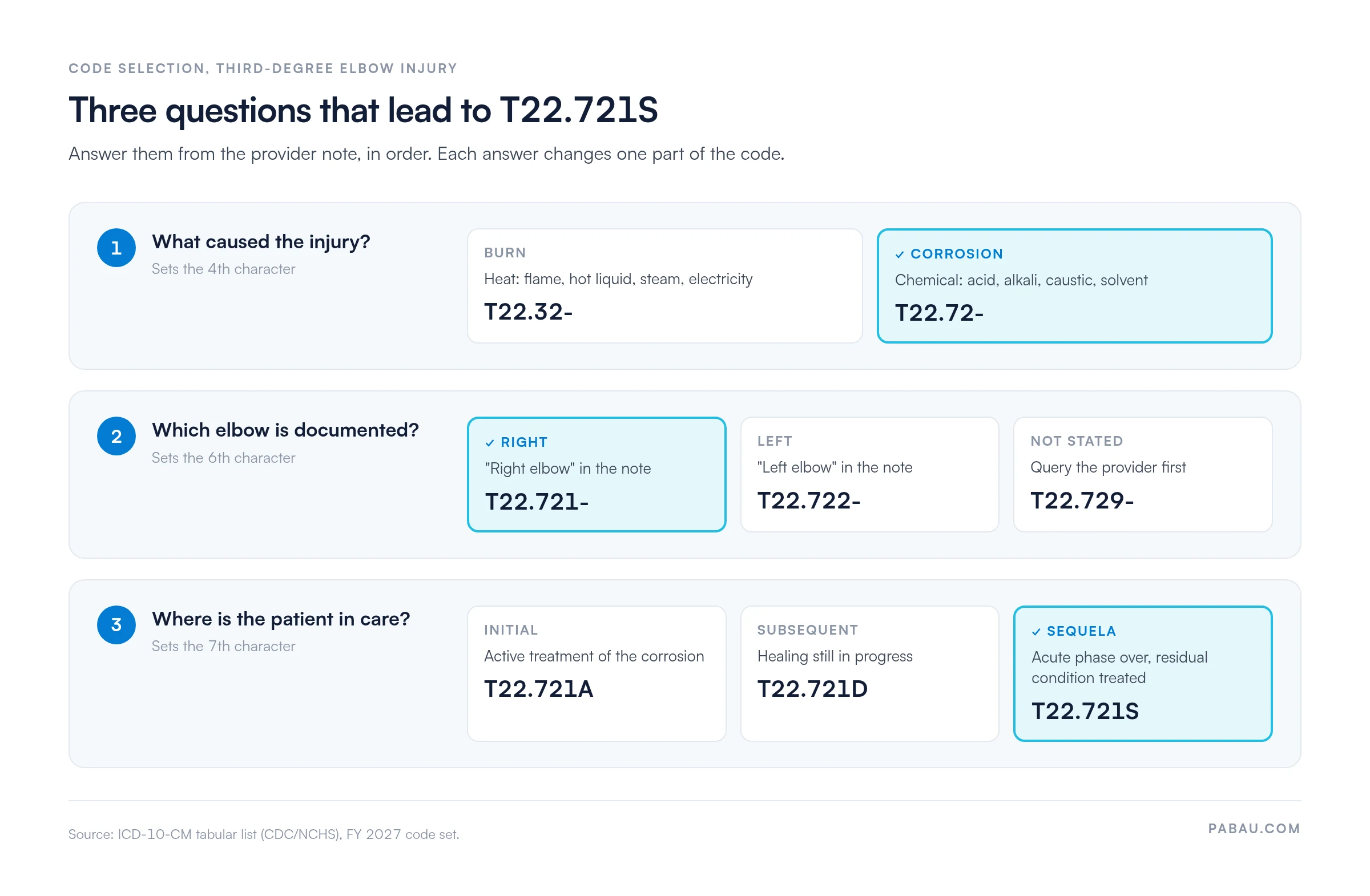
These codes are structurally similar to T22.721S and represent the most common selection errors. The key differentiators are laterality, encounter type, injury category (corrosion vs. burn), and body subsite.
The T22 category carries several instructional notes coders must apply before assigning T22.721S.
ICD-10-CM Official Guidelines Section I.C.20 set no national mandate for external cause reporting. The T20-T25 “use additional external cause code” note still directs you to report one, and many payers expect it. For T22.721S, that code identifies the corrosive substance and the intent behind the injury.
The seventh character on the external cause code must match the seventh character on T22.721S. A sequela T22.721S pairs with an external cause code carrying the “S” suffix. Mismatched seventh characters across the corrosion and external cause codes are a frequent audit finding. Running the claim through the Claim.MD clearinghouse checks these pairings against payer edits before transmission.
Provider documentation must support all four specificity elements to justify T22.721S. A coder who cannot find explicit support for any one of them must query the provider rather than infer.
Clinical documentation improvement (CDI) specialists reviewing T22.721S claims should check that the residual condition is also coded. The sequela code is secondary to the residual condition code in claim sequencing. Thorough documentation also supports medical billing compliance during payer audits and retrospective reviews.
Sequela encounters for third-degree corrosion usually need stronger medical necessity support than initial or subsequent encounters. The payer has to see why a resolved injury is still generating claims.
Payer policy on prior authorization for sequela encounters changes frequently. Verify each payer’s current policy via their provider portal or using claims management software that surfaces real-time eligibility and authorization status before the appointment.
Claims carrying T22.721S are denied for five predictable reasons. Each has a straightforward corrective action.
Tracking denials by code shows which documentation element your providers leave out most often. Denial management workflows help practices resolve T22.721S rejections quickly and stop them recurring across the T22.7xx code family. A clean claim carries the full code set to the payer: T22.721S, the residual condition code and the external cause code.
Before assigning T22.721S, run a three-point check on the provider note: (1) Does it name a chemical or corrosive agent – not just ‘burn’? (2) Does it state third-degree or full-thickness depth explicitly? (3) Does it describe a residual condition rather than ongoing active wound care? Failing any one of these three checks requires a provider query before coding.
Without a connected system, a sequela claim gets checked by hand. A biller reads the note and confirms the agent and the depth. Then they key T22.721S, the residual condition code and the external cause code into a separate claim form.
Pabau, the practice management platform we build, keeps the treatment note, the diagnosis codes and the claim in the same patient record. The claim goes out through the Claim.MD integration, where clearinghouse edits check the code set before it reaches the payer.
The result is fewer resubmissions for your billing team. Claim status for every payer also sits on one screen, so a rejected T22.721S claim gets spotted the day it comes back.

Pabau integrates with Claim.MD to validate diagnosis codes, catch sequela errors before submission, and track claim status across all your payers. Your team spends less time on rework and more time on patient care.

T22.721S is a narrow code, and it is easy to get wrong. The claim only holds when the note names the chemical, states full-thickness depth, records the right side and shows the acute phase is over.
When one of those four is missing, query the provider before you code. A query takes one message, while a denied sequela claim costs a resubmission and can draw an audit.
Pair the code with its residual condition and its external cause code on every claim, and the most common rejection reasons disappear. Book a demo to see how Pabau keeps the note, the codes and the claim together for every corrosion sequela visit.

Need help tracking which claims are denied on specific ICD codes? Denial management in healthcare covers the workflows that reduce recurring rejections across burn and corrosion code families.
Submitting ICD-10 codes through a clearinghouse for the first time? How Claim.MD clearinghouse works explains the validation and transmission process for US payer claims.
Want to understand what makes a claim clean before it reaches the payer? Clean claim standards outlines the code completeness and edit rules that prevent front-end rejections.
ICD-10 Code T22.721S is the billable diagnosis code for corrosion of third degree of the right elbow, sequela. It reports a full-thickness chemical injury to the right elbow at a visit for a residual condition, after the acute phase has resolved. “T22” is the shoulder and upper limb category, and “7” (4th character) indicates corrosion of third degree. “2” (5th) indicates elbow, “1” (6th) indicates right, and “S” indicates a sequela encounter.
Yes, T22.721S is a valid and billable ICD-10-CM diagnosis code for FY 2027. It is the most specific code in the T22.721 series. It is accepted for claim submission when documentation supports chemical causation, third-degree depth, the right elbow site and a sequela encounter type.
The “S” seventh character indicates a sequela encounter, meaning care for a residual condition that remains after the acute injury has healed. For T22.721S, the patient no longer receives active treatment for the original chemical burn. They are treated for a consequence of it, such as a contracture, scarring or a functional deficit. T22.721S is always sequenced after the code for the residual condition on the claim.
In ICD-10-CM, burns come from heat sources such as flame, hot liquids, steam, radiation or electricity. A third-degree burn of the elbow is coded in the T22.32x subcategory. Corrosions come from chemical agents such as acids, alkalis, caustic substances or solvents, and are coded in the T22.7xx subcategory. The two categories take different external cause codes and are not interchangeable. Using a corrosion code for a thermal burn, or the reverse, creates a documentation-code mismatch that payers may flag for review.
T22.721S most often pairs with X46.XXXS (accidental organic solvent exposure), X49.XXXS (accidental exposure to other chemicals) or X86.XXXS (assault by corrosive substance). The seventh character on the external cause code must match the one on T22.721S, so both carry “S” for a sequela encounter. Intent (accidental, assault or self-harm) comes from the provider’s documentation and is never inferred by the coder.
T22.721S describes corrosion of third degree of the right elbow, sequela. T22.722S describes the same injury and encounter type on the left elbow. The only difference is laterality: “1” in the sixth position indicates right, and “2” indicates left. A wrong laterality code is one of the most common denial triggers for this code family, so always verify the documented side.
The most frequent denial reason for T22.721S is assigning “S” while active wound treatment is still ongoing. The others are a missing external cause code, a laterality mismatch, insufficient documentation of third-degree depth, and a corrosion code used for a thermal burn. Each one needs a specific corrective action before resubmission rather than a generic appeal.