ICD-10 Code V92.00XS: Drowning and submersion, merchant ship sequela
ICD-10 Code V92.00XS: Definition and official code description The ICD-10-CM Tab...

Last Updated: Nov 2, 2026
Billable Code Specific Code
T32.52 is the billable ICD-10-CM code for corrosions involving 50-59% of body surface with 20-29% third degree corrosion. A corrosion is a burn caused by a chemical, such as an acid or an alkali.
The final digit marks a 10-point band of third-degree corrosion, so T32.51 and T32.53 sit on either side of it. Thermal burns of the same extent take T31.52 instead. T32.52 is usually reported as a supplementary code with the site-specific corrosion codes in T20-T25, after a T51-T65 code for the chemical and intent.
Let Pabau's smart automation suggest the right codes, reduce claim denials, and keep your practice compliant—effortlessly.
Automate repetitive tasks and focus on what matters most—your patients.
Reduce coding errors and ensure compliance with the latest regulations.
Clean claims, fewer denials, and faster reimbursements.
Powerful insights and reporting to help your practice thrive.
HIPAA compliant SOC 2 certified GDPR-compliant Trusted by 4,000+ clinics worldwide

T32.52 reports corrosions, meaning chemical burns, covering 50–59% of body surface with 20–29% third-degree corrosion. Thermal burns of the same extent use T31.52.
The T32.5 subcategory has six billable codes, T32.50 through T32.55. T32.5 itself is a non-billable header.
T32.52 is a supplementary code reported with site-specific corrosion codes from T20–T25. It is the primary code only when the corrosion site is unspecified.
The corrosion site codes instruct you to code the chemical and intent first, with a toxic effect code from T51–T65.
The record must state the total body surface involved, the third-degree share, the chemical, and each site with its depth.
ICD-10 code T32.52 is the billable ICD-10-CM code for corrosions involving 50–59% of body surface with 20–29% third-degree corrosion. A corrosion is a burn caused by a chemical, such as an acid or an alkali.
The code sits in category T32, “Corrosions classified according to extent of body surface involved.” It records how much skin the chemical injured and how much of the body has full-thickness damage. It does not record where the injury is. The site-specific corrosion codes in T20–T25 carry that detail.
The National Center for Health Statistics (NCHS) maintains ICD-10-CM, and CMS co-publishes the official coding guidelines. T32.52 sits within Chapter 19: Injury, poisoning and certain other consequences of external causes (S00–T88).
ICD-10-CM keeps chemical injuries and thermal injuries in separate categories. Section I.C.19.d of the ICD-10-CM Official Guidelines for Coding and Reporting defines corrosions as burns due to chemicals. Burn codes cover heat sources, electricity and radiation.
The cause decides the category. An acid or drain-cleaner injury covering 54% of the body, with 22% full thickness, takes T32.52. A flame or scald injury with the same figures takes T31.52 instead.
Confirm the agent in the History and Physical or the emergency department note before you choose between T31 and T32. The guidelines are otherwise the same for burns and corrosions.
T32.52 encodes two measurements at once. The first is the total body surface area (TBSA) the chemical injured. The second is the share of body surface with full-thickness corrosion. Both must appear in the medical record for the code to be supported.
50–59% TBSA: A chemical injury over half the body is life-threatening. These patients usually need intensive care, fluid resuscitation and treatment at a burn center. Chemical injuries also need prolonged irrigation, because tissue damage continues while the agent stays on the skin.
20–29% third-degree corrosion: Third-degree (full-thickness) injury destroys the epidermis and the full dermis. It typically needs surgical excision and grafting. Chemical injuries can look shallower at first, so the depth estimate is often revised during the first days of care.
The documented TBSA picks the T32 subcategory, and the third-degree share picks the final digit. Section I.C.19.d.6 of the guidelines states that categories T31 and T32 are based on the classic rule of nines.
The rule of nines assigns a fixed percentage of body surface to each adult body region:
Take an adult with an alkali injury. Third-degree corrosion covers the chest and abdominal wall, which is the anterior trunk (18%), plus part of the right forearm (4%). Second-degree corrosion covers both thighs and lower legs, estimated at 32%.
Total TBSA is 54%, and third-degree corrosion covers 22% of body surface. The breakdown below shows how those two figures point to T32.52.
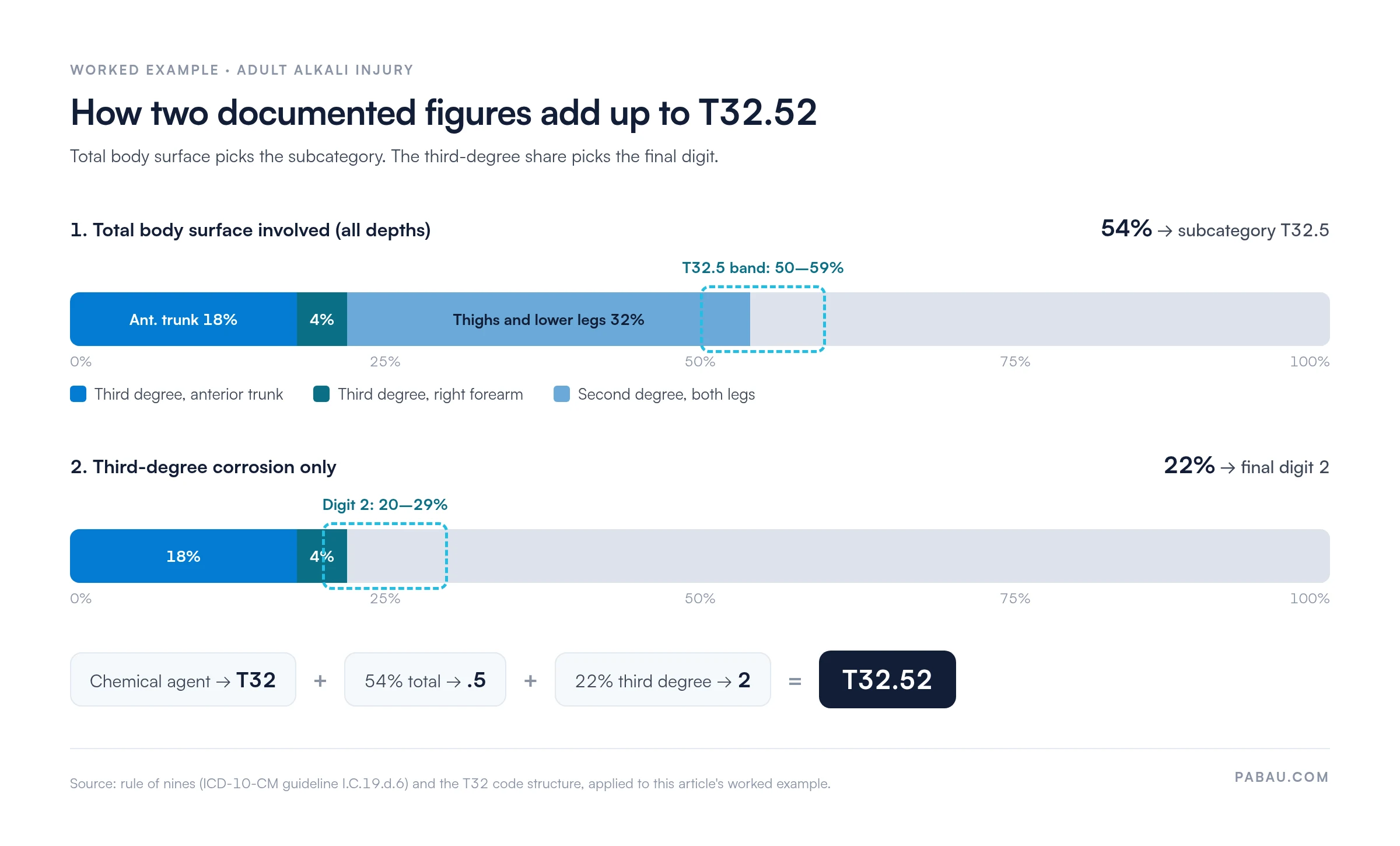
The treating provider should record both estimates and the method used.
The guidelines let providers change these percentages for infants and children, who have proportionately larger heads. The same applies to patients with large buttocks, thighs or abdomen that are involved in the injury.
The American Burn Association recommends the Lund-Browder chart for children, because it adjusts each region by age. A 3-year-old’s head is around 17% of body surface, not 9%. Adult figures can misstate a child’s TBSA and lead to the wrong T32 subcategory.
Each character of T32.52 adds one piece of information about the injury.
T32.5 is a header, not a billable code. It has six billable children, one for each 10-point band of third-degree corrosion. T32 codes take no 7th character.
The subcategory has no unspecified code. If the record gives the TBSA but not the third-degree share, query the provider before you assign any T32.5- code.
A wrong final digit is a common error in this subcategory. The bands do not overlap: 10–19% is T32.51, 20–29% is T32.52, and 30–39% is T32.53.
A worked example: an operative report documents 54% TBSA, with 22% full thickness. That maps to T32.52. Rounding 22% down to the T32.51 band is a coding error, because the documented percentage governs.
T32.50 applies when third-degree corrosion covers less than 10% of body surface, including none at all. T31.52 replaces T32.52 when the agent was thermal rather than chemical.
Check the operative report and wound care notes before assigning a T32.5- code. The third-degree share is often recorded there rather than in the History and Physical. Query the provider when no note states it.
Section I.C.19.d of the ICD-10-CM Official Guidelines covers both burns and corrosions. Under the T32 category note, T32.52 is a supplementary code reported with categories T20–T25 when the sites are specified.
Each corrosion site code in T20–T25 tells you to code first the chemical and intent, using a toxic effect code from T51–T65. List the site codes next, starting with the highest degree. T32.52 follows as the extent code, and a Y92 code records the place.
For the alkali injury above, the codes could read:
An acid injury follows the same pattern with a T54.2- code in first position. The site codes take a 7th character for the encounter type, while T32.52 takes none.
The T32 category note allows it as the primary code only when the site of the corrosion is unspecified. That case is rare, because Section I.C.19.d.5 asks for a separate code for each documented site.
Category T32 is not used for sequelae of corrosions either. A later visit for scarring or contractures takes the site code with 7th character “S” instead.
Two figures must be explicit in the medical record. Without either one, T32.52 cannot be supported at audit, however severe the injury was.
The record should also show:
For inpatient claims, payers expect documentation supporting the medical necessity of burn unit or ICU-level care. Prior authorization rules for grafting vary by payer and plan year. Check them with each payer before scheduling surgery.
Section I.C.19.d.9 says an external cause code should be used with burns and corrosions to identify the source, intent and place. For a corrosion, the T51–T65 toxic effect code already captures the chemical and the intent.
Add a Y92 code for the place of occurrence, such as a home or a factory. Chapter 20 codes are required only under a state reporting mandate or a payer rule, so check what your payers expect.
T32.52 claims tend to fail for the same few reasons. Each fix starts with the documentation, not the claim form.
Tracking which errors recur shows whether problems start in documentation or in coding. Our guides to denial management in healthcare and clean claims walk through that process.
Treatment at this extent often combines dressings or debridement with excision and grafting. The CPT codes below appear on many corrosion claims. Confirm each one against current CPT and NCCI edits before billing.
NCCI edits are updated quarterly. Check the CMS NCCI edits page before billing debridement and grafting on the same date.
Coding T32.52 depends on details spread across the chart: the chemical, each site and its depth, the TBSA total and the encounter type. When those sit in separate notes, a coder has to chase them before the claim can go out.
In Pabau, the practice software we build, treatment notes, digital forms and invoices share one patient record. A custom form can ask for the agent, the TBSA total and the third-degree share at each visit. The figures a coder needs are then on file before coding starts.
For US practices, Pabau’s claims management tools build CMS-1500 claims from existing invoices.
A Claim.MD clearinghouse integration sends those claims electronically and matches remittances to them. Denied claims are flagged for rework, so your team sees which ones need attention.

Pabau keeps the chemical, the injured sites, their depth and the TBSA figures in one patient record. Your team can code T32.52 and its companion codes from a complete chart.

Get the agent right before you look at the numbers. A chemical injury belongs in T32 and a thermal one in T31, however closely their figures match.
Then hold the record to two figures, the TBSA and the third-degree share. When either is missing, query the provider instead of guessing a band, because the T32.5 subcategory has no fallback code.
Pabau keeps those figures, the site details and the claim together for your billing team. Book a demo to see how Pabau supports documentation and claims for corrosion care.

Need to understand how claim denials are managed systemically? Denial management in healthcare covers the full workflow for tracking and resolving payer rejections.
Billing a burn unit or ICU admission? The inpatient billing cheat sheet is a quick reference for coding and billing inpatient stays.
Looking for guidance on the full medical billing process? What is medical billing walks through each stage from encounter to payment posting.
ICD-10 code T32.52 is the billable ICD-10-CM code for corrosions involving 50–59% of body surface with 20–29% third-degree corrosion. Corrosions are burns caused by chemicals. The code is reported alongside site-specific corrosion codes from T20–T25.
Yes. T32.52 is a billable ICD-10-CM code, valid since October 1, 2015, and it needs no 7th character. Its parent, T32.5, is a header and cannot be billed. When the sites are documented, report T32.52 with the T20–T25 site codes rather than on its own.
All three cover corrosions over 50–59% of body surface. T32.51 has 10–19% third-degree corrosion, T32.52 has 20–29%, and T32.53 has 30–39%. The documented third-degree share decides the code. The T32.5 subcategory has no unspecified code, so a missing share calls for a provider query.
Yes. T32.52 is the extent code for chemical burns, which ICD-10-CM calls corrosions. Thermal burns of the same extent use T31.52 instead. Code the chemical and intent first with a T51–T65 toxic effect code.
The record must state the TBSA (50–59%) and the third-degree share (20–29% of body surface). It also needs the chemical agent, each site with its side and depth, and the encounter type. These details usually sit across the History and Physical, operative report and wound care notes.
Only when the site of the corrosion is unspecified, per the T32 category note. When the sites are documented, T32.52 is a supplementary code listed after the T20–T25 site codes. Section I.C.19.d of the ICD-10-CM Official Guidelines covers burn and corrosion coding.