ICD-10 Code R06.02: Shortness of breath billing guide
ICD-10 Code R06.02: Definition and quick-reference details ICD-10 Code R06.02 is...

Last Updated: Nov 9, 2026
Billable Code Specific Code
W17.89XA is the billable ICD-10-CM code for other fall from one level to another, initial encounter. It covers a fall from a height that no more specific fall code names, such as a cherry picker, lift, raised platform or mezzanine.
Report it as a secondary external cause code, after the injury code, never as the principal diagnosis. Rule out falls from a bed, stairs, ladder, scaffolding, building, tree, cliff or dock first. Use W19 only when the note gives no detail about how the fall happened.
Let Pabau's smart automation suggest the right codes, reduce claim denials, and keep your practice compliant—effortlessly.
Automate repetitive tasks and focus on what matters most—your patients.
Reduce coding errors and ensure compliance with the latest regulations.
Clean claims, fewer denials, and faster reimbursements.
Powerful insights and reporting to help your practice thrive.
HIPAA compliant SOC 2 certified GDPR-compliant Trusted by 4,000+ clinics worldwide

W17.89XA is a billable 7-character ICD-10-CM external cause code for other fall from one level to another at the initial encounter.
Rule out falls from a bed, stairs, ladder, scaffolding, building, tree, cliff or dock, and the other W17 codes, before you choose it.
It is never the principal diagnosis, so always sequence the injury code first and W17.89XA after it.
The placeholder X in position 6 is mandatory, and W17.89A without it is an invalid code that payers reject.
Use W17.89XA only on the initial encounter claim, then switch to W17.89XD for subsequent visits and W17.89XS for sequela.
ICD-10 code W17.89XA is the billable ICD-10-CM external cause code for other fall from one level to another, initial encounter.
It covers a fall from a height that no more specific fall code names, such as a cherry picker, lift or mezzanine. The table below lists each core fact from the ICD-10-CM code set that CMS publishes.
W17.89XA means a fall from one level to another that is classed as “other” because no more specific W17 code applies. The A marks the initial encounter for active treatment. Breaking down each character position removes most of the ambiguity coders face with this code.
The phrase “one level to another” means a height change separates the starting and landing points. The tabular list names falls from a cherry picker, lifting device, mobile elevated work platform or sky lift under W17.89. A fall from a raised storage platform or mezzanine fits too, when no more specific code applies. Stumbling on level ground does not qualify, because same-level falls take W01 or W18.
W17.89XA applies when the fall involves a height change from one level to another and no more specific code covers the exact scenario. Emergency departments, urgent care and physical therapy practices all report it when documentation supports a fall from height.
Qualifying scenarios include:
Some look-alike falls have their own codes. A fall from a dock (W17.4) or grocery cart (W17.82) is coded there, and a fall from a bed or bunk bed is W06.
Documentation the provider must record for a coder to assign W17.89XA with confidence:
When the clinical note describes a fall from height but does not name the surface, coders cannot fill in the detail themselves. If documentation is too thin to reach a specific W17 code, query the provider before defaulting to W19 (unspecified fall). W19 is the least specific fall code and should be used only when no detail is documented.
W17.89 requires a 7th character on every claim, and choosing the wrong one is a common error on fall-related external cause codes. The table below maps each option to the clinical situation it covers.
“Initial encounter” in ICD-10-CM means the patient is still receiving active treatment. It does not simply mean the first time this provider has seen the patient. A second surgical procedure on the same injury still uses XA. Once active treatment ends and the provider is managing routine recovery or a late-effect condition, the 7th character must change. The CDC/NCHS ICD-10-CM web tool includes the Official Guidelines that explain this distinction.
W17.89XA is the residual “other” code within category W17. Before assigning it, confirm that no more specific fall code applies. If one exists and documentation supports it, the specificity principle requires using it. The table below shows the alternatives coders most often confuse with it.
The decision rule is simple. Check W06 (bed), W10 (stairs), W11 (ladder), W12 (scaffolding), W13 (building), W14 (tree), W15 (cliff) and W17.0-W17.4 first, then W17.81 and W17.82. W17.89XA is correct only when the fall clearly involves a level change and none of those codes match the documented mechanism. The ladder below puts that order on one page, so you can work down it with the note open.
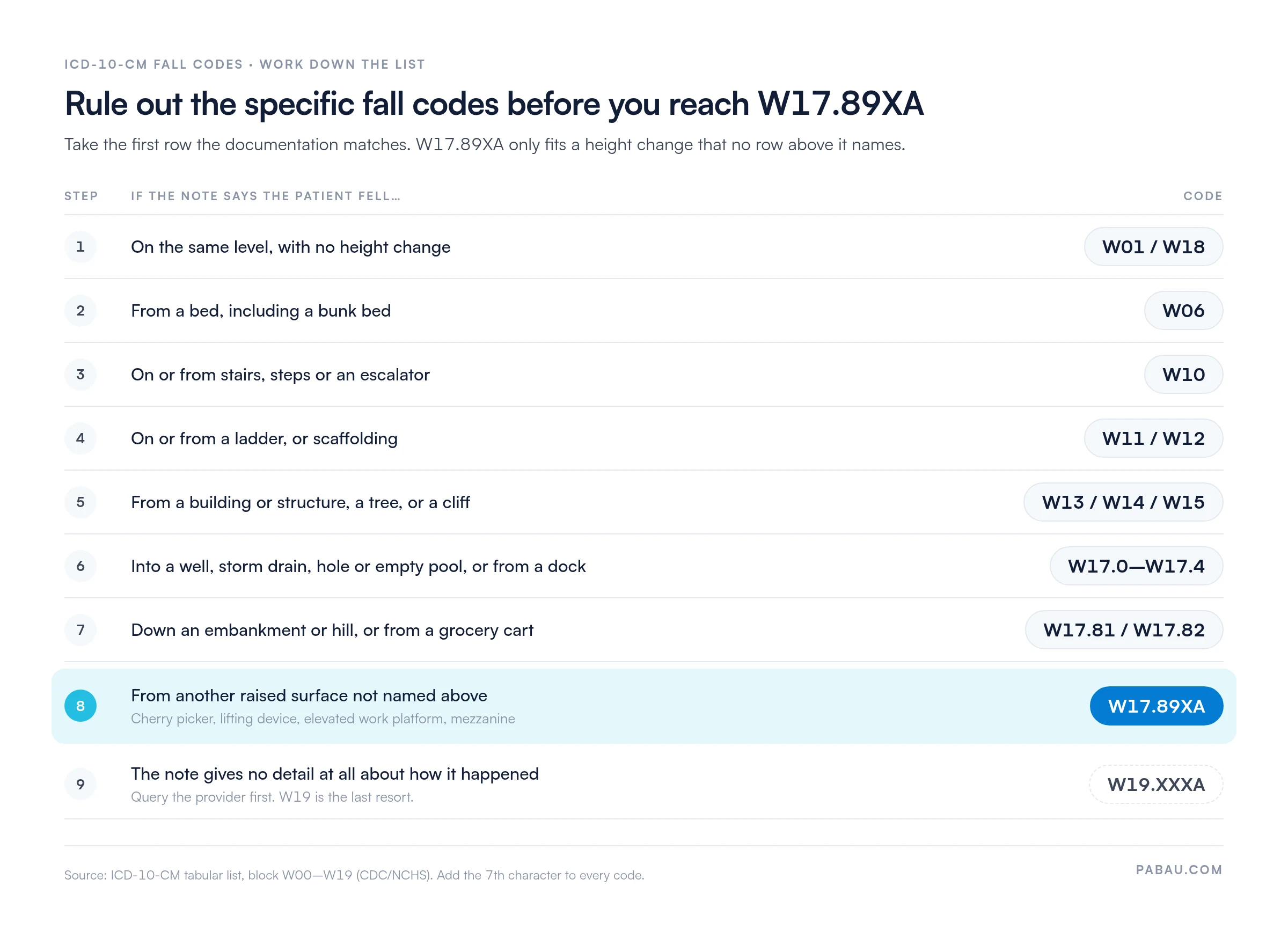
Category W17 carries no Excludes1 note of its own in the ICD-10-CM tabular list. Its neighbors still matter, because a more specific category always wins over W17.89XA. Coding the wrong one can trigger a payer edit or an audit query.
Related categories to check before W17.89XA:
Coding boundaries to know:
When the documentation supports two mechanisms, query the provider before coding. Submitting conflicting codes invites a denial, and reworking a denied claim takes longer than a pre-submission query. The AAPC W17.89 code page lists the inclusion terms for this subcategory, including the cherry picker and sky lift examples.
Run a quick check before you finalize any W17.89XA claim. Confirm the fall involved a height change, that no more specific W17 code applies, and that no W06 or W10-W15 code fits. Three checks, thirty seconds, one fewer avoidable denial.
W17.89XA is an external cause code and must never be sequenced as the principal or first-listed diagnosis. Section I.C.20 of the ICD-10-CM Official Guidelines for Coding and Reporting is unambiguous on this point. Understanding the medical billing process for external cause codes prevents the sequencing errors behind many W17.89XA rejections.
The correct sequencing order for a W17.89XA encounter is:
Place-of-occurrence (Y92), activity (Y93) and status (Y99) codes belong on the initial encounter claim only. Do not carry them forward to subsequent visit claims.
Every W17.89XA initial encounter claim should include the Y92 and Y93 companion codes when documentation supports them. The table below lists the codes most often paired with typical W17.89XA scenarios.
These companion codes are reported on the initial encounter claim only. Do not include Y92 and Y93 codes on W17.89XD (subsequent encounter) or W17.89XS (sequela) claims.
W17.89XA denials follow predictable patterns. Each one below has a specific cause, the payer rule it triggers, and the fix that stops it repeating. Practices that run structured denial management workflows catch most of these before submission.
The electronic remittance advice on a denied claim carries a claim adjustment reason code that points to the cause. For a missing or invalid code that is often CO-16, meaning the claim lacks information or has a submission or billing error. Our guide to denial codes in medical billing explains how to read each one.
Thin clinical documentation drives many W17.89XA coding errors. When a provider writes “patient fell” without further detail, the coder has no choice but to assign W19 (unspecified fall). That loses specificity, invites audit scrutiny, and can affect reimbursement for the companion injury code.
A complete fall note answers five questions:
When documentation supports all five answers, a coder can assign W17.89XA and the correct Y92 and Y93 codes with confidence. When answers are missing, the coder must query before coding, not assume. Submitting a clean claim from the outset avoids the rework cycle.
Add a structured fall mechanism field to your intake and ED triage form. Capture the surface, the landing point, estimated height, location and activity. Five fields in the note template mean far fewer default W19 codes on your claims.
Many practices still code falls from a free-text note and key the claim by hand. The injury code, W17.89XA and the Y92, Y93 and Y99 codes are then typed one by one. That is where the order slips and the placeholder X goes missing.
Pabau, the practice management platform we build, keeps the codes with the patient record and the appointment. In the US, Pabau’s claims management software submits CMS-1500 and 837P claims through the Claim.MD clearinghouse, which runs its own pre-submission checks.
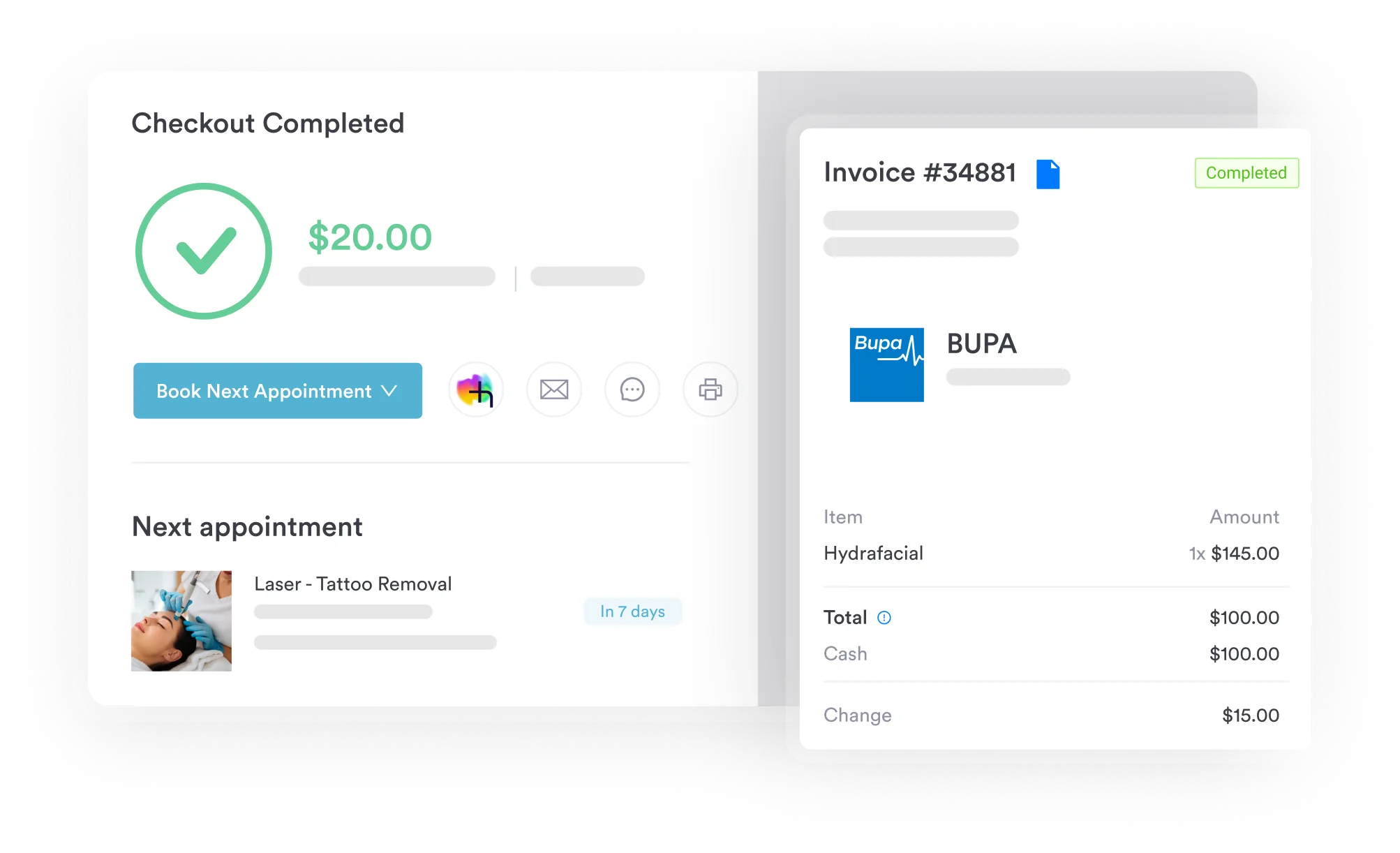
ERA remittances come back through the same connection, so a denied fall claim and its reason code reach your billing team in one place. That means less time chasing rejected external cause codes and more time for patient care.

Pabau submits US claims through the Claim.MD clearinghouse and brings ERA remittances back into Pabau, so your team spends less time reworking denied fall claims.

W17.89XA is the right code only once every specific fall code has been ruled out. Work down from W06 to W17.82 before you settle on “other”, and query the provider when the note can’t answer.
Then protect the claim itself. Keep the injury code first, keep the placeholder X, and change the 7th character when active treatment ends. A claim that misses any of these tends to come back with a CO-16 denial. Reworking it takes more time and effort than a pre-submission fix.
Book a demo to see how Pabau handles claims for fall injuries, from the patient record to the Claim.MD clearinghouse.

Choosing a clearinghouse for US claims? Claim.MD clearinghouse covers what the clearinghouse does and how your claims reach the payer through it.
Want to understand what happens after a claim is paid or denied? Electronic remittance advice explains the 835 transaction and how to read the reason codes behind W17.89XA denials.
Building a denial prevention workflow from scratch? Denial management in healthcare covers the full process from root-cause analysis to resubmission tracking.
Want the coding rules on one page? Medical coding cheat sheet gives your team a printable quick reference for day-to-day coding.
ICD-10 code W17.89XA is the billable external cause code for other fall from one level to another, initial encounter. It applies when a fall from height fits no more specific fall code and the patient is under active treatment. Typical examples are a fall from a cherry picker, lift, raised platform or mezzanine.
Yes, W17.89XA is a billable 7-character ICD-10-CM code in the current tabular list. It cannot, however, appear as the principal or first-listed diagnosis on a claim. It must always be sequenced after the injury or condition code it explains.
W17.89XA documents a fall from one level to another where the mechanism is known but fits no specific fall code. W19 (unspecified fall) is used only when the documentation says nothing about how the fall happened. Using W19 when the note describes how or where the patient fell breaks the ICD-10-CM specificity principle.
Use W17.89XA while the patient is receiving active treatment for the fall-related injury, including ED visits, surgery and initial specialist consultations. Switch to W17.89XD once active treatment ends and the patient returns for routine follow-up, rehabilitation or wound checks. The trigger is the move from active management to routine recovery, not the number of visits.
W17.89XA must always be a secondary code. Section I.C.20 of the ICD-10-CM Official Guidelines bars external cause codes from the principal or first-listed position. The injury code, such as a fracture S-code, is always listed first, with W17.89XA following as the external cause.
The Y92 code depends on where the fall happened. Common pairings are Y92.59 (other trade areas) for commercial premises and Y92.69 (other specified industrial and construction area) for factory or site falls. Use Y92.015 for a home garage. Y92.015 is the private garage of a single-family (private) house. Report the Y92 code once, on the initial encounter claim only.