ICD-10 Code S42.444P: Medial epicondyle fracture, right humerus
ICD-10 Code S42.444P: full descriptor and code validity ICD-10 Code S42.444P car...

Last Updated: Oct 13, 2026
Billable Code Specific Code
T31.30 is the billable ICD-10-CM code for burns involving 30-39% of body surface with 0% to 9% third degree burns.
Assigning T31.30 depends on two figures the clinical record must state separately. One is the TBSA burned, the other is the share of that area that is full thickness.
Let Pabau's smart automation suggest the right codes, reduce claim denials, and keep your practice compliant—effortlessly.
Automate repetitive tasks and focus on what matters most—your patients.
Reduce coding errors and ensure compliance with the latest regulations.
Clean claims, fewer denials, and faster reimbursements.
Powerful insights and reporting to help your practice thrive.
HIPAA compliant SOC 2 certified GDPR-compliant Trusted by 4,000+ clinics worldwide

T31.30 is a billable ICD-10-CM code for burns covering 30-39% of body surface, with 0% to 9% third-degree involvement.
T31.30 took effect on October 1, 2025 as part of the FY2026 ICD-10-CM edition.
T31 codes capture the extent of a burn, T20-T29 codes capture its site, and a claim often needs both.
The site-specific T20-T29 code is sequenced first whenever the record names the burn site.
Practice management software like Pabau routes T31.30 claims to payers and tracks the denial codes that come back.
T31.30 is a billable, specific code in the FY2026 ICD-10-CM edition. It is valid as a principal or additional diagnosis code for burns covering 30-39% of the total body surface area. Third-degree involvement must stay below 10%.
The code became effective October 1, 2025, as part of the annual ICD-10-CM update cycle maintained jointly by the CDC/NCHS and CMS. It sits within the T31 category, which classifies burns by extent of body surface rather than by anatomic location.
T31 is the ICD-10-CM category for burns classified by extent of body surface involved. The T20-T29 category identifies burns by anatomic location instead, such as the face, trunk, or hand. Both categories may appear on the same claim, but they serve different documentation functions.
Within T31, the first decimal digit represents the TBSA range. T31.0 covers less than 10%, T31.1 covers 10-19%, and the sequence runs through T31.9 for 90% or more. The second digit indicates the percentage of that TBSA consisting of third-degree burns.
Per the AAPC ICD-10-CM code reference, T31 codes are assigned as additional codes in most cases. A T20-T29 site-specific code is sequenced first unless the record documents no site information. Understanding this hierarchy prevents sequencing errors that lead to claim rejection.
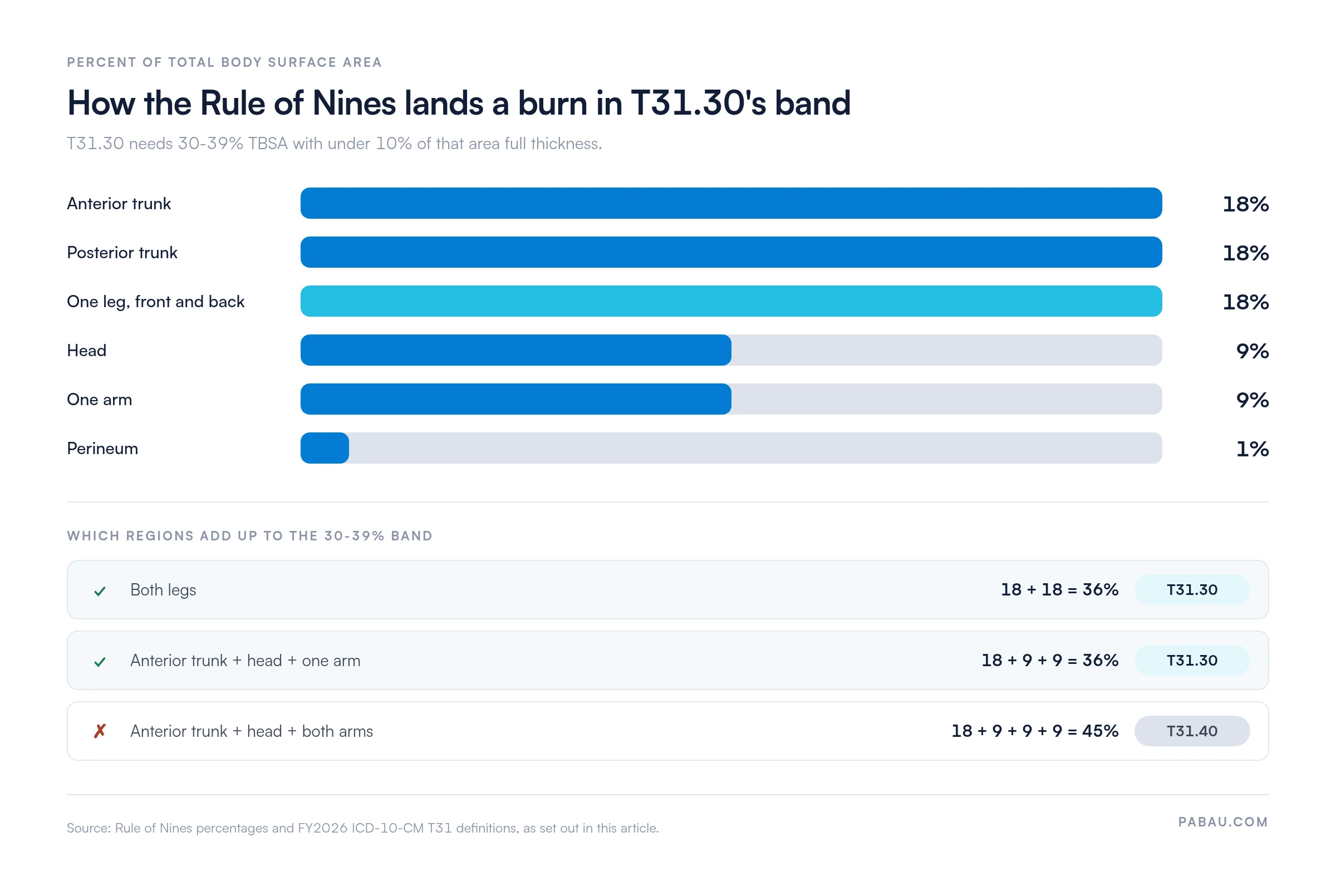
Total body surface area calculation uses the Rule of Nines, which divides the body into regions each representing roughly 9% of the total surface. The head accounts for 9% and each arm for 9%. Each leg accounts for 18% front and back combined, the anterior trunk for 18%, the posterior trunk for 18%, and the perineum for 1%.
A burn covering both legs entirely reaches roughly 36% TBSA. That sits squarely in the T31.30 range, as long as full-thickness involvement stays below 10%. Clinicians at burn centers and wound care units need both figures captured explicitly in the record to support the code.
Several different region combinations land in the same band, which is why the arithmetic decides the subcode rather than the anatomy.
Third-degree (full-thickness) burns destroy all skin layers including the dermis, and often the structures underneath. T31.30 applies when third-degree involvement is minimal. Most of the burned surface area is first- or second-degree.
That distinction is clinically significant because full-thickness involvement drives treatment decisions, DRG grouping, and length-of-stay projections. It is also what separates T31.30 from the three subcodes above it.
When third-degree burns exceed 9% of the total TBSA, the correct code shifts to T31.31, which covers 10-19% third degree within the same 30-39% band. Misidentifying the third-degree band is one of the most common subcode errors in burn coding. The errors section below covers it in detail.
The T31.3x subcategory covers all burns in the 30-39% TBSA range, differentiated by the percentage of third-degree burn involvement. Selecting the wrong subcode triggers payer queries and delayed reimbursement.
T31.30 applies only when the record documents both percentages explicitly. The coder needs the TBSA burned and the third-degree share of that area. Absent documentation is not grounds for assigning T31.30, and the coding guidelines section below covers what to do instead.
The ICD-10-CM Official Guidelines for Coding and Reporting, maintained by CMS and NCHS, give specific direction for burn coding. Two rules decide most T31.30 claims. One governs sequencing against the site-specific codes, the other governs what counts as sufficient documentation.
When the record documents both the site and the extent of a burn, the site-specific T20-T29 code is sequenced as the principal diagnosis. The T31 extent code is then reported as an additional diagnosis.
T31 is sequenced first only when the burn site is not specified anywhere in the record. A burn unit that reports TBSA for mortality or severity tracking still assigns T31 as an additional code, never as the principal diagnosis.
The T31 category carries no Excludes1 notes at category level, so T31.30 can be reported alongside other diagnosis codes without a mutual-exclusivity restriction. T32 (corrosions classified by extent) is the parallel category for chemical burns. Where the injury involves a corrosive substance rather than heat or flame, T32 codes apply instead of T31.
Per medical billing compliance standards, coding from incomplete documentation creates audit risk. If TBSA is not in the record, the coder must query before assigning any T31 code.
Burn coding carries one of the higher denial rates among injury categories. The documentation requirements span two independent measurements, TBSA and third-degree percentage, and clinicians do not always record either one in a coding-ready format. These are the errors that produce the most denials and audit findings on T31.30 claims.
Facilities with high burn case volumes usually flag every T31 claim for clinical documentation review before submission. That review costs less than the appeal that follows a rejection.
Before assigning T31.30, check that the record documents two separate percentages. The first is the TBSA burned. The second is the share of that area that is full thickness. If either is missing, submit a provider query. Defaulting to T31.30 without both figures is an audit risk, not a coding shortcut.
T31.30 is a billable, specific code valid for inpatient and outpatient reimbursement across payers. Burns in the 30-39% TBSA range usually involve admission to a burn unit. That puts T31.30 in the context of MS-DRG grouping for inpatient Medicare claims.
DRG assignment and payment amounts vary by payer, contract, and fiscal year. Confirm current rates through your payer contract or the CMS Physician Fee Schedule rather than a prior-year figure.
The extent code rarely drives payment on its own. The procedures performed, the site-specific T20-T29 codes, and any associated conditions all feed the grouping. A claim carrying T31.30 alone tells the payer how large the burn was and nothing about what was treated.
Clinical documentation and discharge summaries use several alternative descriptions that map to T31.30. Recognizing these synonyms helps coders identify the correct code from narrative documentation.
Burn coding rarely involves a single code. The table below covers the codes used alongside or instead of T31.30, organized by their clinical relationship.
The WHO ICD-10 classification provides the international parent structure that ICD-10-CM derives its burn coding from. NCHS added the US-specific modifications, including the T31.3x subcode structure, to support more precise reimbursement documentation. On rejected burn claims, the payer’s denial codes often point to T31 and T32 having been swapped.
In many burn care billing teams, the diagnosis code, the documentation behind it, and the claim live in three separate systems. A coder assigns T31.30 in one, checks the TBSA figures in another, and submits through a third. Each hand-off is a chance for the percentages to drop out.
Practice management software like Pabau keeps those steps in one place. The note recording the TBSA and third-degree percentages sits in the same patient record as the claim. The coder works from that documentation rather than from a summary of it.
Pabau’s claims management software submits 837P and institutional claims through a built-in clearinghouse integration that reaches over 4,000 US payers. It verifies eligibility before admission and reconciles payment from the 835 remittance files that come back.
Denials arrive with their CARC codes attached to the original claim, so a billing team can see which missing figure caused the rejection. The correction then happens in the record the claim was built from.


Pabau connects your clinical documentation to claim submission in one workflow. The Claim.MD integration handles 837P claims, eligibility checks, and ERA processing, so your billing team spends less time chasing burn claim denials.

Burn coding at the 30-39% TBSA level rests on two clinical measurements that come from different parts of the record. When either is missing, a provider query is the correct next step, not a default to T31.30.
The sequencing rule is the other habit worth building. Whenever the record names the burn site, that T20-T29 code leads and T31.30 follows as an additional diagnosis.
Getting both figures into the record before the claim goes out costs less than correcting them after a denial. Book a demo to see how Pabau keeps the TBSA documentation and the T31.30 claim in one place.

Need guidance on ICD-10-CM coding foundations? Revenue cycle management fundamentals explains how diagnosis coding connects to claim submission and payment outcomes.
Managing burn claim denials? Denial management in healthcare covers how to analyze CARC codes and reduce repeat rejections on complex injury claims.
Curious how clearinghouse submission works? Claim.MD pricing and features outlines how the clearinghouse routes claims, handles ERAs, and supports secondary submissions.
T31.30 is a billable ICD-10-CM diagnosis code describing burns involving 30-39% of the total body surface area with 0% to 9% third-degree (full-thickness) burns. It is valid for FY2026 reimbursement and became effective October 1, 2025 under the annual ICD-10-CM update cycle maintained by CMS and NCHS.
Yes. T31.30 is classified as a billable, specific ICD-10-CM code, which means it can be used directly on claims to indicate a diagnosis for reimbursement. Non-billable header codes (such as the T31.3 parent category) cannot be submitted for payment.
All four codes describe burns covering 30-39% of the body surface. The difference is the percentage of full-thickness (third-degree) involvement: T31.30 = 0-9%, T31.31 = 10-19%, T31.32 = 20-29%, and T31.33 = 30-39%. Selecting the correct subcode requires the clinician to document both figures separately.
TBSA is typically estimated using the Rule of Nines, which assigns approximate surface area percentages to body regions. Those are head 9%, each arm 9%, each leg 18%, anterior trunk 18%, posterior trunk 18%, and perineum 1%. Pediatric calculations use the Lund-Browder chart, which adjusts for age-related surface area differences in children.
T31.30 became effective October 1, 2025 as part of the FY2026 ICD-10-CM edition. Claims with service dates on or after October 1, 2025 use the FY2026 code set. The code has existed across prior editions under the same description.
The clinical record must explicitly state the total TBSA percentage burned, in the 30-39% range. It must also state what percentage of that TBSA is third degree, which has to be under 10%. If either measurement is absent, the coder should submit a provider query rather than assign T31.30 by default.
T31.31 through T31.33 cover the same TBSA range with higher third-degree involvement. T32.30 is the parallel code for corrosion (chemical burns) at the same extent. T20-T29 site-specific codes are often coded alongside T31.30 to capture the anatomic location of the burn.