ICD-10 Code S62.664D: Nondisplaced ring finger fracture
ICD-10 Code S62.664D: quick reference ICD-10 Code S62.664D reports a follow-up v...

Last Updated: Oct 21, 2026
Billable Code Specific Code
T31.99 is the billable ICD-10-CM code for burns involving 90% or more of body surface with 90% or more third degree burns.
It is a complete 5-character code with no 7th character. T31.99 is the primary code only when the burn sites are unspecified. When the sites are documented, it is a supplementary code to the site-specific T20-T25 codes, which carry their own A, D, or S character. The code is valid from FY2024 through FY2027 with no changes to its descriptor or billability status.
Let Pabau's smart automation suggest the right codes, reduce claim denials, and keep your practice compliant—effortlessly.
Automate repetitive tasks and focus on what matters most—your patients.
Reduce coding errors and ensure compliance with the latest regulations.
Clean claims, fewer denials, and faster reimbursements.
Powerful insights and reporting to help your practice thrive.
HIPAA compliant SOC 2 certified GDPR-compliant Trusted by 4,000+ clinics worldwide

T31.99 needs two documented figures. Total body surface area (TBSA) burned must reach 90% or more, and third-degree burns must cover 90% or more.
T31.99 is a complete 5-character code with no 7th character, so T31.99XA does not exist. The A, D, or S character goes on the T20-T25 site codes reported with it.
T31 (burns) and T32 (corrosions) are separate categories. Coding a chemical burn to T31.99 is a misassignment that invites audit review.
Pabau, the practice management platform we build, pairs built-in ICD-10 and CPT catalogs with Claim.MD claims submission for outpatient and private-practice billing.
ICD-10 code T31.99 is the billable, specific ICD-10-CM code for burns covering 90% or more of body surface, with third-degree burns over 90% or more. It is the primary code only when the burn sites are unspecified. Otherwise it follows the T20-T25 site codes as a supplementary extent code.
The code has been effective since October 1, 2015 and is valid through FY2027. The table below collects the fields a coder or revenue cycle analyst checks first.
T31.99 encodes two distinct measurements simultaneously, and both must appear in the clinical documentation before the code is assignable.
Clinicians document TBSA using the Rule of Nines (head 9%, each arm 9%, each leg 18%, trunk anterior 18%, trunk posterior 18%, perineum 1%). For pediatric patients, whose body proportions differ, they use the Lund-Browder chart.
The physician must state both the total TBSA percentage and the third-degree percentage. A note that says “extensive burns” without percentages does not support T31.99, so query the physician before coding.
In practice, T31.99 appears almost exclusively on inpatient admissions at burn centers or burn ICUs. It sits at the top of both T31 scales, the widest extent and the deepest involvement the category records. According to the CMS ICD-10-CM code files, this code has remained stable across all recent fiscal years with no descriptor revisions.
The T31 category covers burns classified by total body surface area. The cause can be thermal, electrical, or radiation-based, but not chemical.
The split that matters most for coders is T31 versus T32. Heat, electricity, friction, or radiation maps to T31. A chemical agent maps to T32. Check the cause in the attending physician’s note before assigning T31.99, and the misassignment never reaches the claim.
T31 codes are structured as T31.XY. X is the TBSA range, and Y is the percentage of body surface with third-degree burns. T31.99 sits at the far end of both, with 90% or more on each scale. The table below shows selected T31.9X codes.
For comparison, T31.10 covers 10-19% TBSA with 0-9% third-degree burns, a far less severe injury. The fifth character climbs from 0 to 9 within each TBSA range, and the documented third-degree percentage decides it. T31.98 and T31.99 differ by one 10-point depth band, so the note needs an exact figure.
T31.99 is a complete, billable 5-character code. No code in the T31 category carries a 7th character. Strings such as T31.99XA, T31.99XD, and T31.99XS do not exist in the CMS ICD-10-CM code files. A claim that appends one fails the payer’s code validity edit.
The episode-of-care characters — A for initial encounter, D for subsequent encounter, S for sequela — belong to the site-specific burn codes in categories T20-T25. A third-degree burn of multiple sites of the head, face, and neck during active treatment, for example, is T20.39XA.
The official note at category T31 sets the relationship between the two. T31 is the primary code only when the burn site is unspecified. When the sites are documented, T31.99 is a supplementary code reported with the T20-T25 codes, and those site codes carry the 7th character.
T31.99 rarely stands alone on a claim. The ICD-10-CM Official Guidelines recommend Chapter 20 external cause codes for injuries, but there is no national reporting requirement. Payers or state rules may require them, so check before you submit.
Assign the external cause code that identifies the mechanism of injury. Common examples for burns reaching the 90%+ TBSA threshold include:
These three code families describe where the injury happened, what the patient was doing, and their status. Each is reported once, at the initial encounter.
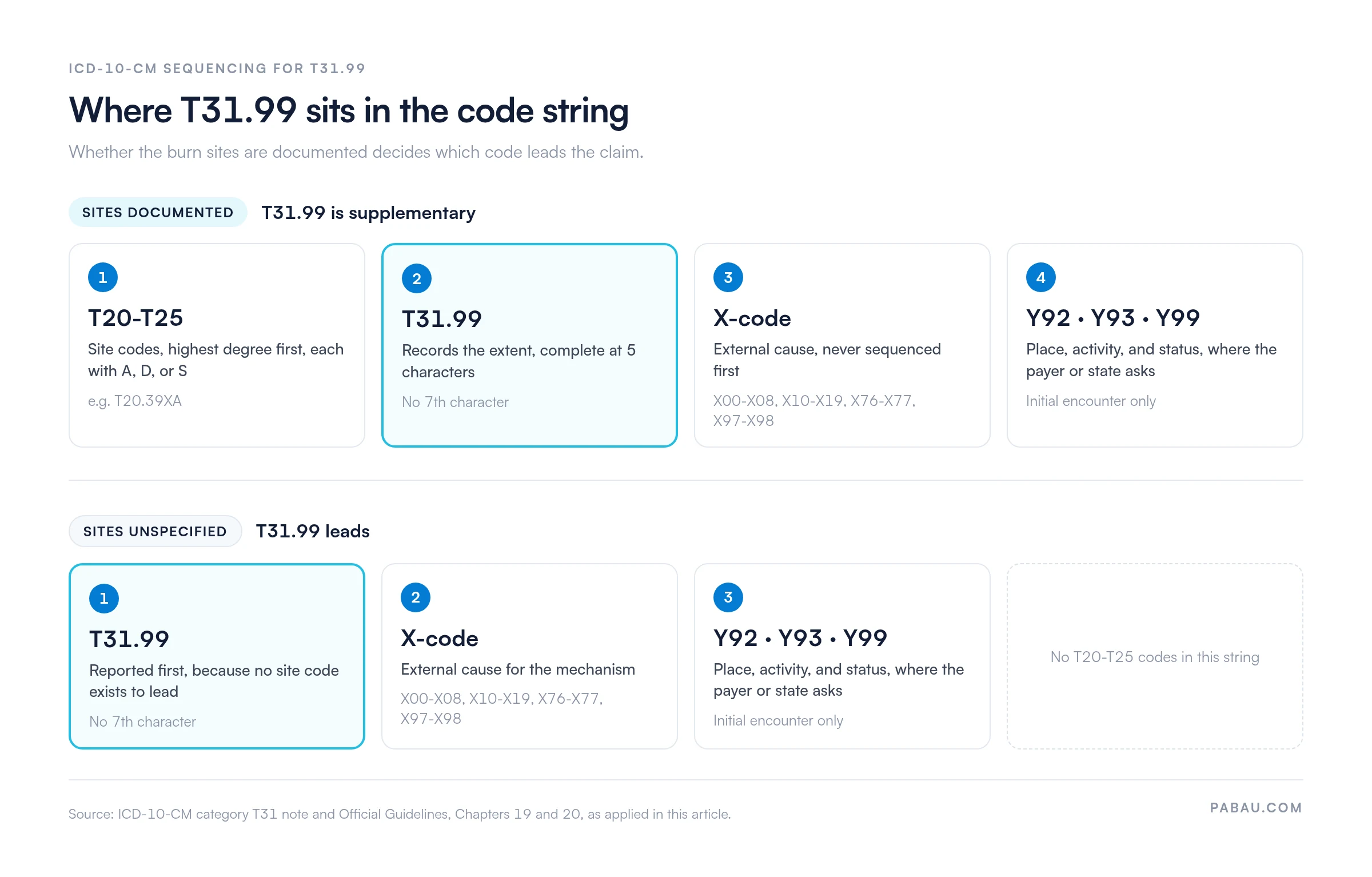
Sequencing rule: T31.99 leads only when the burn site is unspecified. When the sites are documented, the T20-T25 codes come first, starting with the highest-degree burn, and T31.99 follows to record the extent. The external cause code is always a secondary code. The diagram below sets out both orders.
Four code pairs are easy to confuse on catastrophic burn cases. The table shows what separates each pair.
The physician’s documentation must contain five elements before T31.99 is defensible. Depth needs the most care, because the fifth character rests on it alone. Any medical billing compliance review will test that figure against the note.
A common incomplete note records TBSA without a depth percentage. In that case, the clinical documentation specialist should initiate a physician query before code assignment. Assigning T31.99 from an ambiguous note exposes the facility to audit recoupment.
Run a pre-query checklist on every T31.99 candidate case. Confirm (1) an explicit TBSA percentage and (2) a separate depth percentage. Then confirm (3) a documented causative agent and (4) an external cause code assignable from the note. Flag any incomplete field before coding. A physician query at admission costs far less than a post-payment audit recovery demand.
Which MS-DRG a T31.99 case lands in depends on the principal diagnosis and the procedures performed. When the burn sites are documented, the principal diagnosis is a T20-T25 site code, not T31.99. As a principal diagnosis, T31.99 cannot act as its own complication or comorbidity (CC) or major CC (MCC). Grafted burn cases group to MS-DRGs 927-929:
All three sit in Major Diagnostic Category (MDC) 22, the burn category. Accurate extent coding keeps the claim consistent with the documented severity. For revenue cycle management teams, a clearinghouse edit that checks sequencing catches errors before the payer sees them. The ResDAC guide to ICD codes in Medicare files explains how these codes appear on inpatient claims.
MS-DRG relative weights and payment rates are updated annually with the CMS IPPS final rule. Verify DRG assignments against the current fiscal year grouper before using them in budget projections. Processing electronic remittance advice from payers confirms which DRG was actually assigned at adjudication.
T31.99 claims draw scrutiny because the clinical threshold is extreme and the documentation has to match it. Below are six common denial triggers to check before submission. Effective denial management in healthcare starts with catching these before submission.
A clean claim for a T31.99 case resolves every element before submission. That means T20-T25 site codes with the correct 7th character, T31.99 as a 5-character code, and the external cause code. Add place of occurrence (Y92.-), activity (Y93.-), and external cause status (Y99.-) codes where the payer or state requires them. Then confirm the category (T31, not T32) and the sequencing.
Reviewing denial codes in medical billing specific to burn cases helps revenue cycle teams build a pre-submission checklist tailored to each payer’s edits.
Build each payer’s burn-claim edits into your pre-bill audit before finalizing T31.99 claims. External cause reporting rules differ by payer and by state. A claim that passes one payer’s edits may stall at another. Catching those differences before submission costs less than reworking a denial.
A coder can work a T31.99 case in six steps, from documentation review to the final claim.
Many T31.99 errors start before the claim is built. A burn note without a depth percentage, a missing external cause code, or an invalid T31.99XA string slips through easily. It happens most when coders rebuild each case from free-text notes.
Pabau is built for private practices and clinical specialties rather than hospital burn units. For practices coding outpatient and follow-up care, it keeps the clinical note, the codes, and the claim in one record. Built-in ICD-10 and CPT catalogs let coders pick T31.99 and the T20-T25 site codes from current lists.
Claims then go out electronically through the Claim.MD integration, so the clearinghouse checks the code string before it reaches the payer. Rejections come back to the same record, so nobody has to rebuild the case from scratch.
The result is fewer validity-edit rejections, less time reworking claims, and a cleaner audit trail when a payer asks questions.

Pabau’s built-in ICD-10 and CPT catalogs and Claim.MD claims submission help practices send complete, correctly sequenced claims. Coders spend less time reworking rejections.

T31.99 is the most demanding code in the T31 family because the clinical threshold it captures is extreme. The code itself is simple to write — five characters, no extension. The work sits around it: proving the dual 90% threshold, coding each documented site with its own 7th character, and attaching the external cause code.
Treat T31.99 as the extent marker that travels with the site codes, not as a stand-in for them. Coding teams that build that rule into a pre-submission check trade a few minutes per case for far fewer post-payment audit demands. Book a demo to see how Pabau’s ICD-10 catalog and Claim.MD submission help your practice send cleaner injury claims.

Need guidance on burn claim denial patterns? Denial management in healthcare covers the most common post-payment recovery triggers and how to build a pre-submission audit process.
Choosing a clearinghouse for your claims? How Claim.MD clearinghouse works explains eligibility checks, 837P submission, and ERA processing for US payers.
Want the full revenue cycle behind injury claims? What is medical billing walks through the claims lifecycle from encounter to payment posting.
Coding the same TBSA with shallow burns? ICD-10 code T31.90 covers 90% or more of body surface with 0-9% third-degree burns.
Is the burn chemical rather than thermal? ICD-10 code T32.99 is the corrosion counterpart to T31.99.
ICD-10 code T31.99 is the billable diagnosis code for burns involving 90% or more of body surface, with third-degree (full-thickness) burns over 90% or more. It is the most severe code in the T31 family, used almost exclusively for inpatient burn center admissions. It is reported first only when the burn sites are unspecified.
T31.99 covers thermal, electrical, friction, or radiation burns classified by body surface extent. T32.99 is the equivalent code for corrosions, which are injuries caused by chemical agents such as acids or alkalis. Heat or electricity maps to T31, and chemical injury maps to T32. Using T31.99 for a chemical burn is a misassignment and an audit risk.
Yes. T31.99 is a billable, specific ICD-10-CM diagnosis code valid for HIPAA-covered claims transactions. It has been valid and unchanged from FY2024 through FY2027. It is complete at five characters and takes no 7th character.
No. T31.99 is a complete 5-character code, and no code in the T31 category takes a 7th character. T31.99XA, T31.99XD, and T31.99XS do not exist. The A, D, or S episode-of-care character belongs on the site-specific T20-T25 burn codes reported alongside it, such as T20.39XA.
The Official Guidelines recommend an external cause code for the injury mechanism, though there is no national reporting requirement. Use X00-X08 for smoke, fire, and flames, or X10-X19 for contact with heat and hot substances. Use X76-X77 for intentional self-harm, or X97-X98 for assault. Payers or state rules may also require place of occurrence (Y92.-), activity (Y93.-), and external cause status (Y99.-) codes.
T31.99 does not decide the MS-DRG on its own. The group depends on the principal diagnosis, which is a T20-T25 site code when the sites are documented, and on the procedures performed. Grafted burn cases group to MS-DRGs 927-929, and 927 (ventilation over 96 hours with skin graft) carries the highest relative weight. Verify against the current CMS IPPS grouper, as relative weights update annually.