

ICD-10 Code S42.444P: Medial epicondyle fracture, right humerus
ICD-10 Code S42.444P: full descriptor and code validity ICD-10 Code S42.444P car...

Last Updated: Oct 13, 2026
Billable Code Specific Code
T31.98 is the billable ICD-10-CM code for burns involving 90% or more of body surface with 80-89% third degree burns.
Extent codes such as T31.98 are assigned from two documented percentages rather than from the burn site. It also covers the Rule of Nines, sequencing rules, documentation requirements, associated codes, and the ICD-9-CM crosswalk.
Let Pabau's smart automation suggest the right codes, reduce claim denials, and keep your practice compliant—effortlessly.
Automate repetitive tasks and focus on what matters most—your patients.
Reduce coding errors and ensure compliance with the latest regulations.
Clean claims, fewer denials, and faster reimbursements.
Powerful insights and reporting to help your practice thrive.
HIPAA compliant SOC 2 certified GDPR-compliant Trusted by 4,000+ clinics worldwide

ICD-10 Code T31.98 covers burns across 90% or more of total body surface area (TBSA), with 80-89% of that area third degree. It is billable and valid for FY2025 and FY2026.
T31.98 usually sits alongside T20-T25 site-specific codes as a supplementary extent code. It becomes the principal diagnosis only when the burn site is unspecified.
The physician has to record two separate percentages, total TBSA burned and the share of it that is third degree. Adults are assessed with the Rule of Nines, children with the Lund-Browder chart.
Practice management software like Pabau submits and tracks the multi-code claims these admissions produce, so the coded record reaches the payer intact.
ICD-10 Code T31.98 is a billable, specific ICD-10-CM code valid for diagnosis reporting and reimbursement. It holds for FY2025 and FY2026, according to the CDC/NCHS ICD-10-CM web tool. It has not been deleted, revised, or replaced in either fiscal year’s update cycle.
The code descriptor uses the term “third degree” in keeping with ICD-10-CM terminology. Clinically, this corresponds to full-thickness burns that destroy both the epidermis and dermis. The two terms are interchangeable in documentation for coding purposes, but ICD-10-CM uses “third degree” in all official code descriptors.
T31.98 sits four levels deep in the ICD-10-CM injury chapter. Understanding the parent-child structure is essential for coding the correct level of specificity and for navigating crosswalk tools.
T31 covers burns only. T32 covers corrosions classified by the same extent methodology. A chemical burn from an acid or alkali that destroys tissue is coded to T32, not T31. Assign ICD-10 Code T31.98 only when the burn is thermal, electrical, radiation, or another non-corrosive cause.
Within subcategory T31.9 (burns involving 90% or more of body surface), the second decimal digit captures the percentage of those burns that are third degree. T31.90 covers less than 10% third-degree involvement, and T31.99 covers 90% or more. T31.98 sits one step below the top of the series, while T31.10 applies that same breakdown at 10-19% TBSA.
Because the bands run in 10-point steps, a documented percentage lands in exactly one code. A chart recording 75% third-degree burns out of 92% total TBSA maps to T31.97, the band directly below this one. Read the documented third-degree percentage against the band rather than rounding to the nearest code.
T31.98 and T31.93 share the same 90% or more total body surface band. The third-degree share is the only difference, at 80-89% for T31.98 and 30-39% for T31.93.
The American Burn Association describes the Rule of Nines as the standard tool for estimating total body surface area in adults. It divides the adult body into regions each representing approximately 9% of TBSA:
For a patient to meet the 90%+ TBSA threshold required for any T31.9x code, almost the whole body surface must be involved. Burn center admissions at this level carry very high morbidity and mortality.
The physician’s documentation must capture two distinct percentages. Total TBSA burned establishes the T31.9x subcategory. The share of that total which is third degree selects the sibling code, from T31.90 through T31.99. Without both figures in the record, ICD-10 Code T31.98 cannot be validly assigned.
The standard Rule of Nines does not apply to pediatric patients. Children have proportionally larger heads and smaller lower extremities than adults. The adult formula therefore underestimates head burns and overestimates lower extremity burns. The Lund-Browder chart accounts for age-specific body surface proportions and is the preferred tool for children.
ICD-10 Code T31.98 applies to pediatric patients, with no separate pediatric version. The documentation expectation is what changes. The record should reference the Lund-Browder calculation, and the resulting percentages drive code selection exactly as they do for adults.
Category T31 is an extent-based classification system. ICD-10-CM Official Guidelines Section I.C.19.d governs how it interacts with the site-specific burn categories (T20-T25). Four rules cover almost every burn admission:
The order that appears on the claim then depends on whether the record names a burn site.
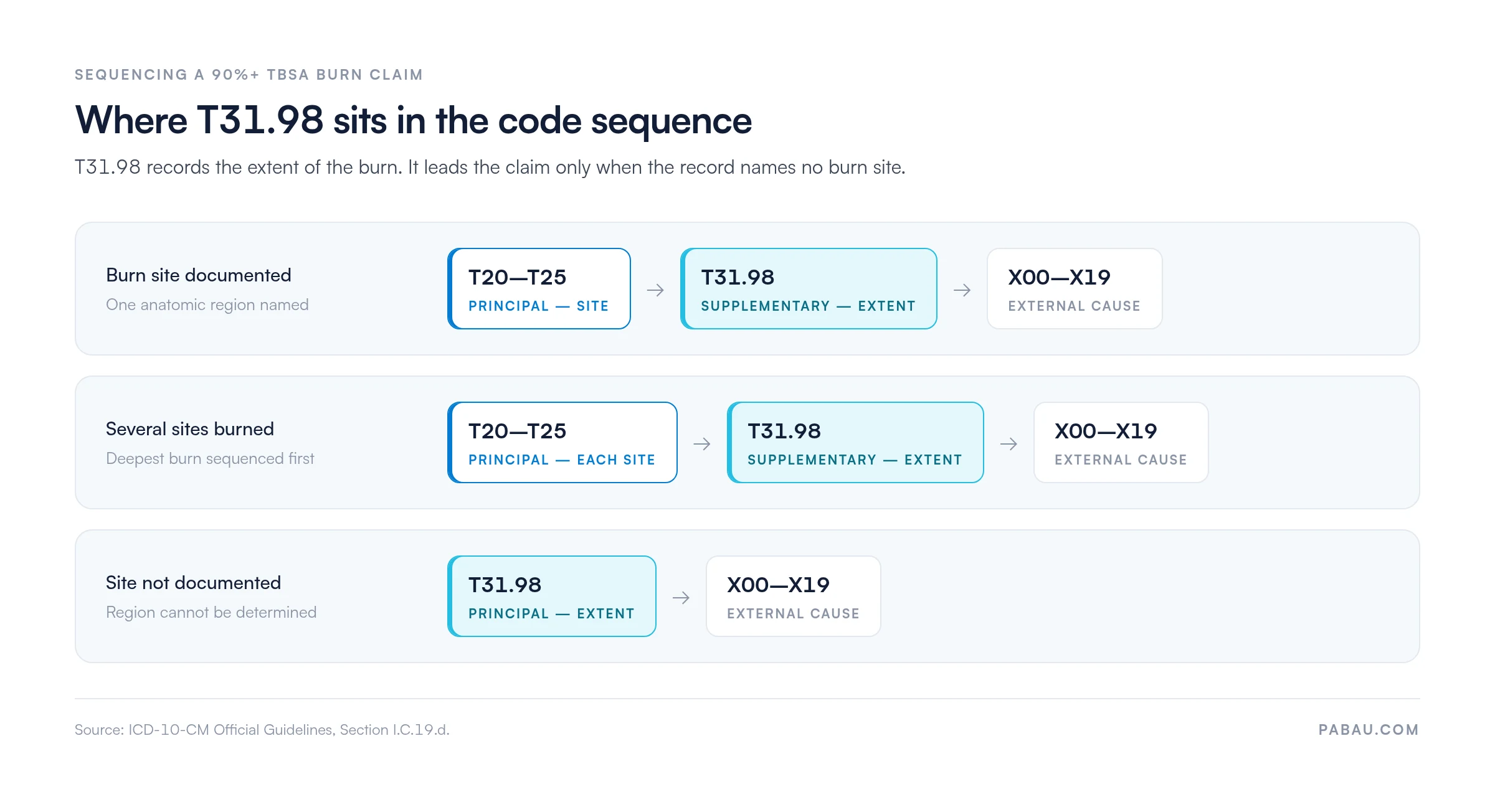
The most common sequencing error with ICD-10 Code T31.98 is assigning it as the sole diagnosis when site-specific codes exist in the record. Payers reviewing severe burn claims expect to see T20-T25 site codes as the primary diagnosis codes when sites are documented. Claims submitted with only a T31.98 and no site codes may trigger medical necessity reviews, particularly for burn center level-of-care billing.
Severe burns at the T31.98 severity level rarely present without complications. The CMS ICD-10-CM coding guidance and Official Guidelines require coders to report all conditions that affect patient management during the encounter. For a burn patient with 90%+ TBSA involvement, this typically means a complex multi-code claim.
Sequencing also matters downstream. A burn admission this large reaches the payer through a clearinghouse, which checks the submission against payer edits first. Codes that arrive out of order are caught there, before the carrier ever sees the claim.
When T59.x inhalation injury codes co-occur with ICD-10 Code T31.98, sequencing follows the reason for the encounter. If the patient is admitted primarily for the burns, the T20-T25 site codes and T31.98 come first. Inhalation and complication codes follow them. Check each added code against the ICD-10-CM codes reference before submission, because a wrong descriptor at this acuity invites a payer review.
Inadequate burn documentation is one of the most common reasons T31.98-level claims face payer scrutiny. Clinical documentation improvement (CDI) teams working with burn center physicians should verify the following elements are captured before the claim is coded.
Burn cases at this severity carry high DRG weights, so payers audit them more closely than routine admissions. A clean claim for a T31.98 case needs every element above documented. It also needs those elements to agree across the physician notes, the nursing assessment, and the discharge summary.
Flag T31.98 cases for CDI review at admission, not at discharge. The burn surgeon documents the third-degree percentage most accurately within 24 hours, while wound assessment is still active. Retrospective queries after discharge are less reliable and they slow the billing cycle.
Legacy system users and researchers working with pre-October 2015 claims data will encounter ICD-9-CM codes rather than ICD-10-CM. The approximate ICD-9-CM equivalent for T31.98 is 948.98, which represents the same clinical concept under the older classification system.
This crosswalk is derived from the CMS General Equivalence Mappings (GEMs). The mapping is approximate rather than exact, because ICD-9-CM and ICD-10-CM use different classification logic. It works for research and for historical data analysis. For current billing, only ICD-10-CM codes apply. Code status can be verified through the AAPC ICD-10-CM code search.
ICD-10 Code T31.98 applies uniformly across age groups, with no separate pediatric or geriatric variant. Documentation expectations, however, differ meaningfully by age.
Pediatric burns require the Lund-Browder chart for TBSA estimation, as noted above. Coders should confirm that the chart, or an age-adjusted equivalent, was used instead of the adult Rule of Nines. A record showing only an unadjusted Rule of Nines figure may overstate or understate TBSA. The CDI team should raise that as a query before the case is coded.
Non-accidental injury burns must also be considered. When abuse is suspected or confirmed, report additional codes from the T74.x series alongside the burn codes. That series covers adult and child abuse, neglect, and other maltreatment. The burn coding itself stays the same, and the maltreatment codes are added to it.
Older adults with burns covering 90%+ TBSA face a substantially higher mortality risk, because physiological reserve is lower. Coding this population usually means additional comorbidity codes such as hypertension, diabetes, and chronic kidney disease. Those codes reflect the complexity of care and support medical necessity for prolonged intensive care. The billing team should confirm they are all represented before submission, since they affect DRG assignment at these severity levels.
At this severity level, claims come from burn center inpatient admissions billed on UB-04 or CMS-1500 forms. One admission can carry several T20-T25 site codes, the T31.98 extent code, external cause codes, and a run of complication codes. Assembling that list by hand, from notes held in separate systems, is where detail goes missing.
Practice management software like Pabau keeps the patient record, the treatment notes, and the invoice in one system. The codes recorded during the encounter travel with the charge, so the billing team is not rekeying them from a second document. Fewer transcription steps mean fewer of the code-combination errors that hold a burn claim up.

Pabau’s claims management software then tracks each submitted claim and the reason attached to any denial. Reviewing those reasons across similar admissions shows which code combinations keep coming back. That is faster than reopening cases one at a time to find the pattern.

Pabau keeps the patient record, the treatment note and the invoice in one system, then tracks each submitted claim and the reason behind any denial. Your billing team stops rekeying codes between documents.

T31.98 is decided by the record, not by the coder. Where the physician documents both percentages and every burn site, the code and its sequence follow without a query. Where either number is missing, the claim stops until someone asks for it.
The practical move is to build the two-percentage check into the burn admission itself, rather than catching it at coding. That puts the question in front of the surgeon while the wound assessment is still open, and keeps a high-weight DRG claim moving. The cost is a small amount of front-loaded effort against a retrospective query that can hold payment for weeks.
Book a demo to see how Pabau carries a coded burn admission from the patient record through to the payer’s response.

Need guidance on ICD-10-CM diagnostic code billing workflows? What is medical billing explains the end-to-end process from diagnosis code assignment through payer remittance.
Concerned about claim denials on complex burn cases? Denial management in healthcare covers the most common denial categories and structured appeal workflows.
Want to understand clearinghouse submission for ICD-10 claims? Medical claims clearinghouse guide explains how electronic claims reach payers and what scrubbing catches before submission.
ICD-10 Code T31.98 is a billable ICD-10-CM diagnosis code for burns covering 90% or more of total body surface area. Within that total, 80-89% is third degree, or full-thickness. It belongs to the T31.9x subcategory and is valid for FY2025 and FY2026.
Yes. T31.98 is a billable, specific ICD-10-CM code that can be used for diagnosis reporting and insurance reimbursement. It is not a header or non-billable parent code. Its validity for FY2025 and FY2026 is confirmed via the CDC/NCHS ICD-10-CM tool and CMS annual release files.
T31.98 applies when 80-89% of the burns (within the 90%+ TBSA total) are third degree. T31.99 applies when 90% or more of those burns are third degree. The physician has to document the third-degree percentage separately from total TBSA. A single number such as 90% burns cannot separate the two codes.
T31.98 is used as a supplementary extent code alongside T20-T25 site-specific burn codes when the burn site is documented. It becomes the principal diagnosis only when the burn site is unspecified or cannot be determined from available documentation. In inpatient settings, T31.98 should almost always appear alongside site-specific codes.
No. T31.98 applies to thermal, electrical, radiation, and other non-corrosive burns only. Chemical burns that destroy tissue through corrosion are coded to T32.98 (or the appropriate T32.9x sibling), not T31.98. The T31 and T32 categories are mutually exclusive based on the mechanism of injury.
The Rule of Nines divides the adult body into regions each representing approximately 9% of TBSA. The physician applies this tool to estimate total burn involvement and then documents what percentage of that total is full-thickness (third degree). Both figures must appear in the medical record for T31.98 to be validly assigned. For pediatric patients, the Lund-Browder chart is used instead.




