

ICD-10 Code S42.444P: Medial epicondyle fracture, right humerus
ICD-10 Code S42.444P: full descriptor and code validity ICD-10 Code S42.444P car...

Last Updated: Oct 13, 2026
Billable Code Specific Code
T31.90 is the billable ICD-10-CM code for burns involving 90% or more of body surface with 0% to 9% third degree burns.
T31.90 has never meant “without mention of third degree burns” in any ICD-10-CM edition since FY 2010. A documented full-thickness component of up to 9% of the burned area still belongs in T31.90.
The Tabular List also carries “Burns involving 90% or more of body surface NOS” as an inclusion term under T31.90. That makes it the default when third degree extent is never documented.
Let Pabau's smart automation suggest the right codes, reduce claim denials, and keep your practice compliant—effortlessly.
Automate repetitive tasks and focus on what matters most—your patients.
Reduce coding errors and ensure compliance with the latest regulations.
Clean claims, fewer denials, and faster reimbursements.
Powerful insights and reporting to help your practice thrive.
HIPAA compliant SOC 2 certified GDPR-compliant Trusted by 4,000+ clinics worldwide

T31.90 covers burns across 90% or more of total body surface area (TBSA) with 0% to 9% third degree burns
Up to 9% documented full-thickness involvement still codes to T31.90, and it is also the default when third degree extent is not documented
The fifth character, not the fourth, carries the third degree band: T31.91 starts at 10% and each step adds 10 points
Payers routinely deny T31.90 claims when the TBSA estimation method (Rule of Nines or Lund-Browder chart) is absent from the clinical record
Practice management software like Pabau supports accurate burn diagnosis code documentation and electronic claim submission via Claim.MD
The table below summarizes the code as published in the CDC/NCHS ICD-10-CM web tool.
These clinical synonyms and lay descriptions all map to T31.90 and may appear in physician documentation or query workflows.
T31 is the parent category for burns classified by the extent of body surface involved. That sets it apart from the T20-T25 series, which classifies burns by anatomical site. Coders use T31 codes when the clinical record documents TBSA as a percentage.
Coding a burn at this extent requires the full T31 hierarchy. The table below lists every active T31 subcategory with its TBSA range.
Each subcategory from T31.1 upward takes a fifth character for third degree extent. T31.0 does not, because a burn under 10% of body surface cannot carry a 10% third degree band.
Payers expect the clinical record to name the estimation method used to arrive at the TBSA percentage. Two tools are standard.
The Rule of Nines divides adult body surface into regions, each representing 9% (or a multiple of 9%) of total surface area. It is the most widely used method for initial triage and ICD-10 burn coding in adult patients.
For pediatric patients, the Lund-Browder chart is the preferred alternative because it adjusts TBSA percentages for age-related differences in body proportion. Children’s heads represent a proportionally larger surface area than adults’, making the Rule of Nines less accurate. Clinicians treating burn patients under 15 years old should document which tool was used.
All T31.9X codes describe burns covering 90% or more of body surface. The fifth character records how much of that area is third degree, in 10-point bands. T31.90 is the lowest band, covering 0% to 9%, and it absorbs cases where depth extent is never stated.
The ladder below shows where each band starts. Every band comes from the CDC/NCHS FY 2026 code descriptions.
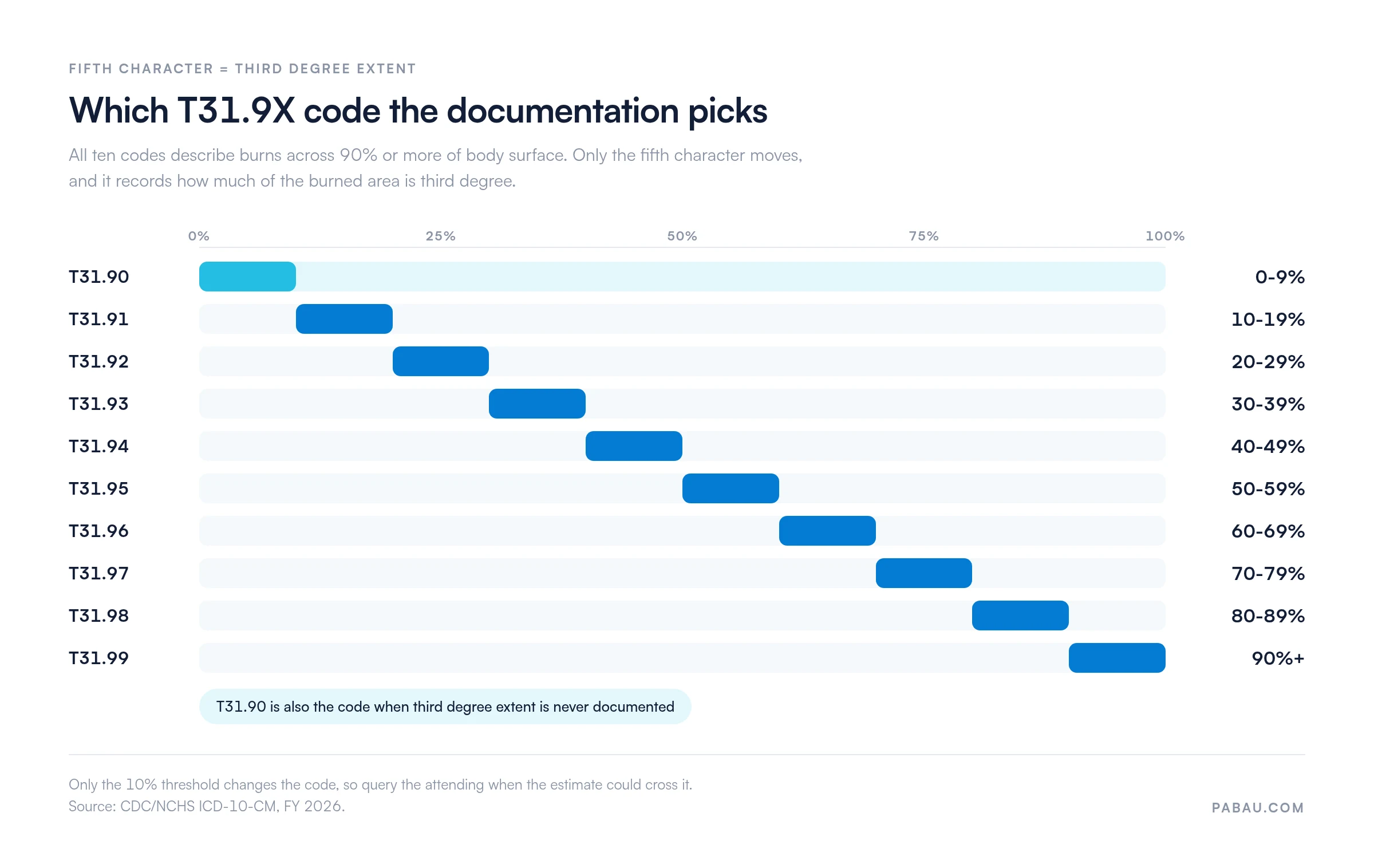
A note putting the full-thickness portion at 30% to 39% of total body surface moves the case to T31.93. The body surface band stays at 90% or more, so only the fifth character changes.
Coding implication: A documented third degree component does not by itself rule out T31.90. Query the attending only when the full-thickness estimate could cross 10%, because that is the line between T31.90 and T31.91.
The medical record must support each element of the T31.90 code. Missing documentation is the primary driver of denial on high-acuity burn claims. Capture all of the following for every burn admission.
A templated burn admission note that captures depth, TBSA, and body region cuts the number of coder queries raised after discharge.
Unspecified burn depth defaults to T31.90 under the NOS inclusion term, so the claim will pass edits. Query it anyway. A later full-thickness estimate of 10% or more shifts the code to T31.91 or above, and changes the MS-DRG.
The ICD-10-CM Official Guidelines for Coding and Reporting (Section I.C.19) govern burn code sequencing and use. Key rules for T31.90 are summarized below.
When the burn injury is the reason for admission, a site-specific T20-T25 code is typically sequenced as the principal diagnosis. T31.90 is then assigned as an additional code to quantify the extent of burn involvement.
However, TBSA sometimes drives care intensity on its own, as in major burn center admissions. T31.90 may then be sequenced as the principal diagnosis. Follow facility policy and consult the attending when sequencing is ambiguous.
T31 codes cover thermal burns. Chemical burns (corrosions) use the T32 series, which mirrors the T31 structure exactly. T32.90 is “Corrosions involving 90% or more of body surface with 0% to 9% third degree corrosion”. The mechanism of injury in the clinical record decides which category applies.
Assign an external cause code from X00-X08 (fire and flames) or X10-X19 (contact with heat sources) alongside T31.90. Place, activity, and status codes may also apply for injuries occurring at work or in specific settings. Missing external cause codes are a frequent trigger for denials on inpatient burn records.
Catching them before submission is the cheapest part of denial management.
When burns involve multiple body sites, assign the most specific site code available from T20-T25 for each site, then T31.90 as the TBSA extent code. ICD-10-CM guidelines treat T31 codes as supplementary. They do not replace site-specific coding when the site is documented.
Hospital inpatient claims with T31.90 as the principal or significant secondary diagnosis route to burn-specific MS-DRGs under the CMS IPPS. Burns sit in MDC 22, and the burn MS-DRG set is not contiguous. The six codes below come from the CMS FY 2026 MS-DRG definitions manual, version 43.0.
Note that 930 to 932 are not burn DRGs, so the range is easy to misquote. Verify assignments and relative weights against the current CMS IPPS Final Rule before using them in billing.
Billing workflows for burn cases have to capture every complicating condition (CC) and major complicating condition (MCC). Those secondary diagnoses move the MS-DRG, and the payment with it. Electronic claim submission can flag a missing secondary diagnosis before the claim leaves the practice.
Relative weights are not listed above because CMS updates them every fiscal year. Pull them from the current IPPS Final Rule tables before you model reimbursement on a burn admission.
Four errors account for most miscoded T31.9X claims. The first is the most common, and the most expensive.
T31.90 is rarely coded in isolation. Burn admissions at this severity almost always generate a cluster of supporting codes. The table below covers the codes most often reported alongside T31.90. Each one has its own entry in our ICD-10-CM codes reference.
Burn cases at this severity generate a long documentation list before a claim can be built. TBSA calculations, depth by region, external cause codes, and POA indicators all have to be captured.
Practice management software like Pabau captures each of those fields in the clinical note, then carries them into its claims management software. Burn care teams go from note to submission without rekeying the record.
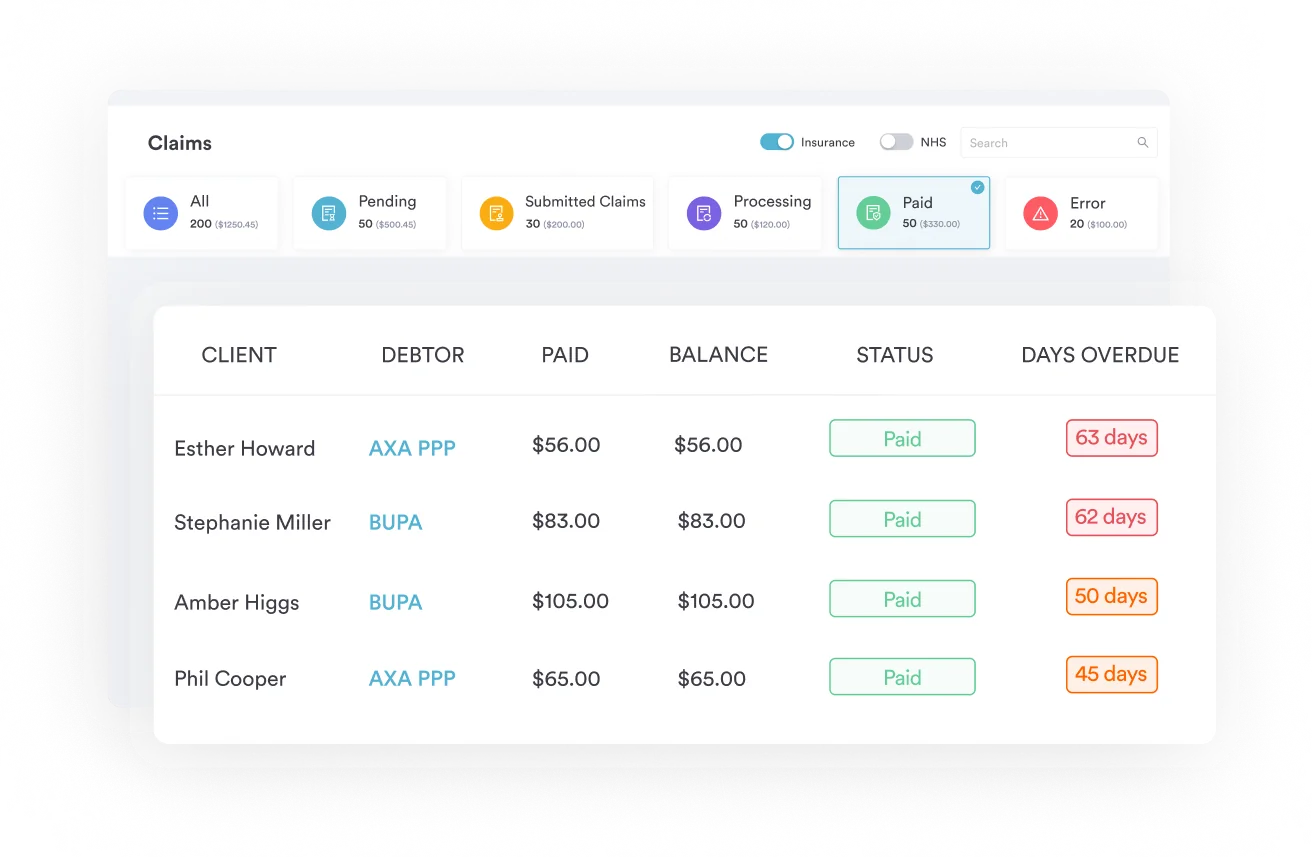
For practices submitting institutional burn claims in the US, Pabau integrates with Claim.MD for electronic claim submission and remittance. Claim.MD supports real-time eligibility checks for over 400 payers. Electronic remittance advice (835) returns denial reason codes automatically, which speeds up correcting fifth-character errors on T31.9X claims.
Pabau’s reporting tools also track denial patterns by code cluster. A burn unit can see which fifth character keeps coming back rejected. Structured intake templates cut down on post-discharge coder queries.

Pabau helps burn care teams capture TBSA percentages, burn depth per region, and mechanism of injury in structured clinical records. That cuts coder queries and speeds up claim submission.

T31.90 is the correct code when burns cover 90% or more of body surface and third degree extent runs from 0% to 9%. It is also the default when depth extent is never documented. The decision point sits on the fifth character, not the fourth.
Documenting TBSA percentage, estimation method, burn depth by region, and external cause code before discharge eliminates the most common denial triggers on high-acuity burn claims.
To see how Pabau can support structured burn injury documentation and streamlined claim submission for your practice, book a demo with our team.

Need guidance on ICD-10 coding compliance for clinical records? Medical billing compliance covers documentation standards and audit-readiness for practice teams.
Want to understand how claims reach payers after submission? Medical claims clearinghouse explains the end-to-end claim routing process from practice to payer.
Looking for strategies to reduce denied burn claims? Denial codes in medical billing breaks down the most common rejection reason codes and how to appeal them.
T31.90 is a billable ICD-10-CM code for burns involving 90% or more of total body surface area (TBSA) with 0% to 9% third degree burns. It sits in the T31 category, which classifies burns by extent of body surface rather than by anatomical site.
Yes. T31.90 is a valid, billable ICD-10-CM code accepted for HIPAA-covered transactions. It is active in the FY 2026 code set with no changes from the prior year and is designated as HCC-relevant for risk adjustment purposes.
Both codes cover burns at the 90%+ TBSA level, and the fifth character separates them. T31.90 applies when third degree burns account for 0% to 9% of the burned area. T31.91 applies when that figure reaches 10% to 19%.
Yes. The ICD-10-CM Tabular List carries “Burns involving 90% or more of body surface NOS” as an inclusion term under T31.90. Assign it as the default, then query the attending for a third degree estimate.
The record needs a documented TBSA of 90% or higher and the estimation method used, either Rule of Nines or the Lund-Browder chart. It also needs burn depth by region and the third degree extent as a percentage. Add the anatomical regions involved, the mechanism of injury, and a POA indicator for inpatient claims.
T31.90 routes to the burn MS-DRGs in MDC 22, which are 927, 928, 929, 933, 934, and 935. That set is not contiguous, so 930 to 932 are not burn DRGs. The assignment depends on ventilation, skin grafting, inhalation injury, and complicating conditions, not on T31.90 alone.
T31.90 is not a substitute for site-specific T20-T25 codes. Use both. Assign the appropriate site-specific code as the principal diagnosis, then T31.90 as an additional code. Use T31.90 alone as principal diagnosis only when TBSA extent is the primary clinical driver, following facility policy.
TBSA is estimated with the Rule of Nines, which divides adult body surface into 9% segments. The Lund-Browder chart is preferred for pediatric patients, since it adjusts for age-related body proportions. The method used must appear in the clinical record.




