ICD-10 Code Y76.0: Diagnostic obstetric and gynecological devices
ICD-10 Code Y76.0: Definition and billable status ICD-10 Code Y76.0 is a valid, ...

Last Updated: Oct 23, 2026
Billable Code Specific Code
T31.86 is the billable ICD-10-CM code for burns involving 80-89% of body surface with 60-69% third degree burns. Both percentages refer to total body surface, and the physician record must state each one.
Common denial causes include a note that gives total TBSA but no third-degree figure, and T31.86 listed without its T20-T25 site code. When the burn site is documented, the site code comes first and T31.86 follows as a supplementary code.
Let Pabau's smart automation suggest the right codes, reduce claim denials, and keep your practice compliant—effortlessly.
Automate repetitive tasks and focus on what matters most—your patients.
Reduce coding errors and ensure compliance with the latest regulations.
Clean claims, fewer denials, and faster reimbursements.
Powerful insights and reporting to help your practice thrive.
HIPAA compliant SOC 2 certified GDPR-compliant Trusted by 4,000+ clinics worldwide

T31.86 covers burns on 80-89% of body surface with third-degree burns on 60-69%, and the physician record must state both percentages.
When the burn sites are documented, T31.86 is a supplementary code that follows the T20-T25 site codes, which carry the seventh character.
T31.86 groups to MDC 22, where a skin graft, ventilation over 96 hours and inhalation injury decide the DRG.
T31.86 may carry CC/MCC status, so verify it against the current CMS CC/MCC list before you rely on it.
T31.86 takes no seventh character, because the A, D or S belongs to the companion site code.
Claims management software such as Pabau helps billing teams review T31.86 claims before submission.
ICD-10 code T31.86 is the billable code for burns covering 80 to 89% of total body surface area (TBSA).
Third-degree burns cover 60 to 69% of the body surface. It belongs to category T31, “Burns classified according to extent of body surface involved.”
Category T31 records how much of the body is burned and how much of it is full-thickness. It says nothing about where the burns are or what caused them.
The code is valid and billable for fiscal years 2025 and 2026 in the ICD-10-CM code set, per the CMS Tabular List. It is a leaf-node code with no further subdivision, so T31.86 is used exactly as written.
T31.86 rests on two independent numbers, and a claim fails if the documentation doesn’t support either one. The first is total TBSA, meaning 80 to 89% of the body surface is burned at any depth. The second is the third-degree share, meaning full-thickness burns cover 60 to 69% of the body surface.
Third-degree burns destroy the epidermis and dermis and extend into subcutaneous tissue. They are insensate, look white, tan, brown or charred, and usually need grafting.
A patient with 85% total burns and 65% full-thickness burns meets the T31.86 criteria exactly. The scale below shows how the code moves when only the third-degree figure changes.
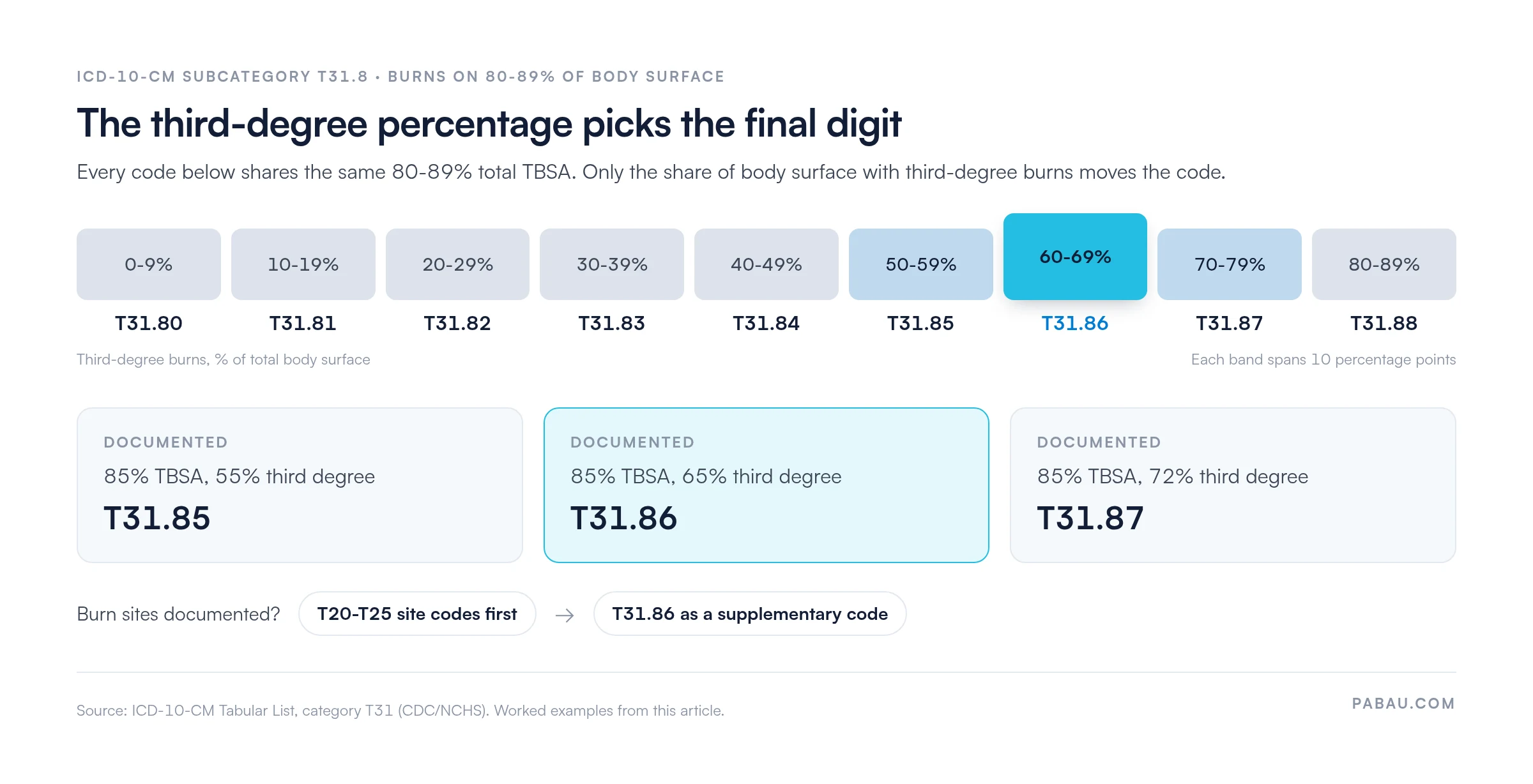
If the third-degree figure falls to 55%, the code drops to T31.85. If it rises to 72%, ICD-10 code T31.87 applies instead.
The rule of nines divides the adult body into segments each representing 9% of total surface area. Clinicians sum the affected segments to arrive at TBSA. The standard adult segmentation is as follows:
For pediatric patients, the rule of nines underestimates head size and overestimates leg size. The Lund-Browder chart adjusts for age-related surface area proportions and is the preferred tool for patients under 15. For ICD-10 coding purposes, the TBSA and degree percentages must come from the physician’s documented assessment, not from the coder’s independent calculation.
The T31.8 subcategory covers the 80 to 89% total TBSA band. The final digit gives the percentage of body surface with third-degree burns. The table lists every code in the subcategory, so coders can confirm the assignment at the boundaries.
Per ICD-10-CM Official Guidelines Section I.C.19.d, T31.86 is rarely reported alone. Category T31 records the extent of the burn. When the burn sites are documented, it accompanies a T20-T25 site code for each site, which records the anatomic location and depth.
The table below shows commonly paired T20-T25 codes for third-degree burns at major anatomic sites, with the initial encounter seventh character applied:
When a patient has burns at multiple sites, each site gets its own T20-T25 code with the appropriate seventh character. T31.86 appears once on the claim, however many site codes are listed.
T31.86 can’t be assigned from a narrative description of a “massive” or “extensive” burn. The physician record must give explicit numbers for both percentages. If either is missing, the coder must query the physician or fall back to a less specific code, which can lower the DRG weight.
These documentation elements must be present, per medical billing compliance principles and ICD-10-CM Official Guidelines Section I.C.19.d:
A note reading “patient has large burns covering most of the body surface with deep partial and full-thickness involvement” gives no basis for T31.86. The coder can’t estimate the percentages independently.
Flag extensive-burn cases for physician query at the assessment, not at coding. Surgeons often dictate TBSA in the admission note. Check that the note gives both the total and the third-degree percentage before the claim is built, because retrospective queries delay billing on high-weight DRGs.
T31.86 maps to MDC 22 (Burns) in the CMS MS-DRG grouper. Within MDC 22, three factors decide the DRG: a skin graft, mechanical ventilation (MV) past 96 hours, and inhalation injury. Complications or comorbidities (CC) and major complications or comorbidities (MCC) split DRGs 928 and 929.
T31.86 may carry CC/MCC status. Verify it against the current fiscal year’s CMS CC/MCC list before submission, because the designation can change in annual updates.
Verify current DRG weights against the CMS ICD-10 codes page for the active fiscal year. Report the ICD-10-PCS skin graft procedure codes accurately alongside T31.86. Without them, the grouper can’t assign a graft DRG (927-929) and falls back to a non-graft DRG.
The broader revenue cycle management workflow shows where a T31.86 claim sits in the full payment lifecycle.
Coders sometimes assume T31.86 carries a seventh character that changes with the encounter type. It doesn’t. T31.86 is reported the same way at initial and subsequent encounters, and the seventh character sits on the companion T20-T25 code.
On outpatient wound care visits, coders sometimes carry T31.86 forward from the original admission. It belongs on the claim only while the burn extent is still clinically relevant. For sequela-only visits, drop T31.86 and report the site code with the S character plus the sequela diagnosis.
Six errors are worth screening for on every T31.86 claim. Fixing them before submission costs far less than working a denial queue on high-value admissions. Good denial management workflows catch most of them at the pre-submission audit.
Submitting a clean claim on a T31.86 admission starts with a pre-submission check:
Teams that pair their billing workflow with electronic remittance advice processing can spot denial patterns sooner and fix the root causes.
Build a burn coding checklist into your CDI workflow. First, confirm the TBSA is 80-89% and the third-degree figure is 60-69%. Then identify every burn site for the T20-T25 codes. Finally, match the seventh character to the encounter and check for documented inhalation injury. Those five checks prevent the most common T31.86 denials.
The T31.8 subcategory spans nine codes, T31.80 to T31.88, each covering a 10-percentage-point band of third-degree involvement. The boundary between T31.86 and T31.87 causes the most confusion, because one percentage point in the documented figure changes the code. When the record says 70%, use T31.87. When it says 69%, use T31.86. Never round or approximate.
The CDC/NCHS ICD-10-CM web tool lets coders check the official descriptor for any T31 code and confirm it is valid this fiscal year. The AAPC Codify ICD-10-CM lookup adds code edits, crosswalks and coding notes. CMS publishes the annual tabular updates and coding guidelines on its ICD-10 codes page, linked above.
Checking an extensive-burn claim by hand means reading the physician note, matching each site code and confirming the sequencing, one line at a time. A missing percentage often surfaces only when the denial arrives, long after the claim joined the medical billing queue.
Pabau, the practice management platform we build, keeps diagnosis codes, clinical notes and payments in the same patient record. Its claims tools help billing teams review claims before submission. The TBSA figures and site codes get checked against the note in one place.

The outcome is fewer resubmissions on high-weight claims. Your billing team spends its time on physician queries instead of rework.

Pabau’s claims management tools help billing teams review claims before submission. Codes, notes and payments sit in one patient record, so T31.86 errors are easier to catch early.

T31.86 rests on two numbers, and both have to be in the physician’s note. An 80 to 89% TBSA burn with 60 to 69% third-degree involvement usually places the admission in a high-weight DRG family. That makes a missing percentage an expensive omission.
So move the check upstream. Confirm both figures at the assessment, list the T20-T25 site codes first and add T31.86 after them. A one-point slip in the third-degree figure changes the code, so query the physician rather than estimate.
The trade-off is a little more time at intake against a much slower denial later. Book a demo to see how Pabau helps your billing team catch coding errors before a claim goes out.

Need guidance on managing claim denials for complex codes? Denial management in healthcare covers the workflows and tools that reduce denial rates on high-acuity claims.
Want to understand how burn claims move through the revenue cycle? Revenue cycle management explained maps the full process from admission coding to final payment posting.
Looking for clearinghouse options for ICD-10 claim submission? Medical claims clearinghouse guide explains how clearinghouses validate and route ICD-coded claims to payers.
ICD-10 code T31.86 is the diagnosis code for burns covering 80 to 89 percent of total body surface area. Third-degree burns cover 60 to 69 percent of the body surface. It belongs to category T31, which classifies burns by extent rather than location. When the burn sites are documented, it is reported after the T20-T25 site codes as a supplementary code.
Yes, T31.86 is a billable and specific ICD-10-CM code valid for fiscal years 2025 and 2026. It is a leaf-node code with no further subdivision, meaning it is used exactly as written without any additional digit.
Both codes cover burns on 80 to 89 percent of total body surface area, but they differ in third-degree involvement. T31.86 applies when third-degree burns cover 60 to 69 percent of the body surface, and T31.87 applies at 70 to 79 percent. One percentage point in the documented figure decides the code, so never round or approximate.
No. T31.86 has no seventh character. The seventh character (A for initial, D for subsequent, S for sequela) goes on the companion T20-T25 site code, not on T31.86. T31.86 is reported identically across all encounter types.
T31.86 maps to MDC 22 (Burns), and the DRG depends on the procedures and complications on the claim. DRG 927 covers extensive or full-thickness burns with mechanical ventilation over 96 hours and a skin graft. DRGs 928 and 929 cover full-thickness burns with a skin graft or inhalation injury, split by CC/MCC. DRG 933 is the non-graft counterpart of 927, and DRG 934 covers full-thickness burns without a graft or inhalation injury. T31.86 may carry CC/MCC status, so verify it against the current CMS CC/MCC list.
Only when the burn site is unspecified. The T31 category note makes T31 the primary code in that case alone. When the site is documented, as it is on most admissions, the T20-T25 site code with the highest degree of burn is sequenced first. T31.86 then follows as a supplementary code, per Official Guidelines Section I.C.19.d.