ICD-10 Code Y76.0: Diagnostic obstetric and gynecological devices
ICD-10 Code Y76.0: Definition and billable status ICD-10 Code Y76.0 is a valid, ...

Last Updated: Oct 23, 2026
Billable Code Specific Code
T31.84 is the billable ICD-10-CM code for burns involving 80-89% of body surface with 40-49% third degree burns. It records how much of the body is burned, not where, so it usually follows a site-specific T20-T25 burn code.
Assigning T31.84 requires the physician to document both the total body surface percentage and the third-degree percentage. If either is missing, query the physician before coding.
Let Pabau's smart automation suggest the right codes, reduce claim denials, and keep your practice compliant—effortlessly.
Automate repetitive tasks and focus on what matters most—your patients.
Reduce coding errors and ensure compliance with the latest regulations.
Clean claims, fewer denials, and faster reimbursements.
Powerful insights and reporting to help your practice thrive.
HIPAA compliant SOC 2 certified GDPR-compliant Trusted by 4,000+ clinics worldwide

T31.84 applies only when the physician documents two figures: 80-89% of body surface burned, and 40-49% of body surface at third degree.
Both percentages are shares of the whole body surface, so a third-degree figure given as a share of the burned area needs a query.
When the burn site is documented, sequence the site-specific T20-T25 code first and add T31.84 as a supplementary code.
Report external cause, place, activity and status codes when they’re documented, and follow your payer and state rules.
A missed or miscoded skin graft moves a burn stay out of MS-DRGs 927-929 and into the lower-weighted 933-934 groups.
ICD-10 code T31.84 is the billable ICD-10-CM code for burns involving 80-89% of body surface with 40-49% third degree burns. It records how much skin is burned and how much of that is full thickness. It says nothing about where the burns are.
The code is valid for submission on claims in the current ICD-10-CM release (FY2027, effective 10/1/2026), per the CDC/NCHS ICD-10-CM tabular list. It sits in Chapter 19 (S00-T88), under category T31 for burns classified by extent of body surface.
So before you assign it, the record needs two separate numbers from the physician. Here’s what each one must say.
Category T31 sorts burns by extent, not by body site. That’s the main difference from the T20-T25 site codes. T31 answers “how much?” while T20-T25 answer “where?”
Think of the code as a two-axis grid. The fourth character (the 8 in T31.8) gives the total-TBSA tier, here 80-89%. The fifth character (the 4 in T31.84) gives the third-degree tier, here 40-49%. Both tiers are measured against the whole body surface.
Every code in the 80-89% row is listed below. One tier down, T31.83 covers 30-39% third degree, while T31.85 starts at 50%.
Clinicians estimate the burned surface with the rule of nines or the Lund-Browder chart. The rule of nines splits the adult body into regions worth 9% or multiples of 9%. Per Official Guidelines I.C.19.d.6, providers may adjust those values for infants and children, whose heads are proportionately larger.
The coder’s job is to read the documented figures, not to calculate them. A body diagram or nursing notes can’t stand in for the physician’s total. If the note lists burned regions without a percentage, query the attending physician first.
Here’s how one chart lands on T31.84. The physician records partial-thickness burns of the head, neck and left arm. The right arm and the front of the trunk are full thickness, along with half the back and half the right leg.
That adds up to 85% of body surface burned and 45% at third degree. The breakdown below sets each region against its rule of nines value.
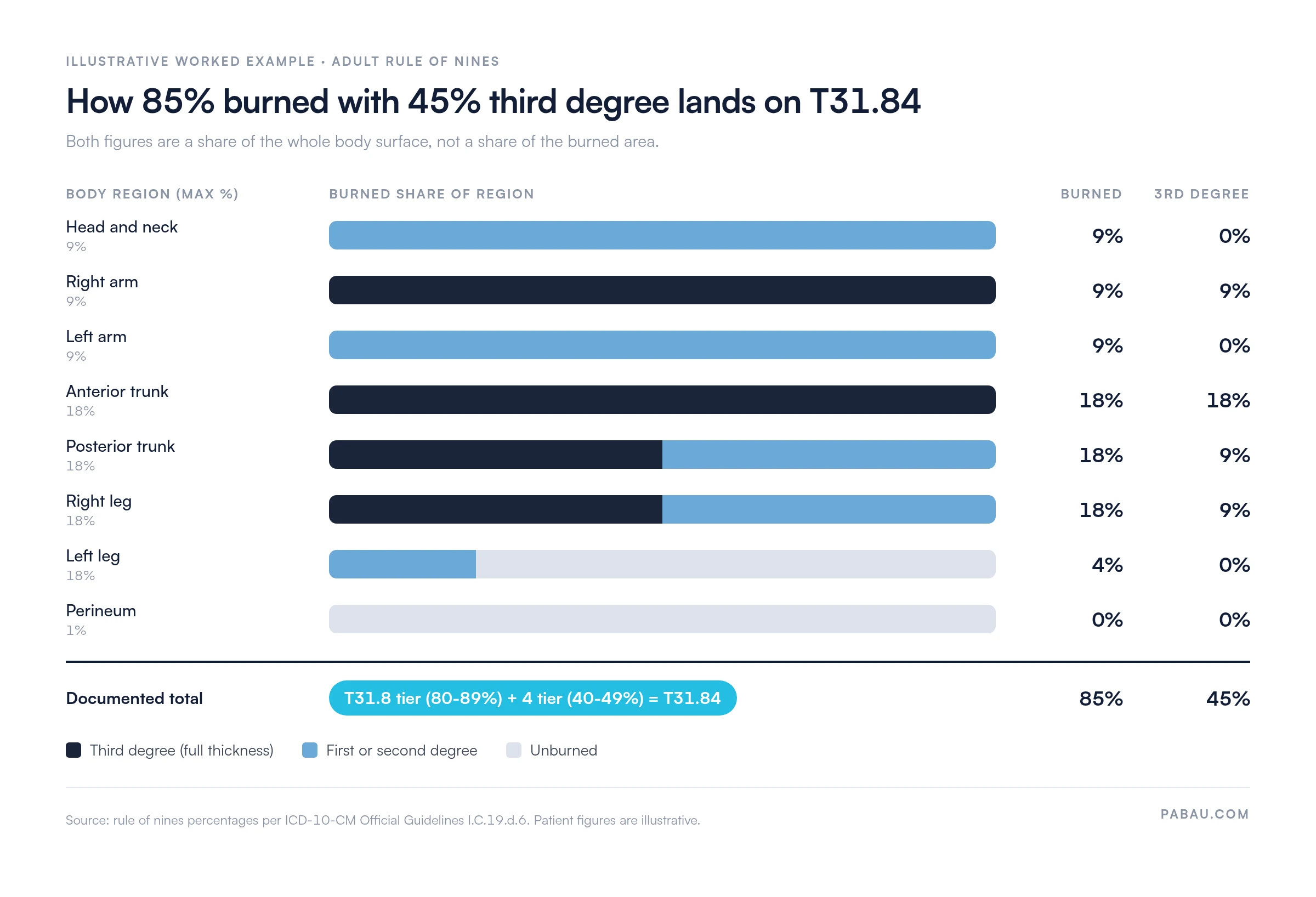
Watch for one trap at this step. A note that says “about half the burn is full thickness” describes the burned area, not the body. Half of 85% is roughly 42%, but the code needs the physician’s own body-surface figure, so query rather than convert.
Reaching 80-89% TBSA in an adult involves nearly every major body region. Patients at this extent are usually treated at regional burn centers.
Under the ICD-10-CM Official Guidelines, Section I.C.19.d, T31 adds extent data to the site-specific burn codes. The tabular note under T31 says to use it as a supplementary code with T20-T25 when the site is specified. You can look up the T20-T25 site codes in our ICD-10-CM code library. Here’s the order to build the claim in.
If the site of the burn isn’t documented, T31.84 may serve as the principal diagnosis on its own. The tabular note says T31 is primary only when the site is unspecified. That’s uncommon in practice, because burn documentation almost always names the anatomical sites.
A checklist works best here, because each element feeds a different code on the claim. The treating physician should document all of the following.
If any element is missing, send a physician query before you finalize the codes. Coding T31.84 from inference rather than explicit documentation creates compliance risk in a RAC or MAC review.
External cause codes tell the payer how the burn happened, where, and what the patient was doing. ICD-10-CM has no national mandate for reporting them, though some states and payers require them. So report them when they’re documented, and follow your payer and state rules.
Timing differs by code type. X00-X19 codes take a 7th character (A, D or S) and can be reported for the length of treatment. Y92 (place), Y93 (activity) and Y99 (status) have no 7th character, so they’re reported once, at the initial encounter.
T31.84 is an inpatient-level code by clinical necessity. At this extent, patients need burn center admission, fluid resuscitation, infection control and usually several surgeries. The MS-DRG then sets the base payment for the whole stay.
The burn DRGs split on three questions. Was a skin graft performed? Was the patient ventilated for more than 96 hours? Is there a CC or MCC? The CMS MS-DRG definitions manual sets out the full logic.
DRG logic and weights change with each IPPS final rule, effective October 1. Check the current year’s rule rather than hard-coding a weight into a coding worksheet.
On the professional side, the surgeon bills grafts with CPT codes such as 15100, the split-thickness autograft code for the trunk, arms or legs. Compare both claims before submission. A graft on the surgeon’s claim but not the facility’s points to a missed procedure code.
Before you finalize the DRG for a T31.84 stay, check that every skin graft has an ICD-10-PCS procedure code with the correct root operation. A missed or miscoded graft drops the stay from DRG 927 to 933, or from 928-929 to 934 when no inhalation injury is coded. Both moves cut the payment.
High-severity burn codes draw close review, and RAC and MAC contractors can pull T31.84 stays for medical necessity checks. Good denial management workflows start before the claim goes out, not after the remittance comes back.
These are the patterns to catch first.
The T31/T32 mix-up deserves a second look on chemical injuries. A corrosion at the same extent codes to T32.84, which mirrors the tiers of this code.
Run this list alongside your clean claim standards before final billing. You’ll catch most of the patterns above in-house.
Medicare applies its standard inpatient admission criteria to T31.84 stays. At 80-89% TBSA, the severity of injury rarely leaves medical necessity in doubt. What gets reviewed instead is whether the record supports each code. Here are quick answers to the questions billing teams ask most.
Several of the mistakes above start with details re-keyed between the chart and the claim form. Pabau, the practice management platform we build, pre-fills claims from the patient record, so diagnosis and procedure details travel with the encounter.
Its claims tools for coders include ICD-10-CM and CPT/HCPCS lookup libraries. Before a claim can be sent, Pabau checks that required fields, such as membership and authorization numbers, are complete. It doesn’t validate sequencing, coding or clinical documentation, so the checks in this guide stay with your coders.
Pabau’s Claim.MD integration supports US claim submission, real-time eligibility checks and ERA posting from the practice record.

Pabau pre-fills claims from the patient record, offers ICD-10-CM and CPT/HCPCS lookup libraries, and checks required claim fields before sending. That helps teams submit complete claims.

T31.84 rewards coders who treat it as a two-number code. Get both percentages from the physician, as shares of the whole body, and the tier follows. Miss one and the claim either understates severity or invites a query after billing.
The bigger money sits elsewhere, in the site codes and the graft procedures that drive the DRG. Reconcile operative notes before final billing, and confirm each payer’s external cause rules once rather than claim by claim.
If your team still copies burn details from the chart into claim forms by hand, that’s the step worth fixing first. Book a demo to see how Pabau pre-fills claims from the record and checks required fields before they go out.

Want to see where high-severity claims stall in transit? Medical claims clearinghouse guide explains how claims flow from provider to payer and where submissions get held up.
Need a framework for catching errors before submission? Clean claim checklist covers the data and code completeness checks that keep burn claims out of the denial queue.
Submitting inpatient burn claims electronically? 837 file guide walks through the 837 transaction set, including the institutional 837I format hospitals use for inpatient stays.
Reading the remittance after a burn stay pays? Electronic remittance advice guide shows how to read the ERA and confirm the payer applied the DRG you expected.
Coding a burn with under 10% at full thickness? ICD-10 code T31.80 covers the lowest third-degree tier in the same 80-89% row.
Yes. T31.84 is billable and valid for submission on claims in the current ICD-10-CM release (FY2027, effective 10/1/2026). T31 codes take no 7th character, so the five-character code is complete as written.
Both cover burns over 80-89% of body surface. T31.83 means 30-39% of body surface is third degree, while T31.84 means 40-49%. Pick the tier from the physician’s documented third-degree figure.
No. Sunburn codes separately to L55, which the T20-T32 burn block excludes. If a note folds sunburn into the TBSA figure, query the physician before assigning T31.84.
Use T32.84 for corrosions involving 80-89% of body surface with 40-49% third-degree corrosion. T31 covers burns, not chemical corrosions, so confirm the source in the record first.