ICD-10 code S61.201A: Open wound of left index finger without nail damage
ICD-10 code S61.201A covers a left index finger wound of unstated type ICD-10 co...

Last Updated: Oct 16, 2026
Billable Code Specific Code
T31.83 is the billable ICD-10-CM code for burns involving 80-89% of body surface with 30-39% third degree burns. It reports the extent of the burn, not its location, so the T20-T25 site codes stay on the claim alongside it.
The two percentages have to come from the physician's own notes. Without a stated third-degree percentage, the supportable code drops to T31.80. A missing total takes the whole T31.8x range off the claim.
Let Pabau's smart automation suggest the right codes, reduce claim denials, and keep your practice compliant—effortlessly.
Automate repetitive tasks and focus on what matters most—your patients.
Reduce coding errors and ensure compliance with the latest regulations.
Clean claims, fewer denials, and faster reimbursements.
Powerful insights and reporting to help your practice thrive.
HIPAA compliant SOC 2 certified GDPR-compliant Trusted by 4,000+ clinics worldwide

T31.83 covers burns across 80-89% of total body surface with 30-39% full-thickness, and it records extent only, never site.
T31.83 is usually an additional code rather than the principal diagnosis, because a documented T20-T25 site code outranks it.
A missing third-degree percentage drops the claim to T31.80, and a missing total TBSA removes T31 from the claim.
External cause codes are not federally mandated, so check your state and payer rules before treating them as required.
Pabau’s claims management software files T31.83 claims electronically through a clearinghouse, then tracks eligibility, claim status and remittances.
ICD-10 code T31.83 is the billable diagnosis code for burns covering 80 to 89 percent of the body. Of that burned area, 30 to 39 percent has to be documented as third degree, meaning full-thickness.
The code belongs to category T31, which groups burns by how much of the body is involved rather than which part. It is valid and billable for fiscal years 2025 and 2026, confirmed by the CDC/NCHS ICD-10-CM code tool.
Two axes define the code. The first is total burn extent, at 80-89% TBSA. The second is the depth qualifier, at 30-39% third degree. Both have to come from the treating physician before the code holds up on a claim.
T31.83 is the last link in a five-level chain inside the ICD-10-CM classification. Knowing where it sits makes the sequencing rules easier to apply, and it catches crosswalk errors before a payer does.
Only the final digit moves. It carries the third-degree proportion. T31.80 means no third-degree burns were documented, and T31.83 means 30 to 39 percent of the burned area is full-thickness. That digit changes the DRG weight the grouper lands on, which makes it a reimbursement decision as much as a coding one.
Further up the same scale, T31.86 holds the 80-89 percent total with 60 to 69 percent of it third degree.
T31.83 is an extent-only code. It tells a payer how much of the body burned and how deep the worst of it goes, but it never says where.
Burn versus corrosion is a frequent audit flag. Payers return claims where T31.83 was used for a chemical injury that belonged in T32.83. The mechanism the physician wrote down is what decides which category applies.
Every code in the T31.8x subcategory shares the same 80-89% extent. Only the final digit changes, and each value stands for a different clinical picture and a different DRG weight. Picking the wrong one is the most common coding error in this subcategory.
Each row above holds the total extent at 80-89% and moves only the third-degree digit. If the physician documents 70-79% of body surface instead, with 30-39% still third degree, the claim moves to code T31.73.
T20-T25 codes say where the burn is, on the face, the hand, the trunk or a lower limb. T31.83 says how much of the body it covers. Section I.C.19.d of the ICD-10-CM Official Guidelines expects both sets on the same claim, and AHA Coding Clinic guidance says the same.
Take a patient admitted after a house fire with burns to the chest wall, the right shoulder and both legs. The physician records 84% TBSA with 35% full-thickness. The coder assigns a T20-T25 code for each burned site, then adds T31.83 for the total extent. Neither set stands in for the other.
The record has to carry both numbers in the physician’s own words. Missing the third-degree percentage is not the same failure as missing the total, and the two lead somewhere different.
Two validated tools support the estimate itself. The Rule of Nines splits the adult body into regions of roughly 9% each. The Lund-Browder chart adjusts those proportions for age. That makes it the correct tool for children, where the adult rule reads high and becomes a compliance risk.
Four elements belong in the record before a T31.83 claim goes out. The physician, not the coder, has to state each one.
Each of those fails differently, and this is where coders most often go wrong. Without a stated total TBSA, no code in the T31.8x range applies at all, and the claim carries only the site codes.
Leave out the third-degree percentage and the supportable code drops to T31.80. Depth and mechanism notes feed other parts of the code set, so their absence weakens the record without changing that default.
The chart below walks the same three checks in the order a coder meets them.
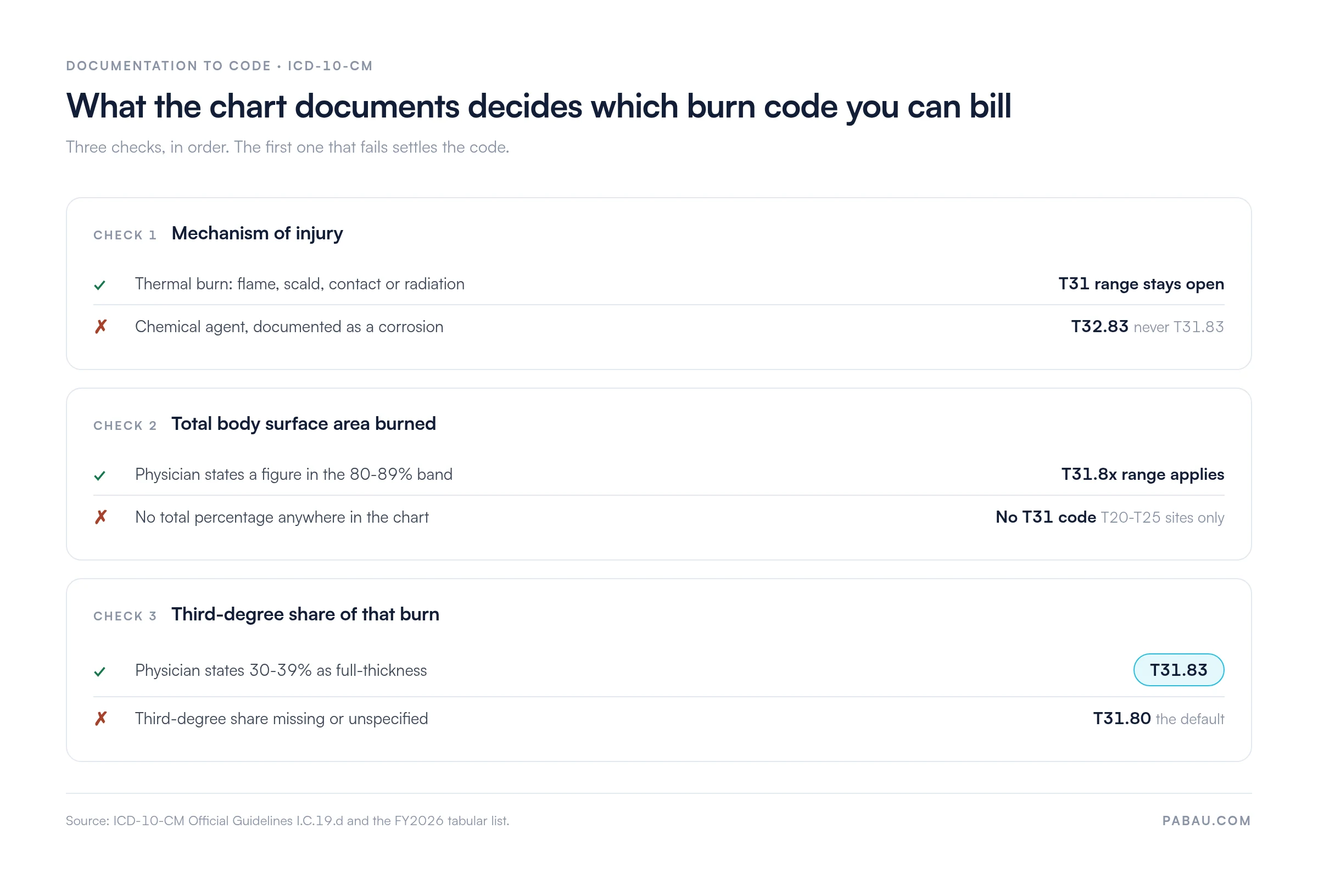
Flag charts where nursing and physician TBSA estimates differ by more than 5 percentage points. Inconsistent estimates are a top audit trigger for T31.83 claims. Reconcile the difference in a physician addendum before submission.
T31.83 rarely goes out alone. External cause codes are the companions coders ask about most, and the rule is narrower than it looks. Section I.C.20 of the ICD-10-CM Official Guidelines sets no national requirement to report them.
Reporting becomes mandatory only where a state, a payer contract or a specific program says so, and it stays voluntary everywhere else.
That makes the external cause code a local question rather than a federal one. Check your own payer mix first, because a burn center billing three states can easily be under three different rules.
A compliant code set for that house-fire admission runs in this order.
The site code for the highest-degree burn leads the claim. T31.83 follows it, because the burned sites are documented and the extent code is supplementary here. Watch the shoulder code in particular: T22.311 is the right forearm, and the right shoulder is T22.351.
Is T31.83 ever the principal diagnosis? Yes, but in one situation only. Section I.C.19.d of the ICD-10-CM Official Guidelines assigns T31 codes as additional codes for extent. They lead the claim only when the burn site is not specified.
So on a chart that names the burned sites, the highest-degree T20-T25 code is principal and T31.83 is supplementary. A coder who puts the extent code first has inverted the set, which is worth checking on any burn claim you inherit.
Two other situations are worth knowing. Outpatient coding follows the reason-for-the-visit rule rather than the most-severe-burn rule, so confirm the encounter type before you sequence.
Where one site drives its own surgery, such as a circumferential hand burn needing emergent escharotomy, that site code may lead for that encounter. The AAPC ICD-10-CM code lookup carries sequencing notes for each code.
Burns at this extent need staged procedures across a long inpatient stay, so the CPT side of a T31.83 claim is rarely short. The codes below are the ones burn centers bill most often against this diagnosis.
Sequencing on the procedure side matters less than on the diagnosis side, but the volume does not help anyone. A single admission can generate dozens of lines across several weeks, so the billing team needs a clear view of what has already gone out.
T31.83 denies more often than most diagnosis codes, because every element of the two-axis descriptor has to be traceable in the chart.
The patterns below are specific to burn coding, and a coder who knows them can clear most of the risk before submission.
On the remittance side, a handful of CARC values come back again and again. CARC 16 means the claim lacks information. CARC 50 says the service was not judged medically necessary. CARC 4 flags an inconsistent modifier. The denial codes reference maps each one back to the documentation a payer is asking for.
Preventing all of that is mostly a documentation exercise rather than a billing one. If you want the wider version of this workflow, the clean claim guide covers the same pre-submission review across other high-acuity encounters.
Run five checks on every T31.83 claim before it leaves. Is the total TBSA in the physician’s own note? Is the third-degree percentage there as well? Does the mechanism of injury match the code you picked? Is the injury confirmed as thermal rather than a corrosion? And does your payer or state want an external cause code? Five yeses, and the documentation reasons for denial are already dealt with.
Under Medicare, a T31.83 admission groups to MDC 22, the burns category, and usually lands in DRG 928 or DRG 929. Both of those cover full-thickness burns with a skin graft or an inhalation injury. What separates them is a complication or comorbidity, so DRG 928 applies with a CC or MCC and DRG 929 without one.
DRG weights change every fiscal year, so check the current CMS IPPS tables before quoting a figure to anyone. Medicaid prior authorization for burn center admission varies by state and contract year, which makes it a conversation with the payer rather than an assumption.
Most commercial payers use American Burn Association referral criteria to authorize the admission. Burns at 80-89% TBSA clear those thresholds comfortably, but the criteria still have to reach the payer with the authorization request. Treat this as general practice and verify it with each payer, since none of it is a policy statement.
A burn center admission produces a long claim with many moving parts. Most billing teams assemble it in the chart, rekey it into a payer portal, then wait for a remittance to tell them what went wrong.
Practice management software like Pabau closes that loop. Pabau’s claims management software files the claim electronically through a clearinghouse and runs eligibility checks before the encounter. Remittance advice then posts back against the claim it belongs to, so the billing team can see status without logging into a portal.
The coding judgment stays with your team. Pabau handles the mechanical work of submission, claim status and reconciliation. A coder then spends more time on the chart and less of it chasing a payer.


Pabau files claims through your clearinghouse, runs eligibility checks before the encounter, and posts remittance advice back against the claim it belongs to.

T31.83 rewards a coder who reads the chart twice. The code itself is straightforward, and the two percentages behind it are the whole argument you are putting to a payer.
If you take one habit away from this page, make it the sequencing check. A burn chart that names its sites puts a T20-T25 code first, with T31.83 behind it. Get that order wrong and the grouper lands on a different DRG, quietly, with no warning on the remittance.
What follows is process, and process is where software earns its place. Book a demo to see how Pabau files a burn admission electronically and posts the remittance back against it.

Want to decode the denial that came back? Denial codes in medical billing maps each CARC and RARC code to the documentation a payer is asking for.
Want to build a clean claim workflow for complex diagnoses? Claim.MD clearinghouse guide explains how electronic claims validation catches errors before they reach the payer.
Looking to understand revenue cycle management for high-acuity encounters? What is revenue cycle management covers the end-to-end process from coding to payment posting.
No. Codes in category T31 are complete at five characters, so T31.83 is billable as it stands. The seventh character belongs to the T20-T25 site codes, which take A for the initial encounter, D for subsequent care and S for a sequela.
T31.83 stops at 89%. Once the physician documents 90% or more of the body surface, the claim moves into the T31.9x range. The final digit again carries the third-degree share, and the documentation rules are identical.
No. T31 reports the total extent of the burn, so a single code from the category covers the whole encounter. A claim carrying both T31.80 and T31.83 shows a conflict in the record and usually comes straight back.
No. The code carries no encounter character, so the same T31.83 is reported while the total extent is still being treated. The site codes around it are what change, moving from A to D or S.
The treating physician. A coder cannot work the percentage out from a burn diagram, and a nursing estimate does not support the code on its own. Where the notes disagree, ask for a physician addendum before the claim goes out.