ICD-10 code T32.0: Corrosions involving less than 10% of body surface area
What ICD-10 code T32.0 covers: Chemical corrosions under 10% T32.0 reports chemi...

Last Updated: Nov 26, 2026
Billable Code Specific Code
A dog bite that splits the left big toenail rarely ends at the first visit, and S91.252D is the ICD-10-CM code for the follow-ups. It is billable and covers an open bite of the left great toe with damage to the nail, at a subsequent encounter. Use it once active treatment is done and the patient returns for routine healing checks.
Three details in the note decide the code. The bite broke the skin, it reached the left big toe, and it injured the nail or nail bed. Without nail damage, S91.152D applies instead. Below, you'll find the seventh-character rules, the cause codes that name the animal, and the checks that keep these claims paid.
Let Pabau's smart automation suggest the right codes, reduce claim denials, and keep your practice compliant—effortlessly.
Automate repetitive tasks and focus on what matters most—your patients.
Reduce coding errors and ensure compliance with the latest regulations.
Clean claims, fewer denials, and faster reimbursements.
Powerful insights and reporting to help your practice thrive.
HIPAA compliant SOC 2 certified GDPR-compliant Trusted by 4,000+ clinics worldwide

S91.252D codes a follow-up visit for an open bite of the left great toe that also damaged the nail.
Use the seventh character D once active treatment is over and the visit is a routine healing check.
No nail damage in the note means S91.152D, and a superficial bite belongs in S90.47- instead.
Add a W-code for the animal, such as W54.0XXD for a dog, with the same seventh character D.
Leave Y92, Y93 and Y99 codes off the follow-up claim, and code any wound infection alongside the bite.
ICD-10 code S91.252D is the billable code for a follow-up visit after an open bite of the left great toe that damaged the nail. The CDC/NCHS ICD-10-CM browser tool lists it under category S91, open wound of ankle, foot and toes. The D tells the payer that active treatment is finished.
In plain terms, something bit the patient hard enough to break the skin of the left big toe. The same bite tore, split or lifted the toenail, or cut the nail bed. The patient is now back for a wound check, a dressing change or a look at how the nail is healing.
Here is where the code sits in the classification:
Only the full seven-character code is billable. S91.25 and S91.252 are headers, so a claim that stops there gets rejected.
Open bites of the toe with nail damage form a family of seven codes. Each one swaps a single detail, so a careless pick lands one row off. Check the note for the side and the digit before you choose.
The great toe has its own codes, while every lesser toe shares one code per side. So a bite to the left second toe is S91.255D, never S91.252D. If the provider wrote only “toe bite,” send a query rather than settling for S91.259D.
The nail decides the subcategory. An open bite of the left great toe with an intact nail is S91.152D. Once the nail or nail bed is injured, the same bite moves to S91.252D.
Count it as nail damage when the provider documents any of these:
Two other boundaries catch coders out. A bite that only grazed the skin is a superficial bite, and S91.25 excludes it in favor of S90.47-. A nonvenomous insect bite goes to S90.46- for the same reason.
Open bite codes also have no foreign-body axis. If the note describes a laceration with debris left in it, that wound belongs in S91.12- or S91.22-, not in the bite family. The path below puts every check from note to final code in reading order.
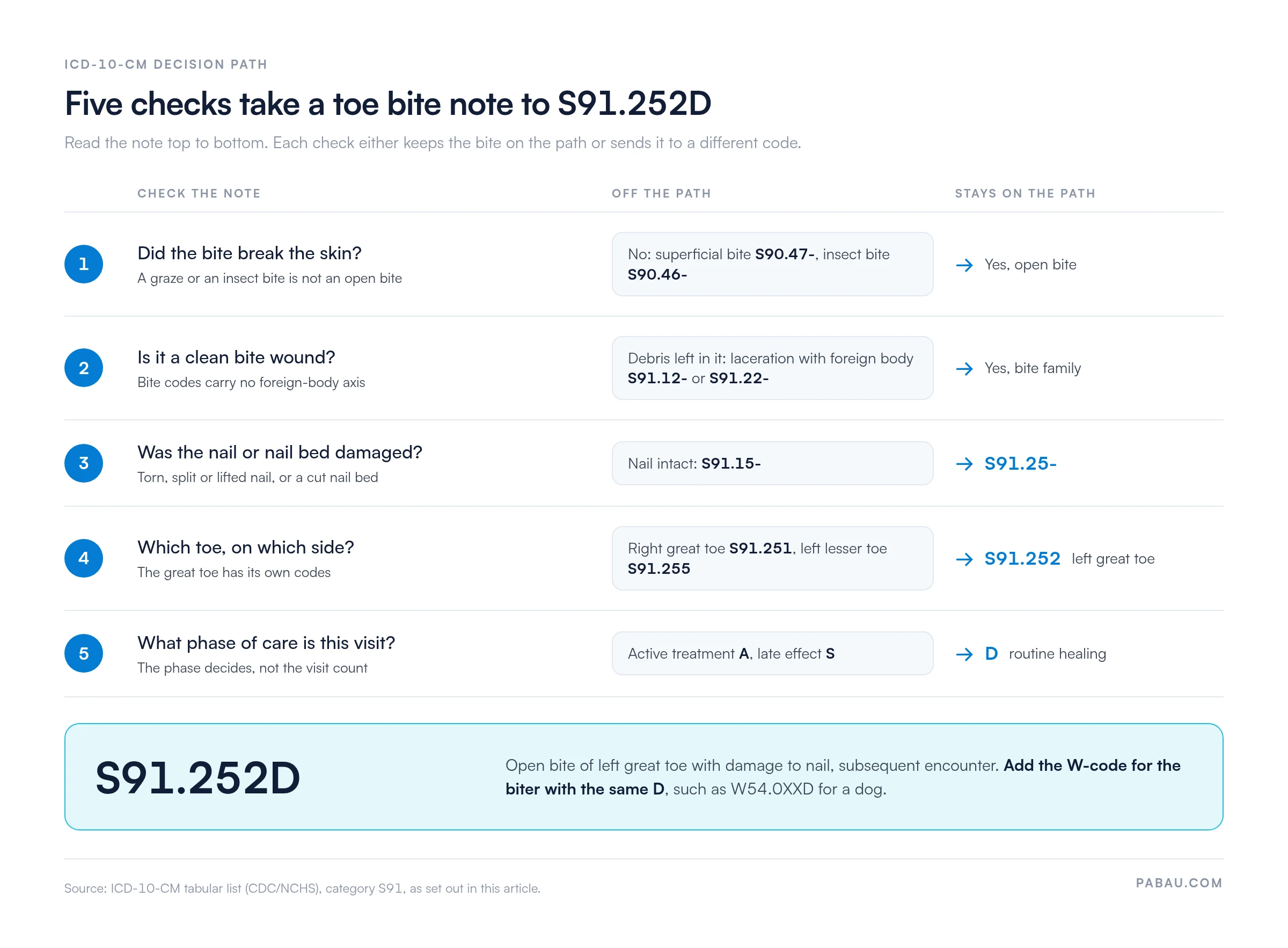
Open wound codes in S91 take one of three seventh characters (A, D or S). The choice reflects what the provider is doing at this visit, so the same patient can see A twice before D ever appears.
The official guidelines define D as routine care during the healing or recovery phase. They also say not to use aftercare Z codes for injuries. The injury code with D does that job.
Sequela claims work in reverse order. Code the late effect first, such as L90.5 for a scar, then add S91.252S to show where it came from.
S91.252D says what happened to the toe. An external cause code says what did it, and it takes the same seventh character on every encounter where the injury is treated.
Watch the near misses. W54.1XXD means struck by a dog, not bitten, and W53.09XD covers contact with a mouse other than a bite. Human bites split by intent, so an accidental bite takes W50.3XXD and an assault takes Y04.1XXD.
Place of occurrence (Y92), activity (Y93) and external cause status (Y99) are different. The guidelines limit them to the initial encounter, so they drop off at the follow-up visits. No national rule requires external cause codes, but many state reporting programs and payers expect them.
A patient comes into urgent care after a neighbor’s dog bit their left foot. The provider irrigates the wound and removes the split nail of the left big toe. They also start antibiotics and record the dog bite.
That first visit is active treatment, so it carries S91.252A with W54.0XXA. The provider can add Y92 and Y93 codes for where and how it happened.
Ten days later the patient returns. The note reads “wound clean, nail bed healing well, no signs of infection, dressing changed.” That visit codes as S91.252D plus W54.0XXD, and the Y92 and Y93 codes stay off.
Now change one detail. Suppose the provider had written “nail intact” at the first visit. Both claims would then use S91.152A and S91.152D instead.
Two minutes with the note saves a resubmission later. Confirm each point before the claim leaves the practice.
Denials on this code usually trace back to a mismatch between the code and the note. They tend to come back with denial reason codes such as CARC 11 (diagnosis inconsistent with the procedure) or CARC 16 (missing or invalid information). A denial management workflow helps you spot the pattern quickly.
Clean coding is half the job. The other half is a clean claim with every required field complete.
No. Report S91.251D for the right great toe and S91.252D for the left, as ICD-10-CM does when no bilateral code exists.
Code the infection too, for example L03.032 for cellulitis of the left toe. Add A28.0 if a lab confirms Pasteurella. Then reassess the seventh character, because renewed active treatment such as debridement points back to A.
Often not. When the provider who repaired the wound removes the sutures, check the global period of the original repair before billing it.
A toe bite with nail damage rarely ends in one visit. Each wound check needs a claim, and the codes shift as care moves from A to D.
Pabau, a practice management platform, has claims management built in. Each claim pre-fills from the invoice, and your team searches for the diagnosis codes it needs. Pabau validates the claim before it goes to the clearinghouse.
US practices submit through the Claim.MD clearinghouse. That route adds eligibility checks before the visit, claim-status tracking and remittance posting afterward. Your team spends less time chasing paperwork and more time on the patient.
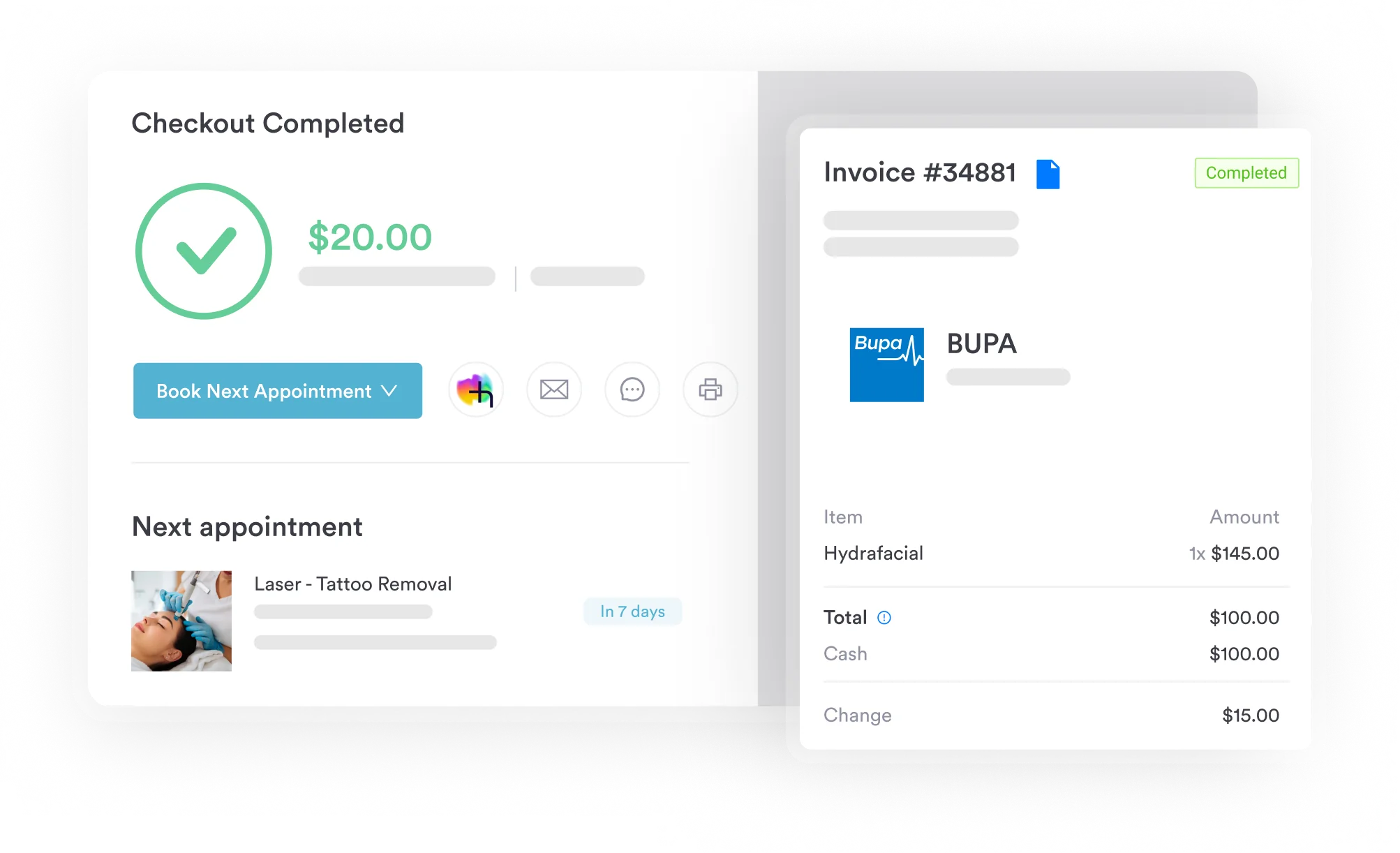

Pabau pre-fills claims from the invoice and validates them before they reach the clearinghouse. US claims go through Claim.MD, with eligibility checks and remittance posting built in.

S91.252D rewards coders who read the note closely. Confirm the bite broke the skin, that it hit the left big toe and that the nail took damage. Then check that care has moved into routine healing.
Pair it with the W-code for the animal, leave the Y92 and Y93 codes on the first claim, and code any infection alongside it. Those habits keep a run of follow-up visits paid without rework.
Book a demo to see how Pabau prepares and sends wound-care claims for your practice.

Coding the visit before this one? ICD-10 code S91.255A covers the initial encounter for an open bite of the left lesser toes with nail damage.
No nail damage on the right side? ICD-10 code S91.151D explains the right great toe bite without nail damage at follow-up.
Seeing denials on wound care claims? Denial codes in medical billing breaks down common CARC reason codes and the fixes that resolve them.
Want to know what your clearinghouse sends? 837 file format guide covers the EDI transaction behind electronic claims, including where diagnosis codes sit.
No. The seventh character tracks the phase of care, so a routine healing check stays S91.252D whichever provider sees the patient. A new provider giving active treatment would use A.
A bite code needs a note that says a person or animal bit the patient. A puncture from a nail or thorn is coded differently. With damage to the left big toenail, it goes to S91.232- or, if debris stayed in, S91.242-.
A visit for a rabies post-exposure dose takes Z23, encounter for immunization, with Z20.3 for the rabies exposure. Add S91.252D only when the provider also checks or treats the toe wound at that visit.
Yes, when the bite follow-up is the main reason for the visit. The W-code for the animal can never lead the claim, because external cause codes are always secondary.