ICD-10 Code S42.444P: Medial epicondyle fracture, right humerus
ICD-10 Code S42.444P: full descriptor and code validity ICD-10 Code S42.444P car...

Last Updated: Oct 13, 2026
Billable Code Specific Code
T31.50 is the billable ICD-10-CM code for burns involving 50-59% of body surface with 0% to 9% third degree burns.
Coders often confuse it with T31.51, which covers the same TBSA range. T31.51 applies when 10 to 19 percent of the burned area is full-thickness. Choosing the wrong fifth character puts the submitted code out of step with the documented third-degree percentage. That triggers payer edits and delays reimbursement on complex inpatient claims.
Let Pabau's smart automation suggest the right codes, reduce claim denials, and keep your practice compliant—effortlessly.
Automate repetitive tasks and focus on what matters most—your patients.
Reduce coding errors and ensure compliance with the latest regulations.
Clean claims, fewer denials, and faster reimbursements.
Powerful insights and reporting to help your practice thrive.
HIPAA compliant SOC 2 certified GDPR-compliant Trusted by 4,000+ clinics worldwide

ICD-10 Code T31.50 is a billable ICD-10-CM code valid for claims with dates of service on or after October 1, 2025 (2026 code year).
The fifth character 0 confirms that 0-9% of the total burned area is full-thickness (third-degree). If the documented percentage is 10% or higher, a different sibling code applies.
T31.50 classifies burn extent rather than anatomic site. When site-specific T20-T25 codes are available, sequence those first and use T31.50 as an additional code.
Documentation must capture the TBSA estimate and the third-degree percentage separately. Missing either figure leaves coders unable to assign a valid fifth character.
Practice management software like Pabau records TBSA, burn depth, and ICD-10 codes in structured patient records, which reduces coding errors before submission.
ICD-10 Code T31.50 is a billable, specific ICD-10-CM diagnosis code.
It covers burns involving 50 to 59 percent of body surface area with 0 to 9 percent third-degree burns. The code belongs to the T31 category, which classifies burns by the extent of body surface involved rather than by anatomic location. The 2026 edition of ICD-10-CM T31.50 became effective October 1, 2025.
The T20-T25 series identifies which body parts were burned. ICD-10 Code T31.50 answers a different clinical question. How much of the patient’s surface is burned, and how much of that area is full-thickness? This dual-axis structure is why the T31 family exists alongside site-specific codes rather than replacing them.
Per CMS ICD-10-CM coding guidance, T31.50 is coded as an additional diagnosis when the site-specific burn code is also documented. Where the burn site is known, it is never the standalone primary code.
Total body surface area (TBSA) is the proportion of a patient’s skin affected by a burn. The rule of nines is the clinical tool used to estimate it quickly at the bedside. It divides the adult body into regions, each representing roughly 9 percent of TBSA or a multiple of it.
The WHO ICD-10 classification underpinning the T31 category relies on this methodology to define its 10-percentage-point TBSA brackets. The regional percentages below are the ones a clinician sums at the bedside.
T31.50 through T31.55 all cover the 50 to 59 percent TBSA range. A burn that large usually involves at least five of the body regions above, and it is a major burn by any clinical definition. Cases like these almost always require inpatient care, often in a specialist burn unit.
The CDC/NCHS ICD-10-CM web tool confirms that T31 codes supplement site-specific burn codes. They give payers and DRG groupers the extent information needed to set inpatient resource weights.
For pediatric patients, the Lund and Browder chart is more accurate than the rule of nines. It accounts for the proportionally larger head and smaller legs in children. Coding conventions in ICD-10-CM, however, use the same T31 structure regardless of patient age. The coder still assigns based on the physician’s documented TBSA estimate, whatever tool was used to derive it.
The fifth character in T31.50 encodes the percentage of the total burned area that is full-thickness (third-degree). For T31.50 specifically, the fifth character is 0, meaning that 0 to 9 percent of the burn is third-degree. The scale below shows where each bracket starts and stops.
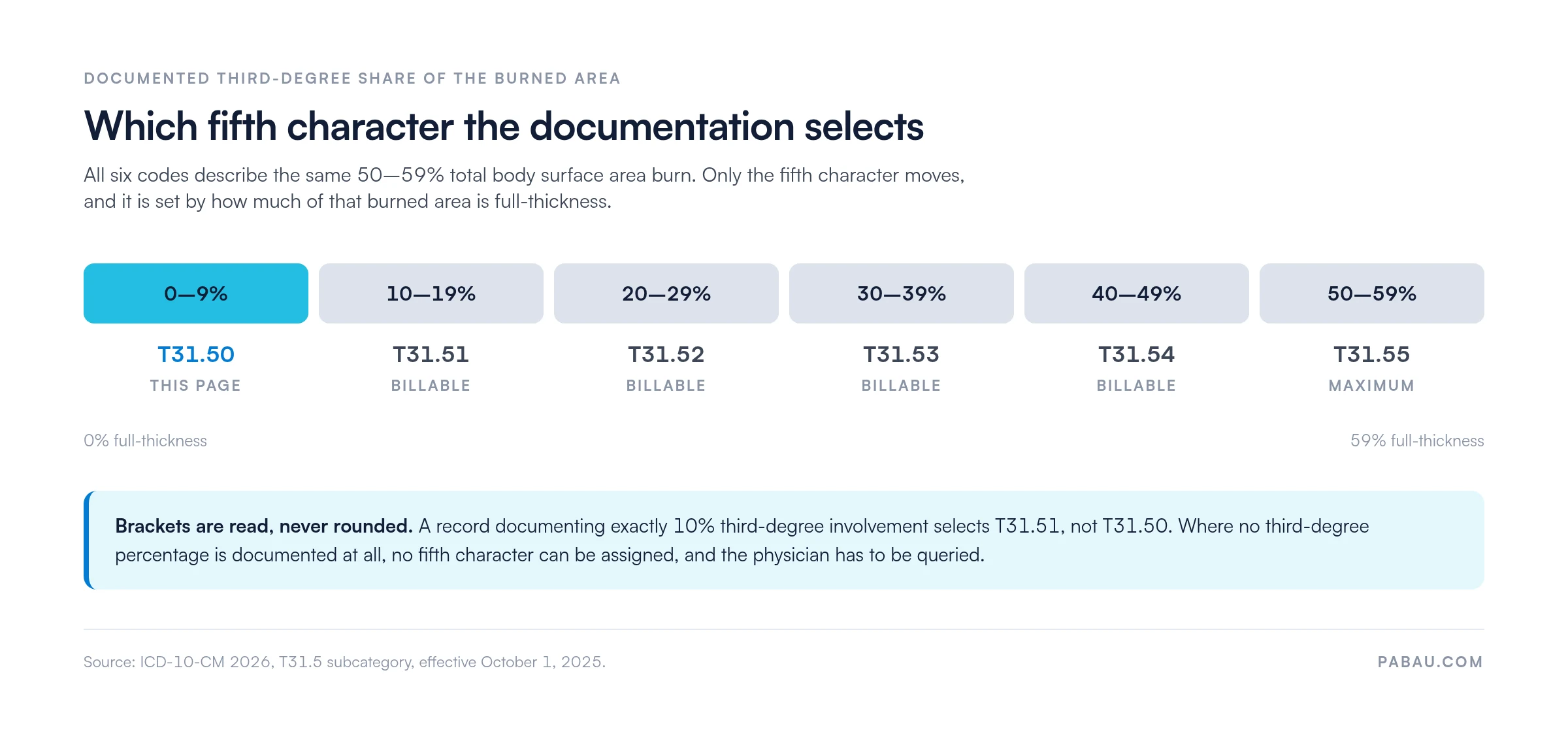
This is the most important selection decision within the T31.5 subcategory, because it separates six distinct billing codes from a single clinical scenario. A patient with 52 percent TBSA burns where only superficial partial-thickness (second-degree) burns are documented maps to T31.50. The same patient, if 11 percent of the burned area has converted to full-thickness necrosis, maps instead to T31.51.
The distinction matters for DRG grouping. Higher third-degree percentages indicate greater resource intensity, and may shift the case to a higher-weighted DRG under MS-DRG 927-929. According to the AAPC ICD-10-CM code reference, the fifth-character subcategories under T31.5 are:
The double-axis documentation trap. Coders must verify that the medical record documents the TBSA percentage and the third-degree depth percentage as two separate figures. A note that says ‘approximately 55% body surface burns’ with no depth breakdown leaves the coder unable to select the correct fifth character. If the third-degree percentage is not documented, query the physician before assigning T31.50 or any sibling code.
T31.50 sits within a three-level hierarchy. Understanding the full tree prevents coders from submitting a non-billable parent code by accident. The category code is header-only, the subcategory code groups the TBSA range, and only the fifth-character code can be billed.
The selection rule is simple in principle. Use the code whose fifth-character bracket contains the physician’s documented third-degree percentage. A 7 percent third-degree area within a 55 percent TBSA burn gives T31.50. A 12 percent third-degree area within the same TBSA burn gives T31.51. Higher in the same TBSA band, a 35 percent third-degree area gives T31.53.
Do not round to the nearest bracket. If the documented figure is exactly 10 percent, assign T31.51 rather than T31.50. When the record states a range such as “approximately 5-10%,” query the physician for the closest estimate before assigning. Payers audit third-degree percentage assignments on high-cost inpatient burn cases, so specificity beats approximation every time.
The T31 category carries governing notes that apply to every code in the family, including T31.50. Review them before assigning any T31.5 sibling, so the claim reflects the right level of specificity. The same convention runs through the wider ICD-10-CM code list. A category code is never submitted where a billable child code exists.
Four elements must appear in the medical record to support T31.50 assignment. Missing any one of them leaves the coder with insufficient specificity to select a valid fifth-character code.
Clinical teams coding for burn units frequently encounter records where the treating physician documents TBSA accurately but omits the third-degree percentage. A structured assessment field for “percent third-degree” in the burn admission note reduces physician queries. It also supports faster, cleaner claim submission.
Practice management software like Pabau lets wound care teams add custom fields to patient records, so both figures are captured at the point of care.


Pabau captures TBSA, burn depth, and ICD-10 codes in structured patient records. Your billing team gets the figures it needs before the claim goes out.

T31.50 is valid for Medicare and Medicaid claims, subject to standard payer-specific coverage rules. For inpatient cases, it influences DRG assignment through the MS-DRG burn grouper (DRGs 927-929). Both the TBSA range and the presence of third-degree burns factor into case weight.
A case coded T31.50 rather than a higher sibling may group to a lower-weighted DRG where the third-degree extent is genuinely minimal. Accurate documentation protects against under-coding and over-coding alike.
T31.50 is an additional code in most burn cases, not the principal diagnosis. Sequencing rules from the ICD-10-CM Official Guidelines direct coders to assign the site-specific burn code (T20-T25) as the principal code when known. T31.50 follows in the additional code position.
Some clearinghouses and payers apply edits that reject a T31 code in the principal position. That edit fires when a site-specific burn code is also present on the same claim. Practices submitting burn claims electronically should confirm their system validates ICD-10-CM code pair combinations.
Real-time eligibility checks and a built-in ICD-10-CM code catalog can flag a sequencing error before the claim reaches the payer. That lowers the denial rate on complex inpatient burn cases, where T31.50 is coded alongside several site-specific codes.
Burn coding is a high-value audit target. Cases involving 50 percent or more TBSA carry substantial reimbursement, and errors in either direction move the payment. Under-coding the third-degree percentage and sequencing T31.50 in the wrong position both cost the practice money.
The T31.50 code itself rarely causes a rejection. A clean claim depends on two upstream steps. The record has to carry the third-degree percentage, and T31.50 has to sit in the right sequencing position on the claim form.
Accurate ICD-10 Code T31.50 assignment depends on two data points from the clinical encounter. They are the TBSA estimate and the third-degree percentage. When those figures live only in a handwritten note or a free-text field, the billing team has to hunt for them. That happens on every complex burn case.
Pabau’s claims management software works off structured patient records, so the clinical data captured during the encounter flows straight into the billing workflow. Wound care and burn teams can add dedicated fields for the TBSA estimate and the burn depth percentage. That removes the free-text ambiguity behind most physician queries, and leaves a documentation trail an auditor can follow.
For practices that generate superbills or submit through a clearinghouse, Pabau handles the electronic submission step. Superbill generation pulls diagnosis codes straight from the structured record. That removes the manual transcription errors that appear when T31.50 has to sit alongside several T20-T25 site-specific codes on one claim.
Set a reminder in your burn admission template. Capture three separate numbered fields: total TBSA percentage, third-degree percentage of the burn, and each anatomic site involved. When these appear as distinct data points rather than narrative prose, coders can assign T31.50 or the correct sibling without a physician query.
ICD-10 Code T31.50 looks straightforward on paper but is frequently misdocumented in practice. The code is billable, specific, and current for 2026. It is only assignable when the record separately documents the TBSA range (50-59%) and the third-degree percentage (0-9%). Missing the second figure forces a physician query and delays submission on cases that already carry complex billing sequences.
Treat the third-degree percentage as a required field in the burn admission note rather than a detail the coder can chase later. Pabau’s structured documentation tools help burn and wound care teams capture both figures at the point of care, so billing starts with complete data. To see how that works on complex diagnostic code cases, book a demo.

Need to understand how clearinghouse edits catch ICD-10 sequencing errors? Claim.MD clearinghouse overview explains how electronic claim validation flags code-pair issues before they reach the payer.
Reviewing your denial workflows for burn coding cases? Electronic remittance advice (ERA) guide covers how to read ERA files and identify the denial reason codes most common in high-complexity inpatient claims.
Want a broader look at ICD-10-CM billing compliance for your practice? Medical billing compliance guide outlines the documentation and sequencing standards that apply across ICD-10-CM diagnostic code assignments.
ICD-10 Code T31.50 is the billable ICD-10-CM diagnosis code for burns involving 50 to 59 percent of total body surface area. It applies when 0 to 9 percent of that burned area is third-degree (full-thickness). The code belongs to the T31 category, which classifies burns by extent of body surface rather than anatomic location.
Yes. T31.50 is a billable, specific ICD-10-CM code valid for claims with dates of service on or after October 1, 2025 (the 2026 code year). Its parent codes T31 and T31.5 are not separately billable.
Both codes cover burns involving 50 to 59 percent TBSA. T31.50 applies when 0 to 9 percent of the burn is third-degree. T31.51 applies when 10 to 19 percent of the burn is third-degree. The fifth character is the sole distinguishing factor, and it must match the physician’s documented percentage exactly.
The rule of nines divides the adult body into regions representing roughly 9 percent of TBSA each. Clinicians sum the percentages for all burned regions to estimate total TBSA, and that figure determines which T31 subcategory applies. For T31.50, the sum must fall between 50 and 59 percent.
T31 codes classify thermal burns (flame, scald, radiation) by extent of body surface involved. T32 codes classify corrosions caused by chemicals using the same TBSA and third-degree percentage structure. T31.50 and T32.50 cover the same ranges but apply to different burn causes, so they must never be interchanged.
The 2026 edition of ICD-10-CM T31.50 became effective October 1, 2025. It stays valid for claims with dates of service through September 30, 2026. The 2027 code year update takes effect the following day.