

ICD-10 code S61.201A: Open wound of left index finger without nail damage
ICD-10 code S61.201A covers a left index finger wound of unstated type ICD-10 co...

Last Updated: Oct 16, 2026
Billable Code Specific Code
T31.41 is the billable ICD-10-CM code for burns involving 40-49% of body surface with 10-19% third degree burns. Both figures are measured against total body surface, not against the burned area.
Coders working major burn cases most often confuse it with T31.40. That code covers the same 40-49% total burn, but with third-degree involvement of 0-9%. That single digit changes the DRG, the payment, and the documentation the payer expects. T31.41 stays valid and active for FY2026, which runs from October 1, 2025 through September 30, 2026.
Let Pabau's smart automation suggest the right codes, reduce claim denials, and keep your practice compliant—effortlessly.
Automate repetitive tasks and focus on what matters most—your patients.
Reduce coding errors and ensure compliance with the latest regulations.
Clean claims, fewer denials, and faster reimbursements.
Powerful insights and reporting to help your practice thrive.
HIPAA compliant SOC 2 certified GDPR-compliant Trusted by 4,000+ clinics worldwide

ICD-10 code T31.41 applies when burns cover 40-49% of body surface and 10-19% is third degree.
Both percentages are measured against total body surface, never against the burned area alone.
T31.40 is the sibling picked by mistake most often, and it covers third-degree involvement of 0-9%.
The burn note has to state both percentages and the assessment method, or the claim fails on audit.
T31.41 leads the claim only when the burn site is unspecified, and otherwise supports a T20-T25 code.
ICD-10 code T31.41 is a billable ICD-10-CM code. Its official descriptor reads “Burns involving 40-49% of body surface with 10-19% third degree burns.” The code sits in category T31, which classifies burns by surface area rather than by body region.
T31 belongs to Chapter 19 of ICD-10-CM, codes S00-T88. Unlike the anatomical burn codes in T20-T29, nothing in T31 identifies where on the body the burn sits.
You can report it in any setting, inpatient, emergency department or outpatient, once the provider has documented both percentages.
The CDC/NCHS ICD-10-CM web tool publishes the official U.S. tabular list every year. Check the descriptor and the active status there before you commit to the code.
The first number is total burn extent. Every burned area added together has to reach 40-49% of body surface. The second number is third-degree extent, so 10-19% of body surface has to be full thickness. Read that second figure against the whole body, not against the burned area. Misreading it is the most common source of a wrong T31 code.
A full-thickness burn destroys the dermis and reaches into subcutaneous tissue. It looks pale and leathery, and the patient cannot feel it there. Those areas need surgical management, which is why payers read them as the marker of acuity.
Two patients make the difference concrete. One has 45% total burns with 14% of body surface full thickness, and that is T31.41. The other has 45% total burns with 6% full thickness, and that is T31.40.
Payers treat the third-degree percentage as a proxy for resource use. Full-thickness areas need grafting, long wound care and a longer stay.
Coding T31.40 where third-degree burns sit in the higher band understates that work. It can also cut the DRG weight assigned to the stay. The CMS ICD-10-CM codes page carries the official guidelines behind T31 assignment.
The Rule of Nines is the standard way to estimate total burn extent in adults. Payers and the American Burn Association both accept it for T31 code selection. Each body region carries a fixed share of body surface, as set out below.
Worked example: burns cover the whole anterior trunk (18%), both arms (9% each) and the head and neck (9%). Added together, that is 45% of body surface, so the case sits in the T31.4 family. The burn note then records full-thickness injury to the head and neck (9%) and the front of one arm (4.5%). Third-degree involvement therefore covers 13.5% of body surface. That falls inside the 10-19% band, so the correct code is T31.41.
The chart below puts that same case on one bar, then shows which fourth digit each third-degree band picks.
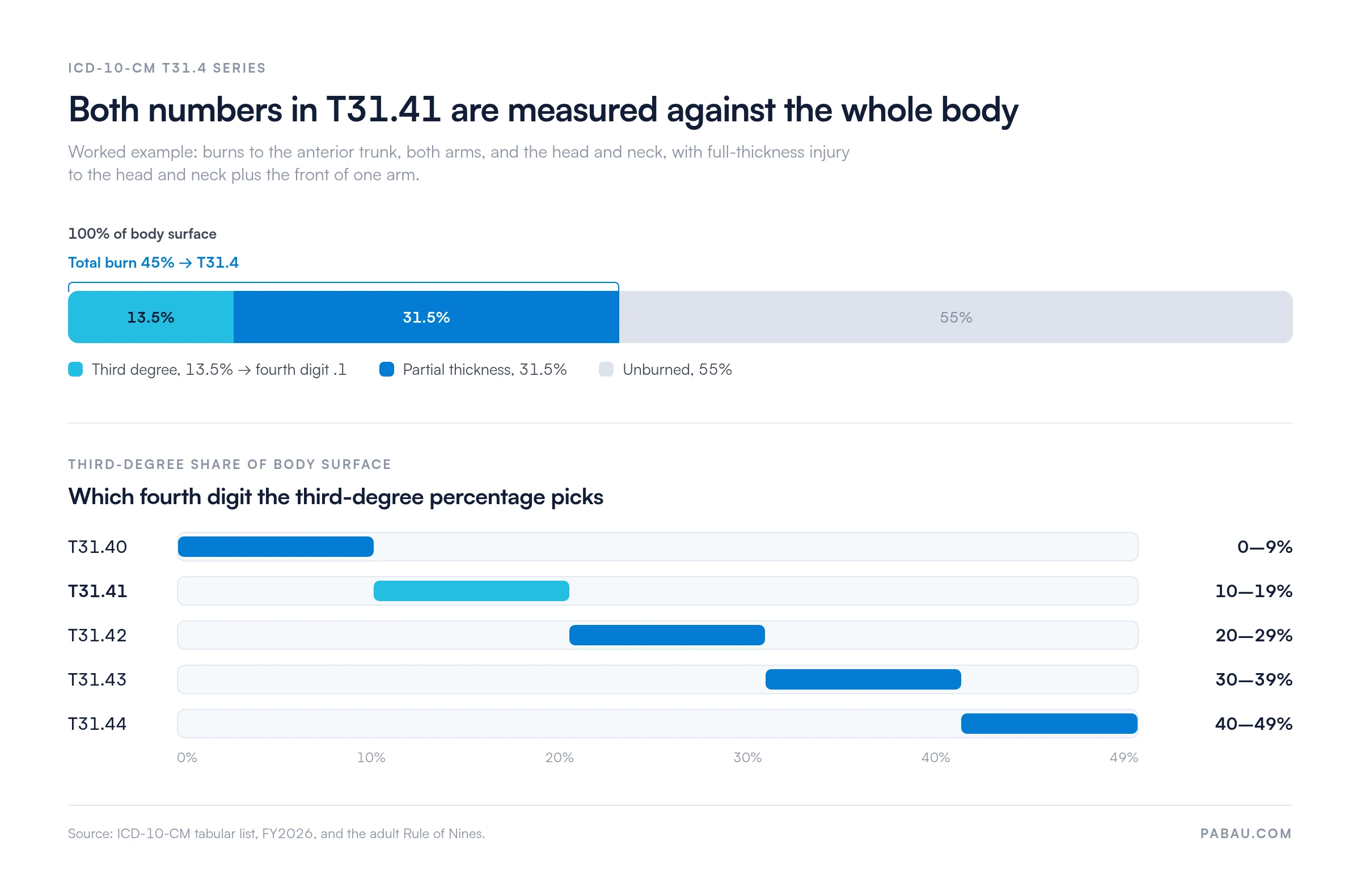
Children are measured differently. The Lund-Browder chart is preferred for pediatric patients, because it corrects for the larger head and shorter legs. Either tool satisfies payers, as long as the note says which one the clinician used.
Always name the assessment method in the burn note, either Rule of Nines or Lund-Browder. Payers audit high-TBSA claims, and they want to see how the percentage was reached. The final figure on its own is not enough.
T31.40 is the code assigned by mistake in place of T31.41 more often than any other. Both cover a total burn of 40-49% of body surface.
The split is the third-degree share, where 0-9% goes to T31.40 and 10-19% goes to T31.41. Choosing T31.40 when the note documents the higher band understates the severity of the case.
In practice, read the third-degree percentage off the burn diagram, then match it to the sub-code. Never fall back on T31.40 because the third-degree figure is missing. Query the provider first, since assuming zero suppresses a claim the record would have supported.
The fourth character splits the same grid on total extent. A total burn of 30-39% with the same 10-19% third degree share takes ICD-10 code T31.31 instead.
T32.41 is the corrosion twin of T31.41, with the same 40-49% and 10-19% bands. ICD-10-CM separates the two categories by cause.
Heat, electricity, radiation and friction produce burns, while acids, alkalis and other chemicals produce corrosions. Coding a chemical injury as T31.41 is an etiology error, and it can trigger a medical-necessity denial.
The etiology line in the note usually settles it in seconds. A named chemical, such as sulfuric acid, lye or bleach, points to T32.41. Flame, steam, electrical contact or friction points to ICD-10 code T31.41. Ambiguous wording is a provider query, not a judgment call.
A T31.41 claim stands or falls on six documented elements. Auditors look for each one before they accept the code as supported.
Get all six into the record before the claim leaves the building, and you have a clean claim. A single missing element is the leading cause of first-pass denials on this code.
ICD-10-CM guidelines encourage an external cause code alongside T31.41, and many payers treat it as mandatory. It sits in a secondary position on the claim and never leads it.
Some payers also want a place-of-occurrence code from category Y92. Record where the burn happened, at home, at work or in a public space, so that secondary code is supported. Y93 is a different category, covering activity codes, so do not reach for it here.
T31.41 is a diagnosis code, so it carries no procedure of its own. Pair it with the CPT codes for the work actually performed. Check the current NCCI edits before you submit any combination, because the bundling rules change every year.
Read what 16020 to 16030 actually describe. They cover partial-thickness burns, so the full-thickness areas that define T31.41 move to excision and grafting codes instead.
Grafting claims also need the graft size in square centimeters, the donor site and whether the graft is autologous. Most payers require prior authorization for inpatient grafting, although the rules vary by plan.
On an inpatient stay, T31.41 feeds the MS-DRG burn grouper. The final assignment turns on ventilator hours, skin graft status, and whether a CC or MCC is documented. Three burn DRGs matter here, and their official titles are worth reading closely.
DRG 927 carries the highest weight of the three, and it is also the hardest to reach. It needs more than 96 hours of mechanical ventilation as well as a graft.
Between 928 and 929, the entire difference is whether a CC or MCC made it into the record. Relative weights update annually, so check the current MS-DRG classifications before you model the payment.
Sequencing comes before any of this. T31.41 leads the claim only when the burn site is not specified. Where a site-specific code from T20-T25 applies, that code is sequenced first and T31.41 supports it as an additional diagnosis. Comorbidities then follow in secondary positions.
Burns of this size rarely arrive alone, and each of the conditions below can change the DRG.
Each of these needs its own clinical support in the record, not a passing mention in the discharge summary. Put the comorbidity review into the burn coding routine. The CC and MCC check then happens before the claim is built. Catching it on the remittance instead means an appeal.

Build a burn-specific coding checklist that prompts a review of inhalation injury, sepsis and AKI on every T31.41 encounter. One missed MCC can move the stay from DRG 928 to DRG 929, and the payment drops with it.
Denial rates on major burn claims run higher than most diagnostic categories, because the supporting record has more to prove. The table below pairs the usual denial reasons with the action that prevents each one.
Denial work on burn claims belongs before submission, not after the rejection lands. The denial codes reference covers the CARC reasons that show up on T31.41 rejections. CO-4 flags a missing modifier, and CO-97 flags a service that is not separately reimbursable.
Most burn units run this work across three systems. The burn diagram sits in the chart and the coding worksheet sits in a spreadsheet. The claim is then keyed into a clearinghouse portal. Every handoff is another chance for the third-degree percentage to go missing.
Practice management software like Pabau keeps the record and the claim together. The clinical note, the signed burn diagram and the codes assigned to the encounter all live on one patient record.
Pabau’s claims management software then builds the claim from that record. It checks the claim fields are complete before anything reaches the clearinghouse.
None of that replaces the coder’s judgment on T31.41. What it removes is the re-keying between systems and the field errors that come with it. What is left to argue with the payer is the clinical record itself.

Pabau’s claims management software builds each claim straight from the patient record. It checks that the claim fields are complete before submission, so complex burn encounters reach the clearinghouse intact. See how it fits your practice.

T31.41 is a two-number code, and both numbers have to be in the record before the claim goes out. Total burn extent of 40-49% of body surface, and third-degree involvement of 10-19% of that same body surface. Where either figure is missing, query the provider rather than defaulting to T31.40.
Sequencing matters just as much as the percentages. T31.41 leads only where the site is unspecified, and it supports a T20-T25 code in every other case. Fold the etiology check and the comorbidity review into the same routine, and the DRG stops arriving as a surprise.
Book a demo to see how Pabau keeps the burn diagram, the codes and the claim on one patient record.

Need a framework for managing ICD-10 claims end to end? Claim.MD clearinghouse overview explains how electronic claim submission works from code entry to ERA receipt.
Want to reduce pre-submission errors on complex claims? Insurance eligibility verification guide walks through how to confirm coverage before billing a high-cost burn encounter.
Looking for the 837 file structure behind a burn claim? 837 electronic claim file guide covers the transaction set used to transmit T31.41 claims to payers.
Working a stack of burn claim rejections? Denial management in healthcare sets out how to triage, appeal and prevent repeat denials.
Want to see where coding sits in the wider billing cycle? Revenue cycle management explained follows an encounter from registration through to posted payment.
No. T31.4 is a subcategory header, not a reportable code. It needs a fifth character before a payer will accept it, and that character is the third-degree band.
No. ICD-10-CM classifies sunburn to category L55, and the burn chapter excludes it. Even extensive sunburn is coded from L55, whatever percentage of body surface it covers.
The site-specific burn codes in T20-T25 need a seventh character for initial, subsequent or sequela encounters. T31 codes report extent rather than a wound being treated. They carry no encounter character and are complete at five.
Late effects are reported with the relevant T20-T25 site code, which carries seventh character S for sequela. Add a code for the residual condition too, such as a scar or a joint contracture. The extent codes describe an acute burn, so they do not stand in for a sequela code.
Rarely. Official guidance calls category T30 extremely vague and advises against using it. Where the record supports any extent figure at all, a T31 code carries far more information to the payer.



