ICD-10 code S61.201A: Open wound of left index finger without nail damage
ICD-10 code S61.201A covers a left index finger wound of unstated type ICD-10 co...

Last Updated: Oct 16, 2026
Billable Code Specific Code
T25.792S is the billable ICD-10-CM code for corrosion of third degree of multiple sites of left ankle and foot, sequela.
Coders reach for it when a patient's current problem grew out of an earlier chemical burn. Scarring, contracture, or a chronic wound at the left ankle or foot all qualify. The 7th character S is where these claims come apart. The note has to state that the presenting condition followed from the original corrosion, or payers deny it.
Let Pabau's smart automation suggest the right codes, reduce claim denials, and keep your practice compliant—effortlessly.
Automate repetitive tasks and focus on what matters most—your patients.
Reduce coding errors and ensure compliance with the latest regulations.
Clean claims, fewer denials, and faster reimbursements.
Powerful insights and reporting to help your practice thrive.
HIPAA compliant SOC 2 certified GDPR-compliant Trusted by 4,000+ clinics worldwide

T25.792S is the billable ICD-10-CM code for third-degree chemical corrosion at multiple sites of the left ankle and foot.
The 7th character S means the visit treats a late effect, such as scarring or contracture, rather than the acute burn.
Corrosion is chemical and a burn is thermal, so a heat injury takes a T25.3x code instead of T25.7x.
The encounter note has to say the current condition followed from the original corrosion, or payers deny the claim.
Pair the claim with an external cause code carrying the same S character, such as X46.XXXS.
ICD-10 code T25.792S is a valid, billable ICD-10-CM diagnosis code for fiscal year 2026, effective October 1, 2025. Five facts sit inside those characters.
The cause was chemical rather than thermal, and the depth reached third degree. More than one site on the left ankle and foot was involved. The visit itself treats what that injury left behind, not the injury.
Billable status means T25.792S can go on a claim by itself, with no more specific code available below it. Laterality is already settled, so the side is not what puts this claim at risk. The 7th character and the documentation behind it are.
Reach for T25.799S instead only when the record genuinely does not say which side was burned. Picking the unspecified sibling while the chart names the left side is a specificity error, and auditors look for it.
Read the code in order and the usual miscodes in this family stop happening. Five elements do the work.
Per the CMS ICD-10-CM coding guidelines, chemicals cause corrosions while heat, electricity, radiation, and friction cause burns. The two run in separate code families, so a thermal injury never takes a T25.7x code.
Three choices stand between the category and the billable code, and the chart below walks through all three.
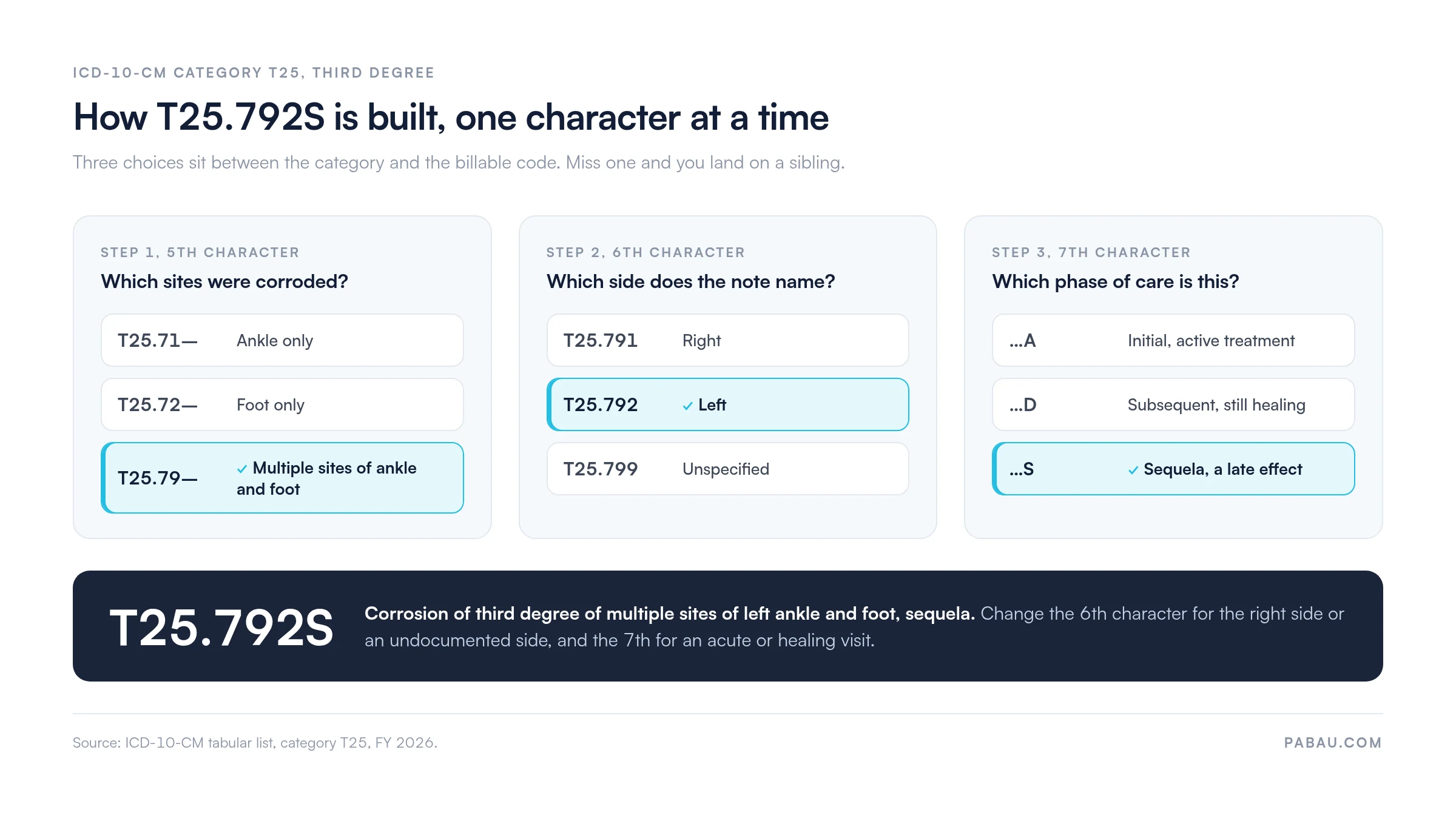
The 7th character in T25.792S is S, and it stands for sequela. Choosing the wrong one denies more claims in this family than any other error. Here is how the three options divide up.
A worked example makes the split concrete. A patient spills drain cleaner across the left foot and ankle in March, and the wounds close by June. She returns in November with a contracture that limits dorsiflexion. March is T25.792A, the June dressing changes are T25.792D, and November is T25.792S.
The common mistake is staying on D once the healing phase has ended. Practices that keep billing T25.792D for late-effect visits get caught on post-payment audits, because the note describes a residual condition rather than a healing wound.
Burn codes and corrosion codes sit in different halves of category T25. Swapping them is a common root cause of rejection on injury claims, because the diagnosis and the external cause code stop agreeing.
The CDC/NCHS ICD-10-CM web tool carries the official tabular list, where the two sub-blocks are set out separately. Whenever the operative note or the ED note uses chemical-agent language, corrosion codes apply, whatever lay term the patient or family used.
T25.792S is the bottom rung of a five-level ladder. Knowing the ladder is how a coder moves sideways when the site or the side changes.
Climbing the ladder is never the fix on a claim. Payers want the bottom rung, so T25.79 or T25 on its own will not pass. The only legitimate moves are sideways, into the siblings below.
Subcategory T25.79 holds three sequela codes. Only the 6th character changes between them, which is why they get mixed up so often.
Coders also cross-reference the other phases of the same code, T25.792A and T25.792D. Depth shifts the code too, so a first-degree corrosion of the foot with no side recorded takes T25.529D at a healing-phase visit. If the injury turns out to be thermal rather than chemical, the sequela code moves into the T25.3x range instead.
T25.399S covers that injury when no side is documented. A chemical corrosion confined to the ankle, with neither degree nor side recorded, takes T25.419S. Browsing the ICD-10-CM code index beats guessing once the site moves off the ankle and foot.
Run a quarterly claim review filtered to the T25.79xS codes. If T25.799S carries more than a small share of that family’s volume, the acute injury notes are not recording a side. Ask clinicians to state right or left at the first visit. Every later sequela claim can then use T25.791S or T25.792S.
Section I.C.19 of the ICD-10-CM Official Guidelines sets what a sequela claim has to show. Miss any one of these four and the claim comes back, either denied or asking for records.
Practices that keep this work in-house lean on software for billing teams to hold that thread. The original injury encounter and every later sequela visit then stay linked on one record.
Strong denial management starts by naming which of the four points was missing on each returned claim, then repairing the intake step that dropped it.
Section I.C.20 asks for an external cause code alongside every injury code. For T25.792S that means naming the chemical, plus the place and the activity where the original injury happened. Some payers treat these as optional and others reject without them, so the safe policy is to treat them as required.
The right range depends on the agent, and two codes cover most chemical exposures. Place and activity then sit in separate chapters of their own.
On a sequela claim the external cause code carries S as well, so X46.XXXS pairs with T25.792S. Mixing a sequela primary with an initial-encounter external cause is a mismatch that some payers catch automatically and return unprocessed. The remittance advice on that claim usually cites a remark code pointing straight at the 7th character.
T25.792S has been in the ICD-10-CM tabular list since the United States adopted the code set. Recent fiscal years look like this.
No code in this family moved across the last three updates. Even so, confirm the status in the CDC/NCHS tool before each October 1, since a retired code is a silent denial.
The AAPC ICD-10-CM code lookup carries the same fiscal year history, with effective and termination dates. Build that check into the billing calendar, so no claim goes out under a superseded edition.
Set a calendar reminder for September to cross-check your T25.79x code templates against the new ICD-10-CM tabular list. CMS releases the update files in June, and the AAPC and CDC tools reflect them by July. That leaves your billing team two clear months to update templates before October 1.
The hard part of a sequela claim is rarely the code. It is proving, months later, that the contracture in front of you grew out of a corrosion recorded last spring. That proof usually sits spread across a chart, a scanned ED note, and a billing system that never saw either.
Practice management software like Pabau keeps the original encounter, the wound photos, and every follow-up note on one patient record. A coder working the sequela visit can open the acute corrosion note without leaving the chart. The causal sentence can then quote the first clinician’s own wording.
Claims leave from that same record and go electronically to Claim.MD, our US clearinghouse partner. Rejections and remittance advice come back to the same place, so whoever repairs the documentation is reading the documentation.

Pabau keeps the acute corrosion note, the follow-up visits, and the claim on one patient record. Claims go out electronically through Claim.MD, so your team can support the causal link without hunting across separate systems.

Sequela corrosion claims fail for three reasons. The 7th character is wrong, or the note never links the current problem to the original burn. The third is an external cause code that points at the wrong agent. Each one is repaired at the documentation source, not on the claim form.
T25.792S already names the left side, so laterality is one argument you do not have to win. Spend the effort on the causal sentence in the encounter note instead. That sentence is what a payer reads when it decides whether this late effect is yours to bill.
Book a demo to see how Pabau keeps the original corrosion note and the sequela claim on the same patient record.

List Item #1
List Item #2
Usually not. ICD-10-CM sequencing rules put the residual condition first, so the scar, contracture, or chronic ulcer leads the claim. T25.792S follows it and explains where that condition came from.
There is no time limit. The S character applies whenever the acute corrosion has healed and the visit treats a late effect. Six months or ten years after the burn makes no difference.
Not for the same injury at the same visit. The 7th character reports the phase of care. One encounter takes A, D, or S, and the choice follows the care given that day.
Then T25.792S is the wrong code and T25.799S applies. Query the provider before you submit, because the unspecified sibling attracts more scrutiny and blocks the more specific code on every later sequela visit.