ICD-10 Code Z74.8: Other problems related to care provider dependency
ICD-10 Code Z74.8: Definition and code details ICD-10 Code Z74.8 is the billable...

Last Updated: Oct 19, 2026
Billable Code Specific Code
T22.622S is the billable ICD-10-CM code for corrosion of second degree of left elbow, sequela. It applies when a chemical or caustic burn of the left elbow has healed. The visit treats a late effect of that injury, such as a scar or contracture.
The 7th character S separates it from T22.622A, used during active treatment, and T22.622D, used for routine healing follow-ups.
Let Pabau's smart automation suggest the right codes, reduce claim denials, and keep your practice compliant—effortlessly.
Automate repetitive tasks and focus on what matters most—your patients.
Reduce coding errors and ensure compliance with the latest regulations.
Clean claims, fewer denials, and faster reimbursements.
Powerful insights and reporting to help your practice thrive.
HIPAA compliant SOC 2 certified GDPR-compliant Trusted by 4,000+ clinics worldwide

T22.622S codes a late effect (sequela) of a second-degree chemical burn of the left elbow, after active treatment and routine healing have ended.
The 7th character S separates sequela from A (active treatment) and D (routine healing). Billing D for a sequela visit is a common denial trigger.
Corrosion codes need a T51-T65 toxic effect code for the chemical and intent. At a sequela visit, that code also takes the 7th character S.
Place of occurrence (Y92) and activity (Y93) codes belong on the initial encounter only, so they aren’t repeated on a T22.622S claim.
Pabau’s claim validation scrubs every claim for missing or invalid details before it leaves Pabau, so fewer sequela claims come back denied.
ICD-10 Code T22.622S is the billable ICD-10-CM code for corrosion of second degree of the left elbow, sequela. It applies when a chemical or caustic burn has healed and the visit treats what it left behind, such as a scar or contracture. The code set is maintained by CMS and the National Center for Health Statistics (NCHS).
T22.622S sits in Chapter 19 (Injury, Poisoning, and Certain Other Consequences of External Causes), block T20-T25, and is valid for the current fiscal year (FY2027). In Pabau’s claims management software, the claim opens pre-filled from the visit’s invoice before it goes to the clearinghouse.
Each character position carries a specific meaning. The table below decodes the full code:
Category T22 covers both burns and corrosions, so the subcategory carries the agent. Thermal injuries at the same site, such as scalds or flame contact, fall under T22.2- rather than T22.6-. For corrosions, the Tabular List adds a “Code first” note: report a T51-T65 toxic effect code to identify the chemical and the intent. The companion codes section below covers it.
A sequela is a late effect. It’s a condition caused by a prior injury that remains after the wound has closed and acute treatment has ended. The S in T22.622S tells the payer the corrosion itself is no longer being treated. The visit addresses what it left behind, such as a hypertrophic scar, a contracture, or a chronic wound complication.
Payers read that character closely. Under the ICD-10-CM Official Guidelines, a sequela visit carries two codes. The code for the residual condition, such as a scar contracture, comes first. T22.622S follows it to identify the original injury.
Three clinical scenarios help distinguish the characters:
The three 7th character variants of T22.622 are often confused, and picking the wrong one is a frequent cause of denials on corrosion sequela visits. The table below maps each character to its clinical trigger and the documentation clues to look for:
A practical rule helps here. When the note records a history of chemical burn and the chief complaint is scarring, restricted movement, or chronic skin changes, S applies. If the wound is still present and under treatment, use A for active treatment or D for a routine healing follow-up.
Selecting the wrong code within category T22 is usually a laterality, depth, or agent error. The table below shows the codes most often confused with T22.622S:
For crosswalk reference, the approximate ICD-9-CM equivalents fall within the 940-949 burn series. ICD-9 captured neither the chemical vs thermal distinction nor laterality, so any mapping to T22.622S is non-specific.
Use crosswalks for legacy audits only, never for active claim submission. The AAPC Codify ICD-10-CM lookup supports code-to-code crosswalk searches.
Confirm the agent before you pick a code. T22.6- covers only chemical or caustic injuries. If the note says thermal burn, scald, or flame injury, the second-degree subcategory is T22.2- instead.
Corrosion codes in category T22 carry a “Code first” note in the ICD-10-CM Tabular List. At a sequela visit, a T22.622S claim usually carries three diagnosis codes:
Place of occurrence (Y92) and activity (Y93) codes work differently. Both are reported once, at the initial encounter, and carry no 7th character. Take Y93.H9 (other activity involving exterior property and land maintenance, building and construction). It belongs on the T22.622A claim from the first visit. It isn’t repeated at a sequela visit.
A missing toxic effect code, or Y92 and Y93 codes copied forward from the first visit, are avoidable errors on these claims. Checking companion codes before submission is a core step in medical billing compliance.
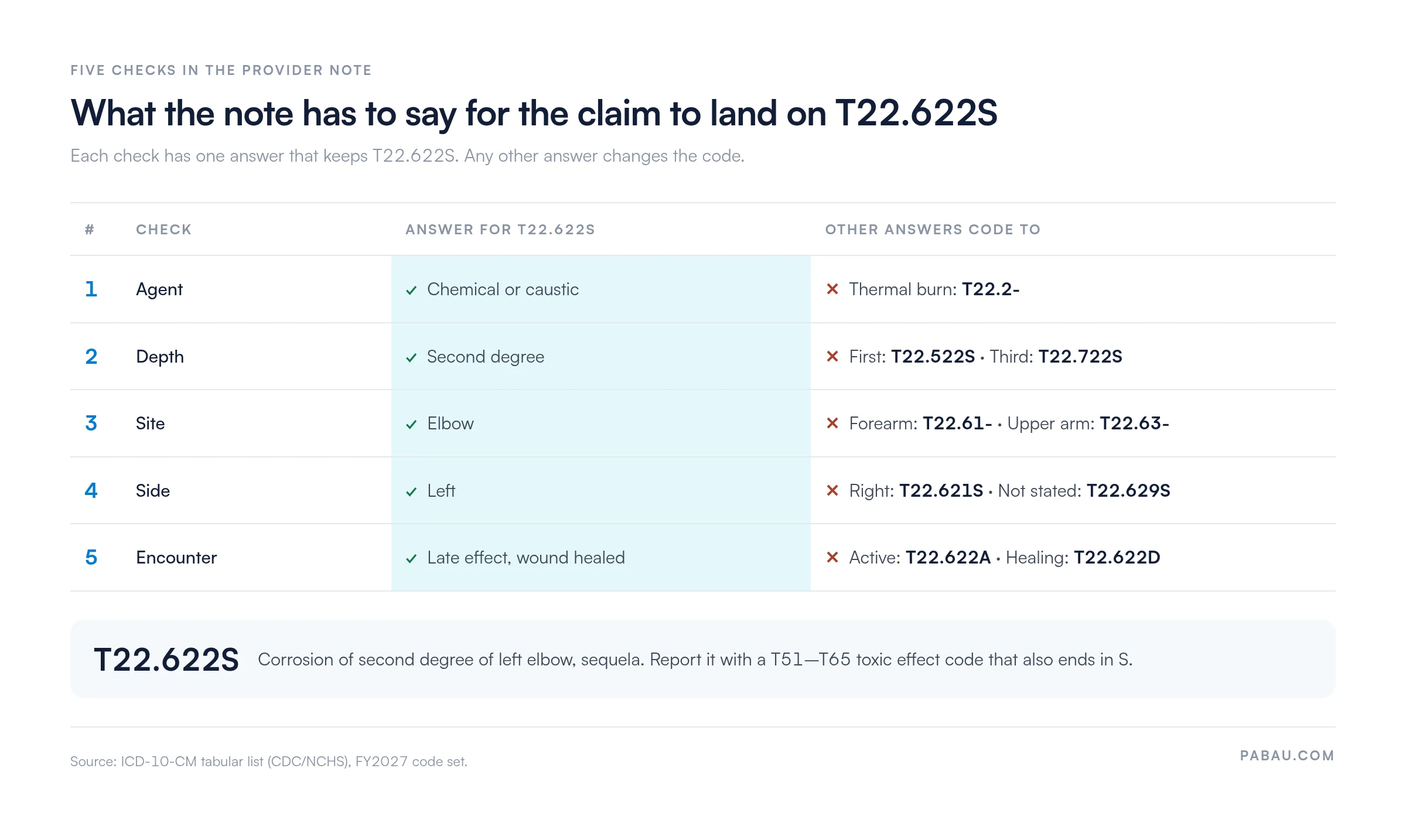
Five documentation elements must appear in the provider note to support T22.622S without triggering a denial or audit flag:
The chart below shows where the code moves when any one of those five answers changes.
Practices that run a structured medical billing workflow can build these five elements into intake and note templates. That way, they’re in the record before the claim is generated.
Medicare, Medicaid, and commercial payers treat sequela burn and corrosion codes as clinically distinct from acute or healing-phase injury codes.
For a sequela visit, payers generally expect T22.622S to sit beside a procedure that treats the late effect. That means skin grafting, scar revision, or occupational therapy for contracture, for example.
A sequela diagnosis paired with a wound-care procedure code is a mismatch, since wound care is more typical of D-character visits. It often triggers a medical-necessity review or an outright denial.
These are the most frequent denial reasons for T22.622S claims, and how to address them:
Systematic denial management for sequela corrosion claims starts with tracking denial reason codes by category. Repeated T22.6- sequela denials often trace back to one upstream cause, such as a note template with no late-effect language. Reviewing denial codes tells you whether a denial is a coder, documentation, or payer-policy issue before you appeal.
Reconstructive procedures billed with a T22.622S diagnosis may need prior authorization from Medicare Advantage and commercial plans. Check the applicable local coverage determination (LCD) for wound-related reconstructive services before scheduling.
Submitting a clean claim from the outset avoids the delays that come with authorization requests after submission. That means all companion codes, the supporting documentation, and the correct procedure-diagnosis pairing.
Build a sequela prompt into your clinical note template. A checkbox or free-text field can confirm ‘Condition is a late effect of prior [injury type], and the original wound has healed.’ That one field addresses three of the five denial reasons in the table above.
Many sequela denials start before the claim is ever sent. A coder picks D instead of S, or the toxic effect code never reaches the claim. The error only surfaces when the payer rejects it, weeks later.
In Pabau, the claim opens pre-filled from the visit’s invoice. Claim validation then scrubs every claim for missing or invalid details before it leaves Pabau. If a claim still comes back rejected, Pabau flags it as Needs action and links straight to the field that needs correcting.
US practices send CMS-1500 claims through Claim.MD to thousands of US payers. Your team can check insurance eligibility before the visit. Payments then settle straight from electronic remittance advice (ERA) files, so less of the week goes into matching payments by hand.

Pabau’s claim validation scrubs every claim for missing or invalid details before it leaves Pabau. Book a demo to see how it catches errors on injury and sequela claims before the payer does.

T22.622S turns on one question asked at every elbow follow-up. Has the wound healed, and is the visit treating what it left behind? If yes, S applies, alongside a toxic effect code that also ends in S.
Put that question into your note template and the claim follows from the documentation. Leave it out, and every sequela claim depends on a coder reading between the lines.
Pabau’s claim validation scrubs every claim for missing or invalid details before it leaves Pabau. Book a demo to see how it keeps your sequela claims moving from note to payment.

Need to understand how clearinghouse submission works? Claim.MD clearinghouse overview explains how electronic claims reach payers and what the adjudication process involves.
Tracking ERA remittances after submission? Electronic remittance advice (ERA) explained covers how 835 remittance files map denial reason codes back to specific claims.
Building a denial prevention workflow? Insurance eligibility verification guide walks through pre-claim eligibility checks that catch coverage problems before T22.622S claims are submitted.
ICD-10 Code T22.622S is the billable diagnosis code for corrosion of second degree of the left elbow, sequela. It means the visit treats a late effect of a prior chemical or caustic burn to the left elbow, not an open wound. It sits in ICD-10-CM Chapter 19, category T22 (burn and corrosion of shoulder and upper limb, except wrist and hand).
T22.622A is used while the corrosion is under active treatment, with the wound still open and being managed. T22.622D applies to routine follow-up visits during the healing phase. T22.622S applies only once the original wound has healed. The patient is then treated for a late effect of the corrosion, such as scarring or contracture.
Use S when the original injury has healed and the visit treats a condition caused by it. The provider note should say the wound has healed. It should also name the current complaint, such as a scar, contracture, pain, or functional loss, as a late effect.
Report a T51-T65 toxic effect code that identifies the chemical and intent, with the 7th character S. For an accidental acid burn, that’s T54.2X1S. List the residual condition, such as a scar or contracture, before T22.622S. Place (Y92) and activity (Y93) codes belong on the initial encounter only.
Four denial reasons are typical. T22.622D is billed instead of T22.622S, or the toxic effect code is missing. The note may not document a late effect. Or a wound-care CPT code is paired with the sequela diagnosis instead of a scar revision or reconstructive code.
Yes, T22.622S is a valid, billable ICD-10-CM code for FY2027. CMS and NCHS publish ICD-10-CM updates every year, effective October 1. Check the code in the current-year file through the CDC/NCHS ICD-10-CM tool before you submit claims in a new fiscal year.