ICD-10 Code V91.84XS: Other burn due to burning watercraft
ICD-10 Code V91.84XS: overview and key facts ICD-10 Code V91.84XS identifies the...

Last Updated: Oct 30, 2026
Billable Code Specific Code
T22.191S is the billable ICD-10-CM code for burn of first degree of multiple sites of right shoulder and upper limb, except wrist and hand, sequela.
Coders assign it once a superficial burn has healed and the patient returns with a late effect, such as itching or hyperpigmentation. The original burn covered two or more unnamed areas of the right upper limb. Assignment rests on a healed burn, right-side multiple sites, and a note linking the late effect to that burn.
Let Pabau's smart automation suggest the right codes, reduce claim denials, and keep your practice compliant—effortlessly.
Automate repetitive tasks and focus on what matters most—your patients.
Reduce coding errors and ensure compliance with the latest regulations.
Clean claims, fewer denials, and faster reimbursements.
Powerful insights and reporting to help your practice thrive.
HIPAA compliant SOC 2 certified GDPR-compliant Trusted by 4,000+ clinics worldwide

T22.191S is the billable ICD-10-CM code for the sequela of a first-degree burn at multiple sites of the right shoulder and upper limb. The left side (T22.192S) and unspecified side (T22.199S) have their own codes.
The 7th character S designates sequela. Use it only after the burn has healed, when the visit treats a late effect rather than the active burn.
Claims are usually denied for an S applied to an active wound, a missing causal link to the prior burn, or the wrong laterality.
Pabau, the practice management platform we build, lets billers submit T22.191S claims through the Claim.MD integration, with the original burn notes in the same record.
In clinical terms, “first degree” means a superficial burn of the epidermis only, with erythema and pain but no blistering or dermal involvement. Once it heals, it can leave late effects such as itching or hyperpigmentation. T22.191S reports those late effects.
The 7th character S tells the payer that the visit treats a late effect of the healed burn, not the burn in its active phase. Which sites count as “multiple” is covered in the section on what “multiple sites” means below.
The code is valid in the FY 2027 code set, effective October 1, 2026, and you can bill it as written.
The reference table below captures the key attributes of T22.191S that coders verify before submitting a claim.
The 7th character S designates sequela, a residual condition that persists after the original burn has healed. The ICD-10-CM Official Guidelines for Coding and Reporting require two codes for a sequela. The condition or nature of the sequela is sequenced first, and the injury code with S follows it. For burns, the guidelines name scars and joint contractures as typical late effects.
The three 7th characters used across burn codes serve distinct purposes. Applying the wrong character is a common cause of claim rejection on injury codes.
The medical record must establish that the burn has fully healed before sequela coding applies. If the wound remains open or treatment is ongoing, character A or D applies instead. Applying S while the injury is still active is an audit risk and a common payer denial trigger.
In category T22, “multiple sites” means the burn involved two or more sites of the shoulder and upper limb on the same side. The official guidelines limit these codes to records that do not specify the individual sites (Section I.C.19.d.5).
When the provider names each burned site, code each one separately with its own single-site code. On the right side, the first-degree sequela codes are:
Two areas sit outside T22 entirely. The wrist and hand are coded under T23, and the interscapular region is coded under T21.
If the note only says “burns to the right arm,” query the treating provider before you assign T22.191S. The guidelines prefer single-site codes whenever the sites are documented, so one clarifying answer can change the code.
T22.191S occupies a specific leaf node within the T22 category. Understanding its siblings clarifies when laterality or degree changes require a different code.
Note that T22.191 codes the right side. Coders sometimes assume “191” is a generic unspecified code because it precedes “192” for the left. The tabular list confirms: T22.191x = right, T22.192x = left, T22.199x = unspecified. Verify laterality in the clinical record before defaulting to T22.199S.
Run a laterality audit on all T22.199x sequela claims. If the original injury notes specify right or left, the unspecified code points to a coding miss rather than an unknown side. Querying providers when the first-degree burn is first coded stops laterality errors from carrying through to sequela visits months later.
Several codes sit adjacent to T22.191S in the tabular list and share part of its descriptor. Five checks against the original burn note decide between them, in the order shown below.
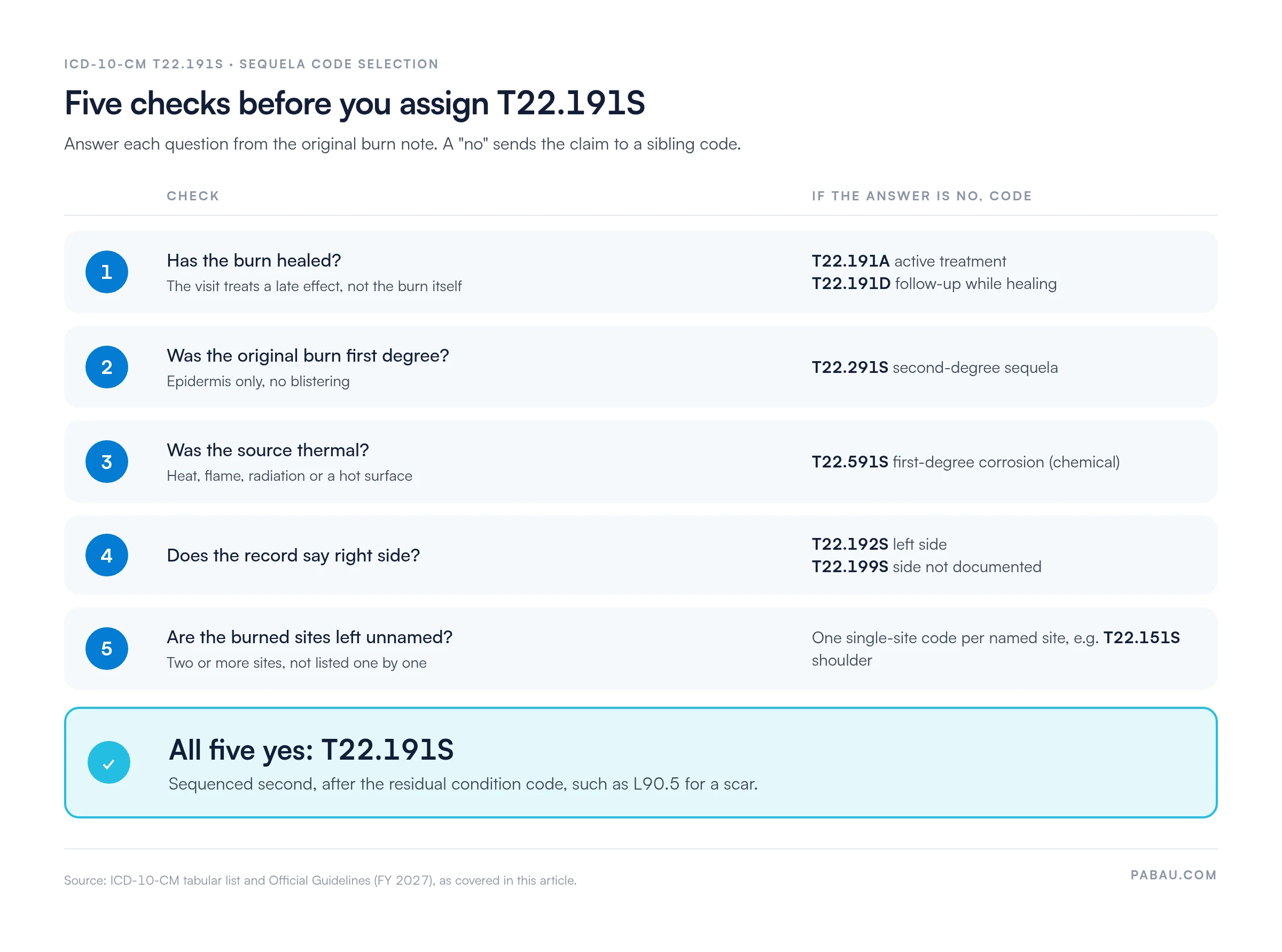
The table adds each sibling’s short descriptor and the documentation detail that separates it from T22.191S.
A corrosion is a burn caused by a chemical agent, not a thermal source. ICD-10-CM keeps the two apart: T22.1- covers first-degree burns at this site, while T22.5- covers first-degree corrosions at the same site. T22.6- is second-degree corrosion, so it does not apply to a first-degree injury. The mechanism matters because it affects treatment, prognosis, and sometimes payer medical necessity criteria.
The mechanism also sets the external cause code. A burn from contact with hot air or hot gases takes X14.1XXS on a sequela visit.
T22.191S and L90.5 are partners, not alternatives. L90.5 names the scar, which is the residual condition, while T22.191S records that a healed first-degree burn caused it. Under the official sequela guideline, L90.5 is listed first and T22.191S second.
First-degree burns rarely leave a scar, so pigment change or itching is the more common late effect. A documented scar can lead a payer to question whether the original burn was first degree, so check the original note.
Medical record documentation must support the elements below before you submit a claim with T22.191S. Missing any one of them creates an audit vulnerability and increases denial probability. Aligning with CMS ICD-10-CM guidelines for sequela coding means meeting these standards in every affected encounter.
Structured medical billing compliance requirements help the documentation from each visit map cleanly to the code on the claim. Mismatches between what the provider records and what the coder submits are where sequela claims most often fail audit scrutiny.
A T22.191S claim needs the residual condition first and the burn code second. Work through these steps in order on every sequela encounter.
Check each T22.191S claim against the original burn encounter record before submission. Confirm that the degree (first vs second), laterality (right vs left), and site detail in that record all match the sequela claim. A quick check at the coding stage saves a denial and a resubmission later.
T22.191S claims face a specific set of denial patterns that differ from those on active-injury codes. Sequela coding needs a documented history and an explicit causal link, so payers have more grounds to question these claims than initial-encounter burn codes. Understanding denial management workflows for injury sequela codes helps billers prevent rejections before submission.
Review the full list of denial codes used in medical billing to map common CARC codes to the scenarios above. Then build payer-specific worklists for injury sequela rejections. For practices experiencing repeat T22.191S denials, cross-referencing clean claim requirements by payer before resubmission cuts the correction cycle significantly.
A sequela claim depends on notes written months apart. The original burn visit holds the degree, side, and sites, while the sequela visit holds the causal link. When those records sit in separate systems, coders have to rebuild the history before they can assign T22.191S.
Pabau keeps the original burn notes and the sequela visit in the same patient record. Coders can check degree, laterality, and site against the first encounter before they code. Through Pabau’s claims software for billers, practices then submit claims electronically via the Claim.MD integration.
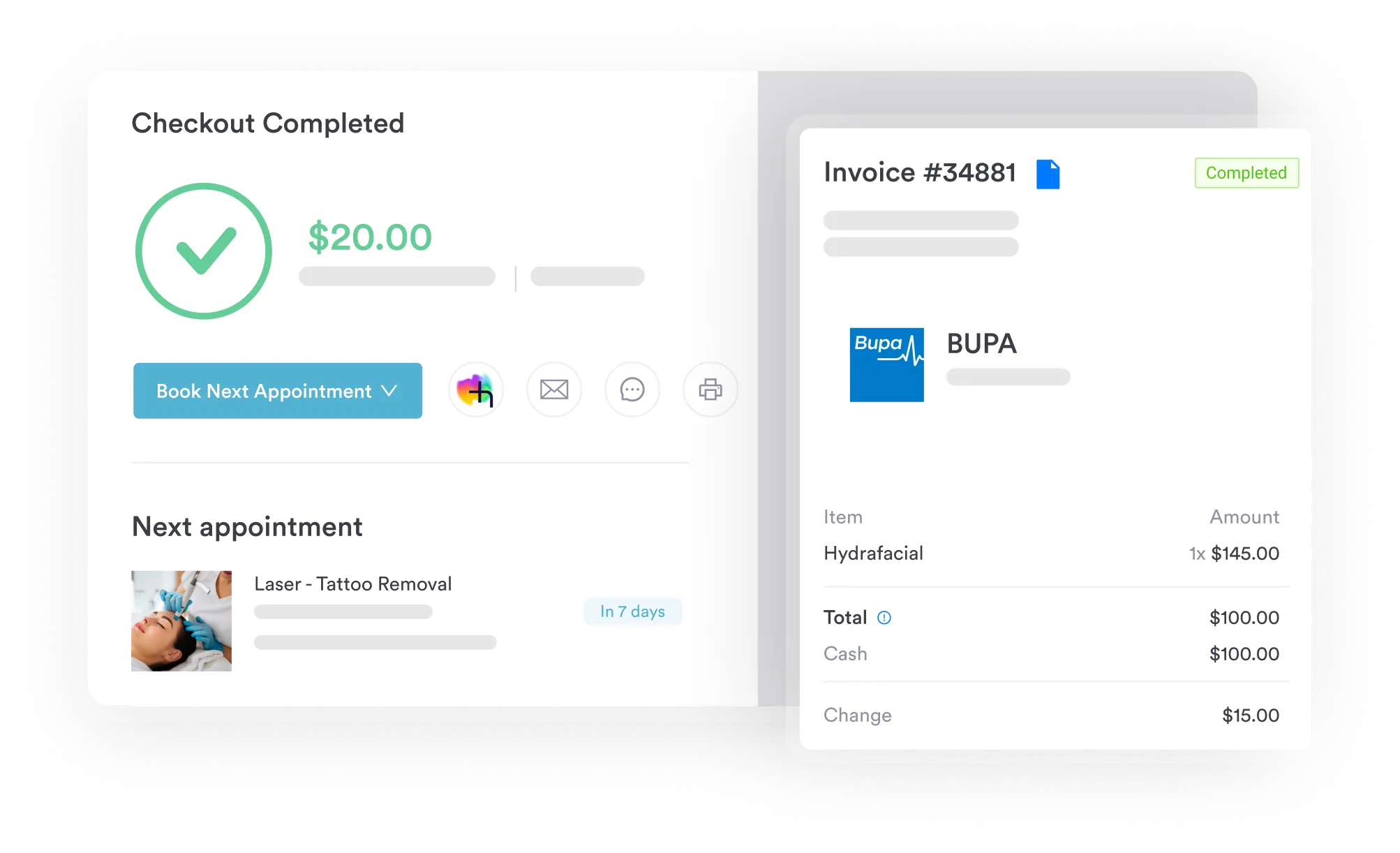
The result is a sequela claim that matches its source documentation, so fewer claims come back for laterality or degree mismatches.

Pabau keeps burn history and sequela notes in one patient record, and you submit claims electronically through the Claim.MD integration. See how your practice can cut avoidable sequela rejections.

T22.191S fits only when three facts line up. The healed burn was first degree, it was on the right side, and it covered several sites the note does not name. Change any one of those and a sibling code fits better, so the decision rests on reading the original documentation closely.
Before every sequela claim, check the original burn encounter and list the residual condition first. That habit heads off the denial patterns above before they start.
Book a demo to see how Pabau keeps burn history, sequela notes, and your medical billing workflow in one place.

Need to understand how injury sequela denials are classified and appealed? Denial management in healthcare covers the full workflow for tracking, appealing, and preventing claim rejections across injury code categories.
Looking for a complete reference on what makes a claim payable first time? Clean claim requirements outlines the data elements payers check before adjudication, relevant to any ICD-10-CM sequela submission.
Want to understand the clearinghouse step in the ICD-10 claims process? Claim.MD clearinghouse guide explains how claims pass through a clearinghouse on their way to the payer.
T22.191S is the billable ICD-10-CM code for the sequela of a first-degree burn at multiple sites of the right shoulder and upper limb. The wrist and hand are excluded. The 7th character S confirms that the burn has healed and the visit treats a late effect, such as pruritus or pigmentation change.
Yes. T22.191S is a billable code in the FY 2027 ICD-10-CM code set. Only complete seven-character T22 codes can go on a claim, so parent codes such as T22.1 or T22.19 are not billable.
Sequela (7th character S) applies when the burn has healed and the visit treats a late effect of that injury. ICD-10-CM does not use the Z48 aftercare codes for injuries. For follow-up while the burn is still healing, report the injury code with 7th character D, such as T22.191D. Use A while the burn is under active treatment.
First-degree burns at T22.1- come from thermal sources such as heat, flame, or radiation. First-degree corrosions at T22.5- come from chemical agents such as acids or alkalis. If the record names a chemical, the matching sequela code is T22.591S rather than T22.191S. T22.6- covers second-degree corrosions, so it does not apply here.
The record must show a prior first-degree thermal burn at multiple sites of the right shoulder and upper limb. It also needs a provider statement linking the current condition to that burn, and confirmation that the wound has healed. Right-side laterality must be documented too, or the code defaults to the unspecified T22.199S.
Yes, and they usually should be when a scar is the late effect. L90.5 identifies the scar and is listed first, and T22.191S follows to show that it came from the healed burn. Both need support in the provider’s note for the same encounter.