ICD-10 code T43.604S: Psychostimulant poisoning sequela
What does ICD-10 code T43.604S cover? ICD-10 code T43.604S covers the late effec...

Last Updated: Oct 22, 2026
Billable Code Specific Code
T22.699D is a billable ICD-10-CM code. It covers corrosion of second degree of multiple sites of unspecified shoulder and upper limb, except wrist and hand, subsequent encounter. Coders use it once active treatment has ended and the patient returns for aftercare, such as dressing changes or wound checks.
The chemical injury has blistered more than one part of the arm, and the chart records the degree and the sites but not the side. Once the side is documented, the code becomes T22.691D (right) or T22.692D (left). Code first the chemical from T51-T65, and add a T32 code for the body surface involved.
Let Pabau's smart automation suggest the right codes, reduce claim denials, and keep your practice compliant—effortlessly.
Automate repetitive tasks and focus on what matters most—your patients.
Reduce coding errors and ensure compliance with the latest regulations.
Clean claims, fewer denials, and faster reimbursements.
Powerful insights and reporting to help your practice thrive.
HIPAA compliant SOC 2 certified GDPR-compliant Trusted by 4,000+ clinics worldwide

ICD-10 Code T22.699D covers follow-up care for second-degree corrosion of multiple upper limb sites when the chart doesn’t record the side.
The 7th character D marks a subsequent encounter: routine aftercare once active treatment has ended, never the visit where active treatment happens.
Only laterality is unspecified in T22.699D, so a documented right or left side upgrades it to T22.691D or T22.692D.
Code first a T51-T65 code for the chemical and intent, then add a T32 code for the body surface involved.
Pabau, the practice management platform we build, checks every claim for missing or invalid details before it reaches the payer through Claim.MD.
The table below gives you the top-line facts before you read the full breakdown.
Each character of ICD-10 Code T22.699D answers one question about the injury. Read left to right, the code shows the chart records the degree and the extent of the corrosion, but not the side.
Second-degree corrosion is a partial-thickness injury, usually with blistering into the dermis. Because a chemical caused it, ICD-10-CM tells you to code first the substance from categories T51-T65. Thermal burns of the same region (T22.0-T22.3) carry no such instruction.
Each character can also change on its own. When the chart records a different degree, extent, side, or encounter type, only that position moves, as the breakdown below shows.
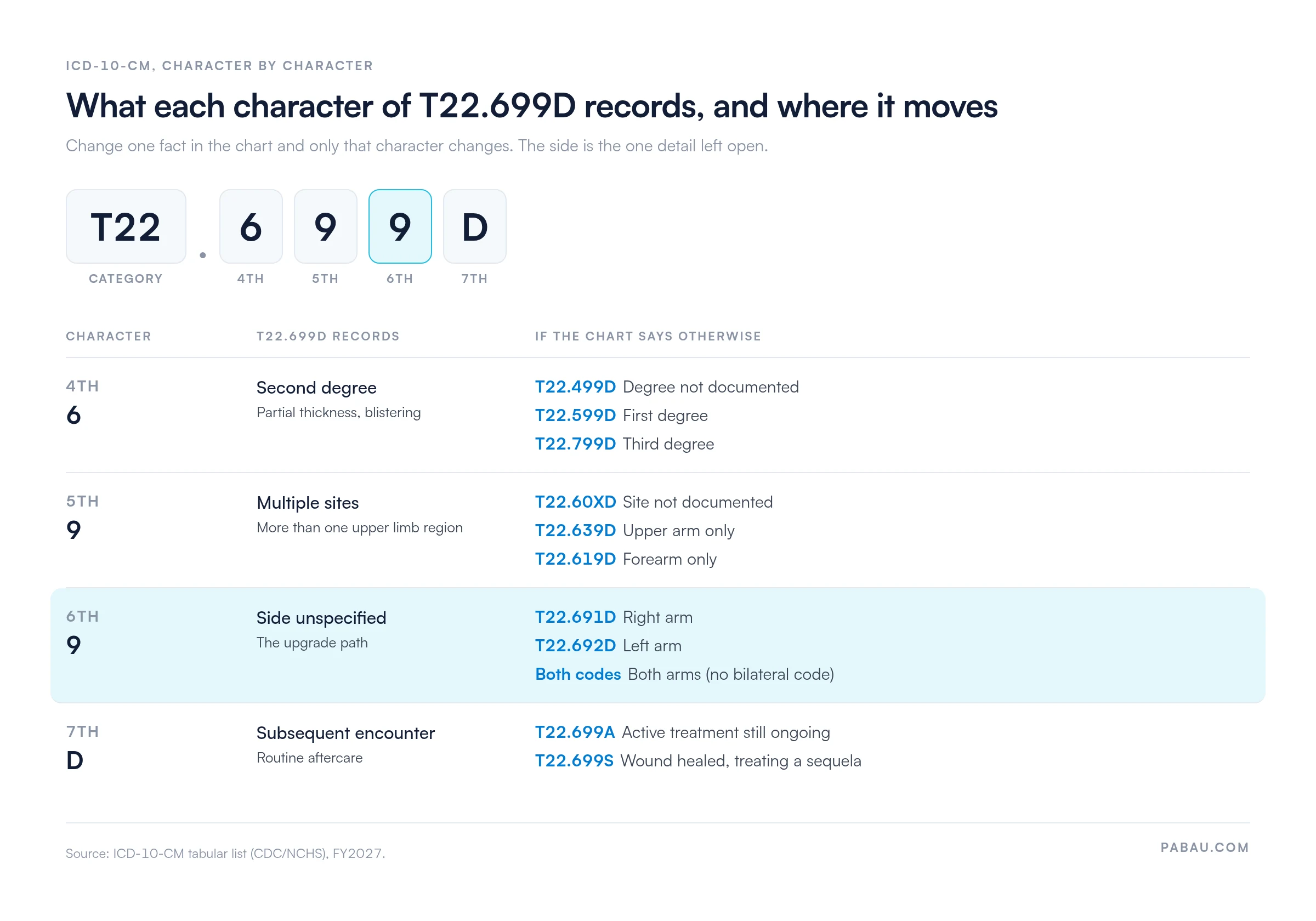
The 7th character D means the active treatment phase has ended and the patient is receiving routine aftercare. Typical visits are wound checks, dressing changes, and debridement follow-ups. D doesn’t mean “second visit.” A patient can have multiple encounters under 7th character A while active treatment is still ongoing.
The ICD-10-CM Official Guidelines for Coding and Reporting (Section I.C.19) are clear: The 7th character reflects the phase of treatment, not the number of visits.
A patient treated by a burn surgeon across three operative sessions is still under initial encounter (A) for all three. D applies only once active treatment ends and wound maintenance begins.
T22.699D applies when the chart documents the degree and the sites but leaves out the side. These are the situations where that happens, and where coders should pause before accepting it.
In each case, the missing fact is which arm. A look at the wound or a quick physician query usually settles it, and the code becomes T22.691D (right) or T22.692D (left). If the chart names only one site, T22.699D is the wrong code. Use the single-site code for that region instead, such as T22.639D for the upper arm.
The T22 category and its parent block carry official ICD-10-CM notations that govern what the code covers and what must be coded separately.
Because T23 is an Excludes2 note, a chemical injury that runs from the forearm onto the hand takes both codes. Report T22.699D, or its sided version, for the upper limb and a T23 code for the hand. Leaving the hand off under-reports the injury.
These are the codes most often confused with T22.699D, and the single axis that separates each one.
T22.699D versus T22.699S is the confusion that surfaces most in audits. S applies only when the original corrosion wound has resolved and the clinician is treating a downstream consequence.
The most common are scar contracture limiting range of motion and hyperpigmentation. If the wound itself is still under active management or monitoring, D is correct.
ICD-10 Code T22.699D has one unspecified axis: the side. The degree (second) and the extent (multiple sites) are already coded, so the only upgrade path is to a code that names the arm.
The ICD-10-CM Official Guidelines (Section I.B.13) reserve the unspecified-side code for records that don’t identify the side. Payers may query it on a wound care claim, especially when the procedure note names a limb.
When both arms carry second-degree corrosion at multiple sites, there is no bilateral code here, so report T22.691D and T22.692D together.
When documentation improves between encounters, recode to the sided code at the next encounter. Carrying T22.699D through an episode after a later note names the side is a coding error that carries audit risk.
The note supporting ICD-10 Code T22.699D has to show three facts. It needs a second-degree corrosion, more than one affected upper limb site, and a visit that is aftercare rather than active treatment. Ideally it records the side as well, which moves the claim to a sided code.
Before you finalize T22.699D, check the wound description, photos, and nursing notes for the side. A single “left forearm” or “right upper arm” moves the claim to T22.692D or T22.691D, which is more defensible on audit.
Denials on ICD-10 Code T22.699D cluster around a handful of failure patterns. Catching them before submission takes far less work than appealing a denial after the fact.
A claim for corrosion of the upper limb is incomplete without the causative substance. ICD-10-CM instructs you to code first a T51-T65 code identifying the chemical and intent, so it is sequenced before T22.699D.
The companion T51-T65 code should carry the same 7th character as T22.699D, so both take D on a subsequent encounter claim. Pairing T22.699D with a T54 code that carries 7th character A is a coding error.
When the chemical agent is genuinely unknown, use T65.91XD (toxic effect of unspecified substance, accidental, subsequent encounter) rather than omitting the companion code. Add a code from category T32 as well, which records the total body surface corroded and the share that is third degree.
Second-degree corrosion is a partial-thickness injury, so aftercare visits usually bill from the burn dressing and debridement range. The procedure note should name the arm, which also settles the side for the diagnosis code. Sharp removal of devitalized tissue during aftercare bills as 97597 for the first 20 sq cm.
Prior authorization requirements for wound care services billed alongside ICD-10 Code T22.699D vary by payer and by the procedure codes on the claim.
Medicare does not generally require prior authorization for routine wound care. Local Coverage Determinations (LCDs) from Medicare Administrative Contractors may still set documentation expectations for wound care services.
Commercial payers and managed Medicaid plans are more variable. Some require authorization when wound care services exceed a defined number of visits per episode.
Confirm the applicable LCDs and payer rules before starting a wound care series, since policies differ by MAC jurisdiction and plan. The eligibility verification step at scheduling is also the right moment to check those requirements.
For wound care billed under a subsequent encounter code, payers generally look for three records. They want a defined treatment plan, an expected duration for the series, and progress notes at each visit.
Claims that carry T22.699D across an extended series without evidence of wound progress are at elevated risk for medical necessity review.
Pabau’s claims management software keeps each patient’s claim history in one place. Your team can see how many subsequent-encounter claims an episode has produced before the next one goes out.
Always confirm billable status against the official tabular list for the current fiscal year before submitting a claim. Code validity changes with annual ICD-10-CM updates, so a code valid last year may since have been revised or deleted.
Our ICD-10-CM reference for coders collects our code guides in one place, which helps when you compare a neighboring code.
When using third-party lookup tools, cross-reference against the CDC’s official tool for any code used on a live claim. Commercial tools are updated frequently but are not the definitive source for billing purposes.
For practices managing ongoing denial management across a high volume of wound care claims, track the denial reason codes on T22.699D rejections over 90 days. The pattern usually shows whether the root cause is the 7th character, the missing chemical code, or the unspecified side.
A grounding in medical billing fundamentals and clean claim requirements helps teams build the documentation habits that prevent these denials upstream.
Most T22.699D denials start before the claim is ever sent. A coder leaves the side unspecified when a later note names it, or the chemical code never reaches the claim. The error only surfaces when the payer rejects it, weeks later.
In Pabau, the claim opens pre-filled from the visit’s invoice. Claim validation then scrubs every claim for missing or invalid details before it leaves Pabau. If a claim still comes back rejected, Pabau flags it as Needs action and links straight to the field that needs correcting.
US practices send CMS-1500 claims electronically through Claim.MD, the clearinghouse connected to Pabau, to thousands of US payers. Your team can check insurance eligibility before the visit. Payments then settle straight from electronic remittance advice (ERA) files, so less of the week goes into matching payments by hand.

Pabau’s claim validation scrubs every claim for missing or invalid details before it leaves Pabau. Book a demo to see how it catches errors on corrosion and burn claims before the payer does.

T22.699D is a holding code. It is correct while the chart leaves the side out, and each wound care visit is a chance to record the arm. A sided code costs one line in the note and takes away the most common reason a payer asks for records.
The trade-off is a few minutes before submission. Checking the side, the T51-T65 chemical code, and the aftercare wording takes minutes per claim. Reworking a denied wound care series takes weeks.
Pabau’s claims management checks every claim for missing or invalid details before it reaches Claim.MD, so these errors surface at your desk first. Book a demo to see how it handles corrosion and burn aftercare claims.

Need help understanding clearinghouse claim edits? Claim.MD clearinghouse overview explains how real-time claim edits catch ICD-10 errors before they reach the payer.
Seeing repeated denials on injury codes? Denial codes in medical billing breaks down the CARC codes payers return when they deny a claim.
Want to understand ERA processing after a corrected claim? Electronic remittance advice covers how 835 remittance files document payer decisions and support appeals workflows.
ICD-10 Code T22.699D stands for corrosion of second degree of multiple sites of unspecified shoulder and upper limb, except wrist and hand, subsequent encounter. It covers an aftercare visit for a chemical injury that blistered more than one part of the arm. The chart records the degree and sites but not which arm is affected.
Yes. T22.699D is a valid, billable ICD-10-CM code for FY2027 claims. Verify it against the current fiscal year tabular list before submitting, as annual updates can affect code validity.
T22.699D (7th character D) is used when the patient is receiving routine aftercare for an active corrosion wound. Typical visits are wound checks, dressing changes, and follow-up debridement. T22.699S (7th character S) applies once the original wound has healed. The clinician is then treating a residual condition such as scar contracture or fibrosis. If the wound itself is still being monitored or managed, D is correct.
No. The 7th character D is reserved for subsequent encounters after active treatment. The first encounter requires 7th character A, and that covers any visit where active or definitive treatment is provided. Using D on a first visit is a coding error that usually leads to a denial.
The most common triggers are an encounter type the payer can’t link to earlier active treatment and a missing T51-T65 code for the chemical. Payer queries on the unspecified side come next. A side mismatch between the procedure note and the diagnosis code is a secondary trigger.
In ICD-10-CM, “burn” refers to thermal injuries caused by heat, flame, or radiation. “Corrosion” refers to injuries caused by chemical agents such as acids or alkalis. For the shoulder and upper limb, T22.0-T22.3 are burns and T22.4-T22.7 are corrosions. Corrosions also take a T51-T65 code, coded first, to identify the substance.
Use T22.691D when the chart names the right arm and T22.692D when it names the left. If both arms have second-degree corrosion at multiple sites, report both codes, since ICD-10-CM has no bilateral code for this injury.