ICD-10 Code T31.51: Burns involving 50-59% of body surface area
ICD-10 Code T31.51: Official descriptor and billable status ICD-10 Code T31.51 i...

Last Updated: Oct 23, 2026
Billable Code Specific Code
S99.201B is the billable ICD-10-CM code for unspecified physeal fracture of phalanx of right toe, initial encounter for open fracture.
It covers an open growth plate fracture of a right toe phalanx, coded at the active-treatment visit. Use it only when the record names no Salter-Harris type. If the physician documents type I, II, III or IV, code S99.211B through S99.241B instead. Follow-up visits take 7th character D, G, K or P.
Let Pabau's smart automation suggest the right codes, reduce claim denials, and keep your practice compliant—effortlessly.
Automate repetitive tasks and focus on what matters most—your patients.
Reduce coding errors and ensure compliance with the latest regulations.
Clean claims, fewer denials, and faster reimbursements.
Powerful insights and reporting to help your practice thrive.
HIPAA compliant SOC 2 certified GDPR-compliant Trusted by 4,000+ clinics worldwide

S99.201B describes an open, initial-encounter fracture through the growth plate of a right toe phalanx where the Salter-Harris type is not documented.
The 7th character B means the patient is receiving active treatment for an open fracture at this visit. Character A covers the same scenario for a closed fracture.
If the physician documents a Salter-Harris type (I through IV), use the matching code from S99.211B to S99.241B instead of S99.201B.
Pabau’s claim validation checks each claim for missing or invalid details before it leaves Pabau, which helps cut avoidable S99.201B denials.
ICD-10 code S99.201B is a seven-character ICD-10-CM diagnosis code for an unspecified physeal (growth plate) fracture of a right toe phalanx.
Its 7th character B marks the initial encounter for an open fracture. It sits in chapter S00-T88 (Injury, poisoning and certain other consequences of external causes) and block S90-S99 (Injuries to the ankle and foot). Within category S99, it falls under subcategory S99.2 (Physeal fracture of phalanx of toe).
The code is valid and billable under ICD-10-CM. Per CMS ICD-10 coding guidance, coders must use the most specific code available. S99.201B therefore applies only when the documentation states no Salter-Harris fracture type. When the type is specified, a more precise code in the S99.21x through S99.24x subcategories is required.
The 7th character in S99.201B tells the payer which phase of treatment the visit belongs to, and payers adjudicate the claim on it. Per ICD-10-CM Official Guidelines Section I.C.19.c, the encounter type reflects the phase of treatment at the visit being billed. It doesn’t depend on when the injury occurred.
A patient presenting to the ED with a freshly identified open toe fracture gets 7th character B on that claim. The same patient returning three weeks later for a wound check gets 7th character D (or G, K or P if healing is complicated). Applying B to a follow-up visit is a frequent denial trigger on S99.201B claims. It usually reflects a documentation mismatch rather than a fraud flag.
A physeal fracture is a break through the growth plate (physis) of a bone. Growth plates are present only in skeletally immature patients, which is why this code appears almost exclusively on pediatric and adolescent claims. The physis is the weakest structural zone in a developing bone. It gives way before the surrounding ligaments and tendons, which would bear the load in an adult.
The WHO ICD-10 classification framework groups physeal injuries under broader injury codes. The US-specific ICD-10-CM system adds the S99.2 subcategory to capture Salter-Harris detail. When the radiologist or treating physician doesn’t describe the fracture in Salter-Harris terms, the coder uses the “unspecified” codes. That is where S99.201B sits.
The Salter-Harris classification system grades physeal fractures by how much of the growth plate and surrounding bone is involved. Each type maps to a specific ICD-10-CM subcategory within S99.2. Coders can’t assign the Salter-Harris type themselves. It comes from physician documentation and radiologic interpretation.
If the documentation reads “Salter-Harris Type II fracture, right great toe,” the correct code is S99.221B, not S99.201B. Using S99.201B when the type is documented is a specificity violation that may trigger a medical record audit. Query the physician before defaulting to “unspecified.” Per guidance from the American Academy of Professional Coders (AAPC), coders should always use the highest level of specificity supported by the documentation.
Several neighboring codes in the S99.20x family are easy to confuse. The table below sets out how each one differs from S99.201B.
The 7th character B already marks the fracture as open. Category S91 (open wound of ankle, foot and toes) excludes open toe fractures, so the same site normally needs no separate open-wound code. If the record shows an associated wound infection or another injury, follow the tabular instructions for category S99 when coding it.
The medical record must support every element of ICD-10 code S99.201B before submission. Missing a single element shifts the code to a sibling code or triggers a payer denial. Integrate these requirements into your medical billing compliance checklist.
Confirm all six elements are in the chart before coding to support clean claim submission. A physician query takes less time than a denial and resubmission cycle.
S99.201B pairs with CPT procedure codes based on the treatment provided. Payer bundling rules and National Correct Coding Initiative (NCCI) edits may affect which CPT codes can be billed together. Verify current NCCI tables before submitting.
Pabau, the practice management and billing platform we build, connects to the Claim.MD clearinghouse. Practices that connect Claim.MD to Pabau can turn invoices into electronic claims and run real-time eligibility checks. They can also track claim status and bring electronic remittance advice (ERA) files back into Pabau.
Consult AMA CPT code set guidance for the current edition definitions before selecting a procedure code. CPT 28496 (percutaneous fixation, great toe) and 28515 (closed manipulation, lesser toe) can pair with S99.201B when the fracture needs reduction. Open treatment is reported with 28505 (great toe) or 28525 (other toes).
Medicare and commercial payer requirements for S99.201B vary by jurisdiction and plan. Complete insurance eligibility verification before treatment whenever possible, since open fracture repairs often cross prior authorization thresholds.
S99.201B denials follow a predictable pattern. The table below covers the most common denial patterns and how to resolve each one. Pair these checks with a structured denial management workflow to catch errors before they reach the clearinghouse.
Review denial codes in medical billing to match the claim adjustment reason code (CARC) on the remittance to a denial reason above. CARC 29 (time limit for filing has expired) and CARC 16 (missing or invalid claim information) can both appear on S99.201B rejections. Pabau’s claims management software shows why a claim was rejected and flags it as Needs action, so billers can find and fix the cause.
Before coding S99.201B, run a three-point chart audit. First, confirm right-side laterality in the radiology report. Second, verify open wound documentation in the physician note or operative report. Third, check whether the record mentions a Salter-Harris type anywhere. If it does, select the matching specific code instead. This quick audit heads off the most common denial patterns on this code.
Work through these six questions in order before assigning any code in the S99.2 family. The flow below shows where each “no” sends you.
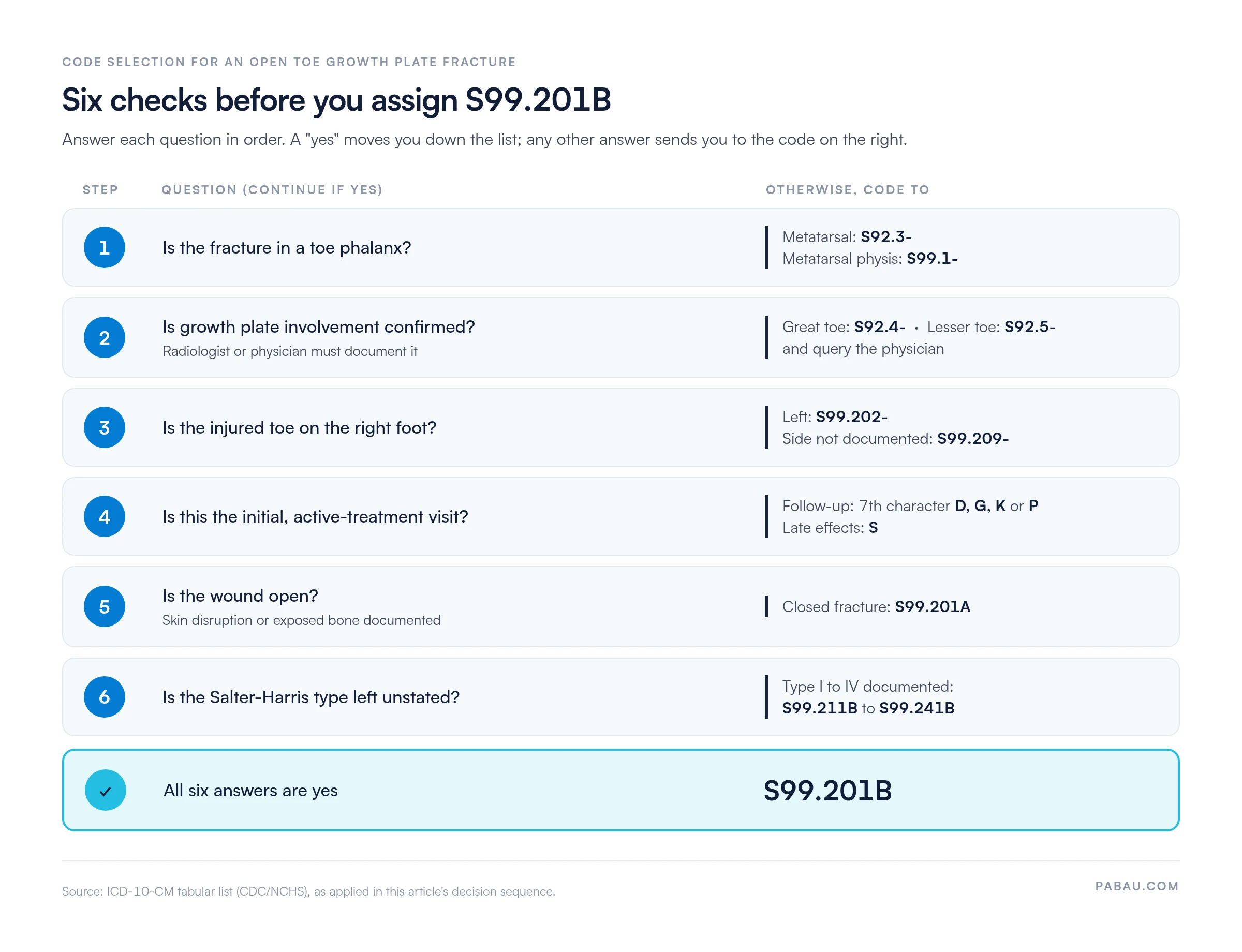
Use the CDC/NCHS ICD-10-CM web tool to verify current code validity and tabular hierarchy for S99.201B and its siblings before your next submission cycle.
An S99.201B denial usually starts with a chart detail, such as a missing side or an undocumented wound. It surfaces weeks later as a remittance code that a biller has to trace back to the visit, fix and resubmit by hand.
Pabau’s claim validation checks each claim for missing or invalid details before submission. When a payer rejects a claim, Pabau shows why and flags it as Needs action, so it doesn’t sit unnoticed in a queue.
For US practices, Pabau also settles payments from ERA files, so billers spend less time posting remittances by hand. The result is fewer avoidable resubmissions on fracture codes like this one.

Pabau’s claim validation checks claims before submission, flags rejections for rework and, for US practices, settles payments from ERA files.

S99.201B only fits when the chart confirms five facts. The fracture is in a right toe phalanx and runs through the growth plate. The wound is open, the visit is active treatment, and no Salter-Harris type is recorded.
When one of those facts is missing or unclear, query the physician before you code. A two-line addendum costs far less than a denial, an appeal and a resubmission.
Pabau’s medical billing workflows connect invoices to electronic claims, so claim details are checked before submission. Book a demo to see how Pabau checks fracture-code claims before they reach the payer.

Need a structured denial recovery workflow? Denial management in healthcare covers root-cause analysis, appeal strategies, and prevention frameworks for common ICD-10 rejection patterns.
Submitting claims electronically? Claim.MD clearinghouse overview explains how electronic claim routing, real-time eligibility checks, and 835 remittances connect to ICD-10 coding accuracy.
Want to understand ERA processing? Electronic remittance advice (ERA) explains how CARC and RARC denial codes map to your posted payments and resubmission queue.
Capturing codes at the visit? Encounter form template records the ICD-10 and CPT codes for each visit, so the encounter type is clear before billing.
Filing a paper claim? Medical insurance claim form sets out the fields payers expect on a submitted claim.
ICD-10 code S99.201B is the billable diagnosis code for an unspecified physeal fracture of the phalanx of the right toe, initial encounter for open fracture. It belongs to subcategory S99.2 (physeal fracture of phalanx of toe). Its 7th character B signals an active-treatment visit for a fracture with an open wound.
S99.201A covers an initial encounter for a closed fracture, while S99.201B covers an initial encounter for an open fracture. The clinical distinction is whether the skin is disrupted and the fracture communicates with the external environment. Applying B when the wound is not documented as open is a frequent denial trigger.
The 7th character B means the patient is receiving active treatment at this visit and the fracture is open. It covers the initial treatment episode only: ED visits, urgent care, and the day of surgery. Follow-up visits use characters D, G, or K depending on the healing status.
S99.201B is valid and billable for FY2025 and FY2026. For FY2027 (effective October 1, 2026), verify against the CMS/NCHS annual update. Confirming code validity each October is standard coding practice.
S99.201B applies when the physeal fracture is on the right toe, and S99.202B applies when it is on the left toe. If the documentation does not specify laterality, use S99.209B. Never assume laterality from procedure side without explicit physician documentation of the affected foot.
Common pairings include CPT 28490 or 28510 for closed treatment without manipulation, and CPT 28496 for percutaneous fixation of the great toe. CPT 28515 covers closed treatment with manipulation of a lesser toe, and CPT 97597/97598 covers open wound debridement. Verify current NCCI edits before submitting any pair, because CMS updates them quarterly.