ICD-10 code S92.422D: Displaced left great toe fracture follow-up
What ICD-10 code S92.422D covers ICD-10 code S92.422D is a billable, fully speci...

Last Updated: Oct 28, 2026
Billable Code Specific Code
S99.102P is the billable ICD-10-CM code for unspecified physeal fracture of left metatarsal, subsequent encounter for fracture with malunion. It fits a left metatarsal growth plate fracture that has healed out of alignment when the record gives no Salter-Harris type.
The 7th character P does the heavy lifting. It tells the payer this visit treats the malunion, from monitoring to corrective surgery. Pick D, S or a type-specific code by mistake, and the claim no longer matches the chart. The sections below cover each character, the notes that support P and the slips behind common denials.
Let Pabau's smart automation suggest the right codes, reduce claim denials, and keep your practice compliant—effortlessly.
Automate repetitive tasks and focus on what matters most—your patients.
Reduce coding errors and ensure compliance with the latest regulations.
Clean claims, fewer denials, and faster reimbursements.
Powerful insights and reporting to help your practice thrive.
HIPAA compliant SOC 2 certified GDPR-compliant Trusted by 4,000+ clinics worldwide

S99.102P codes a left metatarsal growth plate fracture that healed with malunion, when the record gives no Salter-Harris type.
Corrective surgery for the malunion still takes the 7th character P, because the guidelines code fracture complications with the malunion character.
Once imaging names the Salter-Harris type, switch to S99.112P (Type I) through S99.142P (Type IV), or S99.192P for other types.
Late effects take S99.102S instead, with the residual condition listed first.
The code captures the left side but not the ray, so name the injured metatarsal in the note.
ICD-10 code S99.102P identifies an unspecified physeal fracture of the left metatarsal at a follow-up visit for malunion. In plain terms, a growth plate fracture in the forefoot has healed in a poor position. The record also gives no Salter-Harris type.
S99.102P is a valid, billable code. Confirm it for the date of service in the CDC/NCHS ICD-10-CM browser tool, since the code set is updated every fiscal year. Each character narrows the claim, as the breakdown below shows.
Notice what the code leaves out. Subcategory S99.1 treats the first to fifth metatarsals as one site, so the injured ray belongs in the clinical note.
A physeal fracture of the metatarsal is a break that runs through a growth plate in one of the long bones of the forefoot. It happens in children and adolescents whose growth plates are still open.
Where the growth plate sits depends on the bone. The first metatarsal grows from a physis at its base, while the second to fifth metatarsals grow from physes near their heads.
The Salter-Harris system grades these injuries from Type I, through the growth plate alone, to Type IV, which crosses the metaphysis, physis and epiphysis. S99.102P applies when no grade is documented.
Malunion means the fracture has united, but in a poor position. In the forefoot, it can show as angulation, rotation or shortening of the metatarsal. Patients may report pain under the metatarsal heads, calluses or trouble with footwear.
The 7th character P reports a subsequent encounter for a fracture that has healed with malunion. Category S99 uses seven 7th characters, and each one marks a different stage of care. The chart maps them across a typical course of treatment.
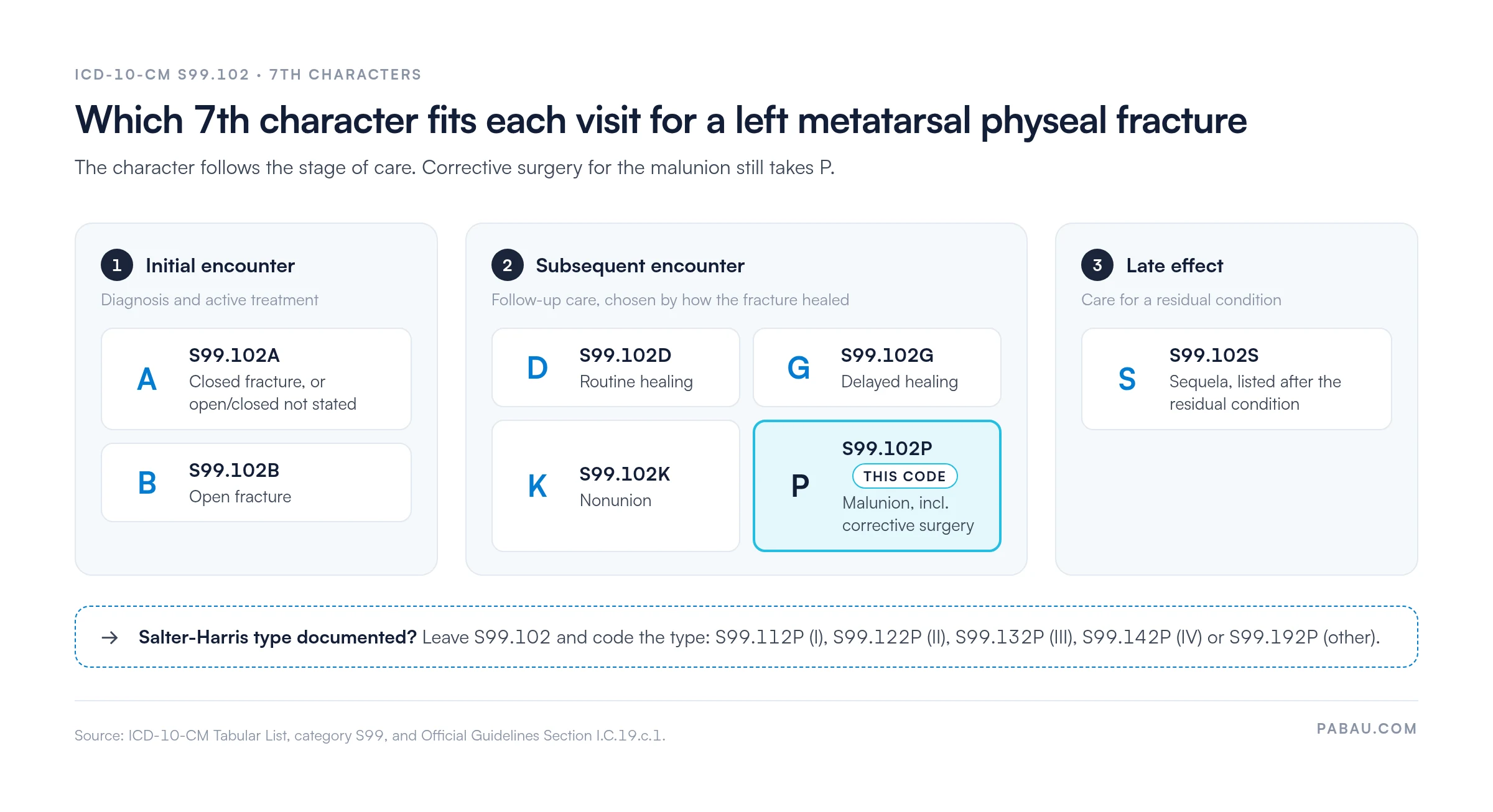
The table adds the typical encounter behind each character.
Surgery is where coders hesitate most. Section I.C.19.c.1 of the ICD-10-CM Official Guidelines reports care for fracture complications, such as malunion, with the malunion character. A corrective osteotomy therefore keeps P, even though it is active surgical treatment.
Late effects work differently. A visit for a residual condition takes S99.102S, and the code for that condition goes first. S99.102P needs no paired sequela code.
Coding errors around S99.102P usually come down to three choices: Salter-Harris type, laterality and healing status. The table gives the deciding fact for each neighboring code.
Always code to the highest specificity the record supports. If the radiology report grades the fracture, S99.102P is no longer the right code. For the initial encounter of a graded injury, see ICD-10 code S99.122A.
Read from the top, each level narrows the injury until only this code is left.
In this subcategory, the 5th character sets the fracture type. A 0 means unspecified, 1 to 4 are Salter-Harris Types I to IV, and 9 means other. The 6th character sets laterality: 1 for right, 2 for left and 9 for unspecified.
Physeal fractures of the calcaneus have their own subcategory, S99.0. Never borrow a calcaneus code for a forefoot injury.
A malunion code tells the payer that a healed fracture still needs care. So the record has to show the original injury, how it healed and why this visit treats the result. Check the note for these five elements.
Here’s how a typical case moves. A 13-year-old returns months after a growth plate fracture of her left fifth metatarsal. X-rays show the bone united with angulation, and the original report never graded the fracture.
She now has pain under the metatarsal head in school shoes. The surgeon documents the malunion, names the ray and plans a corrective osteotomy. From there, the claim moves in four steps.
For this patient, the osteotomy bills as CPT code 28308, which covers any metatarsal other than the first. A first metatarsal case would use 28306 instead.
Each pattern below has a fix at the chart, before the claim ever leaves the practice.
When a claim does come back, the remittance explains why. Our guide to medical billing denial codes decodes those reason codes, and denial management covers the appeal workflow.
These checks take a minute and catch the slips in the table above. Think of them as the code-specific half of a clean claim routine.
The procedure codes paired with S99.102P depend on how the malunion is managed. Confirm each pairing against the payer’s medical necessity policy before submission.
Corrective surgery often needs prior authorization, and the rules vary by payer and plan. The CMS ICD-10 coding resources cover Medicare policy and the current code files.
A malunion claim passes through several hands. The surgeon documents the healed deformity, a coder picks the 7th character and billing staff build the claim. Every handoff is a chance to re-key the code wrong.
In Pabau’s billing software, automated claims management pulls the diagnosis from the patient’s problem list straight onto the claim. Nobody re-types S99.102P, and built-in ICD-10-CM and CPT lookups let staff confirm a code before attaching it.
A claim can’t be sent until its required fields are complete. US claims then go out through Claim.MD, with eligibility checks before the visit and remittances posted back to the patient account. Your billing team spends less time on resubmissions and more on the cases that need a coder.
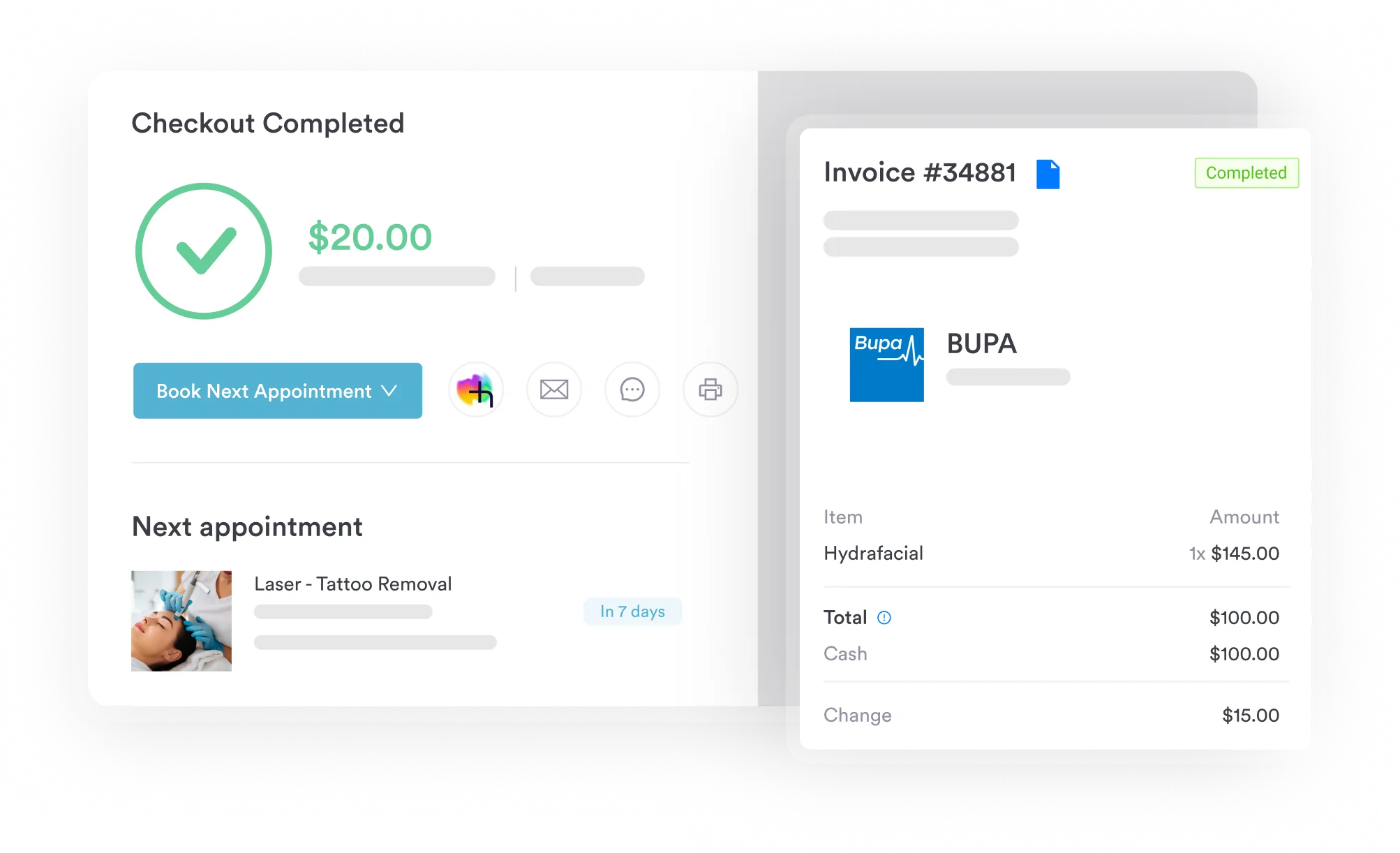

Pabau pre-fills claims from the patient record, offers ICD-10-CM and CPT lookup, and submits through Claim.MD with eligibility checks and remittance posting. See how orthopedic and podiatry practices bill malunion care in one system.

S99.102P fits only when three facts line up: a left metatarsal growth plate fracture, healing with malunion and no documented Salter-Harris type. Change any one of them, and a neighboring code fits better.
Two mistakes cost the most. One is treating P as a sequela character. The other is coding unspecified when the radiology report names the type. Catch both at the chart, and the claim matches the record it came from.
Book a demo to see how Pabau carries the diagnosis from the patient record onto the claim and through to payment.

Got a malunion claim back from the payer? Denial codes in medical billing explains the CARC codes that appear on rejected fracture claims.
Coding a late effect instead? ICD-10 code S99.141S shows how the sequela character works on a metatarsal growth plate fracture.
Submitting US claims electronically? Claim.MD clearinghouse overview covers how claims, eligibility checks and remittances move through the clearinghouse.
Looking for the full medical billing workflow? Revenue cycle management explained walks through the end-to-end process from code assignment to payment posting.
Yes. S99.102P is a valid, billable ICD-10-CM code that can be reported on a claim. Check it against the code set for the date of service, since codes update each October.
Yes, when the malunion is the main reason for the visit. A sequela code works differently. S99.102S is listed after the residual condition it explains.
No national rule requires one. If your payer or state does, report the external cause code with the 7th character D for this follow-up visit. External cause codes use only A, D and S.
Report each side separately. This subcategory has no bilateral option, so a matching right-side malunion adds S99.101P alongside S99.102P.
No. S99.102P belongs to ICD-10-CM, the US clinical modification. WHO ICD-10, used in the UK and many other countries, has no physeal fracture subcategory and records a metatarsal fracture under S92.3.