ICD-10 code S61.201A: Open wound of left index finger without nail damage
ICD-10 code S61.201A covers a left index finger wound of unstated type ICD-10 co...

Last Updated: Oct 16, 2026
Billable Code Specific Code
S99.141S is the billable ICD-10-CM code for salter-Harris Type IV physeal fracture of right metatarsal, sequela.
According to the CMS ICD-10-CM coding guidance, the FY2026 edition took effect on October 1, 2025, and S99.141S is valid under it. Three things have to line up before a coder can use it: the Salter-Harris type, the laterality, and the 7th character.
Let Pabau's smart automation suggest the right codes, reduce claim denials, and keep your practice compliant—effortlessly.
Automate repetitive tasks and focus on what matters most—your patients.
Reduce coding errors and ensure compliance with the latest regulations.
Clean claims, fewer denials, and faster reimbursements.
Powerful insights and reporting to help your practice thrive.
HIPAA compliant SOC 2 certified GDPR-compliant Trusted by 4,000+ clinics worldwide

ICD-10 code S99.141S covers a Salter-Harris Type IV physeal fracture of the right metatarsal, coded as a sequela.
The code applies only after the fracture has healed and the visit treats a late effect such as growth arrest or malunion.
S99.141S is billable on CMS-1500 and UB-04 claim forms under the FY2026 edition, effective October 1, 2025.
Parent code S99.141 accepts seven 7th characters, so S sits alongside A, B, D, G, K and P rather than being one of three options.
The sequela condition is coded first and S99.141S second, which is where most of these claims go wrong.
The full official description for ICD-10 Code S99.141S is Salter-Harris Type IV physeal fracture of right metatarsal, sequela. It is a billable code, valid for reimbursement submission. The table below summarizes the key reference facts.
Coders can confirm the current billable status in the CDC/NCHS ICD-10-CM web tool, which mirrors the official tabular list and alphabetic index. Code selection itself stays a human judgment. The safeguard that catches a wrong 7th character is a documentation review before the claim is built, not an edit further down the line.

Understanding where S99.141S sits in the ICD-10-CM hierarchy helps coders select the correct level of specificity. Moving from chapter down to the final billable code:
Parent code S99.141 is not billable on its own, so a 7th character always has to be appended before submission. S99 sits inside the S90-S99 section for ankle and foot injuries, alongside physeal fractures of the calcaneus (S99.0) and the toe phalanges (S99.2). Reaching for an S99.0 code on a metatarsal fracture is a clinical accuracy error that payers deny. Every other injury category in the ICD-10-CM code set resolves the same way, from chapter down to a billable code carrying its 7th character.
The Salter-Harris classification grades physeal (growth plate) fractures by where the fracture line runs relative to the growth plate anatomy. Type IV is one of the more clinically significant grades, because the fracture crosses all three structures. The same grading applies at other sites, and S59.032G records a Type III fracture of the distal left ulna.
Type IV fractures are seen mainly in pediatric and adolescent patients whose growth plates are still open. The fracture line disrupts the epiphysis. If it heals in a displaced position, the risk of growth disturbance, angular deformity, or malunion is meaningful. That is the scenario a sequela encounter records. The fracture heals, and the patient later presents with a complication caused by the growth plate damage.
The metatarsals of the right foot are the anatomical site captured in S99.141S. They are the five long bones connecting the midfoot to the proximal phalanges. A physeal fracture there, classified as Salter-Harris Type IV and documented as right-sided, maps to S99.141 before the 7th character is applied.
The 7th character is what turns parent code S99.141 into a billable code, and S99.141 accepts seven of them. Each character records a distinct point in the course of the injury. Picking the wrong one is the most common compliance risk on physeal fracture claims. The seven characters group into three stages of care.
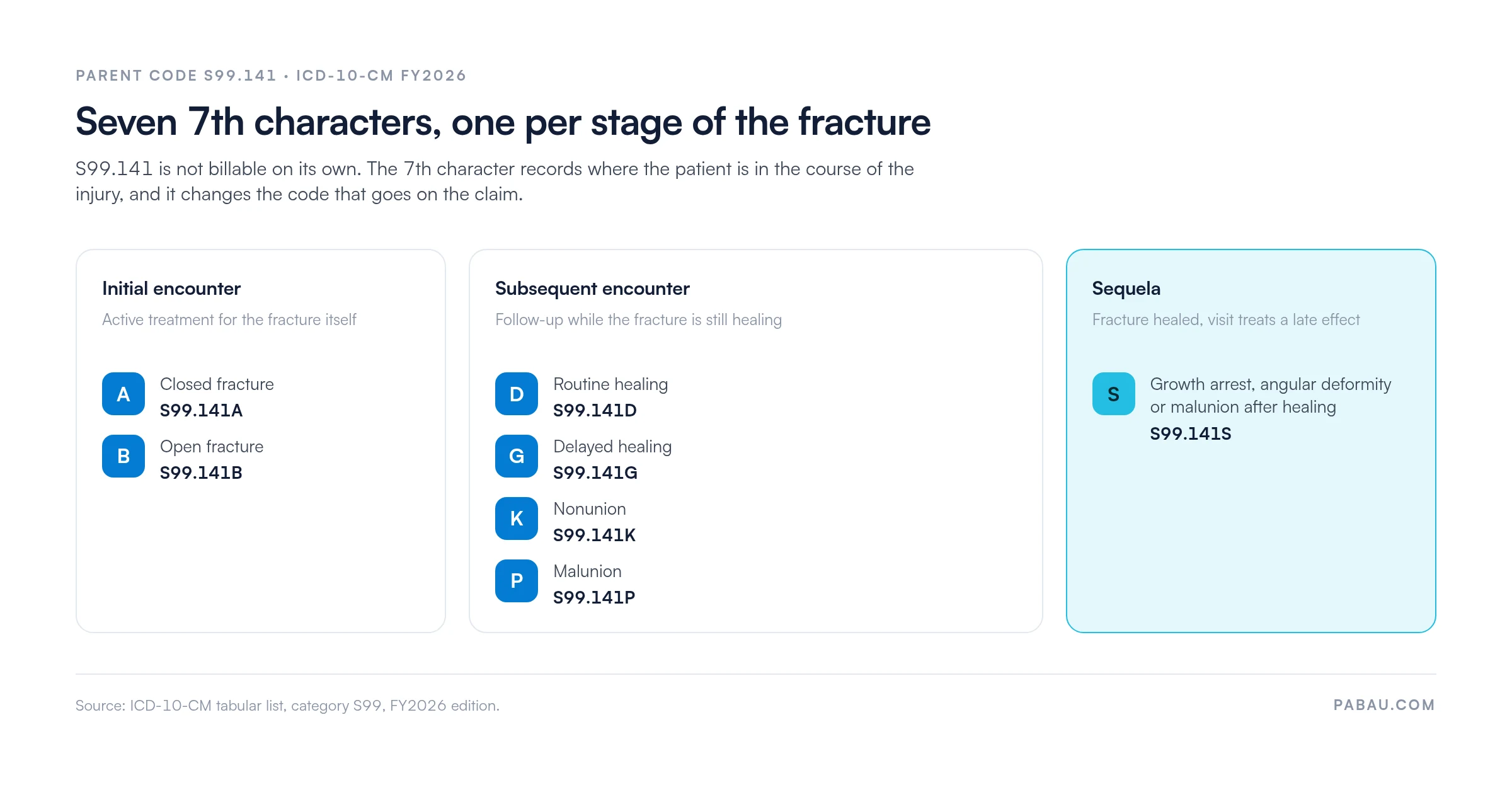
S (sequela) applies when the original fracture has healed and the visit addresses a direct consequence of it. The sequela condition itself, such as growth disturbance of the right foot, becomes the principal diagnosis and is coded first. S99.141S then follows as a secondary code identifying the causative injury. Clinicians routinely document the late effect and leave the causal injury code out.
When coding sequela encounters, document two codes in order. The specific sequela condition comes first, such as growth disturbance or angular deformity of the right foot. S99.141S follows as the secondary code identifying the prior injury. Reversing that order is a sequencing error that payers flag on audit.
Telling ICD-10 Code S99.141S apart from its sibling codes is a recurring challenge, particularly around laterality and Salter-Harris type. The table below covers the alternatives a coder meets most often alongside S99.141S.
The AAPC ICD-10-CM code lookup is useful for checking the full sibling set under S99.14 before finalizing a selection.
S99.141S is a high-specificity code. Every element of the description has to appear in the physician’s documentation before a coder can apply it. Miss one element and the code either drops to a less specific sibling or draws a denial.
Practices managing orthopedic follow-up can capture these elements at intake instead of chasing them at coding. A note template that prompts for type, side, bone, and healing status keeps the record complete months before the sequela visit ever happens.
S99.141S is billable on both the CMS-1500 (professional claims) and UB-04 (institutional claims) forms. Because it codes a sequela rather than active fracture treatment, the reimbursement context differs from the initial and subsequent encounter codes. Payers expect S99.141S to appear as a secondary diagnosis supporting a primary sequela condition code, not as a standalone primary diagnosis.
A clearinghouse moves the claim rather than coding it. Practice management software like Pabau builds CMS-1500 claims from the invoice data already on the patient record, submits them through Claim.MD, and tracks each one. Practices that want cleaner claims management get the submission, tracking, and eligibility side automated. Diagnosis selection and sequencing stay a coder’s judgment call.
Sequela denials on S99.141S usually trace to one of two errors. Either the principal sequela condition code is missing, or S99.141S went out while the fracture was still actively healing and S99.141D applied. Both are correctable with an appeal and supporting documentation, though prevention at the point of coding costs far less. Denial management work on fracture claims usually starts with a root-cause audit of 7th character misuse.
The four errors below account for the majority of claim rejections and audit flags on S99.141S encounters. Each one is preventable with a documentation review step before code assignment.
Billing teams working with pediatric orthopedic patients can turn those four errors into a checklist. Confirm type, laterality, bone site, and healed status before the claim is coded, and most of the rework disappears.
Medical records use lay and clinical terminology that coders have to map back to the classification. The terms below, appearing in a clinical note or a referral letter, should prompt consideration of S99.141S once the 7th character S is confirmed appropriate.
When these terms appear without an explicit Salter-Harris type number, query the physician before assigning S99.141S. A documented “physeal fracture” with no type recorded maps to S99.101S, unspecified physeal fracture of right metatarsal, sequela. S99.191S is a different code and a common mix-up. It covers a physeal fracture the physician did specify, but one that fits no Salter-Harris category.
Standardized intake forms do most of the work here. A note template that requires the Salter-Harris type at the initial encounter is what makes accurate sequela coding possible at a follow-up visit months later.
Salter-Harris Type IV metatarsal fractures occur almost exclusively in pediatric and adolescent patients. The growth plates in the metatarsals typically close between ages 16 and 18, so the injury pattern is close to impossible in skeletally mature adults. The usual presentation is a young athlete taking a direct compressive or twisting force through the forefoot.
Because the fracture crosses the epiphysis, surgical reduction is often needed to restore alignment and protect the growth plate. Cases managed conservatively carry a higher risk of malunion. Sequela encounters coded with S99.141S typically arise 6 to 24 months after the original injury. That is when a parent or clinician notices asymmetric foot growth, forefoot deformity, or an altered gait.
That interval is what makes the code hard to assign. The original injury record and the sequela visit are often separated by a year or more, sometimes by a different clinician and a different practice. Longitudinal patient records are what connect the two, so the coder can find the causal injury that S99.141S has to accompany.
Flag pediatric metatarsal fracture patients for a structured follow-up protocol through adolescence. Growth plate complications from Type IV injuries can emerge over 18 to 24 months. A recall system makes sure the sequela encounter is captured and coded properly, rather than absorbed into an undocumented walk-in visit.
In most practices, the sequela visit and the original fracture live in different places. The initial encounter note sits in one system and the imaging report in another. By the time the follow-up happens 18 months later, the coder is working from whatever the parent remembers.
Pabau, practice management software for medical and aesthetic practices, keeps that chain on one patient record. The initial encounter note, the Salter-Harris type the physician documented, the imaging, and every follow-up sit on the same file. When the sequela visit comes around, the coder can read the documented type and side without raising a records request.
Structured note templates hold that specificity in place. You can require the Salter-Harris type and the side at the point of documentation. The detail S99.141S depends on is then captured at the initial encounter rather than reconstructed later. Recall rules then bring pediatric fracture patients back on schedule, which is how the sequela encounter gets captured at all.
Invoices built on the coded visit go out through Claim.MD as CMS-1500 claims, with status tracking and eligibility checks on the same screen. Every subscription includes the full platform, so none of it sits behind a higher tier.

Pabau holds the initial encounter note, the imaging, and every follow-up on one patient record. The documented Salter-Harris type and side are there when the sequela visit is coded months later.

S99.141S rewards documentation discipline more than coding skill. If the physician named the Salter-Harris type, named the right foot, and recorded that the fracture has healed, the code assigns itself. If any of the three is missing, no appeal will supply it after the fact.
So the work sits at the initial encounter, a year or more before anyone needs the code. Build the note template that forces the type and the side, and the sequela visit becomes a two-minute coding decision instead of a physician query. Book a demo to see how Pabau keeps fracture documentation and claim submission on one record.

Managing orthopedic billing compliance in your practice? Medical billing compliance fundamentals covers the documentation and submission standards that reduce audit exposure across injury codes.
Need to understand how 837P claims move through a clearinghouse? 837 file submission guide explains the electronic claim file format used to submit ICD-10 diagnosis codes to payers.
Setting up insurance billing workflows for a PT or sports medicine clinic? Insurance credentialing guide walks through payer enrollment and the steps that unlock reimbursement for new practice locations.
ICD-10 Code S99.141S is the billable ICD-10-CM diagnosis code for a Salter-Harris Type IV physeal fracture of the right metatarsal, sequela. It applies when treating a late effect or complication of that fracture after the original injury has healed. The code is valid on CMS-1500 and UB-04 claim forms under the FY2026 edition, effective October 1, 2025.
Yes, S99.141S is a fully billable ICD-10-CM diagnosis code. It is valid for submission on both CMS-1500 (professional) and UB-04 (institutional) claim forms. Unlike its parent code S99.141, which requires a 7th character to be billable, S99.141S with the S extension appended is the complete, submittable code.
The 7th character S designates a sequela encounter. It means the visit treats a direct late effect of a previous injury that has now healed. For fracture codes, sequela (S) contrasts with the initial-encounter characters (A and B) and the subsequent-encounter characters (D, G, K and P). Using S when the fracture is still healing is one of the most common audit triggers in fracture coding.
Use S99.141S when the documented Salter-Harris Type IV physeal fracture is confirmed on the right metatarsal and the encounter is a sequela visit. Use S99.142S when the same fracture type and episode of care applies to the left metatarsal. Laterality must be explicitly documented by the physician; coders cannot infer right or left from context alone. When documentation is genuinely ambiguous, S99.149S (unspecified laterality, sequela) applies, though this should be resolved with a physician query wherever possible.