ICD-10 Code T31.77: Burns involving 70-79% of body surface
ICD-10 code T31.77: Quick reference and code details ICD-10 code T31.77 is the b...

Last Updated: Nov 5, 2026
Billable Code Specific Code
S99.121K is the billable ICD-10-CM code for Salter-Harris Type II physeal fracture of right metatarsal, subsequent encounter for fracture with nonunion. It applies when a growth plate fracture of a right metatarsal has failed to unite and the patient returns for follow-up care.
The code sits in category S99 within Chapter 19. Assignment turns on three documented facts: the right side, a Type II fracture pattern, and the provider's statement of nonunion at a follow-up visit.
Let Pabau's smart automation suggest the right codes, reduce claim denials, and keep your practice compliant—effortlessly.
Automate repetitive tasks and focus on what matters most—your patients.
Reduce coding errors and ensure compliance with the latest regulations.
Clean claims, fewer denials, and faster reimbursements.
Powerful insights and reporting to help your practice thrive.
HIPAA compliant SOC 2 certified GDPR-compliant Trusted by 4,000+ clinics worldwide

S99.121K is the billable ICD-10-CM code for a Salter-Harris Type II physeal fracture of the right metatarsal that has not united at follow-up.
The sixth character 1 means right metatarsal, 2 means left and 9 means unspecified side, so laterality must match every document in the record.
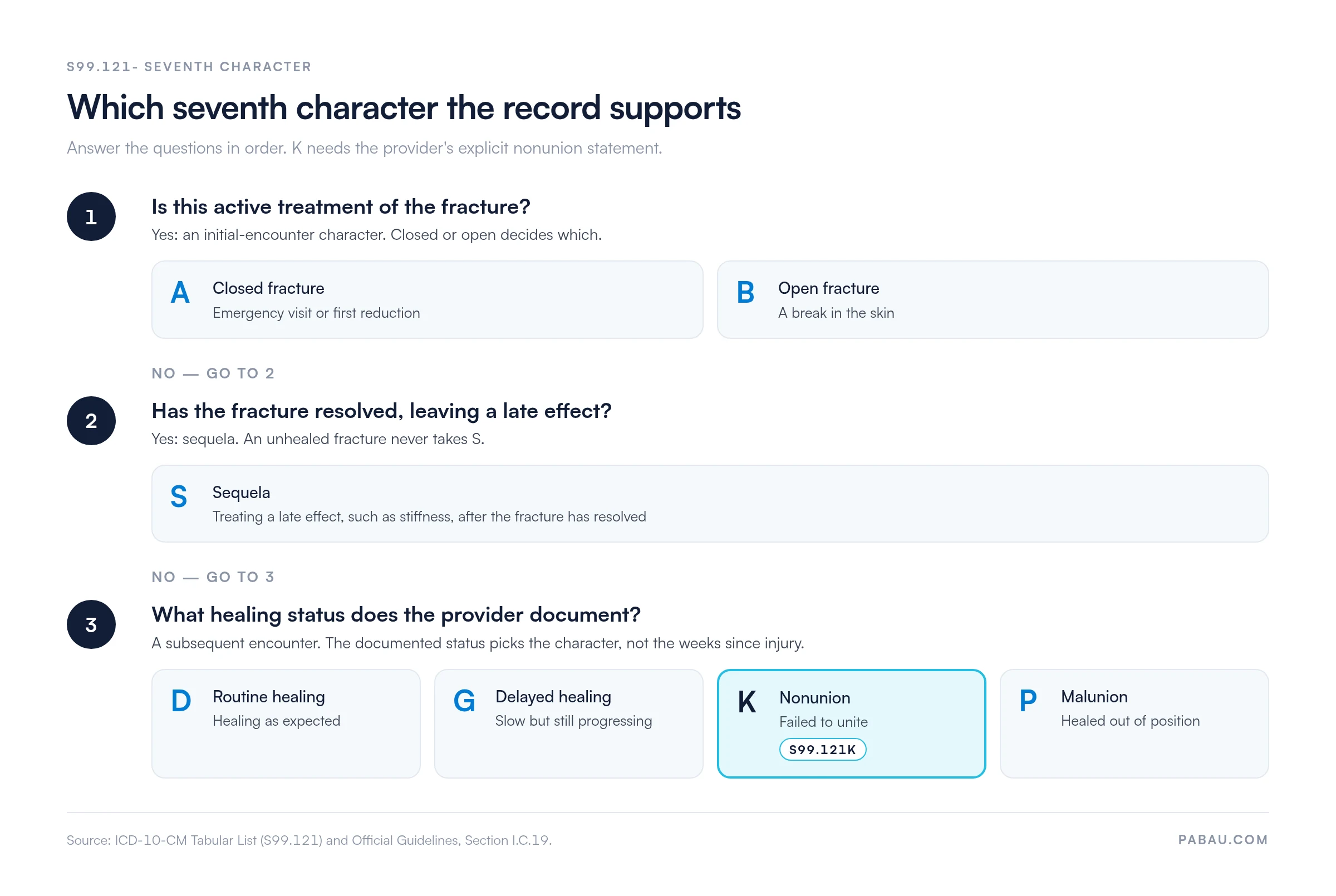
The seventh character K separates nonunion from routine healing (D), delayed healing (G), malunion (P) and sequela (S). It needs an explicit nonunion statement from the provider.
Pair the code with metatarsal procedure codes such as 28470, 28475, 28485 or 28322, never the toe phalanx codes 28510 and 28515.
Pabau, the practice software we build, sends US claims through Claim.MD and checks eligibility, so staff follow each nonunion claim in one place.
ICD-10 Code S99.121K is the billable ICD-10-CM code for a Salter-Harris Type II physeal fracture of the right metatarsal, subsequent encounter for fracture with nonunion. It describes a growth plate fracture of a right metatarsal that has failed to heal. It is reported when the patient returns for care after initial treatment.
The code sits in Chapter 19 (Injury, poisoning and certain other consequences of external causes) of the CMS ICD-10-CM code set. Within that chapter, category S99 holds the physeal fractures of the foot that the S92 fracture codes leave out.
The code hierarchy from broadest to most specific is:
Each character of S99.121K records one clinical fact. Characters 4 through 7 carry the site, the fracture pattern, the side and the encounter, so a misread there changes the code. The table below breaks down all seven positions.
The code does not say which of the five metatarsals is involved, unlike the S92.3- fracture codes. The note should still name the bone, because metatarsal procedure codes are reported per bone treated.
The CDC/NCHS ICD-10-CM lookup tool confirms the current descriptor and billable status. Check it each year, because ICD-10-CM updates take effect every October 1.
A Salter-Harris Type II fracture is the most common growth plate injury pattern. Pediatric fracture texts such as Rang’s Children’s Fractures put it at roughly three-quarters of physeal fractures. The fracture line runs through the physis and exits through the metaphysis, leaving the epiphysis intact.
Metatarsal physeal fractures occur in children and adolescents whose growth plates are still open. In the lesser metatarsals the physis sits at the distal end, near the head. In the first metatarsal it sits at the base, so imaging reports describe the fracture site differently.
Each Salter-Harris type has its own code group under S99.1, so the type in the record decides the fifth character. A Type I fracture of the right metatarsal codes to S99.111-, and a Type III to S99.131-.
Ask for the Thurston Holland fragment to be named in the radiology report or clinic note. It is the radiographic sign of a Type II fracture and gives the coder objective support for the fifth character.
Use the seventh character K when the patient returns for care and the provider documents that the right metatarsal fracture has not united. Two conditions must both appear in the record. The visit follows the initial treatment, and the provider states that the bone has failed to heal.
The full seventh-character set for S99.121 is:
Section I.C.19 of the ICD-10-CM Official Guidelines for Coding and Reporting governs the seventh character across Chapter 19. ICD-10-CM sets no time threshold for nonunion. The coder relies on the provider’s documented determination, not on how many weeks have passed.
Payers can set their own thresholds for treatment, though. The Medicare bone stimulator policy, for example, defines nonunion by serial imaging that shows healing has stopped for at least 3 months.
The decision path below shows how the encounter and the documented healing status pick the seventh character.
The codes most often confused with ICD-10 Code S99.121K are its own family members, plus the toe and adult metatarsal codes nearby. The table below shows when each one applies instead.
The S92.3 subcategory carries an Excludes2 note for physeal fracture of metatarsal (S99.1-). A growth plate fracture therefore codes to S99.1-, not to the S92.3- codes used for adults. Once the growth plate has closed, a displaced right second metatarsal nonunion codes to S92.321K instead.
The K-to-P swap needs the same care. Nonunion (K) means the fracture has not healed, while malunion (P) means it healed out of position. The two lead to different procedures, so check the full descriptor in the AAPC Codify ICD-10-CM lookup before submission.
Supporting S99.121K on a claim requires documentation for each fact the seven characters encode. Medical billing compliance frameworks recommend a pre-submission checklist for subsequent-encounter fracture codes like this one.
For practices focused on building a clean claim, checking these five elements before submission removes the documentation questions payers raise most on this code.
The procedure codes reported with ICD-10 Code S99.121K depend on what the provider does at the nonunion visit. Options range from an office visit and imaging to bone stimulation or surgical repair. Every code below is a metatarsal code; toe phalanx codes 28510 and 28515 describe a different bone.
Metatarsal fracture codes are reported per bone, so units must match the metatarsals treated. National Correct Coding Initiative edits can bundle imaging or a visit with a same-day procedure, so check each payer’s pairing rules first.
Claims software built for practices tracks these claims from submission to payment, and the Claim.MD clearinghouse lets staff check eligibility before the visit.
Medicare covers noninvasive bone stimulators for long bone nonunion under the DME MAC policy for osteogenesis stimulators, LCD L33796. That policy counts the metatarsal as a long bone, so a metatarsal nonunion can qualify.
The LCD requires two sets of radiographs at least 90 days apart, each with multiple views. A treating practitioner must also state in writing that the images show no clinically significant healing between them. The device itself is billed under HCPCS E0747 by the DME supplier.
Key payer requirements to verify before submission:
Understanding revenue cycle management helps practices handle these multi-visit claims. A good workflow catches global period conflicts and medical necessity rules before submission.
Claims for ICD-10 Code S99.121K run into a predictable set of denial patterns. Most trace back to character selection or missing documentation, which a pre-submission review can catch. Solid denial management workflows build these checks into the billing queue.
For practices handling higher volumes of fracture claims, reviewing denial codes in medical billing helps staff respond faster. It also shows which adjustment reason codes payers attach to encounter and laterality errors.
Run a monthly report of claims billed with S99.121- codes and sort them by seventh character. Any K claim dated on or before the original injury visit is a coding error to correct before the payer finds it.
The physeal metatarsal codes interact with the rest of Chapter 19 through excludes notes and sequencing rules. These apply whenever S99.121K appears with other codes on the same claim.
A nonunion claim for S99.121K often follows several earlier claims for the same fracture. Billing staff need to know which visits were paid, which were denied, and whether the patient is still covered before surgery.
Pabau includes US claims management through Claim.MD. It submits claims electronically, tracks each claim’s status, and checks patient eligibility before the visit. Staff can follow the whole fracture episode without logging in to separate payer portals.
The clinical notes, imaging reports and invoices for each visit sit in the same patient record. When a payer asks for the nonunion documentation, the team can find it in one place and respond faster.

Pabau’s US claims management, built on Claim.MD, submits claims, tracks their status and checks patient eligibility. Your team can follow every S99.121K claim from submission to payment in one place.

S99.121K depends on three facts in the record: a right metatarsal, a Type II growth plate fracture, and nonunion at a follow-up visit. Confirm the provider has stated all three before choosing the code. Then pair it with metatarsal procedure codes, never toe codes.
The trade-off is time spent upfront. A query to the provider before billing costs minutes, while a denied nonunion claim can stall payment for a surgery or a stimulator. Pabau’s claims management submits these claims through Claim.MD, tracks their status and checks eligibility. Book a demo to see how it keeps fracture follow-up claims moving.

Need to understand how claim denials are structured? Denial codes in medical billing explains the CARC and RARC codes payers use when rejecting fracture claims, including seventh-character errors.
Want to streamline how your practice handles medical billing? Medical billing fundamentals covers the end-to-end billing process from charge capture through remittance posting.
Looking for guidance on managing the full claims lifecycle? Pabau’s Claim.MD clearinghouse integration explains how electronic claim submission, ERA posting, and real-time eligibility work together to reduce denials.
ICD-10 Code S99.121K is the billable diagnosis code for a Salter-Harris Type II physeal fracture of the right metatarsal, subsequent encounter for fracture with nonunion. It is used at follow-up visits where the provider documents that the fracture has not healed.
Use K when the patient returns after initial treatment and the provider documents that the fracture has failed to unite. Use D for routine healing, G for delayed healing, P for malunion and S for sequela.
Both codes describe follow-up care for the same right metatarsal fracture. S99.121D applies while the fracture heals as expected, and S99.121K applies once the provider documents nonunion.
A physeal fracture is a break through the growth plate of a bone. It occurs in children and adolescents whose growth plates are still open. In a Type II fracture, the break runs through the growth plate and exits through the metaphysis.
S99.122K is the code for a Salter-Harris Type II physeal fracture of the left metatarsal, subsequent encounter for fracture with nonunion. The sixth character changes from 1 for right to 2 for left.