ICD-10 code S61.201A: Open wound of left index finger without nail damage
ICD-10 code S61.201A covers a left index finger wound of unstated type ICD-10 co...

Last Updated: Oct 16, 2026
Billable Code Specific Code
S59.032G is the billable ICD-10-CM code for a Salter-Harris Type III physeal fracture of the lower end of the left ulna with delayed healing. It applies at a subsequent encounter, once the physician documents that the fracture is healing more slowly than expected.
Assignment turns on three documented elements: the Salter-Harris type, left-arm laterality, and clinical or radiographic evidence of delayed healing. Use S59.032D while healing is routine and S59.032K once the physician diagnoses nonunion.
Let Pabau's smart automation suggest the right codes, reduce claim denials, and keep your practice compliant—effortlessly.
Automate repetitive tasks and focus on what matters most—your patients.
Reduce coding errors and ensure compliance with the latest regulations.
Clean claims, fewer denials, and faster reimbursements.
Powerful insights and reporting to help your practice thrive.
HIPAA compliant SOC 2 certified GDPR-compliant Trusted by 4,000+ clinics worldwide

S59.032G covers a Salter-Harris Type III physeal fracture of the lower left ulna, coded at a follow-up visit where delayed healing is documented.
The seventh character G means a subsequent encounter with delayed healing, which sits between D (routine healing) and K (nonunion).
The physician’s note decides between D, G and K, so query the physician whenever the healing language is unclear.
Missing laterality, A reused on a follow-up visit, and G assigned before imaging supports delayed healing are common denial triggers for this code.
Practice management software like Pabau keeps laterality, encounter type and healing notes next to the claim, so coders can check them before submission.
ICD-10 Code S59.032G is the billable ICD-10-CM code for a Salter-Harris Type III physeal fracture of the lower left ulna with delayed healing.
You assign it at a subsequent encounter, once the physician documents that the fracture is healing more slowly than expected. The code sits in category S59 (Other and unspecified injuries of elbow and forearm) and is valid for FY2026.
Each character in S59.032G narrows the diagnosis. S59 is the category for other and unspecified elbow and forearm injuries. The fourth character 0 means a physeal fracture of the lower end of the ulna. The fifth character 3 sets Salter-Harris Type III, and the sixth character 2 sets the left arm. The seventh character G marks a subsequent encounter with delayed healing.
A Salter-Harris Type III fracture is a growth plate injury. The fracture line runs through the physis and then through the epiphysis to the joint surface, leaving the metaphysis intact. That joint involvement makes Type III more clinically significant than Types I or II, and it’s why a generic fracture code won’t do.
The five Salter-Harris types describe how the fracture relates to the growth plate. Type I runs through the physis only, and Type II runs through the physis and metaphysis (the most common pattern). Type III runs through the physis and epiphysis into the joint surface. Type IV crosses all three zones, and Type V is a crush injury to the physis.
For billing, the physician’s documentation must state the Salter-Harris type explicitly. Coders can’t infer it from an imaging report without the physician’s interpretive statement.
The lower (distal) end of the ulna is the smaller of the two forearm bones at the wrist. In skeletally immature patients, a physeal fracture here affects the distal ulnar growth plate, which typically fuses between ages 16 and 18. S59.032G is left-arm only, and the right-arm code is S59.031G.
If the record doesn’t specify laterality, the code is S59.039G (unspecified arm). Submitting the unspecified code when laterality appears elsewhere in the chart may still trigger a payer query.
“Lower end,” “distal end” and “distal ulna” all describe the same site in S59.032G, so the physician may use any of them. Laterality is the element that can’t vary. Check the operative report, the office visit note and any imaging report for consistent left-arm documentation before you assign the code.
The seventh character G means the patient is at a subsequent encounter and the fracture is showing delayed healing. The ICD-10-CM Official Guidelines (Section I.C.19) use subsequent encounters for care after active treatment ends, during the healing or recovery phase. Delayed healing is a clinical judgment by the treating physician. It rests on the absence of expected radiographic union for the fracture type and the patient’s age.
Orthopedic literature often places that window at 6 to 8 weeks for pediatric forearm fractures. Even so, the physician’s documented assessment governs the code, not a fixed calendar threshold. The AAPC ICD-10-CM code reference defines the encounter characters across fracture categories.
G needs the physician to note slow or insufficient healing progress in the record. It doesn’t need a formal “delayed union” diagnosis. K (nonunion) is a stronger conclusion, and it requires the physician to document that the fracture has failed to unite. Assigning K before that conclusion appears in the chart is a coding error, and the same logic holds across injury-chapter fracture codes.
Every seventh-character option for S59.032 covers the same injury, a Salter-Harris Type III fracture of the lower left ulna. Each one adds a different encounter or outcome qualifier. The table below maps each variant to its clinical scenario.
Right-arm equivalents use S59.031 with the same seventh characters, and unspecified laterality uses S59.039. G is the variant most easily confused with its neighbors. Coders reuse A on follow-up visits, or jump to K before the physician documents nonunion. The decision flow below shows how the physician’s documentation picks the character at each visit.
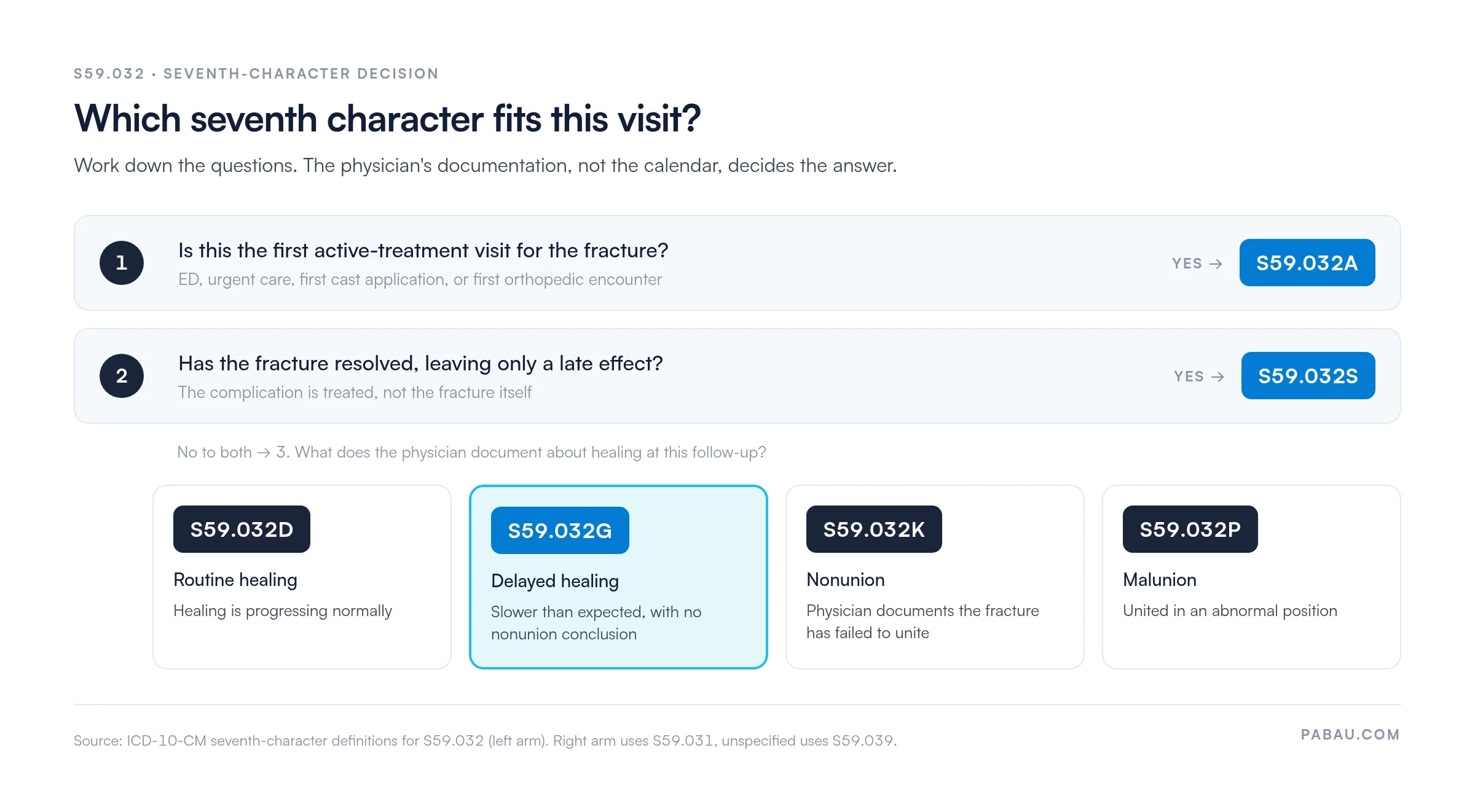
Four comparisons come up again and again with S59.032G. Each one turns on a single documentation element that changes the correct code.
Every element of the S59.032G descriptor must appear in the medical record before you assign the code. If any area below is undocumented, expect a payer denial or a query from your clinical documentation integrity (CDI) team.
Run a four-point check before you submit any S59.032G claim. The chart needs the physician-stated Salter-Harris type and left-arm laterality in the assessment or exam. It also needs ‘lower end’ or ‘distal ulna’ as the site. Finally, it needs a physician statement on delayed healing tied to imaging or clinical findings. If one is missing, hold the claim.
Payer requirements for S59.032G vary by Medicare Administrative Contractor (MAC), state Medicaid plan and commercial plan. The points below are general expectations. Always check the payer’s Local Coverage Determination (LCD) or coverage policy before billing.
Most S59.032G denials come from correctable documentation and coding errors rather than a lack of medical necessity. Read the denial reason on the explanation of benefits (EOB) against the list of medical billing denial codes. That’s the fastest route to a clean corrected claim. The patterns below are the ones to check first.
Track denials by code. If S59.032G claims keep coming back for the same reason, fix the documentation upstream instead of working appeals downstream.
CPT code selection depends on the procedure performed at the encounter, not on the diagnosis code. The table below lists CPT codes often billed alongside S59.032G in orthopedic and pediatric practices. All pairings are illustrative, so verify them against the AMA CPT code set and the services rendered before billing.
CPT 25600 describes distal radius fracture care that can include the ulnar styloid. Confirm the encounter notes support the procedure billed, and query the physician when in doubt.
ICD-9-CM lacked the specificity of ICD-10-CM for physeal fractures. The legacy codes below are approximate matches only, because the General Equivalence Mappings (GEMs) don’t guarantee clinical equivalence. Use them for historical record reconciliation or research on pre-2015 claims data.
ICD-9-CM didn’t capture Salter-Harris class, laterality or delayed healing at the level ICD-10-CM provides. Historical analysis on ICD-9 data will undercount physeal fracture specificity. Label crosswalk content accordingly in research protocols and in payer appeals that cite legacy data.
The parent categories of S59.032G carry instructional notes that govern its use, so apply them before you finalize a claim. The notes below come from the CDC/NCHS ICD-10-CM web tool and the official tabular list.
Orthopedic and pediatric practices billing S59.032G hit the same problem at follow-up visits. The note often holds the right information, but laterality and healing-progress language sit deep in the exam narrative. The billing team has to dig for them before every claim.
Practice management software like Pabau connects the clinical note to the billing queue. Its claims management software lets coders see the treating physician’s notes, imaging references and encounter history in one place before a claim goes out.
For US practices, Pabau sends electronic claims to thousands of US payers through the Claim.MD clearinghouse and checks patient eligibility in real time. Electronic remittance advice (ERA) comes back into Pabau against each claim. When an S59.032G claim is denied, you can see whether laterality, the seventh character or missing documentation caused it.
Fewer claims come back, and the ones that do take less time to correct. Book a demo to see how Pabau handles fracture documentation and claim submission from start to finish.

Pabau keeps laterality, encounter type and healing notes beside the claim, so coders can confirm S59.032G before it reaches the payer.

S59.032G is easy to get right when the chart is built for it, and costly to get wrong when it isn’t. At every follow-up, the deciding question is what the physician wrote about healing.
Treat D as the default for follow-up visits, and move to G only when the note says healing is slower than expected. If the note is ambiguous, a physician query takes minutes, while a denied claim can take weeks to resolve.
The trade-off is a little more discipline at the point of care, in exchange for claims that clear the first time. Book a demo to see how Pabau puts the healing notes and the claim side by side for your coders.

Need to trace denials back to the documentation behind them? Denial management in healthcare walks through how to analyze EOB patterns and fix recurring coding errors at the source.
Submitting ICD-10 claims through a clearinghouse? Electronic remittance advice explained covers how ERA files map payer decisions back to specific claim lines.
Looking for the billing compliance framework behind fracture coding? Medical billing compliance guidance covers the documentation standards that apply across ICD-10-CM injury codes.
Want the whole path from encounter to payment? What is revenue cycle management explains each stage a fracture claim passes through before it is paid.
New to the billing side of the practice? What is medical billing covers how clinical documentation turns into a claim a payer will accept.
ICD-10 Code S59.032G is the billable ICD-10-CM code for a Salter-Harris Type III physeal fracture of the lower left ulna with delayed healing. It’s used at a subsequent encounter, not the initial one. The code combines four elements: the site (distal left ulna growth plate), the Salter-Harris Type III classification, the encounter type and the healing status. All four must be documented before you assign it.
S59.032A covers encounters where the fracture is receiving active treatment, typically in the emergency department or at the first orthopedic appointment. S59.032G covers subsequent encounters where the fracture shows delayed healing. Using A on a follow-up visit is a common denial trigger for this code family. Check the visit sequence in the patient record before you assign the seventh character.
S59.032G applies when the physician documents slower-than-expected healing without concluding that the fracture has failed to unite. S59.032K requires a formal nonunion diagnosis, usually supported by imaging that shows no callus bridging well beyond the expected window. Assigning K before the physician documents nonunion is a coding error. When in doubt, query the physician rather than upgrade to K.
The only difference is laterality. S59.032G covers the left arm and S59.031G covers the right, and the sixth character sets it (2 for left, 1 for right). If the physician’s note doesn’t state laterality, the unspecified code S59.039G applies, though payers may query the claim. Never assign laterality from imaging reports alone without confirmation in the treating provider’s note.
Five reasons come up most often. The first two are A submitted on a follow-up visit and missing laterality in the physician’s note. The third is no imaging or clinical documentation behind the delayed-healing assessment. The fourth is G used before enough time has passed to establish delayed healing. The fifth is an aftercare Z code reported for follow-up fracture care, which the guidelines don’t allow for injuries. Each one is fixable at the documentation level.
Yes. S59.032G is a valid, billable ICD-10-CM code for FY2026, as listed in the CDC/NCHS ICD-10-CM web tool. It wasn’t revised or deleted in the FY2026 update. Check the official NCHS release for FY2027, which takes effect on October 1, 2026.