ICD-10 code S61.201A: Open wound of left index finger without nail damage
ICD-10 code S61.201A covers a left index finger wound of unstated type ICD-10 co...

Last Updated: Oct 16, 2026
Billable Code Specific Code
S98.919S is the billable ICD-10-CM code for complete traumatic amputation of unspecified foot, level unspecified, sequela.
Every word in that description carries coding weight:
Miss any one of those distinctions and a different code applies.
Let Pabau's smart automation suggest the right codes, reduce claim denials, and keep your practice compliant—effortlessly.
Automate repetitive tasks and focus on what matters most—your patients.
Reduce coding errors and ensure compliance with the latest regulations.
Clean claims, fewer denials, and faster reimbursements.
Powerful insights and reporting to help your practice thrive.
HIPAA compliant SOC 2 certified GDPR-compliant Trusted by 4,000+ clinics worldwide

S98.919S is a valid, billable ICD-10-CM code for complete traumatic amputation of unspecified foot, level unspecified, sequela, effective FY2026 (Oct 2025 to Sep 2026).
The seventh character S designates sequela. The visit addresses a late effect or complication of a prior traumatic amputation, not the acute injury itself.
Use S98.919S only when documentation does not specify left or right foot. The laterality-specific codes S98.911S (right) and S98.912S (left) take priority when the record is clear.
Practice management software like Pabau connects ICD-10 code selection to claim submission, which cuts the manual re-entry errors that sink sequela claims.
The seventh character is the most consequential element of this code. It reports which phase of care the visit belongs to, so the wrong character misrepresents the encounter as well as inviting a denial.
For S98.919 (complete traumatic amputation of unspecified foot, level unspecified), three seventh characters apply:
Sequela is the ICD-10-CM term for a late effect. It is a condition that exists as a direct consequence of a prior injury, after healing has concluded. Per CDC/NCHS ICD-10-CM coding guidelines Section I.C.19, reporting a sequela usually takes two codes.
One names the sequela itself, such as phantom limb pain. The other is the injury code with seventh character S, S98.919S, which identifies the cause.
The documentation test is short. Is the current condition a direct result of a prior traumatic amputation, presenting after normal healing? If yes, S is correct.
If the patient is still healing from the original injury, D applies, and A applies at the first treatment contact. Coding D where S belongs is one of the more common denial management triggers on amputation claims.
Knowing where S98.919S sits in the classification tree helps you find parent codes, sibling codes, and the reporting context. The WHO ICD-10 browser shows how Chapter 19 cascades from broad blocks down to individual codes.
Each level adds specificity. S98 is the reporting category for every traumatic amputation of the ankle and foot. S98.91 narrows it to complete rather than partial amputations. S98.919 marks both the side and the level as undocumented. The seventh character S closes the loop by naming the encounter type as sequela.
The S98 category covers traumatic amputations of the ankle and foot across several anatomical sites and amputation types. The AAPC ICD-10-CM code lookup and our own ICD-10-CM code index both let you check a neighboring code before the claim goes out. The table below lists the key S98 codes with the sequela seventh character.
Documentation has to distinguish complete from partial traumatic amputations. The S98.91x codes apply when the entire foot is detached, and the S98.92x codes apply when part of the foot remains attached.
Do not select on clinical inference: the operative or emergency report must state the amputation type. Where the wording is ambiguous, query the treating provider before coding.
S98.919S reports an unspecified foot, meaning neither right nor left appears in the clinical record. That leaves coders a practical decision. When is the unspecified code acceptable, and when should the record go back to the provider for more detail?
ICD-10-CM official guidelines instruct coders to assign the most specific code the documentation supports. For traumatic amputation, laterality matters clinically and for payment. The guidance below covers the three scenarios where each code applies:
Laterality and encounter type are the only two facts that separate the nine codes in the S98.91x family. Read them together and the code selects itself, as the matrix below shows.
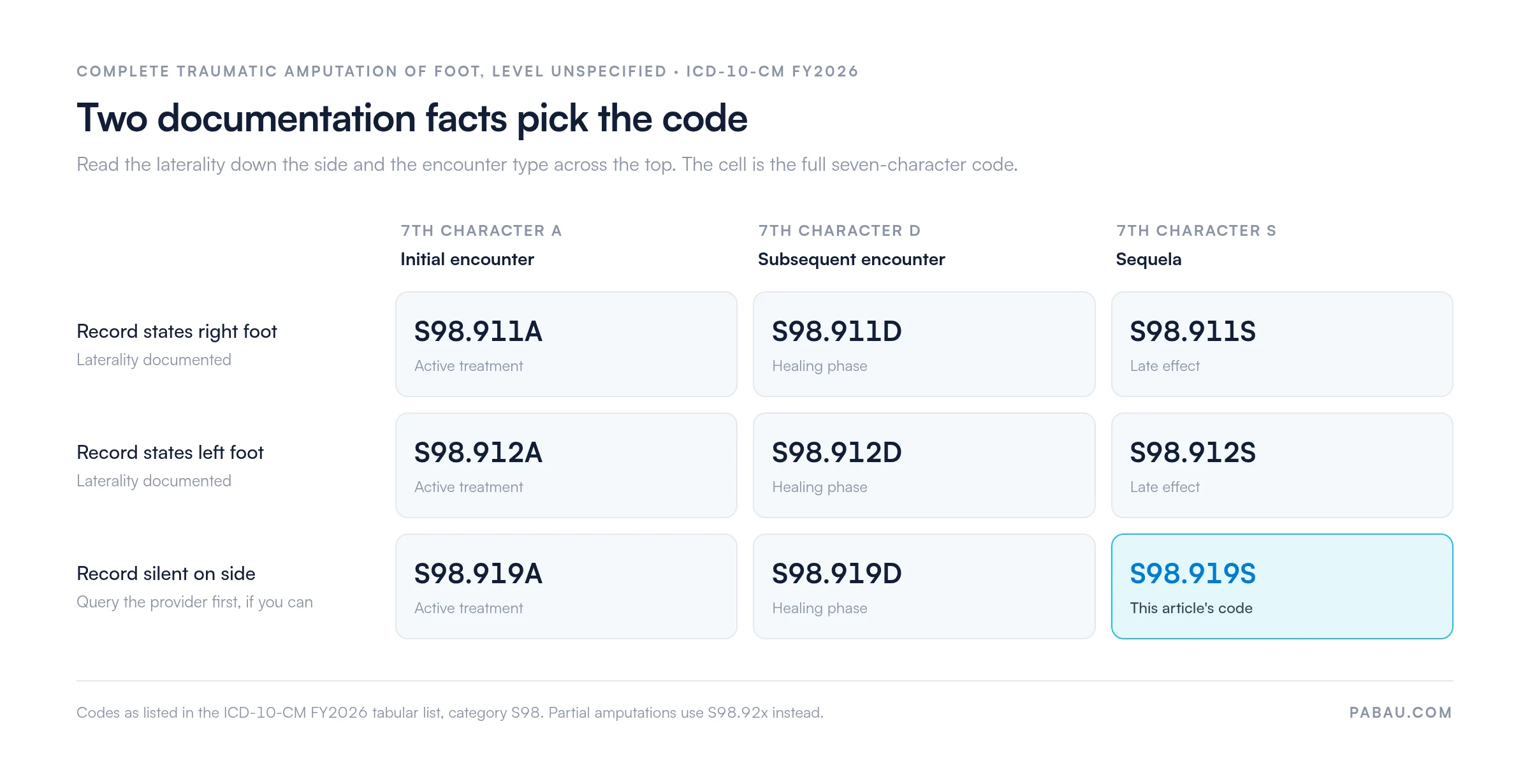
Payers increasingly flag unspecified laterality codes for medical necessity review. Reaching for S98.919S when the record clearly supports S98.911S or S98.912S is a documentation error, and it delays reimbursement. Query the provider before claim submission whenever the timeline allows it.
Run a laterality audit on your S98.919S claims quarterly. Pull all sequela-coded foot amputation claims and check whether the operative or discharge notes specify right or left. Switching to S98.911S or S98.912S where documentation supports it reduces payer audit exposure and prevents unspecified-code denials.
Category S98 carries a single instructional note in the FY2026 tabular list, and it settles the question coders ask most often about vague operative wording. Category-level notes apply to every code in the family, S98.919S included.
Nothing at S98 instructs you to add a second code, so treat any use-additional-code habit here with suspicion. Where a sequela visit also documents infection at the residual limb, code that infection from its own chapter. Sequence the two by the reason the patient came in.
Traumatic foot amputations arise from high-energy mechanisms: industrial accidents, motor vehicle collisions, agricultural equipment injuries, and crush injuries. The sequela encounter arrives well after the acute phase. It is typically the visit where the patient presents for a complication that traces directly back to the original injury.
Common sequela presentations in follow-up settings include:
In each of these scenarios the sequela condition is the principal diagnosis, and S98.919S follows as the late-effect injury that identifies causation. ICD-10-CM official guidelines Section I.C.19 requires that sequencing for injury codes carrying seventh character S.
Where the stump complication is necrosis and no side is documented, the principal diagnosis is T87.50.
Claim accuracy on amputation sequela codes rests on three things: sequencing, documentation that matches the code, and payer coverage checks before submission. The checklist below covers what a clean S98.919S claim carries.
Clearinghouses apply code edit checks that flag a sequela code submitted without a condition code in the first position. Catching that at the point of code entry, rather than after a rejection report comes back, is what keeps these claims moving.
Check payer-specific policies before submitting S98.919S claims. Medicare and commercial payers may publish local coverage determinations that set documentation requirements for traumatic amputation sequela. A practice management system that validates claims before submission, such as Pabau, can flag a missing principal condition code before it reaches the clearinghouse.
In most practices the code is chosen twice. A clinician documents the sequela visit in the record, then someone re-enters the diagnosis into a billing screen or a payer portal. Every re-entry is a chance for S98.919S to arrive alone, without the condition code that has to precede it.
Pabau is practice management software that holds the clinical note, the invoice, and the claim in one record. Our connected claims management software carries the codes you selected in the note straight through to submission, so laterality and sequencing survive the trip. Coders review the claim in the same place the documentation lives.
The result is fewer sequela claims returned for a missing principal diagnosis, and a shorter list of denials to work each month.

Pabau’s end-to-end billing workflow supports ICD-10 code selection, claim sequencing, and clearinghouse submission in one place. See how practices use Pabau to cut manual re-entry and claim denials.

S98.919S is the right code far less often than it gets used. Two of the three facts it reports are absences: no side, no level. So before you submit it, treat it as a prompt to read the operative note once more rather than as a finished answer.
Where the record names a side, S98.911S or S98.912S will hold up under review and S98.919S will not. Where the record genuinely says nothing, S98.919S is defensible, and the query you sent is worth keeping on file.
Fixing the sequencing at the point of code entry is cheaper than working the denial. Book a demo to see how Pabau moves a coded sequela visit through to a submitted claim.

Need to understand how claim submissions are processed? Claim.MD clearinghouse overview explains how electronic claims are validated and routed to payers.
Working on revenue cycle efficiency across your practice? What is revenue cycle management covers the end-to-end billing process from coding through payment posting.
Looking to reduce claim rejections before submission? Clean claim requirements outlines the data elements payers require for first-pass acceptance.
ICD-10 Code S98.919S is a billable diagnosis code for complete traumatic amputation of unspecified foot, level unspecified, sequela. It applies once healing has concluded, when the patient presents with a late effect of the amputation. Phantom limb pain and stump complications are typical examples.
Yes. S98.919S is a valid, billable ICD-10-CM code for FY2026, effective for all HIPAA-covered transactions from October 1, 2025 through September 30, 2026.
The seventh character S designates sequela. It marks a visit for a late effect or complication of a prior injury, after the original injury has healed. That differs from A (initial encounter, active treatment) and D (subsequent encounter, healing phase).
S98.919A is used at the first treatment contact for the acute traumatic amputation. S98.919D is used during the healing and recovery phase for follow-up care on the same injury. S98.919S is used when the patient presents with a late effect or complication that arose from the original amputation, after healing is complete.
Use S98.919S only when the clinical documentation does not specify whether the amputation involved the right or left foot. When the record clearly identifies right foot, use S98.911S; for left foot, use S98.912S. Unspecified laterality codes are appropriate when laterality is genuinely undocumented and the provider cannot be queried before claim submission.
Category S98 carries no use-additional-code note, so the tabular list mandates no second code. In a sequela encounter the sequela condition, such as phantom limb pain, is the principal diagnosis, and S98.919S follows as the causative injury code. Report a documented residual limb infection with its own code.