

ICD-10 code S61.201A: Open wound of left index finger without nail damage
ICD-10 code S61.201A covers a left index finger wound of unstated type ICD-10 co...

Last Updated: Oct 16, 2026
Billable Code Specific Code
S92.144K is the billable ICD-10-CM code for nondisplaced dome fracture of right talus, subsequent encounter for fracture with nonunion.
It covers a nondisplaced fracture of the talar dome, the upper joint surface of the right ankle bone. The K character marks a follow-up visit where the fracture has failed to unite, and imaging in the record must support that. Coders most often confuse S92.144K with S92.144D, its routine-healing counterpart, or with S92.145K, the left-side code.
Let Pabau's smart automation suggest the right codes, reduce claim denials, and keep your practice compliant—effortlessly.
Automate repetitive tasks and focus on what matters most—your patients.
Reduce coding errors and ensure compliance with the latest regulations.
Clean claims, fewer denials, and faster reimbursements.
Powerful insights and reporting to help your practice thrive.
HIPAA compliant SOC 2 certified GDPR-compliant Trusted by 4,000+ clinics worldwide

ICD-10 Code S92.144K covers a nondisplaced dome fracture of the right talus at a subsequent encounter where nonunion is documented, distinct from routine follow-up.
The 7th character K means nonunion specifically. Character D means routine healing and G means delayed healing. These are not interchangeable.
The 6th character 4 means nondisplaced and right-sided. A left talar dome nonunion is S92.145K, and S92.146K is only for records that never state the side.
Pabau, the practice management platform we build, scrubs each claim for missing or invalid details before it reaches the payer, then tracks it to payment.
ICD-10 Code S92.144K is a valid, billable ICD-10-CM code for fiscal year 2027. Its full official descriptor is: Nondisplaced dome fracture of right talus, subsequent encounter for fracture with nonunion.
The code is confirmed active in the CDC/NCHS ICD-10-CM web tool and in the CMS ICD-10-CM code files. It belongs to chapter 19 (Injury, poisoning, and certain other consequences of external causes) and category S92 (Fracture of foot and toe, except ankle).
Every character in S92.144K carries a distinct clinical meaning. Reading the code left to right produces the full clinical picture without referencing the descriptor text.
The 6th character carries both displacement and laterality. Values 1 to 3 mean displaced (right, left, unspecified), and 4 to 6 mean nondisplaced in the same order.
Selecting 4 when imaging shows displaced fragments is a coding error that payers and auditors identify quickly. The two questions below show how the record narrows the talar dome family to one code.
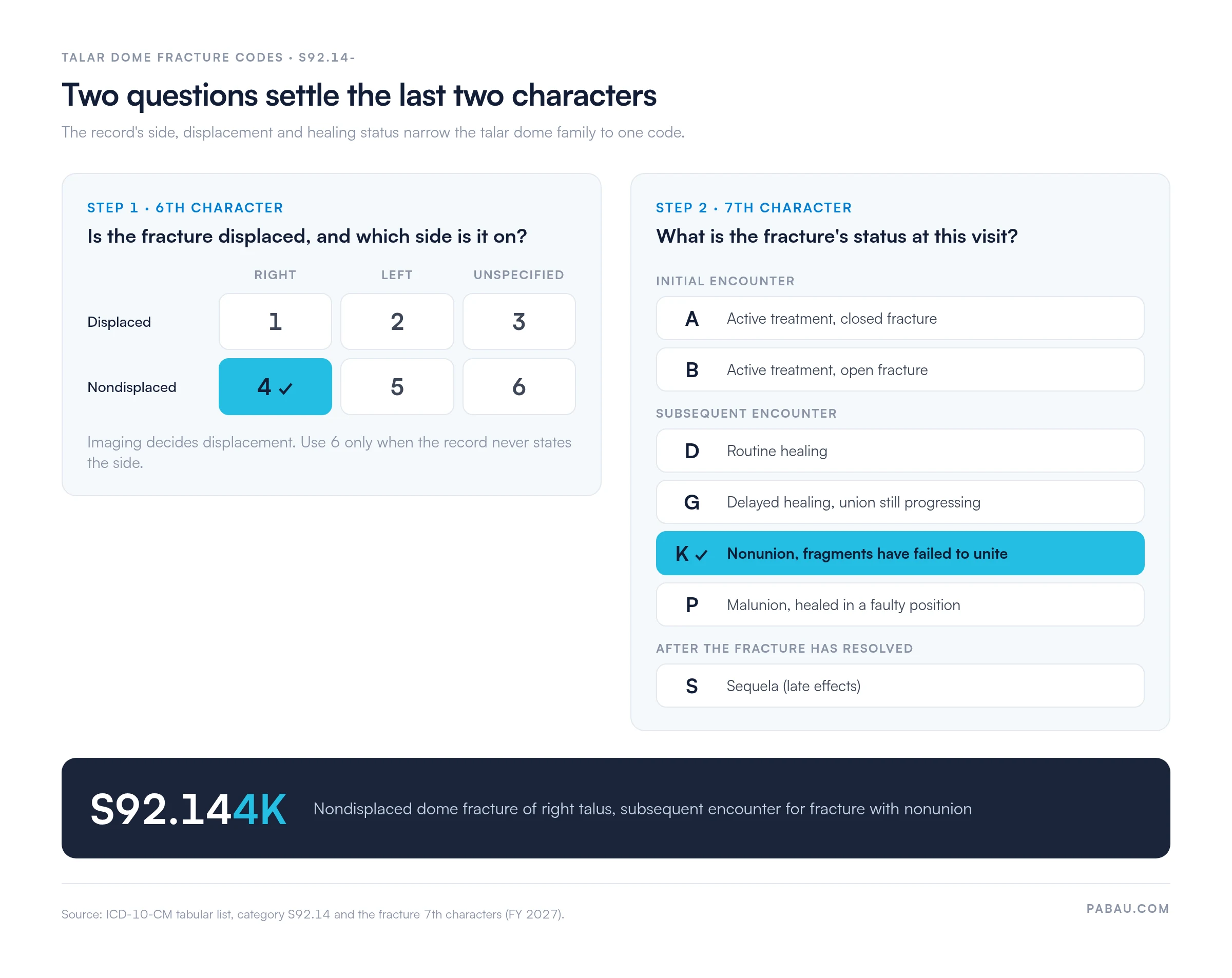
The 7th character K marks a subsequent encounter where the fracture has failed to unite. Routine follow-up during normal healing takes D instead, and mixing the two causes the most denials in orthopedic fracture billing.
According to the ICD-10-CM Official Guidelines for Coding and Reporting, Section I.C.19.c, the 7th character for fractures follows a defined set of meanings. Each character is mutually exclusive and must match the clinical status of the fracture at the time of the visit being coded.
Nonunion means the fracture has not healed and is unlikely to do so without intervention. Delayed healing (G) is a slower version of normal healing. Coding K when the record shows delayed but progressing union is an overcoding error. It misrepresents the clinical picture and exposes the practice to audit risk.
The talus sits between the tibia and fibula above and the calcaneus below. It carries body weight from the leg into the foot. Its dome is the upper, cartilage-covered surface that forms the ankle joint with the tibia.
Talar dome fractures most often follow an ankle sprain or twisting injury, when the dome is compressed or sheared against the tibia or fibula. Many are osteochondral injuries that damage both the cartilage and the bone beneath it. Nondisplaced ones are easy to miss on plain X-rays, so CT or MRI often confirms them.
Nonunion is a particular risk at this site. Most of the talus is covered by cartilage, so blood reaches it through a limited number of small vessels. That fragile supply is why a dome fragment can fail to unite even when it never moved. Smoking, diabetes and early weight-bearing add to the risk.
Nondisplaced talar dome fractures are usually managed without surgery at first, with a cast or boot and protected weight-bearing. That conservative path generates a series of subsequent encounters for boot changes, weight-bearing progression, and imaging review. Those are exactly the visits where encounter type selection becomes a billing risk.
ICD-10 Code S92.144K sits within a tightly grouped family of talus fracture codes. A wrong laterality, displacement or encounter type character is the usual documentation-to-code mismatch for these injuries.
The most frequent swap is with S92.145K, the same nonunion in the left talus. The table below maps the codes most often confused with S92.144K.
When reviewing records from a referring ED or urgent care, confirm which ankle was injured before coding the follow-up visit. Emergency notes often document side in the narrative but omit it from the structured problem list. Talar dome injuries are also often first recorded as a simple ankle sprain, so check the imaging report for the fracture site.
Payers reviewing a claim billed with ICD-10 Code S92.144K will look for specific clinical evidence in the visit note. Missing any of these elements is a common path to denial.
Orthopedic surgeons and physiatrists sometimes use “delayed union” and “nonunion” interchangeably in clinical notes. For coding, they are not interchangeable.
Delayed healing (7th character G) means healing is occurring more slowly than expected but the fracture is progressing toward union. Nonunion (7th character K) means healing has stopped or failed.
When the provider’s note is ambiguous, query before coding. Using K when the provider meant G creates an overcoding risk. Using G when the record supports K may understate the clinical complexity and affect reimbursement for further treatment.
Subsequent encounters for a talar dome fracture with nonunion typically involve fracture management, re-imaging and, when conservative care fails, surgery. The CPT codes below are commonly billed alongside ICD-10 Code S92.144K. Verify NCCI bundling edits for the current year before submission.
When CT confirms the nonunion, the scan bills as 73700. That radiology report is also the document a payer asks for first when it questions the K suffix, so keep it attached to the encounter.
Medicare Part B and most commercial payers apply medical necessity criteria to subsequent fracture management visits. Submitting ICD-10 Code S92.144K does not automatically establish medical necessity. The clinical record must justify why this follow-up visit was required and what clinical decision-making occurred.
Claims billed with ICD-10 Code S92.144K face a predictable set of denial patterns. Most trace back to one root cause. The 7th character was selected without enough documentation to support it.
Each denial comes back with a payer reason code. Our reference on denial codes for coders explains what the common ones mean and how to answer them.
Structured denial management workflows shorten the time between a denial and a corrected resubmission. Practices that track denial reasons by code family spot recurring documentation weaknesses before an auditor does.
The clean claim criteria for these fracture codes include correct encounter type, laterality, and a supporting documentation reference. Checking all three while coding costs far less than reworking a denial.
S92.144K is usually misapplied at three points: laterality, encounter type and the global period. These habits catch each one before the claim goes out.
Physical therapy and sports medicine practices treating talar dome fractures often inherit patients mid-recovery from orthopedic surgery or urgent care. Ask for the original treatment records before coding the first PT visit. The encounter type follows the fracture, not the provider. A PT visit is a subsequent encounter if the fracture received active treatment elsewhere first.
A talar dome nonunion can run through months of boot changes, scans and surgical decisions. Each visit is a fresh chance to send the wrong 7th character or a claim with no imaging behind it. Many orthopedic and physical therapy teams still catch those slips only when the denial arrives.
Pabau moves that check to the front of the process. Its claims software for orthopedic practices scrubs each claim for missing or invalid details before it leaves Pabau. Through the Claim.MD clearinghouse integration, it verifies coverage before the visit and transmits 837P claims to thousands of US payers.
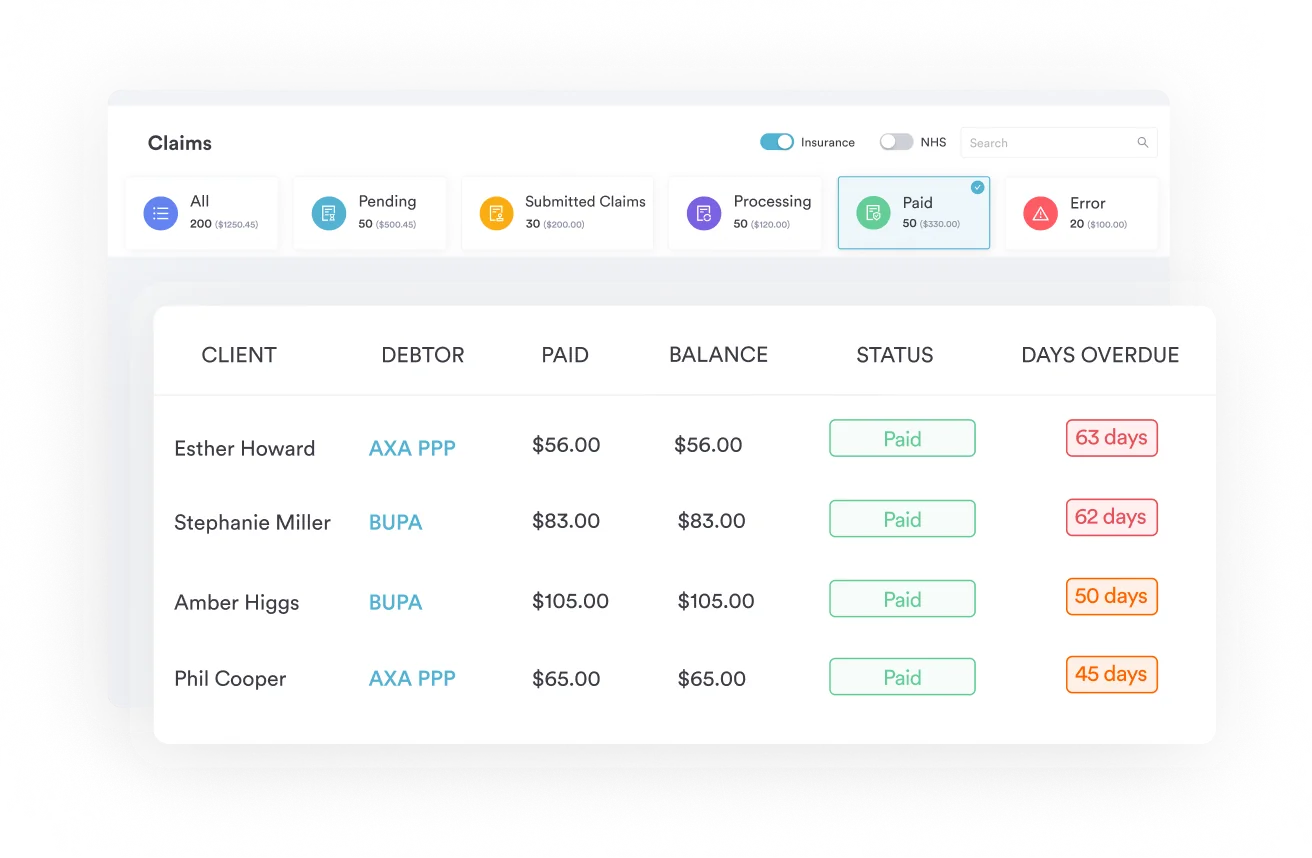
Electronic remittance advice flows back into Pabau and settles payments against the claims they belong to. A rejected claim shows its reason, so your billing team corrects the encounter type and resubmits the same day.

Pabau checks coverage before the visit, scrubs each claim before it leaves, and settles payments from remittance files. Orthopedic and sports medicine practices submit cleaner fracture claims and rework fewer denials.

S92.144K is only correct when four facts line up at the same visit. The fracture is on the right talar dome, it is nondisplaced, the encounter is subsequent, and imaging shows nonunion. If the note cannot support all four, query the provider before the claim goes out.
The cheapest fix is a healing-status prompt in every follow-up template, tied to a dated imaging reference. That one field turns the K suffix from a judgment call into a documented finding. It also protects the surgical claims that usually follow a talar dome nonunion.
A clean medical billing workflow keeps those checks in one place, from the coded visit to the paid claim. Book a demo to see how Pabau helps orthopedic practices get fracture follow-up claims paid on the first submission.

Want to understand how clearinghouse claim submission works? Medical claims clearinghouse guide explains the 837P transmission process from practice to payer.
Tracking a fracture claim from visit to payment? Revenue cycle management overview walks through each stage of the revenue cycle, from patient intake to collections.
ICD-10 Code S92.144K is a billable ICD-10-CM code for a nondisplaced dome fracture of the right talus. It applies at a subsequent encounter where nonunion has been identified. The talar dome is the upper surface of the ankle bone that meets the tibia. The code belongs to category S92 (fractures of foot and toe, except ankle) and is valid for fiscal year 2027 claims.
Yes. S92.144K is a valid, billable 7-character ICD-10-CM code listed in the CMS tabular list. Every fracture code in category S92 needs a 7th character, so S92.144 on its own is not billable.
Both codes describe a nondisplaced dome fracture of the right talus at a subsequent encounter. S92.144D is used when the fracture is healing normally, while S92.144K applies when it has failed to unite. Imaging evidence of nonunion is required to support the K suffix.
Use K when imaging confirms the fracture has failed to unite. Use G when healing is progressing but more slowly than expected. For talar dome fractures, CT or MRI is often needed to show whether the fragment has healed. When the provider’s note is ambiguous, query before coding.
The most common reasons are the wrong 7th character, missing imaging that shows nonunion, and medical necessity notes without clinical content. Laterality and site errors also cause denials. Examples include coding the right talus when the record names the left, or confusing the talus with the calcaneus. Most can be resolved on appeal with supporting documentation.



