ICD-10 Code S49.011P: Salter-Harris physeal fracture, right humerus, malunion
ICD-10 Code S49.011P: Quick reference ICD-10 Code S49.011P is the billable code ...

Last Updated: Oct 15, 2026
Billable Code Specific Code
S92.142G is the billable ICD-10-CM code for displaced dome fracture of left talus, subsequent encounter for fracture with delayed healing.
It applies to a follow-up visit after active treatment, when the provider documents that union is slower than expected. The 6th character 2 encodes both displacement and the left side, and the 7th character G encodes delayed healing. Routine healing takes D, nonunion takes K, and malunion takes P.
Let Pabau's smart automation suggest the right codes, reduce claim denials, and keep your practice compliant—effortlessly.
Automate repetitive tasks and focus on what matters most—your patients.
Reduce coding errors and ensure compliance with the latest regulations.
Clean claims, fewer denials, and faster reimbursements.
Powerful insights and reporting to help your practice thrive.
HIPAA compliant SOC 2 certified GDPR-compliant Trusted by 4,000+ clinics worldwide

S92.142G reports a follow-up visit for a displaced fracture of the left talar dome when the provider documents delayed healing.
The 6th character 2 carries both displacement and the left side. A nondisplaced left dome fracture is S92.145G instead.
The 7th character G means delayed healing only. Routine healing is D, nonunion is K, and malunion is P.
Do not report Z aftercare codes for traumatic fractures. Report S92.142G at each delayed-healing follow-up instead.
Lateral process fractures code to S92.19-, not the dome subcategory, and osteochondritis dissecans (M93.27-) is excluded.
Pabau, the practice management platform we build, sends claims to thousands of US payers through its Claim.MD integration.
ICD-10 Code S92.142G is a billable ICD-10-CM diagnosis code for a displaced fracture of the left talar dome. It is reported at a follow-up visit where the fracture is healing more slowly than expected. Its full official descriptor reads: Displaced dome fracture of left talus, subsequent encounter for fracture with delayed healing.
The code is listed in the CDC/NCHS ICD-10-CM web tool and on the CMS ICD-10 codes page. Both are the authoritative US references for code validity.
The talar dome is the curved upper surface of the talus. It sits under the end of the tibia and forms the floor of the ankle joint, so it carries body weight with every step. Articular cartilage covers most of it.
That anatomy shapes how these fractures heal. Much of the talus is covered by cartilage, which leaves limited room for blood vessels to enter the bone. That is one reason talar fractures can heal slowly. A displaced dome fragment also disturbs the joint surface, so follow-up usually relies on ankle imaging to judge union.
The ICD-10-CM tabular codes each talar site separately:
A lateral process fracture, often called a snowboarder’s fracture, codes to S92.19-, not to the dome subcategory. Confirm the site from the imaging report before choosing any S92.1- code.
Each character in S92.142G carries a distinct meaning. Misreading characters 6 or 7 is the most common reason a claim on this code family is returned.
The 6th character does two jobs on this subcategory. Values 1 to 3 mean displaced, for the right, left, and unspecified side. Values 4 to 6 mean nondisplaced, in the same order. S92.142_ is therefore always a displaced fracture of the left talar dome, and no separate side code is needed.
The 7th character on S92.142G tells the payer the encounter type and, at a follow-up, how the fracture is healing. Category S92 uses the seven values below. Displacement is never carried by the 7th character on this code.
G sits between D and K. Use it when the provider documents that union is slower than expected but still progressing. If a later note states that the fracture has failed to unite, the code moves to S92.142K. ICD-10-CM leaves that judgment to the provider, so a coder should not infer it from the weeks since the injury. The map below traces each character back to the visit type and the note.
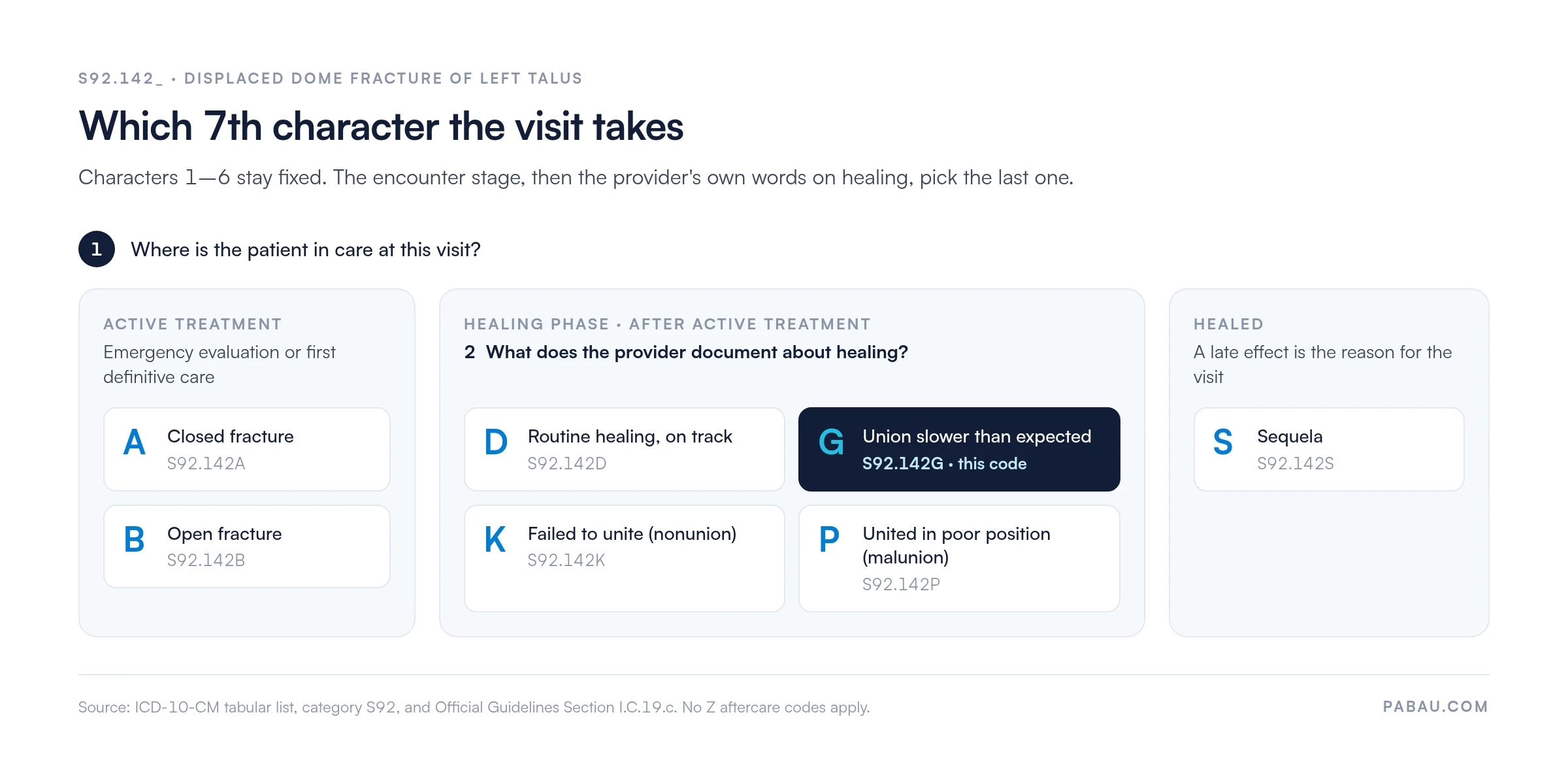
ICD-10-CM Official Guidelines Section I.C.19.c state that aftercare Z codes are not used for traumatic fractures. The fracture code with the correct 7th character is reported for each visit in the healing phase instead.
Some practices still reach for Z47.89 out of habit from ICD-9 workflows. A payer can then reject the claim, because the visit belongs to a fracture code. For a follow-up where the left talar dome fracture is healing slowly, report S92.142G. Submitting a clean claim starts with the fracture code on every follow-up.
The codes most often mixed up with ICD-10 Code S92.142G differ by one character or by fracture site. The table below shows when each one applies instead.
Before submitting any S92.142_ claim, check two characters against the note. The 6th must match the documented displacement and side. The 7th must match the visit type and the healing status the provider recorded.
The clinical note must support every element encoded in ICD-10 Code S92.142G. Payers compare the code’s attributes with the documentation during audit. A missing element can trigger a denial or a request for records.
The record must state “left” explicitly. If the note only says “the ankle” or “the foot,” the side is unsupported. Right-sided injuries take S92.141G. Software that links the clinical note to billing can flag a side mismatch before the claim goes out.
The imaging report or provider note should confirm a displaced fragment. Under the guidelines, a fracture not documented as displaced or nondisplaced defaults to displaced. That default applies only when the record is silent, so query the provider if the imaging report and the note disagree.
The talar dome must be named as the fracture site. “Talus fracture” or “ankle fracture” alone does not support S92.14-. An unspecified talus fracture codes to S92.10-, and a lateral process fracture codes to S92.19-.
The provider must document that healing is slower than expected, for example “delayed union” or “slow consolidation on CT.” A note describing routine progress supports D, not G. A note stating that the fracture has failed to unite supports K.
The visit must fall after active treatment has ended. Follow-up imaging, cast or boot checks, and changes to weight-bearing fit a subsequent encounter. Emergency evaluation or the first definitive treatment does not.
The patient record should include the initial encounter documentation, such as the ER note, the original imaging report, and the diagnosis. That record shows why the follow-up exists. Claims with no traceable prior encounter are often flagged during post-payment audit.
The service rendered, not the diagnosis, decides the CPT code. Still, the subsequent encounter encoded in S92.142G should line up with what is billed. A delayed-healing visit usually includes imaging to check union. The talar dome is assessed on ankle views, such as the complete series billed as CPT 73610.
For US practices, Pabau offers streamlined claims management through its Claim.MD clearinghouse integration. It runs real-time eligibility checks before the visit and validation checks on required claim details before each submission. Claim statuses and ERA remittances then come back into the same dashboard.
S92.142G is a subsequent encounter code, so payers expect the initial fracture care to be on file. A delayed-healing code can also prompt questions about extra imaging. Requirements vary by payer, but these patterns are common.
Treat these as general patterns. Plan rules change each year, so confirm them against each payer’s LCD, NCD, or policy documents.
Most denials on S92.142G claims trace back to a handful of avoidable errors. Knowing the pattern lets billing staff catch them before submission rather than in the remittance. Good denial management workflows log each denial reason so patterns surface early. The full list of billing denial codes maps each CARC denial reason to a root cause and a corrective action.
The governing authority for S92.142G is the ICD-10-CM Official Guidelines for Coding and Reporting, Section I.C.19.c, Coding of traumatic fractures. The guidelines are updated each fiscal year and published through the Centers for Medicare and Medicaid Services. The rules most relevant to this code are:
The AAPC ICD-10-CM code lookup and the ICD List code browser both cross-reference the tabular and index entries for S92.142G and its S92.14- siblings. Check the guidelines for the current fiscal year, as annual updates may change character rules. A broader grounding in medical billing fundamentals keeps your coding and billing workflows aligned.
Delayed-healing visits create more paperwork than routine ones. There are extra radiographs, CT orders, and often a referral, and each one has to line up with S92.142G on the claim.
Pabau keeps the clinical note, imaging reports, and invoice on one patient record. The coder can read the provider’s wording on healing before choosing the 7th character. Claims then go out through Claim.MD after a real-time eligibility check.
Denied claims come back flagged for rework in the same claims dashboard, so your team fixes them in one place. That means fewer resubmissions and faster payment on follow-up visits.

Pabau sends claims to thousands of US payers through Claim.MD and checks eligibility in real time. It also runs validation checks on claim details before submission, and flags denied claims for rework.

S92.142G is narrow by design. It describes one side, one talar site, a displaced fragment, and delayed healing, and each fact must be in the record. The 7th character carries the most risk. The provider’s own words on healing decide between D, G, K and P, so read the note rather than counting weeks.
Keep Z aftercare codes off fracture follow-ups, confirm the side on every note, and send lateral process fractures to S92.19-. To see how Pabau handles a follow-up claim from eligibility check to ERA, book a demo.

Need to understand denial patterns for ICD-10 claims? Denial management in healthcare walks through root-cause analysis and corrective workflows for common payer rejections.
Want to validate ICD-10 codes before the claim reaches your payer? Claim.MD clearinghouse overview explains how real-time eligibility checks and electronic claims through Claim.MD reduce rework on orthopedic claims.
Building a cleaner billing process for musculoskeletal visits? Revenue cycle management fundamentals covers the end-to-end workflow from encounter to collected payment.
ICD-10 Code S92.142G means a displaced dome fracture of the left talus, reported at a subsequent encounter where the fracture shows delayed healing. Use it for follow-up visits after active treatment, when the provider documents slower-than-expected union.
The 7th character G means a subsequent encounter for a fracture with delayed healing. The patient has finished active treatment, and union is slower than expected. D means routine healing, K means nonunion, and P means malunion. Displacement is coded in the 6th character, not the 7th.
A subsequent encounter is coded with the fracture code and a healing-phase 7th character, such as D or G for this code. Aftercare Z codes are not used for traumatic fractures. ICD-10-CM Official Guidelines Section I.C.19.c require the fracture code with the correct 7th character for each healing-phase visit.
No. The left side is already built into the 6th character. On S92.14-, 1 is displaced right, 2 is displaced left, and 3 is displaced with the side unspecified. Values 4 to 6 repeat that order for nondisplaced fractures. Confirm the side in the note before choosing the code.
The most common reason is a 7th character that does not match the note, such as D or A on a delayed-healing visit. Others include a Z aftercare code in place of S92.142G, an undocumented left side, and a dome code used for a lateral process fracture. Imaging billed without a stated reason for checking union also draws denials.
The note must document a left-sided injury, a fracture of the talar dome, and displacement on imaging. It must also show a follow-up visit after active treatment, with delayed healing stated by the provider. The initial encounter record should be on file and linked to the injury.