CPT code 63081: Vertebral corpectomy, cervical spine
CPT code 63081: official descriptor and procedure overview CPT code 63081 descri...

Last Updated: Oct 6, 2026

CPT Code 73700 covers computed tomography of the lower extremity without contrast material, including the leg, knee, ankle, and foot.
Three codes share that region: 73700 without contrast, 73701 with contrast, and 73702 with and without contrast.
Picking the wrong contrast variant is the top denial driver on lower extremity CT claims.
The 2026 Medicare national average is roughly $130.26, and the facility and non-facility rates match.
Documentation must name the ordering provider, the clinical indication, the medical necessity, and any reason contrast was withheld.
CPT Code 73700 is the billable code for computed tomography of the lower extremity performed without contrast material. It covers the leg, knee, ankle, and foot, and it is reported once per study session. The contrast decision is what separates it from 73701 and 73702, and it is the variable coders get wrong most often.
This guide covers the official descriptor, the clinical indications, the modifier logic, the 2026 Medicare rates, and the ICD-10 codes that support medical necessity. It also shows how one non-contrast CT ends up as a single, correctly modified line on the claim.
Official descriptor: Computed tomography, lower extremity; without contrast material.
CPT Code 73700 is assigned when a CT scan of the lower extremity runs without any intravenous contrast agent. The AMA CPT code set places it in the Radiology section. It applies to imaging of the leg, knee, ankle, or foot.
The “lower extremity” designation covers the whole limb below the pelvis. The specific area imaged belongs in the clinical record, but it does not change the code you report.
The code is reported once per study session, not once per anatomical sub-region. If both lower extremities are imaged, modifiers LT and RT or modifier 50 apply.
Contrast is the only difference between the three codes. All three describe the same anatomical region, so the acquisition protocol decides which one goes on the claim.
If contrast was planned but withheld for patient factors, the clinical record has to say so. Billing 73700 is still correct in that scenario. The documentation simply needs to explain why contrast was withheld, such as a documented allergy or renal insufficiency.
Non-contrast CT is appropriate whenever the clinical question can be answered without vascular or soft-tissue enhancement. The AAPC CPT code lookup references 73700 across orthopedic, podiatric, and sports medicine settings.
Common appropriate use scenarios include:
Non-contrast is generally preferred when renal function is compromised or a contrast allergy is documented. Some payers require prior authorization for lower extremity CT. Document the clinical indication before the study is ordered, so the request has support behind it.
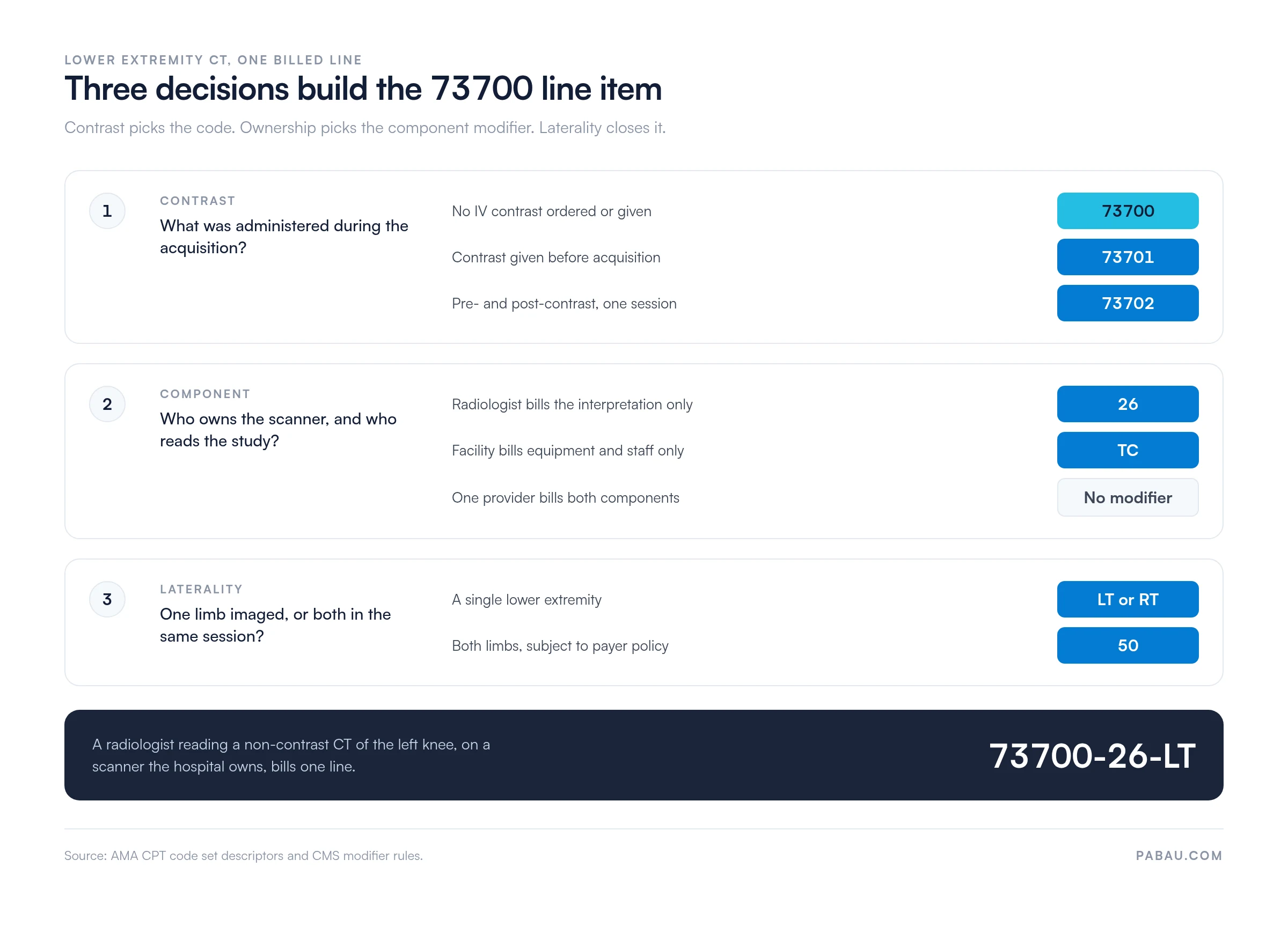
Three variables drive modifier selection for 73700: equipment ownership, interpretation, and laterality. Attaching the wrong modifier is one of the most common reasons radiology claims get denied or downcoded.
When the interpreting radiologist and the technical facility are separate entities, both bill 73700. One line carries modifier 26 and the other carries modifier TC. Billing global when a split applies is a compliance risk, so verify the approach against current NCCI edits and payer policy.
Read together, the three decisions produce one coded line rather than three separate choices.
Medicare payment for 73700 varies by geographic locality. The CMS Physician Fee Schedule lookup tool is the authoritative source for current rates. The figures below are national averages, so confirm your own locality before posting an expected payment.
Unlike most codes on the fee schedule, 73700 carries no facility differential. CMS pays the same national average whether the study happens in a hospital or an independent imaging center. So a facility rate that differs from the non-facility rate in your billing system is a setup error, not a payer rule.
The split between the two components is worth knowing before you reconcile a remittance. The technical component carries roughly 60% of the payment, and the professional component the remaining 40%.
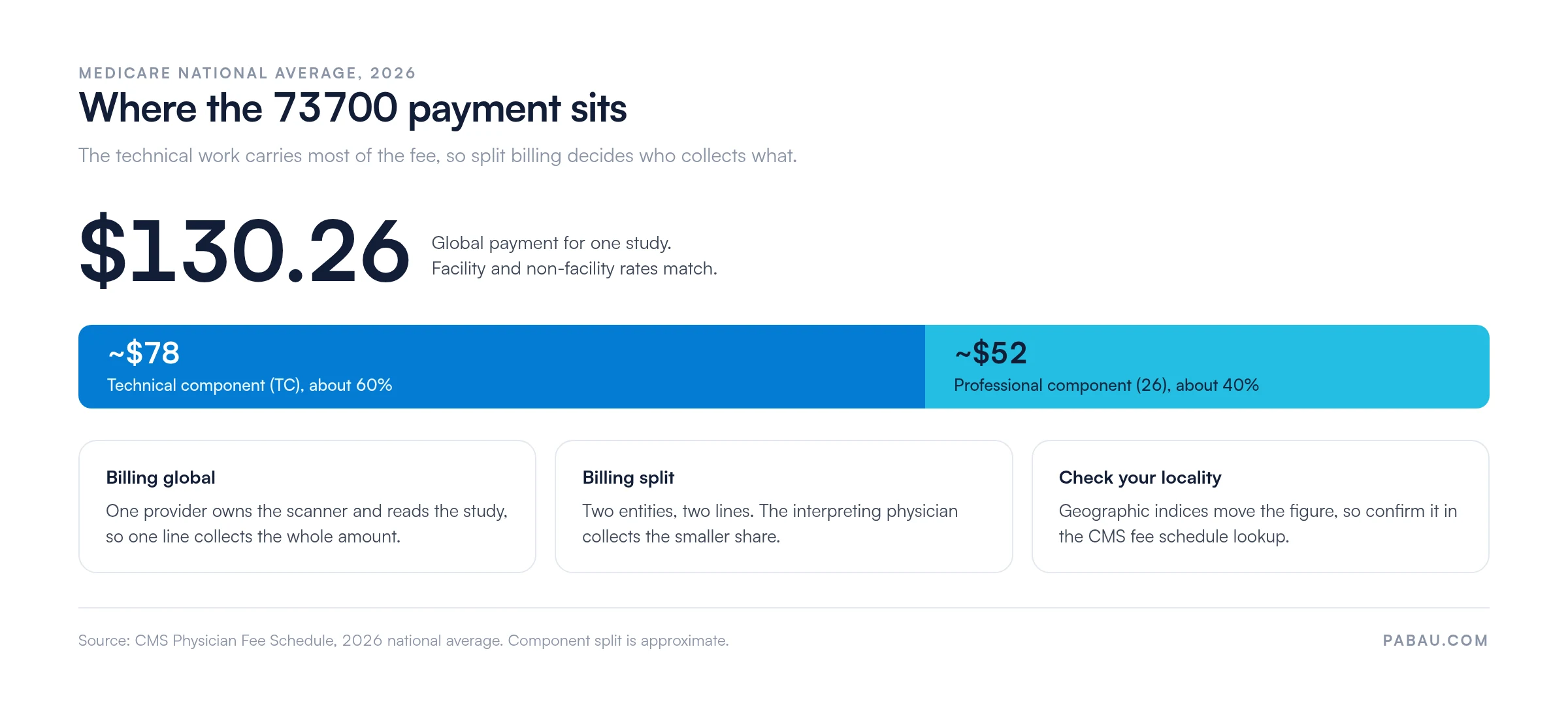
Geographic payment localities move these figures, so check the work, practice expense, and malpractice RVU values that apply to your area. Validating each line against your payer-specific fee schedule catches a stale rate before the claim leaves the practice.
Verify 73700 rates against the CMS fee schedule for the current calendar year before quoting reimbursement to patients or administrators. Medicare updates the schedule each January 1. A rate cited in an internal billing guide can go stale within weeks of a new year.
Incomplete documentation is the second most common reason 73700 claims are denied. Payers look for specific elements to establish medical necessity, and a missing element can trigger a records request or an outright rejection. Build the record at the point of order, not at the point of submission.
A complete 73700 claim requires documentation of all of the following:
Capturing these elements when the study is ordered removes most back-end rework. When the clinical note travels with the claim, the payer has less reason to ask for records before it pays.
The ICD-10-CM diagnosis code on the claim must support the medical necessity of 73700. Not every diagnosis code is accepted by every payer for lower extremity CT. Confirm coverage against the payer’s local coverage determination before submission.
A non-specific symptom code such as M79.671 needs strong supporting documentation behind it. Payers approve 73700 more readily when a structural diagnosis accompanies the claim. Work with your ordering providers to capture the most specific diagnosis available at the time of imaging.
Laterality and encounter character are where these codes are most often mistyped. When the documentation names a diagnosis outside the list above, the ICD-10-CM code index is the place to check both.
The National Correct Coding Initiative (NCCI) publishes quarterly updates to bundling edits. Those edits govern how 73700 interacts with other codes billed on the same date of service, and violating one triggers an automatic rejection.
Key bundling considerations for CPT Code 73700:
NCCI edit tables change four times a year, so review your radiology codes each quarter. An edit that did not apply last quarter may be active today.
Radiology billing is denial-prone because contrast status, laterality, split billing, and add-on codes all have to align on one line. Each of the errors below is visible before submission if someone checks for it.
The most frequent errors on CPT Code 73700 claims:
Pre-submission scrubbing catches most of these before the claim reaches the payer. The two checks that pay for themselves are contrast code against the acquisition record, and modifier against place of service.
Coders working with lower extremity CT regularly meet related codes in the same region or modality family. The table below lists the most common companions and crosswalk references to CPT Code 73700.
When the clinical question is ligament or cartilage detail rather than bone, 73721 is usually billed instead. Confirm the modality with the ordering provider before you code, because a CT and an MRI of the same joint answer different questions.
Radiology billing has more moving parts than most outpatient specialties. Split billing between components, quarterly NCCI updates, and payer-specific prior authorization rules all land on the same claim. So does modifier logic that changes with place of service.
Most practices find these problems on the remittance, weeks after the claim went out. Practice management software like Pabau moves the check forward instead. Pabau’s claims software for radiology connects to the Claim.MD clearinghouse and validates each claim before it is submitted.
The validation covers modifier logic, NCCI edit compliance, and diagnosis-to-procedure pairing. A 73700 line billed global when the hospital owns the scanner gets flagged inside the practice. You fix it once, rather than appeal it later.
For orthopedics, sports medicine, and podiatry, one record holds the appointment, the clinical note, the codes, and the remittance. That means fewer touches per claim, so your team spends less of the month chasing paperwork on high-volume imaging codes.

Pabau’s claims management connects to Claim.MD to validate CPT codes, flag modifier errors, and submit clean claims before they reach a payer. See how it works for orthopedic and radiology practices.

73700 is a precision code. Contrast alone decides which of three sibling codes applies, and the wrong pick generates a denial before a human reviewer ever sees the claim.
Get the contrast, the component, and the laterality right at the point of coding, and the rest of the claim follows. That discipline is worth more than a strong appeal process, because the cheapest denial is the one that never happens.
Book a demo to see how Pabau flags a bad modifier on a 73700 line before the claim ever leaves your practice.

Managing claim denials across your practice? Denial management in healthcare covers strategies for identifying, appealing, and preventing the most common claim rejections.
Working through a rejection on a radiology claim? Denial codes in medical billing explains what the most common codes mean and what each one asks you to fix.
Need to understand how clearinghouse pricing works? Claim.MD pricing guide breaks down how clearinghouse fees are structured and what to compare when evaluating options.
Brushing up on medical billing fundamentals? What is medical billing covers the end-to-end cycle from charge capture through payment reconciliation.
CPT Code 73700 is the billing code for computed tomography of the lower extremity performed without contrast material. It covers CT imaging of the leg, knee, ankle, or foot when no intravenous contrast agent is given during the acquisition. The code is maintained by the AMA and sits in the Radiology section of the CPT code set.
73700 is without contrast, 73701 is with contrast, and 73702 covers both pre- and post-contrast phases. The three codes are mutually exclusive for the same extremity on the same date. Select the one that matches what the technologist acquired. Billing the wrong variant is the most common denial trigger for lower extremity CT claims.
The 2026 Medicare national average for CPT 73700 is roughly $130.26 for the global service, and the facility and non-facility rates match. The professional component alone is around $52, and the technical component around $78. Rates vary by locality and change each January 1, so verify them in the CMS Physician Fee Schedule lookup tool.
Common ICD-10-CM pairings include M84.369A for a tibial stress fracture and M86.169 for acute osteomyelitis. Others are Q66.89 for tarsal coalition, C40.20 for a bone neoplasm, and S82.101A for a proximal tibial fracture. The diagnosis code must support medical necessity for non-contrast CT specifically. Payer local coverage determinations may restrict which codes are covered, so verify before submission.
Yes, in many cases. CPT 76377 can be appended to 73700 when the interpreting physician generates and reviews 3D reconstructions as part of the study. The radiology report must document that 3D images were produced and used in the interpretation. Coverage is payer-specific, so verify against current NCCI edits before billing the combination.
CPT Code 73700 is the correct code for a CT scan of the knee performed without contrast material. The code covers any portion of the lower extremity, including the knee. Append modifier LT or RT to indicate laterality. If both knees are imaged in the same session, use modifier 50 or bill two line items per payer instructions.