

HCPCS Code L0472: Hyperextension TLSO billing guide
HCPCS code L0472: Official descriptor and device definition HCPCS code L0472 des...

Last Updated: Nov 5, 2026
29892 is the CPT code for arthroscopically aided repair of a large osteochondritis dissecans lesion, talar dome fracture or tibial plafond fracture. Internal fixation is optional, and the arthroscopy is included in the code.
The code needs repair or fixation of the lesion or fracture itself. Drilling or microfracture of a talar defect is reported with 29891, and debridement alone with 29897 or 29898. The operative note should state the lesion size and the side, and the ICD-10 code must match the documented finding.
Let Pabau's smart automation suggest the right codes, reduce claim denials, and keep your practice compliant—effortlessly.
Automate repetitive tasks and focus on what matters most—your patients.
Reduce coding errors and ensure compliance with the latest regulations.
Clean claims, fewer denials, and faster reimbursements.
Powerful insights and reporting to help your practice thrive.
HIPAA compliant SOC 2 certified GDPR-compliant Trusted by 4,000+ clinics worldwide

CPT 29892 covers arthroscopically aided repair of a large OCD lesion, talar dome fracture or tibial plafond fracture, with or without internal fixation.
Drilling or microfracture of a talar defect is 29891, and debridement alone is 29897 or 29898, so the operative note decides the code.
The operative note must describe the OCD lesion as large, or 29892 is unsupported.
Most payers require modifier -LT or -RT, and a missing laterality modifier is a frequent denial reason.
Pabau’s claims management builds CMS-1500 claims from invoices, checks eligibility in real time and tracks claim status.
CPT code 29892 reports arthroscopically aided repair of a large osteochondritis dissecans (OCD) lesion, talar dome fracture or tibial plafond fracture. Internal fixation is optional, and the arthroscopy itself is included in the code.
The code sits in the 29800-29999 endoscopy/arthroscopy subsection of the CPT code set. The American Medical Association (AMA) maintains the official descriptor. CPT® is a registered trademark of the AMA.
Official AMA descriptor: Arthroscopically aided repair of large osteochondritis dissecans lesion, talar dome fracture, or tibial plafond fracture, with or without internal fixation; includes arthroscopy.
Three clinical scenarios support this code, and the operative note has to show which one applies.
Ankle arthroscopy claims put 29892 next to 29891 and the debridement codes. The operative note settles which one applies on every claim.
The procedure involves arthroscopic visualization of the ankle joint followed by repair of the lesion or fracture. The operative note must describe the findings, the lesion size, and the repair.
Core documentation elements for CPT 29892:
With or without internal fixation means the code is reported whether or not screws or other hardware are placed. Do not report a separate fixation code alongside 29892, because hardware placement is already included.
A frequent miscoding error in ankle arthroscopy is reporting 29892 when 29891 or 29898 is correct. So the distinction is what the surgeon did to the lesion. CPT 29892 needs repair or fixation of the lesion or fracture. CPT 29891 covers excision of an osteochondral defect, including drilling or microfracture, while 29897 and 29898 cover debridement only.
Key decision rule: If the note describes repair or fixation of the lesion or fracture, report 29892. If the defect was excised and drilled or microfractured, report 29891. If the note describes debridement only, report 29897 (limited) or 29898 (extensive).
The chart below maps each operative-note finding to its code.
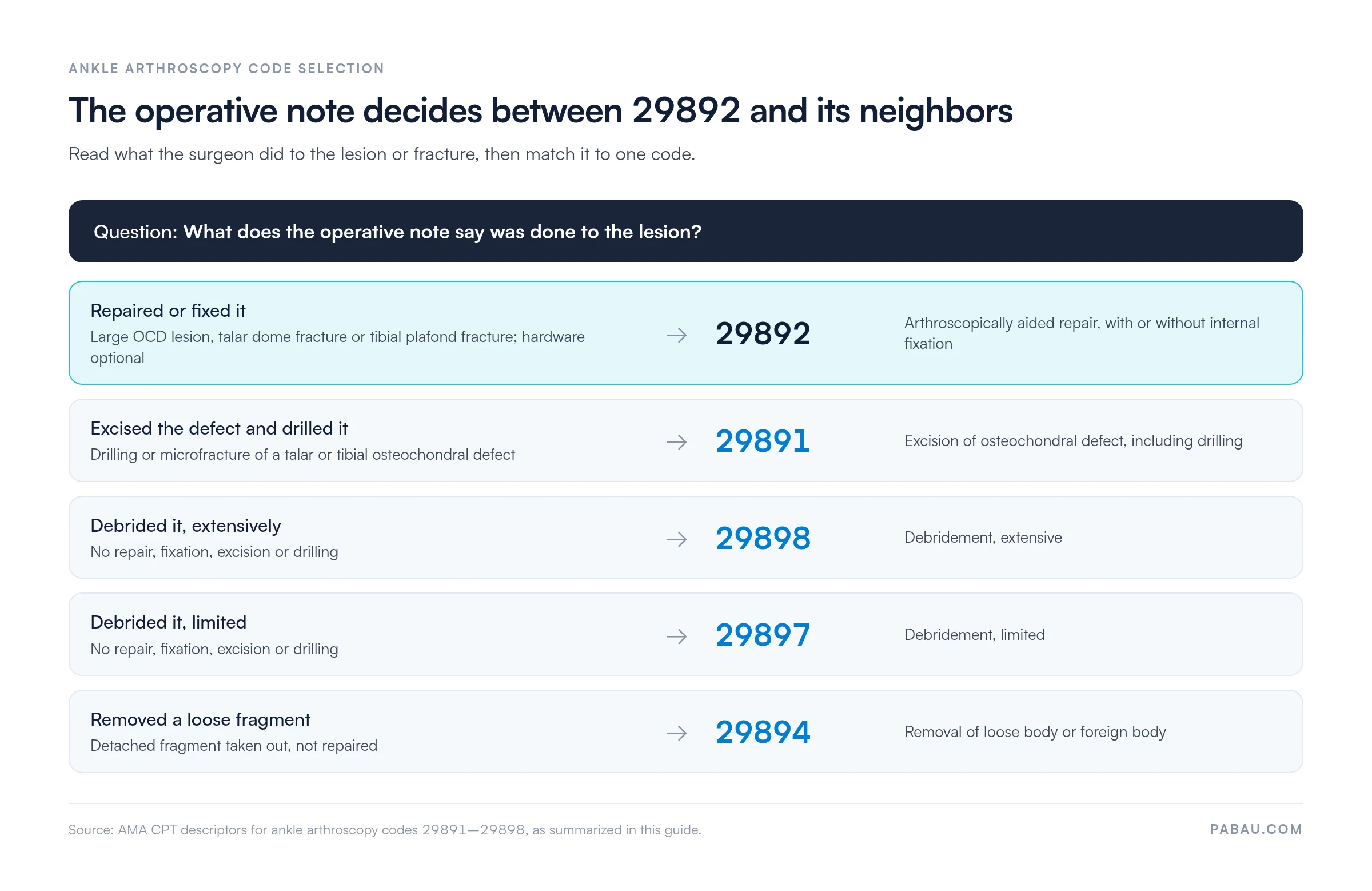
Before submitting a 29892 claim, re-read the operative note with one question in mind: Does it describe what was repaired or fixed, and how? If the note describes drilling or microfracture of the defect, the code is 29891. If it describes debridement only, the code is 29897 or 29898.
Payer medical necessity review for CPT 29892 starts with the diagnosis code. Linking the wrong ICD-10 code, or using a non-specific code when a more precise one is available, is a primary denial trigger. The diagnosis must match the clinical finding documented in the operative note.
Commercial payers often require prior authorization for ankle arthroscopy. Include MRI findings documenting lesion size and evidence that conservative treatment, such as physical therapy or immobilization, failed. Medicare has no national coverage determination (NCD) specifically for ankle arthroscopy. Coverage falls to MAC-issued Local Coverage Determinations (LCDs), which vary by region.
Modifier errors are also a common cause of 29892 denials. The table below covers the modifiers most relevant to this code, when each applies, and what happens when one is misapplied.
However, modifier rules are not universal. Some commercial payers do not require -LT/-RT, while Medicare and most MACs do. Check laterality modifier rules against your payer contracts before assuming either way.
Medicare pays CPT code 29892 under the Medicare Physician Fee Schedule (MPFS), published annually by the Centers for Medicare and Medicaid Services (CMS). The figures below come from the CY2026 CMS PFS relative value file.
However, geographic payment localities change the dollar amount received for CPT code 29892. For example, a practice in a high-cost urban locality receives more than one in a rural locality, even though the RVUs are identical. Always apply your own locality when calculating expected reimbursement.
MACs govern Medicare coverage for ankle arthroscopy through Local Coverage Determinations (LCDs). Not all MACs have published an active LCD specifically for ankle arthroscopy procedures, so coverage criteria may default to general medical necessity standards. Check with your MAC before the procedure.
Yet for commercial payers, prior authorization is standard practice. The authorization package usually includes imaging confirming the lesion or fracture, documentation of failed conservative treatment, and the proposed surgical approach. A consistent prior authorization process keeps those documents together before the request goes out.
Submit the ICD-10 code that exactly matches the authorized diagnosis. A mismatch between the authorized diagnosis and the claim diagnosis therefore invites a denial.
Standardized prior authorization packets for high-volume surgical codes cut rework on every case. Submitting clean claims for ankle arthroscopy starts before the authorization request, not after the procedure.
Denials for CPT 29892 follow predictable patterns. Still, most are preventable with a pre-submission checklist applied to every claim.
Systematic denial management workflows that track denial codes by CPT code help billing teams catch patterns early. A CO-4 denial (procedure code inconsistent with modifier) on repeated 29892 claims signals a systematic modifier issue, not a one-off keying error. Knowing the common medical billing denial codes helps you decide which denials to appeal and which to correct and resubmit.
Build a 29892 pre-submission checklist: (1) Laterality modifier present? (2) ICD-10 code matches the operative note finding and side? (3) Lesion documented as large? (4) Repair or fixation documented, not only drilling or debridement? (5) Authorization number on file? (6) No fixation code billed separately? Run these six checks before every submission.
Where CPT 29892 is performed determines how payers calculate reimbursement for both the surgeon and the facility. The billing rules differ greatly between an ambulatory surgery center (ASC) and a hospital outpatient department.
Billing teams with high ASC volume should confirm each year that CPT 29892 is still on the ASC Covered Procedures List. Check that its payment indicator has not changed, too. Knowing medical billing basics matters for practices that work across several facility types.
Many orthopedic billing teams code 29892 from the operative note, key the claim into a separate system, and check coverage by phone or payer portal. Each handoff, however, is another chance to drop a laterality modifier or attach the wrong encounter code.
Pabau, the practice management platform we build, keeps that work in one system. Its claims management software builds CMS-1500 claims from invoices through its Claim.MD clearinghouse integration. It checks eligibility in real time before the procedure date and tracks each claim’s status after submission.
Remittances match back to the claims they pay, so an underpaid or denied 29892 claim surfaces while the operative note is still fresh. Your coders still choose the code and modifiers, and Pabau shortens the submission and follow-up work around them.
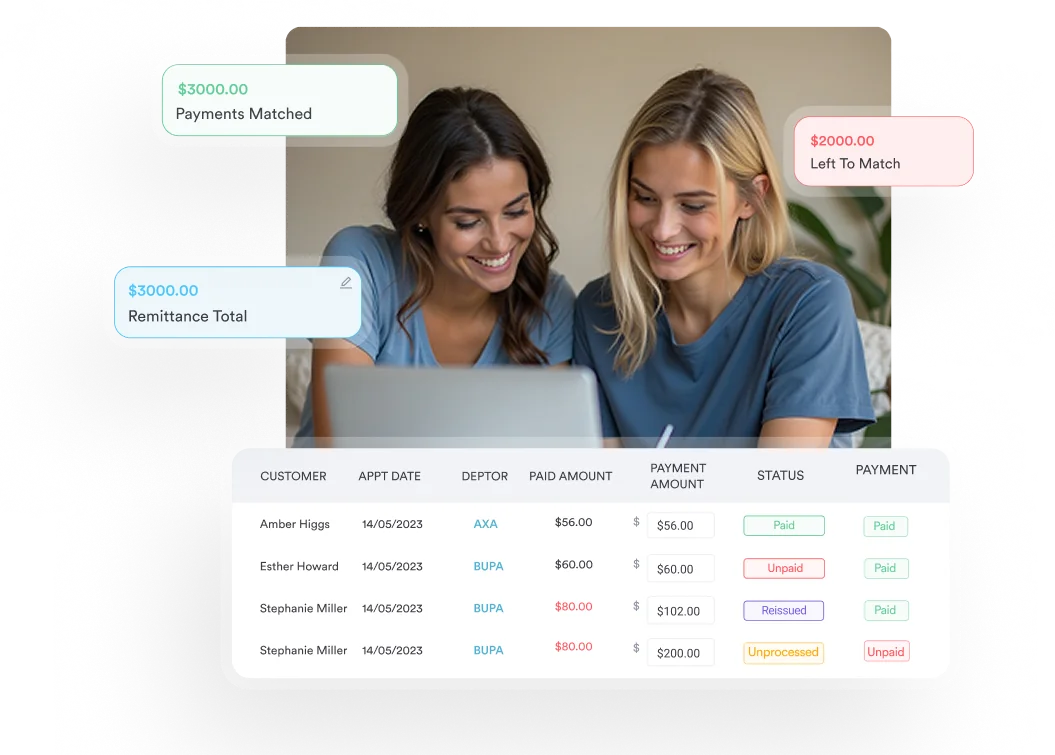

Pabau builds CMS-1500 claims from invoices, checks eligibility in real time and tracks the status of each claim. Your team spends less time chasing 29892 payments.

The 29892 decision rests on one line of the operative note: what the surgeon did to the lesion. First, repair or fixation supports 29892. Second, drilling or microfracture points to 29891, and debridement alone points to 29897 or 29898.
Settle that before you build the claim, then confirm lesion size, laterality and the matching ICD-10 code. That extra minute per case costs far less than reworking a denied 090-day surgical claim.
Pabau’s claims management builds CMS-1500 claims from invoices, checks eligibility in real time and tracks claim status after submission. Book a demo to see how Pabau can shorten follow-up on your orthopedic surgical claims.

Need a framework for managing claim denials across codes? Denial management in healthcare covers systematic workflows for tracking, appealing, and preventing denials by CPT code.
Billing multiple procedures on the same surgical date? Submitting clean claims explains how to structure multi-procedure claims to pass payer edits on the first submission.
Working with a US clearinghouse for the first time? Understanding medical claims clearinghouses outlines how clearinghouse validation catches errors before claims reach payers.
Filing the surgeon’s professional claim? CMS-1500 form template gives you the claim form surgeons use for 29892.
Preparing an authorization request for ankle surgery? Medical prior authorization form gives you a ready template for the request packet.
CPT code 29892 covers arthroscopically aided repair of a large osteochondritis dissecans (OCD) lesion, a talar dome fracture or a tibial plafond fracture. Internal fixation is optional, and the arthroscopy is included rather than reported separately. Report debridement alone with 29897 or 29898, and drilling or microfracture of the defect with 29891.
Medicare pays CPT 29892 on 17.89 total RVUs in CY2026. At the $33.4009 conversion factor, that is about $597.54 nationally before locality adjustment, or $600.52 for qualifying APM participants. Facility and non-facility totals are identical, so the setting does not change the surgeon’s fee. Then check your MAC locality in the CMS Physician Fee Schedule lookup for the exact amount.
Modifier -LT or -RT identifies the side, and Medicare and most commercial payers require it on ankle procedures. Modifier -51 applies when you bill 29892 with other procedures on the same date, appended to the secondary code. Modifier -59 marks a distinct, separately documented service that NCCI edits would otherwise bundle. Modifier -22 applies when the procedure was substantially more complex than usual, supported by the operative note.
Billing CPT 29892 with other ankle arthroscopy codes, such as 29891 or 29894-29898, triggers NCCI bundling edits. Some combinations allow modifier -59 when both procedures were distinct and separately documented. Review the NCCI edit table for each code pair before billing, and make sure the operative note documents both procedures independently.



