ICD-10 Code Y76.0: Diagnostic obstetric and gynecological devices
ICD-10 Code Y76.0: Definition and billable status ICD-10 Code Y76.0 is a valid, ...

Last Updated: Oct 23, 2026
Billable Code Specific Code
S92.021A is the billable ICD-10-CM code for displaced fracture of anterior process of right calcaneus, initial encounter for closed fracture.
Coders submitting claims for this presentation need the full seven-character code, not the truncated S92.021 parent code, to satisfy payer requirements under HIPAA.
The table below summarizes the key attributes of ICD-10 code S92.021A for quick reference.
Let Pabau's smart automation suggest the right codes, reduce claim denials, and keep your practice compliant—effortlessly.
Automate repetitive tasks and focus on what matters most—your patients.
Reduce coding errors and ensure compliance with the latest regulations.
Clean claims, fewer denials, and faster reimbursements.
Powerful insights and reporting to help your practice thrive.
HIPAA compliant SOC 2 certified GDPR-compliant Trusted by 4,000+ clinics worldwide

ICD-10 code S92.021A describes a displaced fracture of the anterior process of the right calcaneus, initial encounter for closed fracture.
S92.021A is billable and valid for FY2026 (October 1, 2025 through September 30, 2026) for HIPAA-covered transactions.
The seventh character A signals active treatment at the initial encounter. Switching to D, G, K, P, or S depends on the phase of care.
Four elements must appear in the note: Fracture site, laterality, displacement status, and encounter phase.
Pabau’s claims management software integrates with Claim.MD to streamline submission of calcaneus fracture claims.
The calcaneus, commonly called the heel bone, is the most commonly fractured tarsal bone. Its anterior process is a bony projection at the front of the calcaneus that articulates with the cuboid bone. This small area is the attachment point for both the bifurcate ligament and the extensor digitorum brevis muscle.
Fractures here tend to result from one of two mechanisms. The first is an avulsion injury caused by sudden tension on the bifurcate ligament, typically during inversion of the foot. The second is a compressive force driving the cuboid into the anterior process. Both are common in athletic and occupational settings.
The anatomy matters at the keyboard as much as at the bedside. Documentation of the fracture site has to be precise. A vaguer note collapses this code into the generic calcaneus and ankle injury codes beside it.
The seventh character is the most consequential coding decision for this fracture. The same fracture at the same anatomical site carries a different code depending on the phase of care at the time of the encounter. Applying character A to a routine follow-up visit is one of the more common reasons calcaneus fracture claims are flagged for review.
The seventh character reflects the phase of treatment, not the number of times a patient has been seen. The CMS ICD-10-CM Official Guidelines for Coding and Reporting set this out in Section I.C.19.a. The table below defines all six options for the S92.021 code family.
The same phase-of-care principle runs through every Chapter 19 injury code, so the logic here transfers to other fracture families. The wider ICD-10-CM code reference sets out those families in full.
Clinicians document anterior process calcaneus fractures using a range of terminology. The following terms all map to ICD-10 code S92.021A when laterality is right, displacement is confirmed, and the encounter is initial.
When physician notes use the term “os calcis” instead of “calcaneus,” the coding is identical. Confirm four variables before assigning S92.021A: Right side, displaced, anterior process, and initial encounter. If any element differs, a sibling code applies instead.
ICD-10 code S92.021A sits within a specific hierarchical path in the ICD-10-CM classification. Knowing the parent codes helps coders navigate related code families and apply the correct level of specificity.
The code S92.021 (without a seventh character) is not valid for claim submission. Payers require the complete seven-character code, and submitting S92.021 will result in rejection under HIPAA transaction standards.
Several sibling and parent codes cover the calcaneus fracture family. Selecting the wrong laterality or displacement status is among the most common reasons these claims are returned. The CDC/NCHS ICD-10-CM web tool allows verification of each code’s official description before submission.
A claim can differ from S92.021A on more than one axis at a time. A nondisplaced tuberosity fracture that is not an avulsion, with no side documented and delayed healing at follow-up, codes to S92.046G.
Anterior process calcaneus fractures are regularly missed at first presentation. Standard anteroposterior and lateral X-rays of the ankle or foot may not show the fracture clearly, because the anterior process sits at an oblique angle.
Clinicians ordering imaging should consider an oblique foot view or CT scan. That applies when a lateral ankle sprain is suspected but symptoms persist or outrun the apparent injury.
The typical presentation includes lateral foot pain just anterior to the ankle, point tenderness over the sinus tarsi region, and pain with weight-bearing. Those findings overlap heavily with lateral ankle ligament sprains, which is why the injury is frequently underdiagnosed at the first visit.
That has a direct coding consequence. A patient may return after a failed “ankle sprain” course, with imaging that then confirms the fracture. The first fracture-specific encounter still carries seventh character A, provided active treatment for the fracture starts there.
Treatment selection depends on the fragment size and the degree of displacement. Most anterior process fractures respond to conservative management. Surgery is reserved for larger fragments that involve a significant portion of the calcaneocuboid joint surface.
The move from seventh character A to D typically happens once the definitive treatment plan is set and the patient enters routine follow-up care. Characters G, K, or P apply if healing complications emerge later.
ICD-10 code S92.021A pairs with procedure codes that match the treatment provided. A mismatched ICD-CPT pairing is a common reason for claim denial, so the procedure code has to follow what the note describes.
Payers may hold specific policies on which CPT-ICD combinations they accept, so confirm medical necessity requirements for each payer before submitting. Software for billing teams with built-in code validation catches those mismatches before they turn into denials.

Check the fragment size note in the operative or imaging report before selecting CPT 28400 vs 28415. Conservative management codes pair naturally with S92.021A for smaller anterior process fractures. Surgical codes require documentation of fragment involvement in the articular surface to support medical necessity.
Most coding errors on anterior process calcaneus fractures start in the note, not in the code lookup. The medical record has to support every element of ICD-10 code S92.021A explicitly. Partial documentation forces coders down to a less specific code and raises audit exposure.
Four elements decide whether S92.021A survives review. The chart below shows what the note must say for each one, and which code the claim falls back to when the wording is vague.
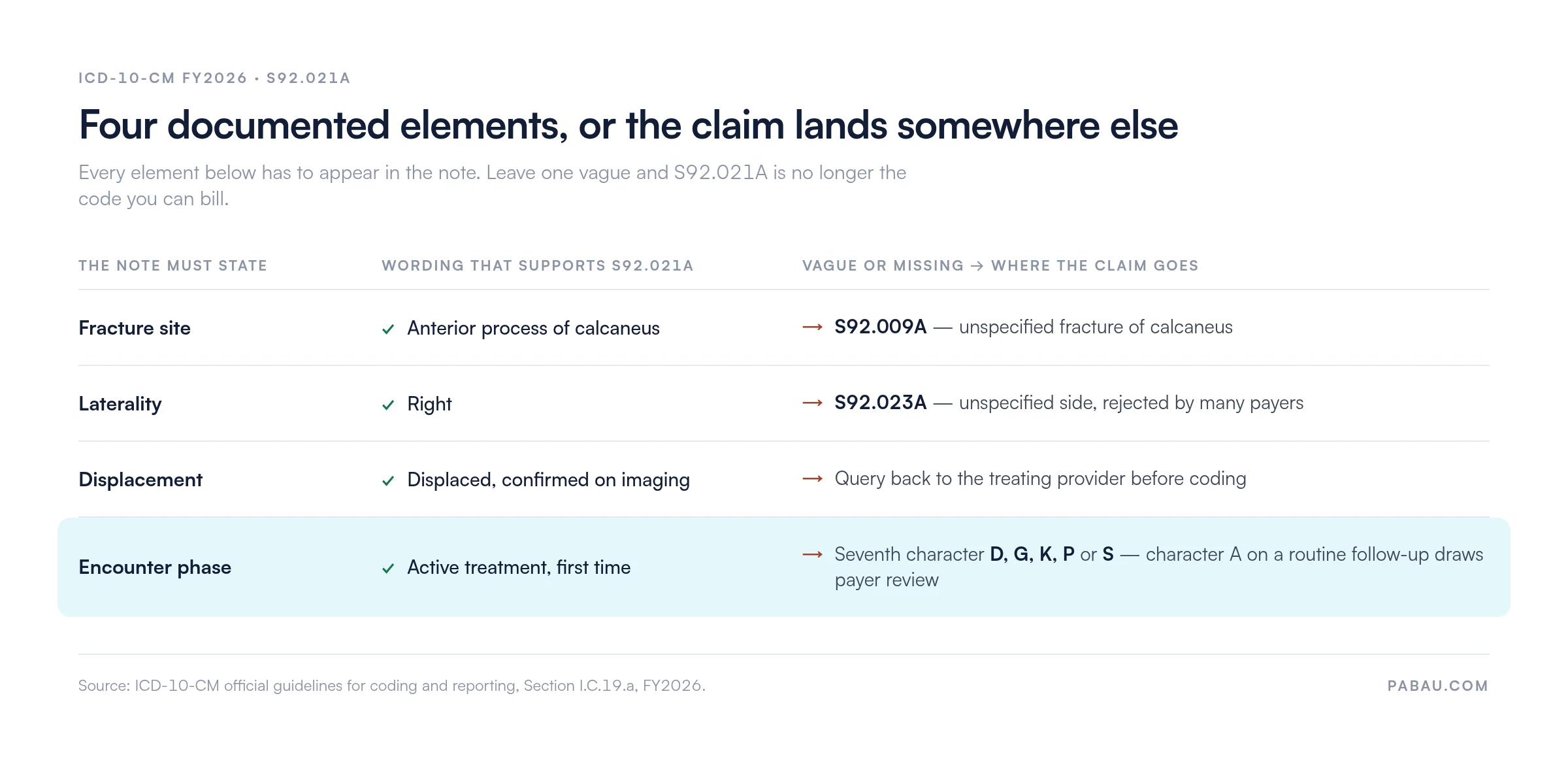
Site and laterality sometimes fail in the same note. When the note describes a displaced extraarticular fracture outside the anterior process and names no side, the initial encounter claim takes ICD-10 code S92.053A. A nondisplaced intraarticular fracture with no side documented bills as S92.066D once the patient returns and healing is routine.
Structured clinical note templates help front-line clinicians capture all four elements at the point of care, while the detail is still fresh. When the note is complete at the initial encounter, the claim leaves the practice whole. Reviewing clean claim requirements shows what else a payer checks before it pays.
The same principle governs every ICD-10-CM family: The code must match the documented clinical findings exactly. The AAPC ICD-10-CM code library gives a second opinion when the documentation reads ambiguously.
In a typical practice, the coder reads the note after the visit is over. Laterality, displacement, and phase of care get reconstructed from whatever the clinician typed. A missing qualifier then surfaces days later as a denial or a provider query.
Practice management software like Pabau moves that check forward. The fracture encounter, the imaging order, the note, and the charge all sit on one patient record. The coder reads the source rather than a summary of it.
Pabau’s claims management then submits through the Claim.MD clearinghouse, which validates the ICD-CPT pairing before the claim reaches the payer. Coding queries get answered while the encounter is still open, so fewer calcaneus fracture claims come back for rework and payment arrives sooner.

Pabau integrates with Claim.MD to validate ICD-CPT pairings before submission, helping orthopedic and physical therapy practices reduce fracture claim denials and speed up reimbursement.

S92.021A is not a difficult code to look up. It is a difficult code to earn, because four separate pieces of documentation have to line up before it holds.
The practical move is to fix the note rather than the claim. Ask for the oblique view when a lateral sprain does not behave like one. Ask the provider for the displacement qualifier before the charge goes out. Both cost minutes at the encounter and save a rework cycle afterward.
The trade-off worth remembering is specificity against speed: A coder who queries once at the initial encounter rarely queries again. Book a demo to see how Pabau validates fracture coding before the claim ever reaches a payer.

Need a quick reference for everyday coding? Medical coding cheat sheet collects the code families and modifiers billing teams look up most often.
Building documentation standards that hold up? Medical billing compliance covers the record-keeping habits that keep coded claims audit-ready.
Want to reduce claim denials across your practice? Denial management strategies in healthcare walks through the most common causes and how to address them systematically.
ICD-10 code S92.021A is a billable diagnosis code for a displaced fracture of the anterior process of the right calcaneus. The encounter is the initial one for a closed fracture. The code is valid for FY2026 and used on HIPAA-covered claims where the clinician is actively managing the fracture for the first time.
Yes. S92.021A is a billable, specific ICD-10-CM code valid for fiscal year 2026, which runs October 1, 2025 through September 30, 2026. It is a seven-character code and can be submitted directly on HIPAA-covered transactions without further extension. The parent code S92.021 without a seventh character is not valid for submission.
S92.021A applies to the initial encounter, meaning active fracture treatment is being provided for the first time. S92.021D applies to subsequent encounters during routine follow-up after the treatment plan is established. The fracture anatomy is identical. Only the phase of care differs. Using A on a routine cast check is a common coding error that can trigger payer review.
Seventh character A denotes the initial encounter. That is the visit at which a patient first receives active treatment for the fracture. Per the ICD-10-CM Official Guidelines (Section I.C.19.a), this includes ED visits, first assessments, casting, manipulation, and surgical repair. It does not simply mean the first visit. It means the first visit for active treatment of that injury.
CPT 28400 (closed treatment without manipulation) and 28415 (open treatment with or without internal fixation) are the primary procedure codes paired with S92.021A. Which one applies depends on whether management is conservative or surgical. Imaging codes 73630 (foot X-ray) and 73700 (CT lower extremity) are commonly billed at the diagnostic encounter. Payer-specific policies on CPT-ICD pairings should always be confirmed before submission.
Anterior process calcaneus fractures present with lateral foot pain and tenderness that closely mimics a lateral ankle sprain. Standard AP and lateral X-rays may not capture the fracture because of the oblique orientation of the anterior process. An oblique foot view or CT scan is often needed to confirm the diagnosis. The injury is frequently missed until symptoms fail to resolve with standard sprain treatment.