

ICD-10 Code S42.444P: Medial epicondyle fracture, right humerus
ICD-10 Code S42.444P: full descriptor and code validity ICD-10 Code S42.444P car...

Last Updated: Oct 13, 2026
Billable Code Specific Code
S92.046G is the billable ICD-10-CM code for nondisplaced other fracture of tuberosity of unspecified calcaneus, subsequent encounter for fracture with delayed healing. "Other" means non-avulsion, and the final 6 marks a calcaneus the record does not identify as right or left.
Most denials for this code trace to one mistake. Coders assign G when the documentation does not explicitly state delayed healing. In those records, D (routine healing) is the character the note actually supports.
Under CMS ICD-10-CM guidelines, S92.046G is valid for FY 2025 and FY 2026 with no revisions. It belongs to category S92 (Fracture of foot and toe, except ankle) under Chapter 19 of ICD-10-CM.
Let Pabau's smart automation suggest the right codes, reduce claim denials, and keep your practice compliant—effortlessly.
Automate repetitive tasks and focus on what matters most—your patients.
Reduce coding errors and ensure compliance with the latest regulations.
Clean claims, fewer denials, and faster reimbursements.
Powerful insights and reporting to help your practice thrive.
HIPAA compliant SOC 2 certified GDPR-compliant Trusted by 4,000+ clinics worldwide

S92.046G is billable for subsequent encounters where documentation explicitly confirms delayed healing of the calcaneal tuberosity fracture
The 7th character G differs from D (routine healing), K (nonunion), and P (malunion): using the wrong character is the leading cause of claim denial
Avulsion fractures of the calcaneal tuberosity are a separate family, S92.03, and never code to S92.04
The final 6 in S92.046 marks an unspecified calcaneus. When the record names a side, code S92.044G for the right or S92.045G for the left
Pabau’s claims management software routes S92.046G claims through Claim.MD, flagging missing documentation before submission
ICD-10 Code S92.046G is a specific, billable code valid for all HIPAA-compliant transactions in the current fiscal year. The table below mirrors the at-a-glance format coders consult on the CDC/NCHS ICD-10-CM web tool.
S92.046G encodes four distinct clinical facts in sequence, each controlled by a different digit or character group. Misreading any one of them produces a wrong code.
The word “other” in this descriptor means non-avulsion. Avulsion fractures of the same tuberosity carry their own subcategory, S92.03. The documented mechanism therefore decides the subcategory before displacement and laterality are read.
Site splits the subcategories as sharply as mechanism does. An extraarticular fracture that does not involve the tuberosity, the body, or the anterior process sits in S92.05 instead. Within that subcategory, S92.053A applies to a displaced, closed fracture of an unspecified calcaneus at the initial encounter.
Joint involvement moves the code once more. A calcaneal fracture that extends into the joint surface sits in S92.06, not in S92.04. There, S92.066D describes a nondisplaced intraarticular fracture of an unspecified calcaneus healing routinely at a subsequent encounter.
The calcaneal tuberosity is the posterior inferior prominence of the heel bone. The Achilles tendon attaches superiorly and the plantar fascia inferiorly. It bears the full ground-reaction force with each step.
Documentation of the mechanism is essential. A record that says only “heel fracture” cannot separate an avulsion from an “other” fracture. ICD-10-CM conventions bar coders from assigning a more specific code than the note supports. The grid below shows where each documented combination lands.
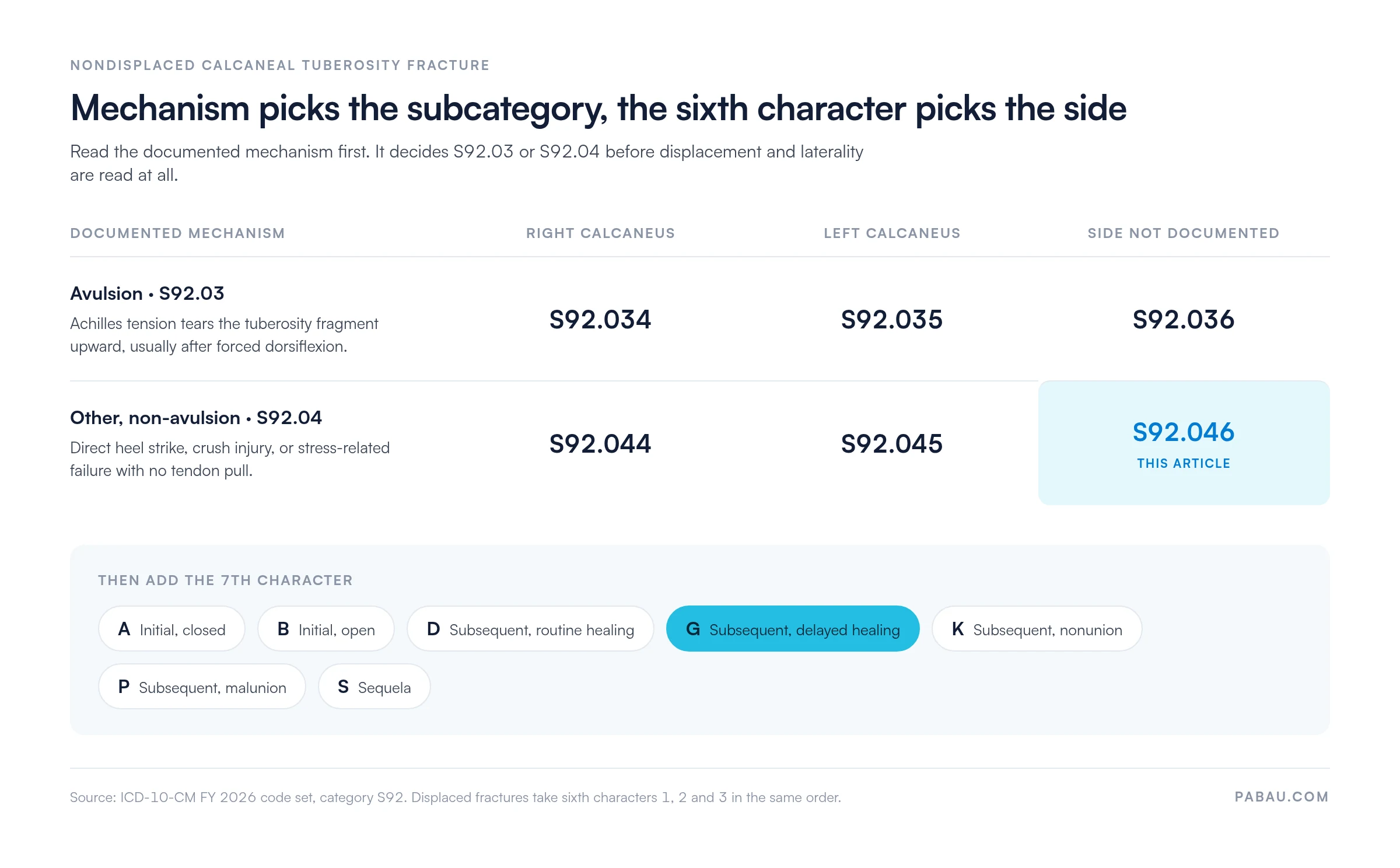
The 7th character G applies when two conditions are true at once. The encounter is a follow-up, meaning active treatment has ended. The clinical record also documents delayed healing explicitly. ICD-10-CM and its Official Guidelines set no fixed number of weeks for delayed healing. It is a clinical determination by the treating provider, sometimes informed by AHA Coding Clinic guidance. Coders should not assign G unless a provider has stated delayed healing in the record.
All valid 7th-character options for the S92.046 code stem are shown below. Knowing where G sits prevents the most common coding errors on this code. The same extension rules run across every injury category in Chapter 19.
Six codes account for most S92.046G substitution errors. The table below shows the clinical trigger that separates each one. Payer edits test the split between G, D, K and P first on a subsequent-encounter claim.
Every element of the S92.046G descriptor must appear in the medical record. Missing any one of them exposes the claim to denial on audit. Working the list below before submission catches the omissions that medical billing compliance reviews pick up months later.
S92.046G is sequenced as the principal or first-listed diagnosis when the reason for the encounter is management of the delayed-healing calcaneal tuberosity fracture. The AAPC ICD-10-CM lookup confirms the code’s billable status, but sequencing decisions follow ICD-10-CM Official Guidelines Section C.19.
Medicare coverage for services billed with S92.046G depends on which Local Coverage Determination (LCD) applies in the contractor jurisdiction. MACs issue their own foot and ankle orthopedic LCDs. Practices should verify the applicable LCD before billing DME or extended PT authorizations against this code.
Key coverage considerations for physical therapy authorization and orthopedic follow-up billing:
Practice management software like Pabau runs that check before the claim leaves the practice. Pabau’s claims management software holds a maintained ICD-10 catalog. A S92.046G claim missing an external cause code, or carrying a date-of-service mismatch, is flagged at submission.
S92.046G is a diagnosis code only. It must pair with a procedure code to generate a billable claim. The table below lists typical pairings for physical therapy and orthopedic follow-up encounters. These are pairing examples, not coverage guarantees. Medical necessity must be documented separately for each service.
Delayed-healing fracture codes attract a specific set of payer edits that routine subsequent-encounter codes do not. Understanding the denial pattern protects revenue and reduces the rework burden on billing staff. The six failures below account for most rejected S92.046G claims.
A pre-submission checklist removes most of these errors. It verifies that the 7th character matches the visit documentation before the claim leaves the practice. Remittances that still come back rejected carry a reason code, and denial codes in medical billing explains what each one is asking for.
Before submitting S92.046G, run a two-step documentation check. First, open the visit note and confirm the words ‘delayed healing’ or a clinical equivalent appear. Second, verify the imaging report on file uses ‘nondisplaced’ and identifies the tuberosity. If either element is missing, query the provider before submission rather than correcting after a denial.
In most practices, a 7th-character error surfaces only after the remittance arrives. A biller reopens the visit note, hunts for the words that support G, and rebuilds the claim weeks after the encounter. The same check takes a minute at the point of submission.
Pabau keeps the ICD-10 catalog inside the patient record. Coders select S92.046G from a maintained list instead of typing a stem from memory. A mistyped subcategory such as S92.036 or S92.045 never reaches the claim. Claims then pass through Claim.MD, where scrubbing rules test the diagnosis against the date of service before submission.
Documentation prompts sit where the clinician writes the note, so the statement that supports G is captured at the visit. Nobody has to chase it in an addendum weeks later. Billing staff then spend their time on the claims that genuinely need a human.

Pabau routes orthopedic and physical therapy claims through Claim.MD, catching missing documentation flags on delayed-healing fracture codes before submission. See how it works for your practice.

S92.046G has a narrow clinical trigger. It covers a nondisplaced, non-avulsion fracture of the calcaneal tuberosity on a side the record does not name. The provider must document healing slower than expected at follow-up. Three substitutions drive most denials on this code family. They are S92.046D for routine healing, S92.046K for nonunion, and the separate avulsion subcategory at S92.03.
Pabau pre-screens orthopedic and physical therapy claims for 7th-character mismatches and missing documentation before they reach the payer. That turns a denial you would have worked twice into a claim that pays the first time. Book a demo to see it run against your own coding.

Need guidance on denial codes your practice is seeing? Denial codes in medical billing covers the CARC and RARC codes that appear on remittances for orthopedic fracture claims.
Submitting claims through a clearinghouse? Understanding the 837 file format explains how ICD-10 codes like S92.046G are transmitted in EDI transactions.
Verifying eligibility before physical therapy visits? Insurance eligibility verification walks through the checks that prevent authorization issues on delayed-healing PT claims.
ICD-10 Code S92.046G is the billable diagnosis code for a nondisplaced other fracture of the tuberosity of an unspecified calcaneus. The 7th character G marks a subsequent encounter for fracture with delayed healing. It is valid for FY 2025 and FY 2026 under ICD-10-CM. Use it when a patient returns for follow-up care and the provider documents that the fracture is healing more slowly than expected.
S92.046D applies when healing is progressing normally at a follow-up visit. S92.046G applies when the provider explicitly documents delayed healing. The distinction is entirely documentation-driven. If the note says the fracture is healing well, D is the correct character. If it states delayed healing or an equivalent, G applies instead. Assigning G without a provider statement of delayed healing is the leading cause of denial on this code.
Use S92.046G when the provider documents delayed healing but fracture union is still possible and healing is ongoing. Use S92.046K (nonunion) when imaging confirms the fracture fragments have definitively failed to unite. Nonunion requires radiographic evidence; delayed healing (G) is a clinical determination based on the expected healing timeline without requiring radiographic proof of union failure.
Yes, S92.046G is valid as the supporting diagnosis for physical therapy claims when PT is being provided to manage a delayed-healing calcaneal tuberosity fracture. Many payers require a dated delayed-healing notation within the authorization window. Check with the specific payer whether each PT authorization renewal needs a fresh provider note.
External cause codes are recommended by ICD-10-CM Official Guidelines Section C.20 but are not universally mandatory. However, some MACs and commercial payers require them on injury claims. Establish a standard practice of appending the relevant W-series or Y-series code to all S92 claims to avoid soft denials from MACs that require them.
No. S92.046G is a subsequent-encounter code and cannot be used for the first visit at which a patient receives active treatment for the fracture. The initial encounter requires S92.046A (closed fracture) or S92.046B (open fracture). Using G on an initial encounter is a hard edit failure that will generate a claim denial.
S92.046G describes a non-avulsion fracture, so an avulsion of the calcaneal tuberosity never codes here. Avulsion fractures have their own subcategory, S92.03. Displaced avulsions use S92.031 (right), S92.032 (left) and S92.033 (unspecified). Nondisplaced avulsions use S92.034, S92.035 and S92.036 in the same order. The matching delayed-healing code for a nondisplaced avulsion of an unspecified calcaneus is S92.036G.
No. The final 6 in S92.046 marks an unspecified calcaneus. When the record names a side, use S92.044G for the right heel or S92.045G for the left. Reserve S92.046G for documentation that never identifies which heel was injured, because payers may query repeated use of an unspecified code.




