ICD-10 Code Y76.0: Diagnostic obstetric and gynecological devices
ICD-10 Code Y76.0: Definition and billable status ICD-10 Code Y76.0 is a valid, ...

Last Updated: Oct 23, 2026
Billable Code Specific Code
S92.066D is the billable ICD-10-CM code for nondisplaced intraarticular fracture of unspecified calcaneus, subsequent encounter for fracture with routine healing. It covers follow-up visits once active treatment has ended and the heel bone is healing as expected.
The code sits in the S90-S99 block (injuries to the ankle and foot), under category S92 (fracture of foot and toe, except ankle). Its subcategory is S92.066. Seventh character D marks a subsequent encounter, and "unspecified" means the record does not state which foot was injured.
Let Pabau's smart automation suggest the right codes, reduce claim denials, and keep your practice compliant—effortlessly.
Automate repetitive tasks and focus on what matters most—your patients.
Reduce coding errors and ensure compliance with the latest regulations.
Clean claims, fewer denials, and faster reimbursements.
Powerful insights and reporting to help your practice thrive.
HIPAA compliant SOC 2 certified GDPR-compliant Trusted by 4,000+ clinics worldwide

S92.066D is a billable ICD-10-CM code for a nondisplaced intra-articular calcaneus fracture at a subsequent encounter during routine healing.
Seventh character D applies only after active treatment has ended. Using A (initial) at a follow-up visit is the leading denial trigger for this code family.
Unspecified laterality needs chart-level support. When the record names the right or left foot, use S92.064D or S92.065D instead.
Pabau’s claims management software checks details insurers need, like membership numbers and authorization codes, before a claim is sent. Claims then reach thousands of payers via Claim.MD, with eligibility checks built in.
ICD-10 Code S92.066D describes a nondisplaced intra-articular fracture of the unspecified calcaneus at a subsequent encounter during routine healing.
The calcaneus (heel bone) is the largest tarsal bone, forming the posterior foundation of the foot.
An intra-articular fracture crosses the subtalar joint surface, distinguishing it from extra-articular variants that spare the joint. “Nondisplaced” means the fracture fragments have not shifted from their anatomical position.
“Unspecified” laterality means the claim does not document whether the injury is left or right. This element of the code requires specific clinical justification. The code is valid and billable in the current ICD-10-CM fiscal year. It is used only at follow-up visits, not at the initial acute presentation.
The seventh character D denotes a subsequent encounter during the active healing phase of a fracture. Per ICD-10-CM Official Guidelines Section I.C.19.a, “subsequent encounter” applies once the patient has completed active treatment. The patient is then receiving routine care during healing or recovery. This is distinct from the initial encounter (A) and from sequela (S).
The right character depends on where the patient is in the episode of care. The table below maps each character to the clinical trigger for using it.
Seventh character D marks a patient who is past active treatment, however many visits that took. Code D applies to a patient managed conservatively with a cast or boot who returns for a two-week follow-up. An ED patient with an acute fracture seen for the first time gets A, whatever their history of calcaneus injuries.
The S92.066 family covers nondisplaced intra-articular fracture of the unspecified calcaneus across all episode-of-care characters. Every code in this family shares the same anatomical specificity; only the encounter type changes.
Verify the S92.066 code variants against the official CDC/NCHS ICD-10-CM tabular list each fiscal year. Annual code updates take effect on October 1.
S92.066D captures follow-up care for a calcaneus fracture that meets three conditions:
The encounter is a subsequent visit during routine healing, not the original acute presentation.
What the code does not cover:
The ICD-10-CM Official Guidelines require the highest level of specificity supported by the documentation. According to CMS ICD-10 coding guidance, an unspecified code used when the record holds the detail is a coding deficiency. It can trigger medical necessity denials and recovery audits.
Many S92.066D denials trace back to a neighboring code from the same family. Displacement sets the row and the documented side sets the column, as the grid below shows.
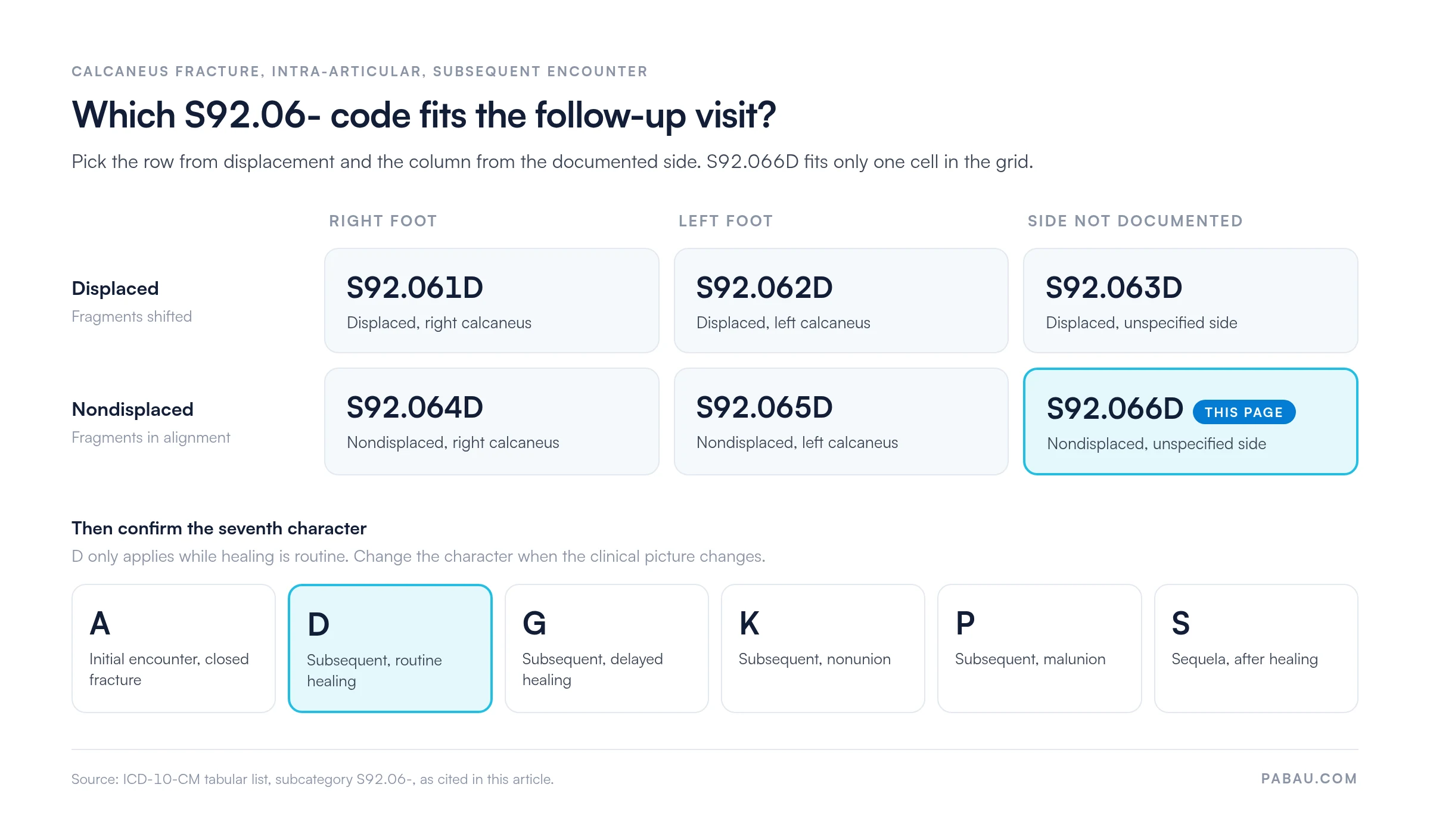
Side and displacement are only part of the picture. The table below adds the encounter-character and fracture-type mix-ups that also trip up claims.
The physician note, radiology report, and encounter record must collectively support each element of ICD-10 Code S92.066D. Missing any single element is enough for a payer to deny the claim or flag it in a compliance audit. Good billing compliance documentation practices address this at the point of care, not retrospectively.
Required documentation elements:
Verifying documentation completeness before submission supports clean claim submission rates. A claim built on thorough documentation is far less likely to trigger an automated denial or a retrospective audit request.
S92.066D is the diagnosis code on a claim. A CPT code describes the procedure performed at that visit, and it must suit a subsequent (follow-up) encounter. Pairing an acute surgical CPT code with a subsequent encounter ICD-10 code creates a clinical timeline contradiction that claim edits often flag.
Physical therapy providers billing S92.066D can use PT evaluation and treatment CPT codes (97110, 97162, 97530) throughout the healing phase. Codes 97110 and 97530 are timed, so Medicare counts their units under the Medicare 8-minute rule.
In Pabau’s claims software, background validation checks hold a claim until required details like membership numbers are complete. The CPT/ICD-10 pairing itself still needs a coder’s review before submission.
Medicare covers follow-up visits for fracture management when medical necessity is documented and the service falls within covered benefit categories. For orthopedic follow-up billed with S92.066D, Medicare Part B typically covers E/M visits, imaging, and cast or splint applications. The services must be medically necessary, and documentation must support the encounter level.
Physical therapy services billed with S92.066D count toward Medicare’s annual therapy threshold. Medicare Part B applies annual KX-modifier thresholds above which documented medical necessity is required.
Commercial payers may set different visit-frequency limits and their own prior authorization process. For Medicare claims, check the local coverage determination (LCD) from your Medicare Administrative Contractor before assuming coverage.
Practices billing through Pabau send claims electronically via the Claim.MD clearinghouse. Electronic claims via Claim.MD reach thousands of US payers and support real-time eligibility checks before treatment.
Claims for S92.066D tend to fail for the same handful of reasons. A structured denial management workflow tackles them at the source instead of appeal by appeal.
When a denial does come back, the remittance names it with a reason code. Our guide to medical billing denial codes explains what each one means and how to fix it.
Calcaneus fractures present across orthopedics, podiatry, sports medicine, and physical therapy settings. Each specialty encounters S92.066D at a different point in the care continuum, which creates variation in how the code is applied and where errors occur.
Orthopedic surgeons manage the full episode from initial fracture through healing. Their billing teams are more likely to get the A-to-D transition right because the same provider tracks both phases. Podiatrists and sports medicine physicians often see patients mid-care, after a transfer or self-referral. They face a higher risk of using A wrongly because the initial encounter happened elsewhere.
Physical therapists begin treating in the subsequent phase. For PT providers, the D-character code covers the whole rehabilitation episode while healing stays routine. S92.066D applies only when the referral and chart don’t state a side.
Without a pre-send check, a claim missing an authorization code or membership number goes out anyway. The problem only surfaces when the denial comes back, and the follow-up visit sits unpaid while someone reworks the claim.
Pabau, the practice management platform we build, runs validation checks in the background every time you send a claim. Its self-checking claims management keeps the Send button disabled until required details are filled in correctly.
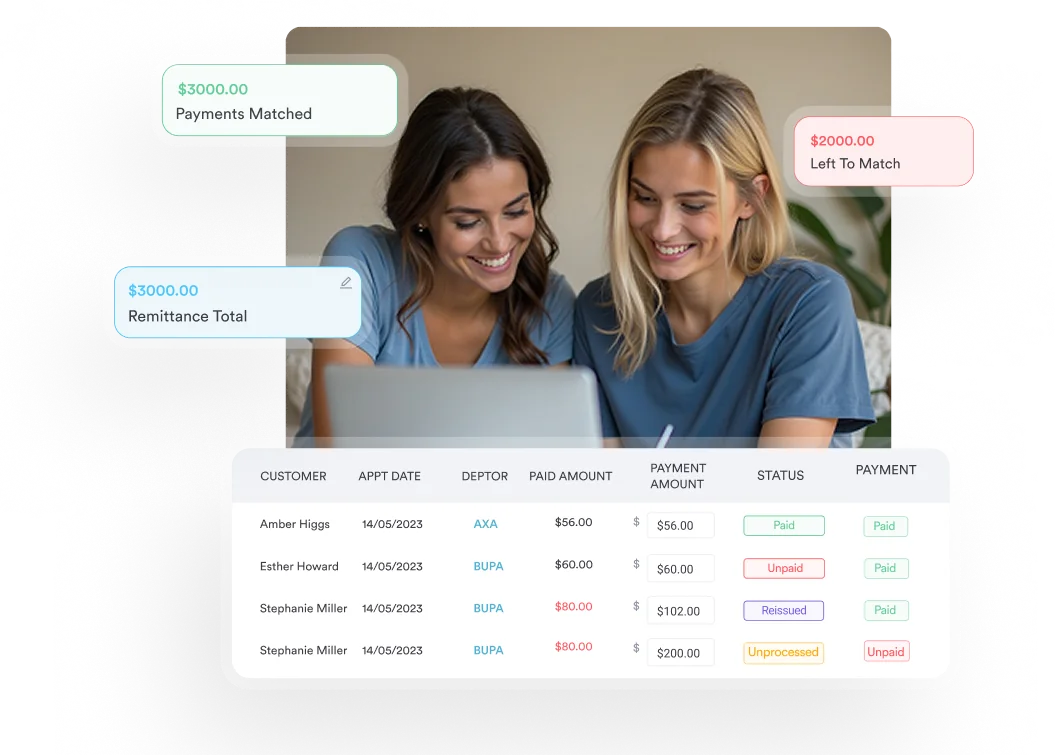
In the US, Pabau connects to Claim.MD, so claims go to thousands of payers electronically. Your team can run real-time eligibility checks, track claim status and post ERA remittances from the same dashboard.

Pabau checks the details insurers need, like membership numbers and authorization codes, before each claim goes out. Claims then reach thousands of payers through Claim.MD, with real-time eligibility checks built in.

Reach for S92.066D only when no document in the record names a side, and only while healing stays routine. Once imaging shows delayed healing, nonunion or malunion, the seventh character has to change with it.
Both checks take a minute at the coding desk. An appeal on a denied follow-up claim takes far longer, and it delays payment for care already delivered.
Pabau adds a safety net by checking details insurers need, like membership numbers and authorization codes, before each claim is sent. Claims then reach thousands of payers through Claim.MD, with eligibility checks run before treatment. Book a demo to see how it keeps orthopedic and physical therapy claims complete.

Need to understand how clearinghouse claim validation works? Medical claims clearinghouse guide explains how claims are scrubbed, routed, and validated before reaching payers.
Want to track denial patterns across your billing team? Denial codes in medical billing covers the most common CARC and RARC denial codes and how to address them systematically.
Want to see the whole claim lifecycle? Revenue cycle management for healthcare practices covers the full claim lifecycle from patient intake through payment posting.
Checking coverage before a PT plan of care starts? Insurance eligibility verification walks through what to confirm with the payer before the first visit.
ICD-10 Code S92.066D is the billable diagnosis code for a nondisplaced intra-articular fracture of the unspecified calcaneus at a subsequent encounter during routine healing. It is used at follow-up visits after active treatment has ended and the fracture is healing without complications. The medical record also documents no side.
S92.066A is for encounters during active treatment. S92.066D is for follow-up visits during routine healing once active treatment has ended. S92.066S covers sequela visits, when a healed fracture leaves a residual condition such as post-traumatic arthritis or chronic subtalar pain. Using A at a follow-up or S during active healing are the two most common errors in this code family.
Yes. Physical therapists may use S92.066D as the diagnosis code when treating a patient in the subsequent healing phase of a calcaneus fracture. Pair it with PT CPT codes such as 97110 or 97530. Payer policies on PT authorization and visit limits vary, so verify prior authorization requirements with each payer before submitting.
The most common reasons are a wrong seventh character, a mismatched CPT code, and thin documentation. Claims fail when S92.066A (initial encounter) is billed at a follow-up visit. They also fail when an acute surgical CPT code such as 28406 is paired with this diagnosis. Weak documentation of fracture type and laterality causes denials too. So does billing D after imaging confirms delayed healing (G) or nonunion (K). Reviewing the seventh character, laterality and CPT pairing before submission catches these errors early.
Use S92.066D when healing is progressing normally without complications. Switch to S92.066G when clinical or radiographic findings indicate delayed healing beyond the expected timeline for a nondisplaced intra-articular calcaneus fracture. The switch requires documentation in the physician note and ideally a supporting radiology report. Continuing to bill D when the record documents delayed healing is a clinical inconsistency that can trigger utilization review.
Unspecified laterality is acceptable only when the medical record does not document whether the injury is left or right. A typical case is a patient who transfers care when the original records are unavailable. When the chart specifies laterality, ICD-10-CM guidelines require using the specific code (S92.064D for right, S92.065D for left). Using S92.066D when laterality is documented is a specificity deficiency that can attract audit queries from payers.