ICD-10 code S72.454D: Nondisplaced supracondylar femur fracture, subsequent encounter
ICD-10 code S72.454D: Code details at a glance ICD-10 code S72.454D is the billa...

Last Updated: Oct 22, 2026
Billable Code Specific Code
S92.002G is the billable ICD-10-CM code for unspecified fracture of left calcaneus, subsequent encounter for fracture with delayed healing. It covers follow-up visits for a left heel fracture with an unspecified pattern and healing the clinician documents as slower than expected.
The seventh character G separates this code from routine healing (D) and nonunion (K). Assign it only when the note explicitly records delayed healing or delayed union.
Let Pabau's smart automation suggest the right codes, reduce claim denials, and keep your practice compliant—effortlessly.
Automate repetitive tasks and focus on what matters most—your patients.
Reduce coding errors and ensure compliance with the latest regulations.
Clean claims, fewer denials, and faster reimbursements.
Powerful insights and reporting to help your practice thrive.
HIPAA compliant SOC 2 certified GDPR-compliant Trusted by 4,000+ clinics worldwide

S92.002G is a billable ICD-10-CM code for an unspecified left calcaneus fracture at a subsequent encounter with documented delayed healing. It sits between routine healing (D) and nonunion (K).
Use the seventh character G only when the clinician explicitly documents delayed healing in the record. Without that wording, D or K fits, depending on how the fracture is healing.
Laterality errors, such as S92.001G for the right heel or S92.009G for an unspecified side, are a common denial trigger. Confirm left-side documentation before coding.
Pabau’s claims management software runs claim validation that catches missing or invalid details before a fracture aftercare claim is submitted.
ICD-10 code S92.002G describes an unspecified fracture of the left calcaneus at a subsequent encounter, where the fracture is healing with delay. Each part of the code carries its own coding meaning:
Unspecified fracture means the operative or imaging report does not detail the fracture pattern. A radiologist may describe a “calcaneal fracture” without saying whether it is a body, sustentaculum or anterior process fracture. In that case, the unspecified code is appropriate. Coders should not assume a more specific code just to avoid an “unspecified” designation.
Subsequent encounter means active treatment is complete, and the patient is receiving routine care during the healing phase. This includes cast checks, physical therapy referrals, imaging to monitor union progress, and medication management.
Delayed healing means the fracture is not progressing toward union at the expected rate, as documented by the treating clinician. The ICD-10-CM Official Guidelines do not prescribe a specific number of weeks. Delayed healing is a clinical determination documented in the note.
The calcaneus is the largest tarsal bone and bears the body’s full weight during standing and walking. It sits beneath the talus and projects backward to form the heel. Calcaneal fractures account for about 60% of all tarsal bone fractures, according to StatPearls.
The most common mechanism is axial loading, typically a fall from height that lands on the heel. Stress fractures occur in athletes or military recruits through repetitive loading without adequate rest.
The mechanism matters for coding because it drives the fracture pattern, which in turn drives specificity. When imaging does not specify the pattern, S92.002G is correct, or the matching sibling code for laterality and encounter type.
Any calcaneal fracture can heal more slowly than expected, and the clinical note should record what is slowing it. Contributing factors include:
These factors should appear in the clinical documentation when the treating clinician selects G as the seventh character.
The seventh character is the most consequential coding decision for S92.002 and its siblings. Getting it wrong is a common reason a calcaneus fracture claim is denied on medical necessity grounds.
The ICD-10-CM tabular list, maintained for CMS ICD-10-CM coding, gives S92.002 these seventh characters:
The critical distinction is between G and K. Delayed healing means the bone is still trying to heal, but progress is slower than expected. Nonunion means healing has stopped entirely, typically confirmed by serial imaging showing no callus progression over three to six months.
G fits a note that reads “fracture showing delayed healing, will continue conservative management.” K fits a note that reads “established nonunion confirmed on CT, patient consented to revision ORIF.” The chart below matches common note wording to the seventh character it supports.
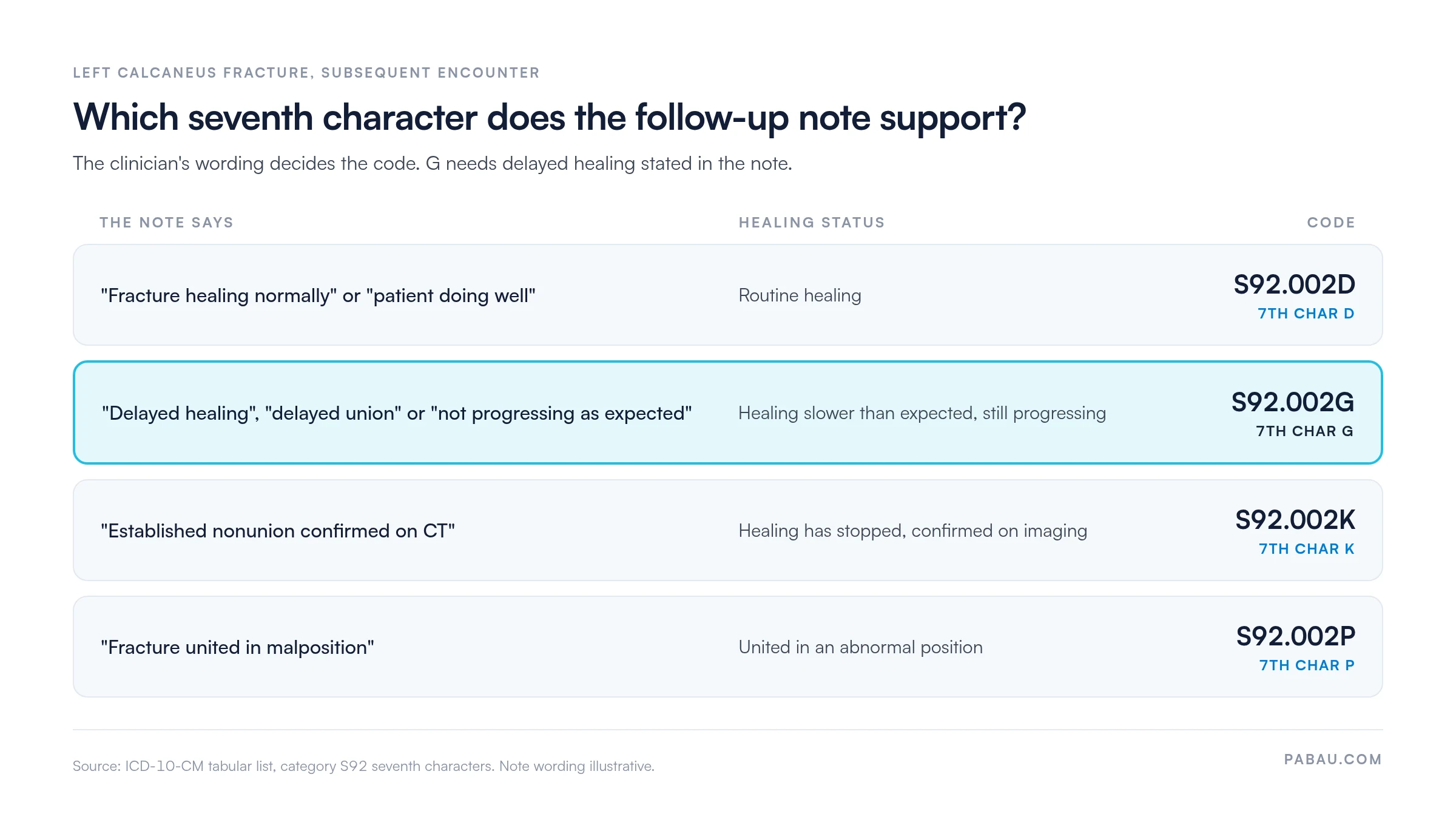
ICD-10 code S92.002G sits within a group of closely related calcaneus fracture codes. The table below shows the siblings coders confuse most often. For neighboring foot and ankle codes, browse our ICD-10-CM codes library.
The laterality distinction between S92.001G and S92.002G is a common payer edit trigger. Many EHR templates default to “unspecified side.” Confirm left-side documentation in the operative note, radiology report or clinical note before finalizing the code.
The S92 category carries coding guidance that affects how S92.002G can be used. Per the CDC/NCHS ICD-10-CM tabular list, S92 carries these Excludes2 notes:
Growth plate injuries follow a separate path. ICD-10-CM gives physeal fractures of the calcaneus their own subcategory, S99.0-. When imaging describes a growth plate fracture in a child, check that subcategory before settling on S92.002G.
The ICD-10-CM Official Guidelines for Coding and Reporting, Section I.C.19, govern fracture coding. Two rules apply directly to S92.002G:
S92.002G is a diagnosis code. It pairs with CPT procedure codes that describe what was done at the subsequent encounter, most often an established-patient visit such as 99213. The table below lists the codes most commonly submitted alongside it.
A superbill for follow-up visits that lists the seventh character by encounter type helps prevent D-instead-of-G errors at the point of service. It also keeps the CPT and diagnosis codes for each visit side by side before the claim is built.
A claim for ICD-10 code S92.002G is likely to be denied if the medical record does not support each element of the code. The checklist below covers the elements payers audit on delayed-healing calcaneus fracture claims.
Delayed healing sometimes prompts an order for a bone growth stimulator (E0747, E0760). For Medicare claims, the Local Coverage Determinations (LCDs) for these devices may require additional documentation. Verify current LCD requirements with your Medicare Administrative Contractor (MAC) before billing.
Commercial payer prior-authorization rules for delayed-healing fracture management vary by plan and state. Always confirm them before ordering advanced interventions.
Run a query in your practice management system for every claim billed with S92.002G in the last 90 days. Compare its denial rate with S92.002D claims from the same period. If G claims are denied noticeably more often, the documentation is often missing the explicit delayed-healing phrase. Audit five denied records before assuming the code is wrong.
ICD-10 code S92.002G attracts a distinct set of denial patterns. Knowing them reduces preventable write-offs on delayed-healing calcaneal fracture encounters.
Many orthopedic and physical therapy practices code fracture aftercare from template notes. A missing laterality or a wrong seventh character then surfaces only when the remittance arrives, and the claim goes back for rework.
Pabau, the practice management platform we build, includes claims management software with claim validation that catches missing or invalid details before submission. Through Pabau’s integration with Claim.MD, our US clearinghouse partner, claims reach thousands of US payers from the same system.
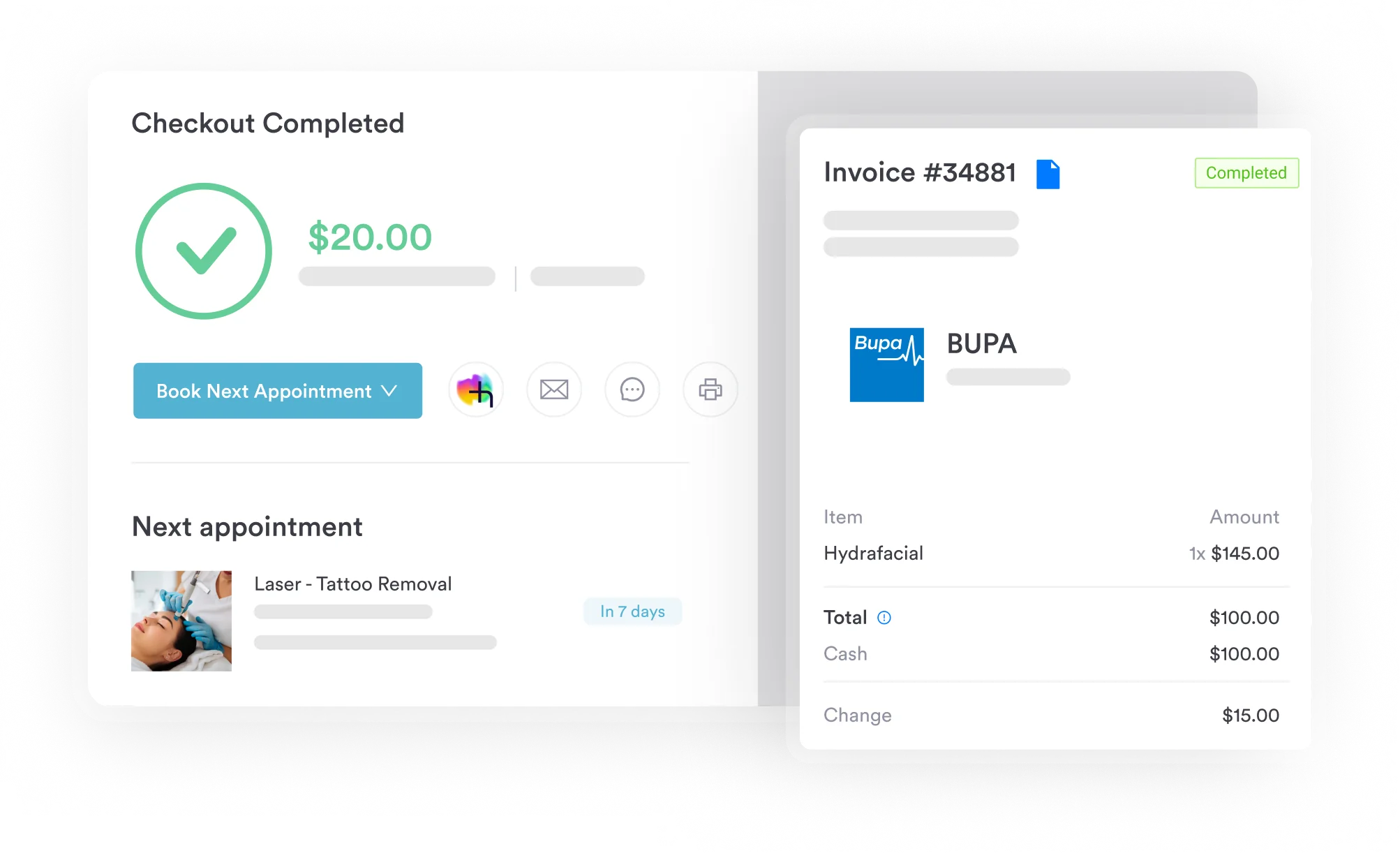
Coders fix a missing detail while the chart is still open, instead of after a rejection. Denial management workflows then handle what still comes back, and submitting a clean claim on the first pass avoids a rework cycle.

Pabau’s claim validation catches missing or invalid details before your fracture aftercare claims are submitted. See how it works.

Coding accuracy for calcaneus fracture aftercare lives in two places: the seventh character and the clinical note that justifies it. S92.002G is valid and billable, but only when the documentation confirms left-side delayed healing at a subsequent encounter.
The most reliable fix sits upstream of the coder. Build delayed-healing language and a laterality field into your orthopedic follow-up template, so the note supports G whenever it applies.
Claim validation then catches any missing or invalid details before submission. Book a demo to see how Pabau fits an orthopedic or physical therapy practice.

Need to understand how clean claims shorten the payment cycle? Clean claim submission guide walks through the pre-submission checks that catch errors before they reach the payer.
Managing delayed fracture billing across multiple visits? Medical billing documentation guide covers how to structure encounter notes so each visit’s billing aligns with the clinical record.
Looking for the right clearinghouse for orthopedic claims? Medical claims clearinghouse overview explains how clearinghouses check claims for missing or invalid details before they reach payers.
Decoding a remittance after a fracture claim is denied? Denial codes in medical billing explains what each code means and how to respond.
ICD-10 code S92.002G is the billable ICD-10-CM code for an unspecified left calcaneus (heel bone) fracture at a subsequent encounter with delayed healing. The S92 category covers foot and toe fractures, and the sixth character 2 confirms left laterality. The seventh character G specifies a subsequent encounter with delayed healing rather than routine union.
Yes, S92.002G is a billable, specific code, valid in the current ICD-10-CM code set (FY2027). It is a leaf-level code with no further subcategory and can be reported directly on a claim.
S92.002D is used when the left calcaneus fracture is healing at a normal rate at a subsequent visit. S92.002G applies only when the clinician explicitly documents delayed healing. Using D when the note says “healing slower than expected” is a common denial trigger on calcaneus fracture aftercare claims.
Use S92.002G when the fracture is still healing but progress is slower than expected, as documented by the treating clinician. Use S92.002K when imaging confirms established nonunion, meaning healing has stopped entirely. Delayed healing (G) can progress to nonunion (K), but the two are different clinical stages that need distinct documentation.
The medical record must confirm left calcaneus laterality and subsequent encounter status, meaning active treatment is complete. It also needs explicit documentation of delayed healing or delayed union, plus imaging showing inadequate callus formation or a persistent fracture line. Missing any of these elements exposes the claim to a medical necessity denial.
Four errors come up often. Coders select D instead of G when the note documents delayed healing, or use the unspecified laterality code S92.009G when left-side documentation exists. Others apply a subsequent encounter character (G) to an initial treatment visit. The fourth is failing to attach imaging where payers require radiology evidence of delayed healing.