ICD-10 Code T31.77: Burns involving 70-79% of body surface
ICD-10 code T31.77: Quick reference and code details ICD-10 code T31.77 is the b...

Last Updated: Nov 5, 2026
Billable Code Specific Code
S82.51XF is the billable ICD-10-CM code for a displaced fracture of the medial malleolus of the right tibia at a subsequent encounter. It covers an open fracture of Gustilo type IIIA, IIIB, or IIIC with routine healing. Coders use it at follow-up visits once active treatment has ended.
The 7th character F needs a surgeon-documented Gustilo type IIIA, IIIB, or IIIC. An open fracture with no documented type defaults to type I or II, which is S82.51XE. Delayed healing, nonunion, and malunion move the code to S82.51XJ, S82.51XN, or S82.51XR.
Let Pabau's smart automation suggest the right codes, reduce claim denials, and keep your practice compliant—effortlessly.
Automate repetitive tasks and focus on what matters most—your patients.
Reduce coding errors and ensure compliance with the latest regulations.
Clean claims, fewer denials, and faster reimbursements.
Powerful insights and reporting to help your practice thrive.
HIPAA compliant SOC 2 certified GDPR-compliant Trusted by 4,000+ clinics worldwide

S82.51XF covers follow-up visits for a displaced right medial malleolus fracture that was open, Gustilo type IIIA, IIIB, or IIIC, and is healing normally.
An open fracture with no documented Gustilo type defaults to type I or II, so its routine-healing follow-up code is S82.51XE, not S82.51XF.
The X in position 6 is a mandatory placeholder, so S82.51F is an invalid code that payers reject outright.
Delayed healing, nonunion, and malunion of this open fracture move the 7th character to J, N, or R, and only physician documentation supports that switch.
Pabau’s practice software submits and tracks these claims through Claim.MD, while the coder still assigns every diagnosis and procedure code from the chart.
ICD-10 Code S82.51XF identifies a displaced fracture of the right medial malleolus at a follow-up visit, with routine healing. The original fracture was open and graded Gustilo type IIIA, IIIB, or IIIC. Each of the seven characters carries one part of that meaning.
ICD-10-CM requires a 7th character on every fracture code in the S82 category. S82.51 has only five characters, so the X in position six holds the sixth slot open. It has no clinical meaning, and its sole purpose is to let F sit in the seventh position.
Omitting the X produces the invalid string S82.51F, which payers and clearinghouses reject at the edit level before a human reviewer sees the claim. This is one of the most mechanical and avoidable denial causes for this code.
S82.51XF applies at follow-up visits once active treatment of an open, displaced right medial malleolus fracture is complete and healing is on schedule. Three conditions must all hold for F to be correct.
The ICD-10-CM Official Guidelines for Coding and Reporting, Section I.C.19, govern fracture 7th character assignment. The grid below maps every subsequent-encounter character by fracture type and healing status. F sits where open type IIIA, IIIB, or IIIC meets routine healing.
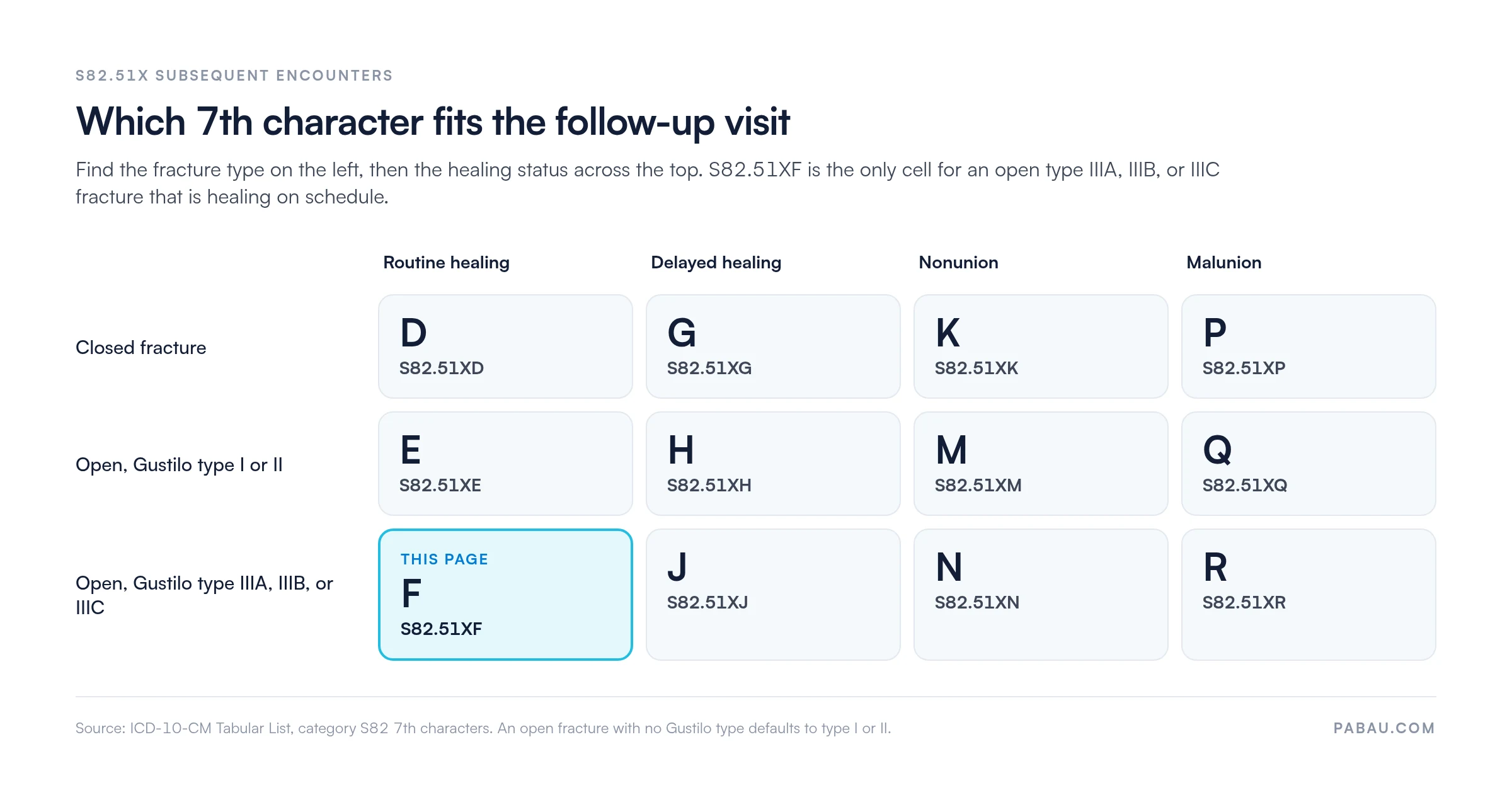
The complete table for the S82.51X series also includes the initial-encounter and sequela characters.
Every code in the S82.51X series shares one root, and the 7th character carries the encounter, the wound grade, and the healing status. A wrong 7th character is one of the most frequent causes of fracture coding denials.
S82.51XC is the initial-encounter code for this open type IIIA, IIIB, or IIIC fracture, used while active treatment is under way. S82.51XF is for subsequent encounters, the follow-up visits after active treatment has ended and the patient is in routine healing care.
A common miscoding pattern is billing S82.51XC at every visit, including routine post-operative checks six weeks after ORIF. Active treatment ends when definitive fracture management is complete. From then on, an open type IIIA, IIIB, or IIIC fracture takes F at follow-up visits, per CMS ICD-10-CM guidance. Type I or II takes E, and a closed fracture takes D.
The F character specifies routine healing, so the 7th character must change when healing deviates from the expected course.
For an open type IIIA, IIIB, or IIIC fracture, delayed healing uses the J character. Nonunion uses N, when imaging shows no bony bridging well past the expected timeline. Malunion uses R, applied when the fracture has united in an abnormal position.
K and P are the nonunion and malunion characters for closed fractures, so they do not fit this open fracture. Coders may not make the healing determination independently either.
The physician’s note or radiology report must document the abnormal healing status. A note that says only “patient continuing to have ankle pain” at week 12 does not support a switch to J, N, or R.
S82.51 codes a displaced fracture of the right medial malleolus. S82.52 is the same displaced fracture of the left tibia, and S82.53 covers an unspecified side.
A nondisplaced fracture moves to S82.54, S82.55, or S82.56 for the right, left, or unspecified side. The original operative note or imaging report must confirm displacement, because coders may not infer it from the treatment approach alone.
The medial malleolus is the bony prominence on the inner side of the ankle, formed by the distal end of the tibia. It forms the medial wall of the ankle mortise and stabilizes the talus during weight-bearing.
Displaced fractures of the medial malleolus usually result from rotational or eversion ankle injuries. An open type IIIA, IIIB, or IIIC wound points to high-energy trauma and significant soft-tissue damage. Because the fragment has shifted, surgical fixation is usually needed to restore the ankle mortise. That is why ORIF and CPT code 27766 appear so often alongside this diagnosis code.
Orthopedic and sports medicine practices managing post-operative fracture care will meet S82.51XF at most follow-up appointments after the initial surgical encounter.
S82.51XF is a diagnosis-only code. The visit also needs a separate procedure code for the service rendered at that encounter.
Note that 27766 pairs with the initial-encounter codes, not with S82.51XF. By the time the F character applies, the surgery has already been billed. When the operating surgeon sees the patient inside the global period, the visit is reported with 99024 and is not paid separately.
Outside that window, a follow-up visit usually bills an established-patient code such as 99213. Healing films taken at the visit are typically billed with 73610.
Four documentation elements must be present to support S82.51XF. Missing any one of them gives a payer grounds to deny on medical necessity or coding accuracy.
Consistent use of these four elements in every post-operative orthopedic note is the most reliable way to avoid downstream denials. Submitting a clean claim for a subsequent encounter requires the supporting documentation to match the code before the claim leaves the practice.
Medicare and most commercial payers expect a subsequent fracture encounter to be supported by a contemporaneous office note that references imaging findings. On the CMS-1500 form, Box 21 lists S82.51XF, and the diagnosis pointer in Box 24E links it to each service line.
Some Medicare Administrative Contractors apply Local Coverage Determinations to fracture care. Checking the relevant LCD before billing is part of standard medical billing compliance requirements for orthopedic practices.
Before billing any subsequent-encounter fracture code, pull the treating physician’s note. Confirm it records the original Gustilo classification, imaging at this visit, and a statement about healing progress. Claims that arrive at a payer without all three supporting elements in the chart are far more likely to trigger a request for additional documentation.
Most S82.51XF denials trace back to one of five avoidable errors.
Effective denial management in healthcare for fracture codes means catching these errors before the claim leaves the practice. Clearinghouse edits can reject malformed codes before a claim reaches the payer. The electronic remittance advice returned after adjudication then lists any remaining denial reasons as CARC codes for targeted appeals.
The governing reference for S82.51XF is the ICD-10-CM Official Guidelines for Coding and Reporting, Section I.C.19 (Injury, Poisoning and Certain Other Consequences of External Causes). It sets the rules for fracture 7th character selection and defines the encounter type framework.
A fracture not documented as open or closed is coded as closed. An open fracture with no Gustilo type defaults to type I or II.
Additional guidance comes from the American Hospital Association (AHA) Coding Clinic, the official source for ICD-10-CM coding advice approved by the Cooperating Parties. Its fracture guidance carries official weight with payers and auditors.
Check the CDC/NCHS ICD-10-CM code tool to confirm S82.51XF is active and billable for the fiscal year of the date of service. Fiscal years run from October 1 through September 30.
Coders can also check current-year status at AAPC’s ICD-10-CM lookup or in Pabau’s ICD-10-CM code library. Billing for subsequent fracture encounters should always run on the current-year tabular list, not on cached encoder data from a prior fiscal year.
At many orthopedic practices, the follow-up note, the imaging report, and the claim live in different systems. The coder reads the chart, assigns S82.51XF, and then rekeys patient and visit details into a separate clearinghouse portal.
Pabau, the practice management and billing platform we build, keeps the encounter note, imaging results, and patient details on one record. The coder still assigns every diagnosis and procedure code. Pabau’s claims management software then pulls that record data into a pre-filled claim and submits it through Claim.MD, our US clearinghouse integration.
Claim status is tracked in the same place, and remittance advice posts back against the visit. A rejected claim goes back to the coder with the chart one click away, so the corrected claim goes out the same day.

Pabau submits and tracks your claims through Claim.MD, with eligibility checks before the visit. Your coders assign the codes, and the note, claim, and remittance stay on one patient record.

Coding S82.51XF correctly comes down to one question at every follow-up visit. Does the chart prove all three parts of the 7th character? The F needs a surgeon-documented IIIA, IIIB, or IIIC grade and an imaging-backed healing statement. Active treatment must also be finished. When any one is missing, the right answer is a query or a different character.
The trade-off is time. Querying the surgeon about a missing Gustilo grade holds the claim for a day, while billing F without it invites a denial and a resubmission. Build the grade and the healing statement into your fracture follow-up templates, and the query rarely comes up.
Book a demo to see how Pabau keeps fracture follow-up notes and claims on one record, so clean claims leave your practice faster.

Need to know what a clearinghouse checks before a claim reaches the payer? Claim.MD clearinghouse overview explains how claims are scrubbed and routed electronically.
Building a superbill for fracture follow-up visits? Superbill documentation requirements covers how to structure billing records that support ICD-10 code accuracy.
Want eligibility confirmed before the follow-up visit? Insurance eligibility verification covers real-time eligibility checks and the rejections they prevent.
Got a CARC code back on a fracture claim? Denial codes in medical billing explains what the common codes mean and how to respond.
ICD-10 Code S82.51XF is the diagnosis code for a displaced fracture of the right medial malleolus at a follow-up visit, with routine healing. The 7th character F means the original fracture was open, Gustilo type IIIA, IIIB, or IIIC. It applies after active treatment ends, while the fracture heals normally.
S82.51XC is used at the initial encounter, while the open type IIIA, IIIB, or IIIC fracture is under active treatment. S82.51XF is used at subsequent encounters, the follow-up visits after active treatment is complete. Using C at a post-operative follow-up appointment is a coding error and a common denial trigger.
The F character covers Gustilo type IIIA, IIIB, and IIIC open fractures only. Type I or II routes to E for a subsequent encounter with routine healing. When the surgeon documents an open fracture without a type, the guideline default is type I or II, so query the surgeon before assigning F.
S82.51XF applies when the fracture is healing as expected. S82.51XN applies when this open type IIIA, IIIB, or IIIC fracture has progressed to nonunion. K is the nonunion character for closed fractures, so it does not fit here. Switching from F to N requires explicit physician or radiology documentation of nonunion.
The most common denial reasons are a wrong 7th character, such as C instead of F at a follow-up visit, and a missing X placeholder. Others include an operative note with no Gustilo type, and a follow-up note with no imaging or healing status reference. Each is preventable by checking the chart and the code before submission.
Sequela coding (7th character S, producing S82.51XS) applies after the fracture has healed. The patient presents for a late complication caused by the original fracture, such as post-traumatic arthritis. Once the fracture itself is resolved, the sequela character replaces the healing-phase characters.