ICD-10 Code R34: Anuria and oliguria
ICD-10 Code R34 is the billable ICD-10-CM diagnosis code for anuria and oliguria...

Last Updated: Oct 6, 2026
Billable Code Specific Code
S82.432J is the billable ICD-10-CM code for a displaced oblique fracture of the shaft of the left fibula. It applies at a subsequent encounter for an open type IIIA, IIIB, or IIIC fracture with delayed healing.
Open fibula fractures with delayed healing are among the more coding-intensive scenarios in orthopedic billing. The fracture type, laterality, encounter stage, and healing outcome each need their own line in the record. For ICD-10 code S82.432J that means a left displaced oblique pattern, an open type III wound, subsequent care, and delayed healing.
Let Pabau's smart automation suggest the right codes, reduce claim denials, and keep your practice compliant—effortlessly.
Automate repetitive tasks and focus on what matters most—your patients.
Reduce coding errors and ensure compliance with the latest regulations.
Clean claims, fewer denials, and faster reimbursements.
Powerful insights and reporting to help your practice thrive.
HIPAA compliant SOC 2 certified GDPR-compliant Trusted by 4,000+ clinics worldwide

ICD-10 code S82.432J covers a displaced oblique fracture of the shaft of the left fibula. The visit is a subsequent encounter for an open type IIIA, IIIB, or IIIC fracture with delayed healing.
S82.432J is a fully billable ICD-10-CM code, effective October 1, 2025 (FY2026). The base code S82.432 is not billable until a 7th character is appended.
Delayed healing is not nonunion. S82.432J applies while union is still progressing slowly, and S82.432N applies once the fracture has stopped healing altogether.
The 7th character also records the wound. J is reserved for open type III, H covers open type I or II, and G covers a closed fracture.
Pabau’s claims management software validates ICD-10 codes through Claim.MD at submission. A missing or mismatched 7th character is caught before the payer sees the claim.
S82.432J is a valid, billable ICD-10-CM diagnosis code for fiscal year 2026. It became effective October 1, 2025 and applies to claims with dates of service on or after that date. The full description reads displaced oblique fracture of shaft of left fibula, subsequent encounter for open fracture type IIIA, IIIB, or IIIC with delayed healing.
The healing status in that description is delayed healing, not nonunion. The fracture is still moving toward union, only more slowly than the surgeon expected. Once union stops altogether, the encounter belongs to S82.432N instead.
The base code S82.432, without any 7th character extension, is not billable. Coders must always append a valid 7th character before submitting. Confirm the current code against the CDC/NCHS ICD-10-CM web tool or the CMS ICD-10 codes page for the applicable fiscal year before billing.
Understanding the parent code chain clarifies which coding rules apply at each level. S82.432J inherits documentation and sequencing requirements from every level above it. Every code in the ICD-10-CM code index is read the same way, from the chapter down to the 7th character.
Each step down the hierarchy adds specificity. The laterality, left or right, appears at the S82.432 level. The encounter type and the healing status are encoded entirely by the 7th character. Coders who shortcut the hierarchy and jump straight to a sibling code risk picking the wrong laterality or the wrong fracture pattern.
S82.432 requires a 7th character extension to become billable. The extension encodes three variables at once. It records the encounter type, the wound at the time of injury, and, at subsequent encounters, how the fracture is healing. Selecting the wrong extension is one of the most common sources of claim denials on fracture codes.
Category S82 uses the full 16-character set below. Three characters cover initial encounters, twelve cover subsequent encounters, and one covers sequela.
Read the set as a grid rather than a list. The wound runs across it, in three states, closed, open type I or II, and open type III. The healing status runs down it, in four states, routine, delayed, nonunion, and malunion. J is the cell where open type III meets delayed healing. Verify extension options against the AAPC ICD-10-CM lookup to confirm all valid characters for the specific fiscal year before submitting.
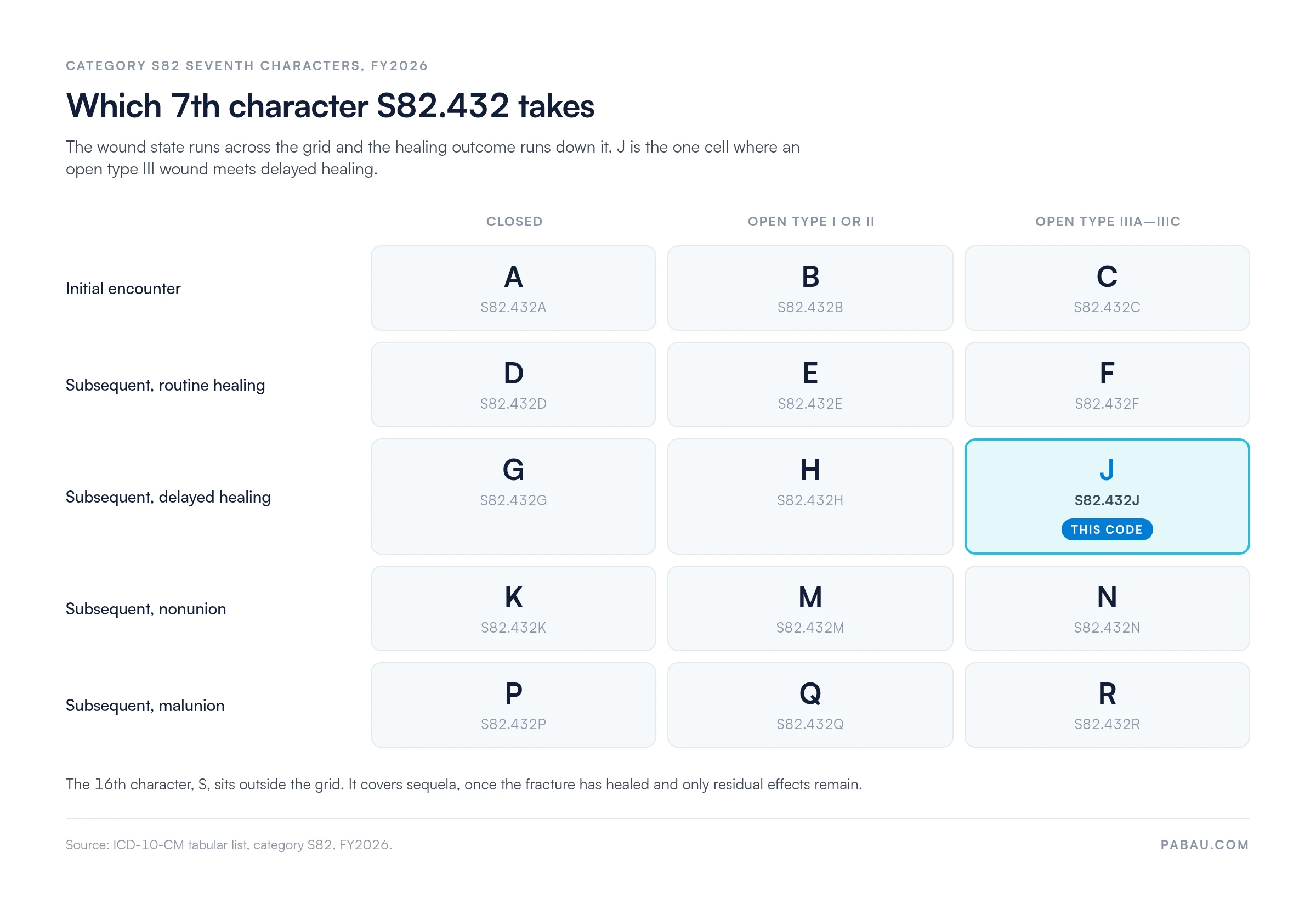
Two swaps account for most mis-coded J claims. Coders reach for J when the note says nonunion, which the N character covers. They also reach for J when the wound was type I or II, which H covers. Check the healing word and the Gustilo type before the character goes on the claim.
Each word in the code description carries clinical and coding weight. Misreading any component shifts the coder to a different code entirely, and laterality and displacement status are the two that move most often.
Orthopedic, trauma, and sports medicine practices meet this code pattern after high-energy lower-extremity trauma. It also turns up when an earlier open fracture repair has not healed on schedule.
The Gustilo-Anderson classification system sorts open fractures by wound severity and soft-tissue damage. ICD-10-CM groups types IIIA, IIIB, and IIIC under a single set of 7th characters, because the code set does not separate the three subtypes. Clinically the distinction still matters for surgical planning and prognosis.
The three subtypes share one extension. Any Gustilo type III open fracture of the left fibular shaft therefore maps to S82.432J at a subsequent encounter with delayed healing. The documented subtype does not change the character. It does change the surgical narrative and the CPT codes that sit alongside the diagnosis.
Subsequent encounter means the patient is being seen for a fracture that was already treated at an earlier visit. The healing phase is ongoing and the initial encounter has passed. That differs from the sequela extension S, which applies once the fracture has healed and only residual effects remain.
Delayed healing means union is taking longer than expected, while the fracture is still consolidating. Radiographs show callus, but less of it than the interval would predict. Nonunion is the further state, where the fragments have stopped uniting and no healing progression is visible. Malunion is a third state, where the fracture has united in a poor position.
No universal time threshold separates the two. Standard orthopedic references treat a fracture with no radiographic progression after roughly six months as a nonunion candidate. Clinical judgment and payer policy both vary. Until that call is made and documented, a slow-healing open type III left fibular shaft fracture is coded J, not N.
Document the Gustilo classification type explicitly in your operative or clinical note. If the note says ‘open fracture’ without stating type I, II, IIIA, IIIB, or IIIC, a coder cannot validly select the J extension. Query the provider before assigning S82.432J.
Four of the near misses live inside the same subcategory and differ from J by one variable. Three more sit outside S82 altogether, and the tabular list handles them in two different ways.
A tibial shaft fracture treated at the same encounter is coded separately from category S82.2. Both codes may appear on one claim when both bones are fractured, because ICD-10-CM has no combination code for the pair.
ICD-10-CM Official Guidelines for Coding and Reporting set out several rules that govern S82.432J assignment directly. Working to those rules lowers audit and denial risk on complex fracture accounts.
Practices can apply these rules automatically with claims software that validates every ICD-10 code at the point of claim creation. A missing 7th character or an incomplete code structure gets flagged before submission. A clearinghouse adds a second layer, checking the diagnosis against payer-specific edits before the claim leaves the practice.
S82.432J sits in a dense cluster of sibling codes that each differ by a single variable. Choosing between them means confirming four coding axes, which are laterality, displacement, encounter stage, and healing outcome.
The J versus N distinction deserves the closest attention. Both cover subsequent encounters for an open type III fracture of the same bone at the same site. Only the healing outcome separates them. J says union is still progressing, slower than expected, while N says progression has stopped and the bone is not uniting. Radiology reports and orthopedic notes should state plainly which of the two applies. The Check ICD-10 code lookup tool mirrors official CMS/NCHS data and cross-references sibling codes quickly during a coding review.
Two further codes differ from S82.432J on more than one axis at once. When the note records neither the fracture pattern nor the displacement, the left fibula shaft falls to the unspecified series. S82.402R carries that unspecified fracture at a subsequent encounter for an open type III wound, with malunion instead of delayed healing.
A nondisplaced oblique fracture of the fibula shaft moves out of S82.432 into its own subcategory. S82.434P covers the right side at a subsequent encounter, after a closed injury that healed in poor alignment.
Several clinical phrasings map to S82.432J in provider documentation. Coders who recognize them land on the right code when the note’s language drifts from the official ICD-10-CM description.
Phrases such as “slow to heal”, “delayed union”, or “callus present but sparse for the interval” point to S82.432J. That holds when the wound was type III and the visit is a follow-up.
Wording such as “failed union”, “fracture not healing”, or “no radiographic progression of callus” points to S82.432N instead. An orthopedic follow-up encounter form should carry a field for the Gustilo type and one for the healing status.
Build a fracture encounter template that prompts providers to record four items at every fracture follow-up. Those are laterality, the Gustilo classification if the fracture was open, the healing status, and whether the care is initial or subsequent. Healing status means routine, delayed, nonunion, or malunion. That turns 7th character selection into a lookup instead of a post-visit query.
S82.432J is a follow-up code, so the procedures billed alongside it are usually assessment and supportive care rather than initial fixation. The two-view tibia and fibula study, 73590, is the code that documents how far union has progressed.
The table below lists the CPT codes that most often accompany a delayed-healing fracture visit. Confirm every one against the current CPT code set, which the American Medical Association maintains and revises each year.
Bone stimulation codes draw payer scrutiny, so keep the medical necessity record tight. Most policies want the interval since injury and the imaging that shows incomplete union. They also want a note on why the surgeon is not yet calling it a nonunion.
Fracture codes with 7th character extensions are among the most denial-prone categories in orthopedic billing. Four errors account for most of the rework on this code.
The parent code is invalid on a claim and payers reject it outright. This usually happens when a code is typed from memory rather than picked from the encoder.
This is the error the code’s own reputation creates, because J is widely mislabeled as the nonunion character. Nonunion of an open type III left fibular shaft fracture is S82.432N. A J claim against a nonunion note invites a medical necessity denial and an audit finding.
Characters A, B, and C belong to the first course of active treatment. Once the patient returns for healing-phase care, the claim needs a subsequent-encounter character. Payers match the character against the patient’s claim history and deny the mismatch.
J requires a documented type IIIA, IIIB, or IIIC wound. A note that says only “open fracture” supports neither J nor H, so the coder has to query before the claim goes out. Validating the character against the documented wound type is what keeps these claims out of the rework queue.
In most orthopedic practices the healing status lives in free-text notes, and the coder reads the narrative afterward to pick a character. The Gustilo type sits in an operative report from months earlier, in a different part of the chart. A slow-healing fibula then generates a query, a delay, and often a denial.
Practice management software like Pabau closes that loop inside one record. Digital forms capture laterality, Gustilo type, and healing status as structured fields at the follow-up visit. The facts that decide the 7th character then sit on the encounter, not in the middle of a narrative note. The patient’s full fracture history stays on one timeline, which tells the coder immediately whether this visit is initial or subsequent care.
Pabau’s claims management then submits electronically through our Claim.MD integration, with ICD-10 validation and payer-specific edits applied before the claim leaves the practice. Missing 7th characters and invalid parent codes get caught at that point. Electronic remittance through ERA/835 brings the response back into the same record. A claim needing appeal gets identified in days, not at the end of the month.
The outcome is fewer coder queries on fracture follow-ups and fewer resubmissions on open fracture accounts. It also leaves a documentation trail that holds up when a payer asks why the encounter was coded J and not N.

Pabau integrates with Claim.MD to validate ICD-10 diagnosis codes before submission. Catch missing 7th characters, incomplete codes, and payer edits automatically, so your team spends less time on rework and more time on patient care.

S82.432J is a fully billable ICD-10-CM code that rests on six documented variables. Those are displacement, the oblique pattern, left laterality, an open Gustilo type IIIA, IIIB, or IIIC wound, a subsequent encounter, and delayed healing. Each one has to appear in the provider’s record for the code to survive an audit.
Delayed healing is all that the character J carries. Nonunion is covered by N, and a closed fracture by the G character. Reading J as nonunion is the most expensive mistake on this code. It puts a claim on record that the clinical note cannot support.
For orthopedic and trauma practices handling a high volume of open fracture follow-ups, structured documentation cuts the coding query burden and speeds up submission. To see how Pabau supports ICD-10 code validation and claim submission for complex fracture encounters, book a demo with the Pabau team.

Need to understand how ICD-10 coding affects your revenue cycle? What is revenue cycle management explains how diagnosis code accuracy connects to payment timelines and denial rates.
Managing insurance claims for orthopedic encounters? Clean claim submission guidelines outlines the key components that prevent rejections before claims reach the payer.
Building an encounter form for orthopedic follow-ups? Superbill documentation shows which fields belong on the form, so the Gustilo type and the healing status are captured at the visit.
S82.432J is the ICD-10-CM diagnosis code for a displaced oblique fracture of the shaft of the left fibula. It is used at a subsequent encounter. The fracture was originally open at Gustilo type IIIA, IIIB, or IIIC and now shows delayed healing. Six components have to be documented. Those are displacement, the oblique pattern, left laterality, the open type III wound, subsequent care, and delayed healing.
Yes, S82.432J is a fully billable ICD-10-CM code, valid for claims with dates of service on or after October 1, 2025 (FY2026). The base code S82.432 without any 7th character extension is not billable and will be rejected by payers.
Both codes cover a subsequent encounter with delayed healing on the same left fibular shaft fracture. The wound is what separates them. S82.432J applies when the fracture was open at Gustilo type IIIA, IIIB, or IIIC, and S82.432G applies when the fracture was closed. The wound status at the time of the original injury drives the choice, not the wound at the follow-up visit.
Gustilo-Anderson type III open fractures are high-energy injuries with significant wound contamination or soft-tissue damage. Type IIIA allows adequate soft-tissue coverage of the bone. Type IIIB involves periosteal stripping and bone exposure requiring flap coverage. Type IIIC includes arterial injury requiring vascular repair. ICD-10-CM groups all three under the same 7th character extensions, so any type III subtype maps to the same character.
Use S82.432J while the open type III left fibular shaft fracture is still uniting, only more slowly than expected. Use S82.432N once the surgeon documents that healing has stopped and the fragments are not uniting. J is the delayed healing character and N is the nonunion character, and the clinical note has to say which state the fracture is in.
S82.432 takes 16 valid 7th characters. Initial encounters use A for a closed fracture, B for open type I or II, and C for open type IIIA, IIIB, or IIIC. Subsequent encounters repeat those three wound states across four healing outcomes. The D, E and F characters cover routine healing. G, H and J cover delayed healing. K, M and N cover nonunion. P, Q and R cover malunion. The S character covers sequela. Confirm the complete list for the applicable fiscal year via the CDC/NCHS ICD-10-CM tool.