ICD-10 code S61.201A: Open wound of left index finger without nail damage
ICD-10 code S61.201A covers a left index finger wound of unstated type ICD-10 co...

Last Updated: Oct 16, 2026
Billable Code Specific Code
S82.434P is the billable ICD-10-CM code for nondisplaced oblique fracture of shaft of right fibula, subsequent encounter for closed fracture with malunion.
The seventh character P is often misread as sequela. Sequela for this fracture is S82.434S. Coders also confuse P with S82.434D, which covers routine healing, and S82.434K, which covers nonunion. Assigning P correctly needs a documented closed fracture on the right side, plus imaging showing union in a malaligned position at a follow-up visit.
Let Pabau's smart automation suggest the right codes, reduce claim denials, and keep your practice compliant—effortlessly.
Automate repetitive tasks and focus on what matters most—your patients.
Reduce coding errors and ensure compliance with the latest regulations.
Clean claims, fewer denials, and faster reimbursements.
Powerful insights and reporting to help your practice thrive.
HIPAA compliant SOC 2 certified GDPR-compliant Trusted by 4,000+ clinics worldwide

S82.434P is the billable ICD-10-CM code for a nondisplaced oblique fracture of the right fibula shaft that has united with malunion.
The seventh character P means subsequent encounter for closed fracture with malunion. It does not mean sequela, and sequela for this fracture is S82.434S.
P, Q and R all describe malunion. Fracture type separates them: P is closed, Q is open type I or II, and R is open type IIIA, IIIB or IIIC.
S82.434P can be reported as the first-listed diagnosis. The sequencing rule that puts a residual condition first belongs to sequela codes, not to P.
Denials cluster around three errors: D left in place after malunion is documented, K confused with P, and an open fracture coded as closed.
ICD-10 Code S82.434P is a billable, specific ICD-10-CM diagnosis code. Its full official descriptor is Nondisplaced oblique fracture of shaft of right fibula, subsequent encounter for closed fracture with malunion.
The code is valid for claim submission in the current fiscal year under the CDC/NCHS ICD-10-CM system. The base code S82.434 is not billable on its own, because a fracture code in this category needs a seventh character.
Breaking the code down segment by segment helps coders avoid misassignment. Each character carries a specific anatomical or encounter meaning. A single wrong character produces a different clinical statement on the claim.
The code sits within the broader ICD-10-CM framework that governs trauma and injury reporting. Knowing the hierarchy prevents the most common mistake on this family. Payers accept only the seven-character code, so S82.434 and S82.43 are rejected on a claim.
In a nondisplaced oblique fracture of the fibula shaft, the fracture line runs diagonally across the bone at an angle. The fractured ends stay in acceptable anatomical alignment, without significant separation. That is the feature separating it from displaced variants coded under S82.431 (right) or S82.432 (left). A spiral line twists around the shaft instead of crossing it diagonally, which moves the case out of S82.43 entirely. S82.441J covers the displaced right-sided spiral fracture at follow-up, with delayed healing after an open Gustilo type IIIA, IIIB, or IIIC injury.
The fibula shaft, also called the diaphysis, runs along the lateral aspect of the lower leg. Fractures here differ from ankle fractures (coded under S82.6xx) and fibula head or neck fractures (S82.1xx). The right-side laterality in S82.434P is fixed, so coders must verify the side explicitly from the operative or clinical note before submission.
The seventh character P changes what the encounter is about. The fracture line has united, but it united in a position that is off anatomical alignment. That outcome is malunion. The patient is still in the healing and recovery phase for the same injury. That is why the encounter is a subsequent one rather than a late effect.
The seventh character on an S82.434 code states three facts at once: the encounter type, the fracture type, and the healing outcome. Choosing it wrongly is the most common reason a fibula fracture claim is denied.
P is frequently misread as sequela. P means subsequent encounter for closed fracture with malunion. Sequela is carried by a different character, giving the code S82.434S. CMS sets out the full seventh-character set in its ICD-10-CM coding guidelines under Section I.C.19.
P, Q and R all describe malunion, and only the fracture type separates them. P is the closed injury that healed crooked. Q and R cover open injuries, graded under the Gustilo-Anderson system. Coding P for an open grade III injury puts the claim at odds with the operative report. Two questions settle the character, and the chart below walks through both.
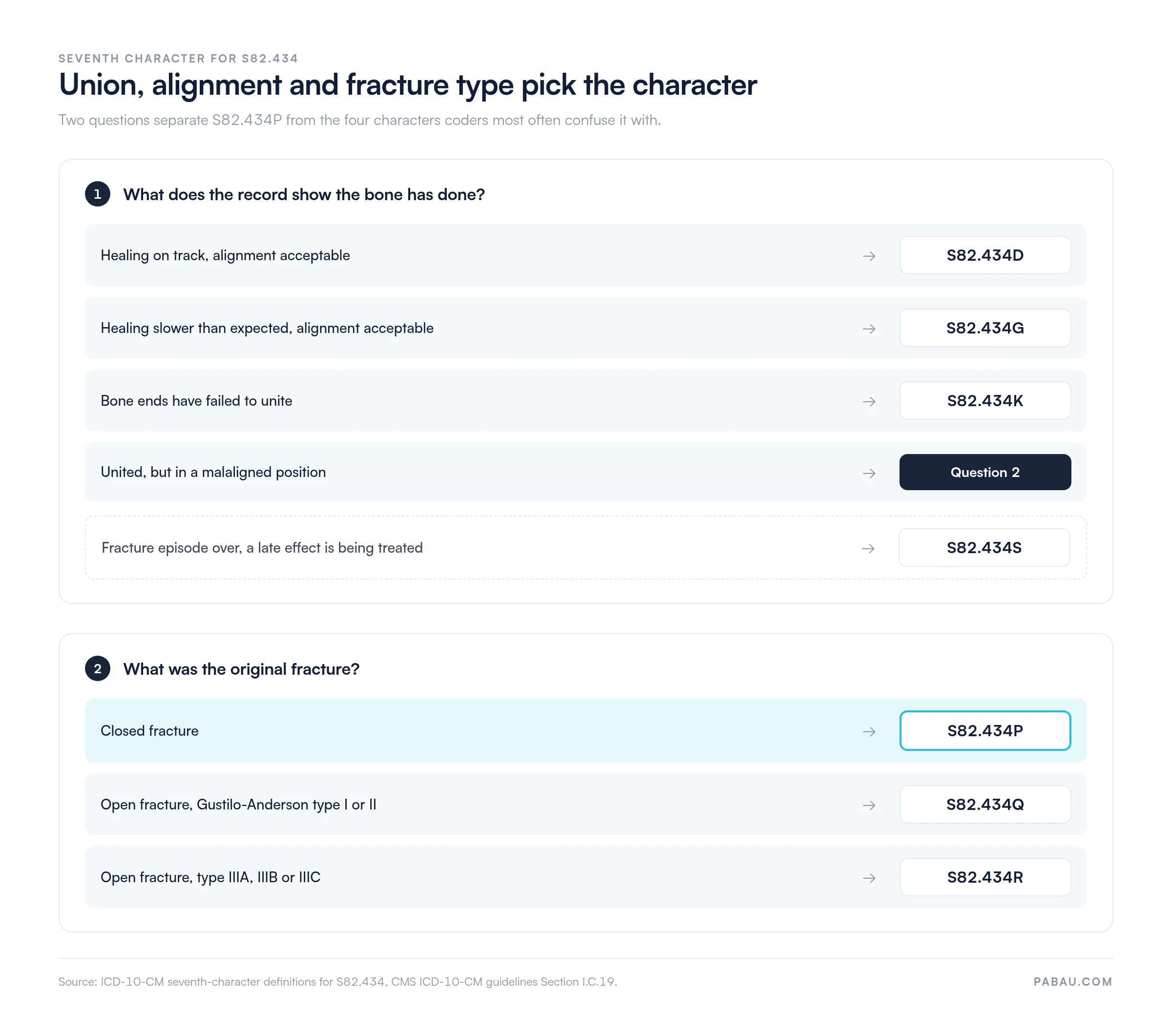
There is no fixed interval after the injury at which P becomes correct. ICD-10-CM sets no timeframe for any of the subsequent-encounter characters. What triggers P is a clinical finding. The provider has documented union in a malaligned position on a closed fracture.
All sixteen variants share the same base code, S82.434 (nondisplaced oblique fracture of shaft of right fibula). They differ by encounter status, fracture type, and healing outcome. Every one of them is billable.
Laterality and displacement sit in the fifth and sixth characters, not the seventh. S82.431P covers the displaced right variant, S82.435P the nondisplaced left variant, and S82.436P the unspecified side. Use S82.436P only when the record genuinely does not state a side.
The seventh-character set is not unique to S82.434. Every subcategory under S82.4 uses it. S82.402R applies to a left fibula shaft fracture whose pattern and displacement the record never states. Its seventh character R marks malunion after an open type IIIA, IIIB, or IIIC injury.
S82.434P fits a narrow set of follow-up encounters. Each one needs documentation tying the visit to a closed, nondisplaced oblique fracture of the right fibula shaft that has united out of alignment.
S82.434P may be reported as the first-listed diagnosis. It describes the current condition itself, so nothing has to precede it on the claim. The sequencing rule that puts a residual condition ahead of the injury code belongs to sequela codes such as S82.434S. Do not reach for an aftercare Z code either, because ICD-10-CM directs coders to report the fracture code with the correct seventh character instead.
S82.434P is narrow in scope. Several neighboring scenarios fall outside it and require different codes entirely.
Ambiguous documentation is the fastest route to a denial on S82.434P. Orthopedic and physical therapy records should carry all five elements below before the code is submitted.
Practices using structured clinical note templates capture these five elements more consistently. That lowers the documentation-related denial rate on fracture follow-up claims.
Run a five-point check before submitting S82.434P. Confirm malunion stated by the provider, a closed fracture, right laterality, a nondisplaced oblique pattern, and a follow-up visit. Miss one element and the claim invites a denial or an audit. Build the check into your orthopedic pre-submission workflow.
CPT selection on an S82.434P claim must match the work done for the malunion, not the work that treated the original fracture. A cleaner claims management workflow confirms CPT-to-ICD-10 medical necessity before each submission. The AAPC ICD-10-CM code range lookup is useful for crosswalk checks.
One pairing trips coders up repeatedly. CPT 27720, 27722 and 27724 describe repair of nonunion or malunion of the tibia, not the fibula. Billing them against S82.434P alone creates a mismatch between the procedure and the diagnosis, so pair them with the relevant tibial diagnosis code.
CPT choice depends on the operative note and the surgeon’s attestation. Verify every code against the current AMA CPT manual before submission. Make the CPT-to-ICD-10 crosswalk a standard pre-submission step on every malunion claim.
Medicare applies Local Coverage Determinations (LCDs) to most surgical procedures used to correct a fracture malunion. Which LCD governs a specific claim depends on the MAC jurisdiction covering the practice’s service area, so payer rules cannot be stated as universal absolutes. Review the applicable CMS Physician Fee Schedule for current reimbursement data and LCD links.
S82.434P does not carry the sequencing restriction that applies to sequela codes. It can lead the claim when the malunion is the reason for the visit. Routing the claim through clearinghouse claim submission lets a practice validate code pairs before the payer sees them. The remittance data coming back then shows which payers reject fracture follow-up claims, and why.
These four characters cover the same right fibula fracture at different points in its course. The distinction is clinical rather than clerical. The coder needs to know what the bone has done before picking a seventh character.
Time elapsed does not decide the character. Union status and alignment do. Without a note on alignment, a “fracture follow-up” entry gives the coder no basis for the P character. Query the provider instead of defaulting to the D character.
Claims submitted with S82.434P fail for predictable, preventable reasons. Review denial codes in medical billing to see how payers communicate each rejection type. Then build the matching fix into your pre-submission workflow.
A submission platform with built-in ICD-10 and CPT catalogs catches many of these errors before the claim reaches the payer. That removes a costly rework cycle from the billing team’s week.
Most fibula coding errors start in the note. The provider writes “fracture follow-up”, and the alignment appears only in an attached imaging report. The coder then picks D, since the note offers no alternative.
Pabau, practice management software for medical and multi-specialty practices, keeps the imaging result, the clinical note, and the diagnosis code on one patient record. Coders can see what the last X-ray showed before they choose a seventh character. Structured note templates prompt the provider to state union status and alignment while the patient is still in the room.
Claims then go out through the built-in claims management module and the Claim.MD clearinghouse integration. Code pairs get validated before submission, and remittance data returns to the same record. Your team can then see which fracture claims were rejected and fix the documentation behind them.

Pabau connects ICD-10 coding with clinical notes, claims management, and Claim.MD submission, so your team catches seventh-character errors before they reach the payer.

Add a seventh-character review step to your orthopedic coding workflow. Before any S82.434x code goes out, record in writing whether the fracture is healing routinely, healing slowly, nonunited, malunited, or resolved. One line in the pre-submission checklist catches most D-versus-P and K-versus-P errors.
The seventh character is the only part of S82.434 a coder has to reason about, and it is where claims are lost. Treat P as sequela and the claim comes back. S82.434S is the sequela code, and the two characters describe different points in the same injury.
Get the documentation right and the code follows. The record needs malunion stated, the fracture confirmed as closed, the right side named, and the visit identified as a follow-up. Pabau ties that documentation to the claim itself, so coding errors surface before submission. Book a demo to see how fracture coding and claims run together in one system.

Need to verify ICD-10 code pairs before submission? Clean claim requirements in medical billing covers what every claim needs to pass payer edits the first time.
Seeing denial patterns across your orthopedic claims? Insurance eligibility verification workflows explains how to catch coverage issues before they become denials.
Rejections piling up after submission? Denial management in healthcare shows how to work each rejection back into the documentation that caused it.
S82.434P is the billable ICD-10-CM code for a nondisplaced oblique fracture of the shaft of the right fibula, subsequent encounter for closed fracture with malunion. The fracture has united, but it united out of anatomical alignment. The seventh character P does not mean sequela.
No. P means subsequent encounter for closed fracture with malunion. The sequela character for this fracture is S, which gives S82.434S. P applies while the patient is still in the healing and recovery phase for the original injury.
Yes. S82.434P is a billable, specific ICD-10-CM code valid for claim submission. The base code S82.434 is not billable on its own, because a fracture code in this category needs a seventh character.
S82.434D is the follow-up code while the closed fracture heals normally. S82.434P applies once the record shows the fracture united in a malaligned position. Leaving D in place after malunion is documented is a common denial trigger.
S82.434K is nonunion, where the bone ends have failed to unite at all. S82.434P is malunion, where the bone united in the wrong position. Imaging findings and the provider’s wording decide which one applies.
Yes. S82.434P describes the current condition, so nothing has to be sequenced ahead of it. The rule that puts a residual condition first belongs to sequela codes such as S82.434S, not to P.
Use Q when the original injury was an open fracture of Gustilo-Anderson type I or II. Use R for open type IIIA, IIIB, or IIIC injuries. P is reserved for closed fractures, and all three describe malunion.