ICD code S82.432A – Displaced oblique fracture of left fibula shaft
Billable Code•Specific Code
Code Definition
S82.432A is the billable ICD-10-CM code for displaced oblique fracture of shaft of left fibula, initial encounter for closed fracture.
It sits in Chapter 19 (S00–T88) and is valid for the current fiscal year. When notes do not state displacement, the Official Guidelines default to displaced. The 6th character, 2, records both the left side and displacement, so the nondisplaced left code is S82.435A. The 7th character A marks an encounter where the patient receives active treatment.
Related Information
Chapter
S00-T88 Injury, poisoning and certain other consequences of external causes
Category
S82 Fracture of lower leg, including ankle
Group
S82.432 Displaced oblique fracture of shaft of left fibula
Billable
Yes
Code also known as
left fibula oblique fracture, fibula shaft fracture, lower leg fracture
Save time. Improve accuracy. Get paid faster.
Automate coding with Pabau
Let Pabau's smart automation suggest the right codes, reduce claim denials, and keep your practice compliant—effortlessly.
S82.432ADisplaced oblique fracture of left fibula shaft
ICD Code Suggestion
AI
Suggested code
S82.432ADisplaced oblique fracture of left fibula shaftHigh match
Confidence score
98%
Why this code?
Matches patient diagnosis
Supported by clinical notes
Commonly used for this condition
Why practices choose Pabau
Save hours every week
Automate repetitive tasks and focus on what matters most—your patients.
Improve accuracy
Reduce coding errors and ensure compliance with the latest regulations.
Get paid faster
Clean claims, fewer denials, and faster reimbursements.
Grow with confidence
Powerful insights and reporting to help your practice thrive.
HIPAA compliant•SOC 2 certified•GDPR-compliant•Trusted by 4,000+ clinics worldwide
Key takeaways
S82.432A is billable for a closed, displaced oblique fracture of the left fibula shaft during active treatment.
The 7th character A means initial encounter. Use D for routine follow-up visits once active treatment ends.
If displacement status is not documented, ICD-10-CM guidelines default to displaced, making S82.432A the correct code.
The 6th character sets both side and displacement, so S82.431A is the right fibula and S82.435A is the left, nondisplaced.
Pabau, the practice management platform we build, runs eligibility checks and submits fracture claims electronically through Claim.MD.
ICD-10 code S82.432A: Quick reference summary
ICD-10 code S82.432A is the billable ICD-10-CM code for a displaced oblique fracture of the left fibula shaft. It applies at the initial encounter for a closed fracture. S82.432A is listed as a valid billable code in CMS’s FY 2027 ICD-10-CM files, which cover encounters from October 1, 2026 to September 30, 2027.
The table below sets out the descriptor, chapter, category and encounter rules.
Field
Detail
Code
S82.432A
Official descriptor
Displaced oblique fracture of shaft of left fibula, initial encounter for closed fracture
Billable
Yes, specific enough for claim submission
ICD-10-CM chapter
Chapter 19: Injury, Poisoning and Certain Other Consequences of External Causes (S00-T88)
Category
S82: Fracture of lower leg, including ankle
7th character
A: Initial encounter for closed fracture
Valid in current FY
Yes, in the FY 2027 code set effective October 1, 2026
External cause code required
Recommended; required only where a state mandate or payer requires it
What S82.432A covers: Clinical definition and anatomical scope
S82.432A describes a closed fracture at the shaft (diaphysis) of the left fibula. The bone fragments have shifted out of anatomical alignment, and the fracture line runs diagonally across the bone. Each word in the descriptor carries coding weight, and misreading any one of them produces the wrong code.
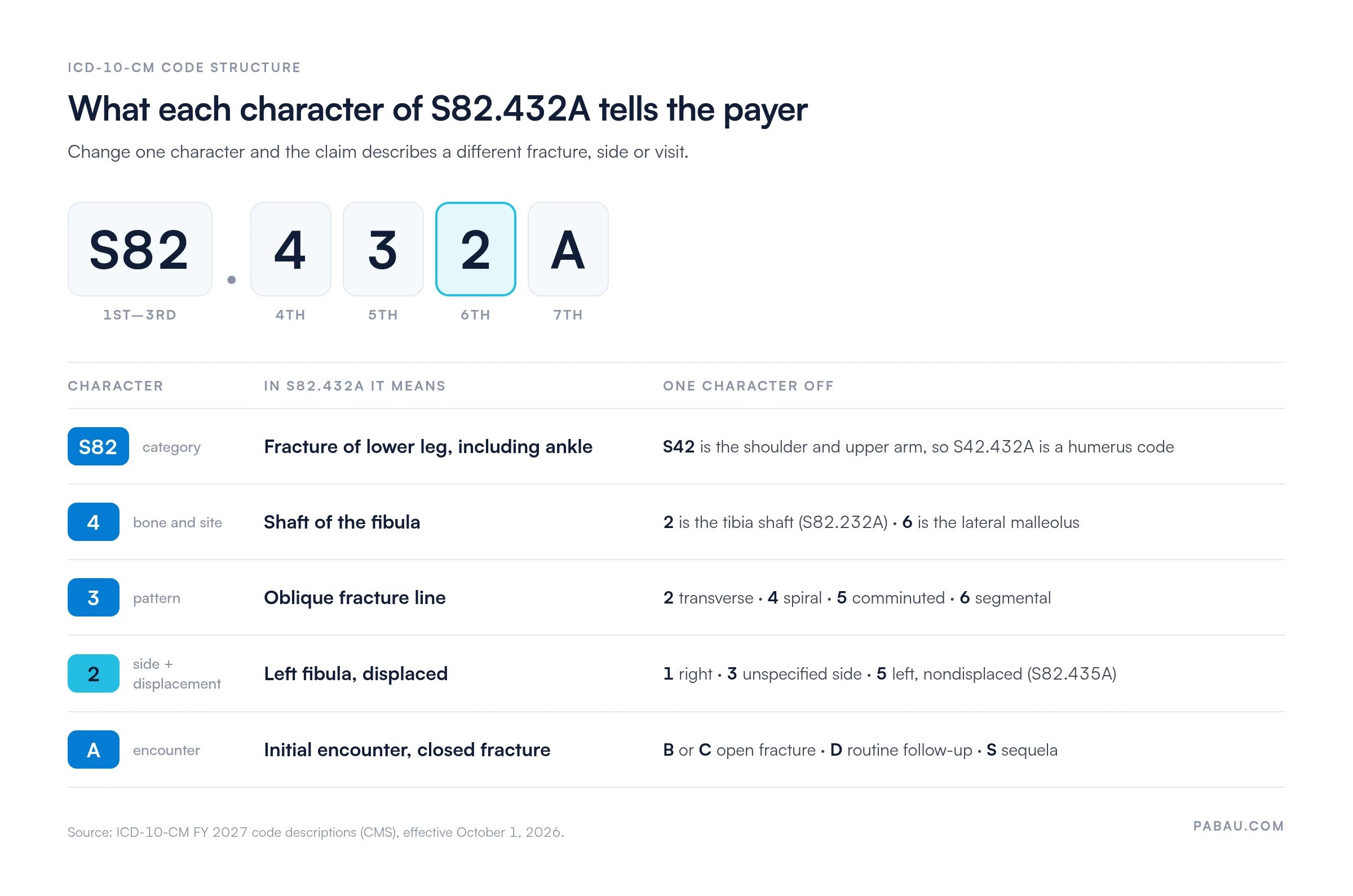
Coders see this presentation most often from emergency, orthopedic and sports medicine practices. Contact sport, falls from height and motor vehicle accidents are the usual mechanisms. Each part of the descriptor maps to one character of the code, and the diagram shows what a one-character change would report instead.
Read left to right, S82.432A narrows from a lower leg fracture to one side, one pattern and one visit type. Code titles come from the CMS FY 2027 ICD-10-CM code descriptions.
Displaced: The fracture fragments have moved relative to each other. Per the ICD-10-CM Official Guidelines for Coding and Reporting, if the physician notes do not state displacement status, the default is displaced. This means S82.432A, not S82.435A, applies whenever documentation is silent on the point.
Oblique: The fracture line crosses the fibula diagonally. Radiologically this appears as an angled line on AP or lateral views. Oblique fractures are distinct from transverse (S82.42x) and spiral (S82.44x) patterns, and from comminuted fractures (S82.45x). The radiology report must use language consistent with an oblique pattern for this code to be defensible.
Shaft: The fracture occurs in the diaphysis, the central cylindrical portion of the fibula between the proximal and distal metaphyses. Fractures of the distal fibula near the ankle fall under different S82.6x codes. The clinical note or imaging report must place the fracture in the shaft.
Left fibula: Laterality is encoded in the 6th character. In the S82.43 oblique category, 1 is right, 2 is left and 3 is unspecified for a displaced fracture. Values 4, 5 and 6 repeat that order for nondisplaced fractures. The physician note or imaging report must state left explicitly.
Initial encounter: The 7th character A applies while the patient receives active treatment. That covers the emergency department visit, the first orthopedic assessment, and the operating room on the day of surgery.
ICD-10 code S82.432A: Understanding the 7th character extension
The 7th character is the most common source of claim denials for S82.432A. Each character maps to a specific phase of fracture care. Using the wrong one for the encounter type is an audit risk under the Chapter 19 fracture rules of the ICD-10-CM Official Guidelines.
7th character
Encounter type
Clinical scenario
A
Initial encounter, closed fracture
ED visit, first orthopedic assessment, day of open reduction and internal fixation (ORIF)
B
Initial encounter, open fracture type I or II
First active-treatment visit where fracture has broken through skin (Gustilo I or II)
C
Initial encounter, open fracture type IIIA, IIIB, or IIIC
First active-treatment visit, high-energy open fracture with significant soft-tissue damage
D
Subsequent encounter, routine healing
Follow-up cast check, suture removal or postoperative visit, with the fracture healing normally
G
Subsequent encounter, delayed healing
Follow-up visit where imaging shows healing slower than expected but not nonunion
K
Subsequent encounter, nonunion
Follow-up where imaging confirms failure to unite
P
Subsequent encounter, malunion
Follow-up where fracture has healed in abnormal alignment
S
Sequela
Late effect being treated after the fracture is considered healed, such as chronic pain or deformity
Common error: Coders continue using 7th character A on the third and fourth postoperative visits. Once active treatment ends and the patient enters routine follow-up, D is correct. Continuing to submit A on follow-up visits is a known audit flag.
Displaced vs nondisplaced: Choosing between S82.432A and S82.435A
S82.432A is the displaced variant. S82.435A is the nondisplaced oblique fracture of the shaft of the left fibula, initial encounter for closed fracture. The choice turns on whether the bone fragments have shifted from their normal alignment.
Feature
S82.432A (displaced)
S82.435A (nondisplaced)
Fragment alignment
Fragments shifted out of anatomical position
Fragments remain in anatomical alignment
Documentation trigger
“Displaced” stated, OR displacement status not documented (default rule)
“Nondisplaced” or “in situ” explicitly documented
Typical treatment
Often requires reduction (closed or open), casting, or ORIF
Often managed conservatively with cast or boot
ICD-10-CM default rule
Yes, applied when documentation is silent
No, requires explicit documentation
The displaced-default rule sits in the Chapter 19 fracture instructions of the FY 2027 ICD-10-CM Official Guidelines, so coders have no discretion over it. Applying S82.435A when notes are silent on displacement is a coding error.
Right vs left: S82.431A vs S82.432A and other laterality variants
In the S82.43 oblique category, the 6th character encodes laterality. For a displaced fracture, the right fibula takes 1, the left takes 2, and an unspecified side takes 3. The same character also carries displacement, so 4, 5 and 6 are the nondisplaced right, left and unspecified codes.
The 5th character, 3, identifies the oblique pattern. Swapping the 6th character creates a mismatch with the operative or clinical record.
The 7th character never carries laterality. It records the encounter and the fracture type, so B and C mark open fractures on the same left fibula.
Code
Laterality
Encounter
Use when
S82.431A
Right
Initial, closed
Active-treatment visit, right fibula, closed fracture
S82.432A
Left
Initial, closed
Active-treatment visit, left fibula, closed fracture
S82.433A
Unspecified
Initial, closed
Use only when laterality cannot be determined from the medical record
S82.432B
Left
Initial, open I/II
Active-treatment visit, left fibula, open fracture Gustilo I or II
S82.432C
Left
Initial, open IIIA/B/C
Active-treatment visit, left fibula, open fracture Gustilo IIIA, IIIB, or IIIC
S82.432D
Left
Subsequent, routine healing
All follow-up visits after active treatment ends, healing normally
S82.432K
Left
Subsequent, nonunion
Follow-up where imaging confirms failure to unite, left fibula
S82.432P
Left
Subsequent, malunion
Follow-up where fracture has healed in abnormal alignment, left fibula
S82.432S
Left
Sequela
Late effect of a left fibula oblique fracture being treated after healing, such as chronic pain
Commonly confused codes: S82.432A vs S82.232A, S82.832A, and S42.432A
Several codes share enough visual similarity with S82.432A to cause lookup errors under time pressure. The table below isolates the key differentiator for each one.
Code
Describes
Key differentiator from S82.432A
S82.432A
Displaced oblique fracture, shaft of LEFT fibula, initial encounter for closed fracture
Reference code
S82.232A
Displaced oblique fracture, shaft of LEFT tibia, initial encounter
Same side (left) but a different bone, the tibia rather than the fibula. S82.2 = tibia shaft; S82.4 = fibula shaft.
S82.832A
Other fracture of upper and lower end of LEFT fibula, initial encounter
Same side (left), but S82.83 covers the upper and lower ends of the fibula, not the shaft. It does not encode the fracture pattern.
S42.432A
Displaced (avulsion) fracture of lateral epicondyle of left humerus, initial encounter for closed fracture
Completely different anatomical region (humerus, upper extremity). S42 = shoulder/upper arm; S82 = lower leg.
S82.435A
Nondisplaced oblique fracture, shaft of left fibula, initial encounter
Same site and pattern but nondisplaced. Requires explicit “nondisplaced” documentation to use.
Oblique vs spiral vs transverse: Matching the fracture pattern to the code
ICD-10-CM separates fibula shaft fractures by the radiological pattern of the fracture line, and each pattern has its own category within S82.4. The 5th character comes straight from how the radiology report describes the fracture line.
Oblique (S82.43x): Fracture line runs diagonally across the shaft. Radiology report language: “oblique fracture,” “angulated fracture line,” “diagonal fracture.” Maps to S82.432A (displaced, left) or S82.435A (nondisplaced, left).
Spiral (S82.44x): Fracture line wraps around the shaft in a helical pattern, typically from a rotational mechanism. Report language: “spiral fracture,” “torsional fracture,” “helical fracture pattern.” Do not use S82.43x for a spiral.
Transverse (S82.42x): Fracture line crosses perpendicular to the long axis of the bone. Report language: “transverse fracture,” “horizontal fracture line.” Common in direct-blow mechanisms.
Comminuted (S82.45x): Three or more fragments. Report language: “comminuted,” “multi-fragmentary.” High-energy mechanism.
Segmental (S82.46x): Fracture in two places with an isolated middle segment. Report language: “segmental fracture.”
When the radiology report does not name the pattern (“fracture of fibula”), the coder should query the treating physician rather than default to oblique. Using S82.432A without documented oblique morphology is a specificity error.
Documentation requirements for S82.432A
A claim submitted with S82.432A requires the medical record to support every component of the code. Missing even one element gives payers grounds for denial on medical necessity or specificity review. Good medical billing compliance starts with ensuring the clinical note captures all required elements before coding begins.
Laterality: The physician note or imaging report must state “left” fibula. “Ipsilateral” is acceptable only if the chart also establishes which side is the operative or injured side.
Fracture morphology: The word “oblique” (or equivalent radiological descriptor) must appear in the radiology report or operative note. Without it, S82.432A cannot be justified on audit.
Displacement status: “Displaced” explicitly documented, or the note silent on displacement (triggering the ICD-10-CM default). If “nondisplaced” is stated, use S82.435A instead.
Anatomical site: “Shaft” or “diaphysis” of the fibula. A fracture described as “distal fibula” maps to the S82.6x category, not S82.4x.
Encounter type: The note must support the 7th character. For A, the patient must be receiving active treatment at that visit. For D, the note should reflect follow-up management of a previously treated fracture.
External cause code: A W/X/Y external cause code is reported as an additional code when a payer or state mandate requires it. Otherwise, reporting one is recommended. It describes the mechanism of injury, such as W11.XXXA for a fall on and from a ladder.
Payer requirements and prior authorization for fibula shaft fracture coding
Medicare and most commercial payers expect S82.432A claims to be supported by imaging (X-ray or CT) documented in the chart. That imaging should match the stated fracture pattern and displacement status. For ORIF, the operative report must describe the fracture morphology and confirm laterality.
Payer-specific prior authorization requirements vary by plan year and product line. Practices should verify requirements directly with each payer before submitting, as these rules are not universal. A clear, well-documented chart reduces the need for retrospective appeals regardless of payer.
Common claim denials for S82.432A and how to prevent them
Fracture coding denials for S82.432A cluster around a small set of preventable errors. Most trace back to a mismatch between the code and what the chart documents. The table below maps the most common denial reasons to their corrective actions.
Denial reason
Root cause
Corrective action
Invalid 7th character
Using A on a follow-up visit or D on the initial treatment visit
Map 7th character to encounter type at the time of coding, not at the time of billing
Laterality mismatch
Code says left; operative or radiology report says right
Cross-check laterality in the code against the imaging report before submission
Missing external cause code, where the payer or state requires it
W/X/Y mechanism code omitted from a claim to a payer or state that mandates it
Add the mechanism code, such as W19.XXXA for an unspecified fall, as an additional diagnosis
Displacement not documented
Payer requests documentation to support S82.432A vs S82.435A
Cite the ICD-10-CM default rule in the appeal; request physician addendum if payer requires positive confirmation
Fracture pattern not in record
Radiology report does not use “oblique”; coding is not supported
Query radiologist or treating physician for amended report before appeal
Unbundling or CPT mismatch
CPT code on claim is inconsistent with the injury (e.g. tibia ORIF CPT billed with fibula ICD-10)
Confirm CPT-ICD-10 pairing maps to the same anatomical site and procedure
Effective denial management in healthcare catches these patterns before they become write-offs. Tracking denial reasons by code family shows whether an error is systematic or isolated. A systematic error points to a coding template, and an isolated one to a single provider’s documentation. Our list of medical billing denial codes decodes the CARC and RARC reasons on a remittance advice.
Pro Tip
Run a monthly report of all S82.432A claims submitted with 7th character A. Filter for visits more than 90 days after the initial fracture date. Any match is a likely coding error. The patient is almost certainly in routine follow-up and should be coded with D instead.
CPT codes commonly billed with S82.432A
The CPT codes paired with S82.432A depend on whether the fibula fracture is managed conservatively or surgically. Closed treatment, closed reduction and open fixation of the fibula shaft each have their own code. Imaging of the shaft is billed as CPT code 73590, the two-view tibia and fibula X-ray.
Coverage policies differ by payer for each CPT code, so verify them before submission.
Pabau’s claims management submits claims through Claim.MD and runs eligibility checks, so you confirm coverage before an S82.432A claim goes out.
CPT code
Procedure
Use with S82.432A when
27780
Closed treatment of proximal fibula or shaft fracture, without manipulation
Conservative management, no reduction performed
27781
Closed treatment of proximal fibula or shaft fracture, with manipulation
Closed reduction performed in the ED or office
27784
Open treatment of proximal fibula or shaft fracture, includes internal fixation, when performed
ORIF performed. The operative note must confirm open treatment of the fibula shaft and document displacement
29405
Application of short leg cast (below knee to toes)
Short leg cast applied at the initial treatment visit
29425
Application of short leg cast, walking or ambulatory type
Walking cast applied; patient cleared for weight-bearing
73590
Radiologic examination; tibia and fibula, 2 views
Imaging performed at the initial or follow-up visit to assess fracture and alignment
When submitting a clean claim for surgical fibula repair, confirm that the CPT code describes the procedure performed. The operative report language should also match both the CPT descriptor and the ICD-10 diagnosis code.
ICD-10-CM official coding guidelines for S82.432A
Several sections of the ICD-10-CM Official Guidelines for Coding and Reporting bear directly on how S82.432A is applied. According to CMS’s ICD-10 coding resources, the guidelines are updated annually and practices should verify they are using the current fiscal year release.
Chapter 19 fracture rules: Fractures not specified as open or closed are coded as closed. Fractures not stated as displaced or nondisplaced default to displaced. Both rules apply to S82.432A.
7th character assignment: The 7th character is assigned based on the type of encounter, not the date. Active treatment at any visit uses character A, including the operative visit for a delayed ORIF.
Multiple fractures sequencing: When a patient sustains both a tibia and fibula fracture, sequence the more severe injury as the principal diagnosis. The fibula fracture may be a secondary diagnosis if the tibia fracture is the primary injury being treated.
External cause codes: Chapter 20 codes from the W/X/Y categories describe the mechanism and place of occurrence. Report one as an additional code when a payer or state mandate requires it. Elsewhere the guidelines encourage voluntary reporting.
Aftercare vs injury codes: Do not use Z-category aftercare codes (Z47.1, Z47.89) in place of S82.432D for fracture follow-up. The ICD-10-CM guidelines direct coders to use the injury code with the appropriate 7th character for the entire course of fracture treatment.
For teams newer to insurance work, our guide to medical billing walks from code selection through ERA reconciliation.
How Pabau keeps fracture claims consistent with the chart
In many orthopedic and urgent care practices, the fracture details live in the visit note while the claim is built somewhere else. Someone at the billing desk reads the note, picks the code and retypes it into a clearinghouse portal. Side, displacement and encounter type are all rekeyed, and each one is a chance for a laterality or 7th-character error.
Pabau keeps the clinical record and the claim in one system. Its medical billing software checks the patient’s eligibility, then creates CMS-1500 and 837P claims and submits them through Claim.MD. Billing staff code from the same patient record the physician writes in, with no second system to reconcile.
Remittances come back as ERAs, and secondary claims go out from the same record. Our Claim.MD clearinghouse guide explains how that routing works. Your billing team spends less time rekeying codes and chasing coverage, and more time working the denials in the table above.
Send fracture claims from the patient record
Pabau runs eligibility checks and submits 837P claims through Claim.MD, with ERAs posted back to the same record. See how it fits the claim workflow of orthopedic and sports medicine practices.
S82.432A holds up on audit when the chart names the side, the oblique pattern and the encounter type in plain words. When one of the three is missing, query the physician before the claim goes out, because a payer will not infer it.
Displacement is the one detail where a silent note still works, since the guidelines default to displaced. External cause codes are a payer-by-payer and state-by-state call. Report them where they are required, and voluntarily elsewhere, as the guidelines encourage.
Once those details are in the record, Pabau’s claims management sends the claim through Claim.MD. Book a demo to see how it handles fracture claims for orthopedic and sports medicine practices.
Continue your research
Need to manage fracture-related medical billing end to end?What is revenue cycle management explains how the full billing workflow connects from diagnosis coding through payment posting.
Looking for guidance on clean-claim submission for orthopedic codes?Claim.MD clearinghouse overview covers how electronic claim routing and ERA reconciliation work with Pabau.
Want to reduce payer denials systematically?Denial codes in medical billing provides a reference for CARC and RARC denial reason codes that appear on remittance advices for S82.432A claims.
Frequently asked questions
What does ICD-10 code S82.432A mean?
ICD-10 code S82.432A is the billable diagnosis code for a displaced oblique fracture of the left fibula shaft. It applies at an initial encounter for a closed fracture. Displacement, pattern, site, side and encounter type are each encoded in the code. The clinical record must support every one of them for the code to hold up on audit.
Is S82.432A a billable ICD-10 code?
Yes, S82.432A is a fully billable ICD-10-CM code for the current fiscal year. It is specific enough for claim submission without a more detailed sub-code. It also generates valid MS-DRG assignment for inpatient claims per the CMS MS-DRG Definitions Manual.
What is the difference between S82.432A and S82.432B?
Both codes describe a displaced oblique fracture of the shaft of the left fibula at an initial encounter. Only the 7th character differs. A is a closed fracture, and B is an open fracture of Gustilo type I or II. Laterality sits in the 6th character, where 2 means left and displaced. The right-side code is S82.431A.
When do you use 7th character A vs D for a fibula fracture?
Use A at every visit where active treatment is provided, including the first orthopedic assessment, closed reduction, and the day of surgery. Use D for all routine follow-up visits once active treatment has ended and the patient is in the healing phase. The switch from A to D is determined by the nature of the encounter, not by elapsed time.
What is the difference between S82.432A and S82.435A?
S82.435A is the nondisplaced version of the same fracture: Oblique fracture, shaft of left fibula, initial encounter. Use S82.432A when the physician documents “displaced” or when displacement status is not documented at all (ICD-10-CM defaults to displaced). Use S82.435A only when “nondisplaced” is explicitly stated in the chart.
Why would a claim with S82.432A be denied?
Four errors cause most denials. The first is a 7th character that does not fit the encounter, such as A on a follow-up. The second is a laterality mismatch between the code and the operative or radiology report. The third is a missing W/X/Y external cause code, where the payer or state requires it. The fourth is a CPT code that describes a different anatomical site than the diagnosis code.