ICD-10 Code S42.444P: Medial epicondyle fracture, right humerus
ICD-10 Code S42.444P: full descriptor and code validity ICD-10 Code S42.444P car...

Last Updated: Oct 13, 2026
Billable Code Specific Code
S82.402R is the billable ICD-10-CM code for an unspecified fracture of the shaft of the left fibula. It applies at a subsequent encounter for an open fracture type IIIA, IIIB, or IIIC with malunion.
The code is valid for FY2025 and FY2026 claims. Two errors send these claims back most often. Coders apply 7th character A after initial active treatment has already ended. They also pick S82.402N, the nonunion code, when imaging shows a united bone with angular deformity.
Let Pabau's smart automation suggest the right codes, reduce claim denials, and keep your practice compliant—effortlessly.
Automate repetitive tasks and focus on what matters most—your patients.
Reduce coding errors and ensure compliance with the latest regulations.
Clean claims, fewer denials, and faster reimbursements.
Powerful insights and reporting to help your practice thrive.
HIPAA compliant SOC 2 certified GDPR-compliant Trusted by 4,000+ clinics worldwide

S82.402R is the billable ICD-10-CM code for an unspecified fracture of the shaft of the left fibula. The 7th character R means a subsequent encounter for open fracture type IIIA, IIIB, or IIIC with malunion.
R applies only to open fractures graded Gustilo type IIIA, IIIB, or IIIC. A closed fibula shaft fracture that healed crooked takes P instead, and an open type I or II takes Q.
Use R only after active fracture treatment has ended and imaging confirms the bone healed in a faulty position.
The note must carry four facts: left laterality, shaft location, the Gustilo open-fracture type from the original injury, and malunion confirmed on imaging.
Pabau’s claims management software helps orthopedic and physical therapy practices submit S82.402R claims with the correct 7th character and supporting documentation attached.
ICD-10 Code S82.402R describes a fracture of the shaft of the left fibula.
The injury was open at the time it happened, and graded Gustilo type IIIA, IIIB, or IIIC. The patient is now at a subsequent encounter, and the bone has consolidated in a faulty position. Each element of that descriptor carries a billing consequence.
The fibula shaft runs from below the knee joint to above the ankle mortise. Shaft fractures in this zone follow high-energy trauma, which is also what produces grade III open wounds. When such a fracture consolidates with angular deformity, R is the correct 7th character. A fracture of the same type that never unites at all is nonunion, which codes to N.
Every character in S82.402R encodes a specific anatomical or encounter-status fact. Misreading a single position is the most common source of incorrect code selection on orthopedic claims.
Category S82 covers all fractures of the lower leg including the ankle. The subcategory .4 isolates the fibula shaft. That separates these injuries from tibial shaft fractures (S82.2x) and from fibular head or malleolus fractures coded elsewhere in S82. Within .4, the fifth character records the fracture pattern, and 0 is the group used when that pattern is not documented.
When the record names the fracture pattern, the fifth character moves out of 0. A 3 there marks the oblique group, where S82.434P covers a nondisplaced oblique fracture of the right fibula shaft. It applies at a subsequent encounter for a closed fracture with malunion, so it differs from S82.402R on pattern, side, and wound status. A 4 marks the spiral group, where S82.441J covers a displaced spiral fracture of the right fibula shaft. That code applies at a subsequent encounter for an open fracture of type IIIA, IIIB, or IIIC with delayed healing.
Walking the hierarchy from the top makes the code assemble itself:
The 7th character is where most S82.402 coding errors occur. “Subsequent encounter” does not mean the second visit. It means the active treatment phase has ended and the patient is now receiving follow-up care, physical therapy, or evaluation of complications.
Malunion means the fracture has consolidated but the bone healed in an anatomically incorrect position, producing deformity, pain, or functional limitation. Malunion is confirmed radiographically. A clinical suspicion without supporting imaging is not sufficient documentation for R.
R carries a second fact alongside the healing outcome. It states that the original injury was an open fracture graded Gustilo type IIIA, IIIB, or IIIC. Closed fractures and lower-grade open fractures take different characters, even when the healing outcome is identical.
Read the table in two directions. Across the malunion row group, P, Q, and R differ only by the fracture type recorded at the injury. Down the open type III column, F, J, N, and R differ only by how the bone healed. The grid below sets both readings side by side.
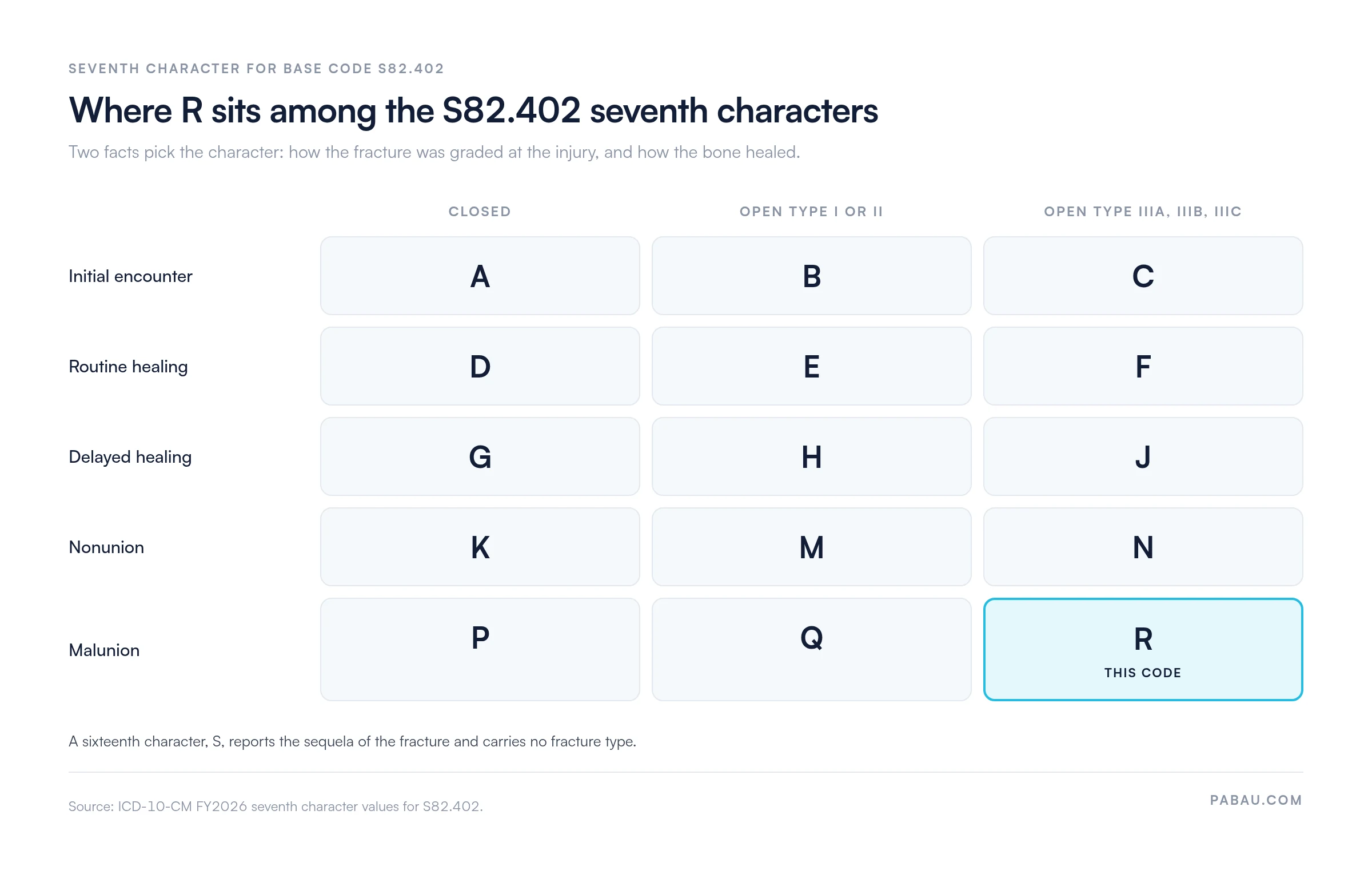
Nonunion (N) means bone healing never completed. Malunion (R) means healing completed but in a faulty position. Imaging that shows bony bridging with angular deformity indicates malunion. Imaging that shows a persistent fracture gap without bridging indicates nonunion.
When documentation is ambiguous between delayed healing (J) and malunion (R), request the radiology report rather than interpreting a clinical note. The radiologist’s language, such as ‘healed in varus angulation’ or ‘bony union with deformity’, is your coding justification for R.
ICD-10-CM ties the open fracture 7th characters to the Gustilo-Anderson classification, the orthopedic grading system for open fracture severity. The surgeon assigns the grade at the time of the original injury, usually in the operative note from the initial debridement. That grade then follows the patient through every subsequent encounter code.
The official ICD-10-CM guidelines settle what happens when the grade is missing. When the record documents an open fracture but does not designate the type, coders assign the type I or II classification. At a malunion follow-up, that means using Q rather than the R character. Grade III is never assumed from the severity of the injury description alone.
Pull the Gustilo grade into the problem list at the initial encounter rather than leaving it in the operative note. Coders working a follow-up visit six months later rarely open the surgical record. That is how an open type III injury quietly turns into a Q or a P on the claim.
All sixteen variants share the same base code, S82.402 (unspecified fracture of shaft of left fibula). They differ by encounter status, fracture type, and healing outcome. Every one of them is billable.
P, Q, and R all describe malunion, and only the fracture type separates them. S82.402P is the closed fracture that healed crooked. S82.402R is the open type IIIA, IIIB, or IIIC fracture that healed crooked. Choosing P for a grade III open injury, or R for a closed one, puts the claim at odds with the operative record. See the CDC/NCHS ICD-10-CM web tool to confirm current-year validity for each variant.
Several codes are routinely confused with S82.402R. Selecting the wrong fracture type, laterality, or healing outcome is the fastest path to a denial. The table below maps the alternatives coders reach for most often, and what separates each one from S82.402R.
ICD-10-CM places important instructions at the S82 category level that govern how S82.402R can be used. Reviewing them prevents claim edits before submission. Per CMS ICD-10 guidance, coders must read category-level notes alongside the specific code.
One Excludes1 pairing at the S82 level deserves a second look. A patient with metastatic disease who sustains what looks like a traumatic fibula fracture may have a pathological fracture instead. That belongs in M84.464 (pathological fracture, left fibula) or M84.364 (stress fracture, left fibula), not S82, and both need their own 7th character.
Review the mechanism of injury and bone quality documentation before assigning S82.402R. The wider ICD-10-CM code set applies the same category-level instructions to every musculoskeletal chapter.
S82.402R requires five documentation elements to support a clean claim. Any one of them missing is a predictable denial trigger. Documentation must sit in the provider’s note at the time of service, not be reconstructed after a payer request.
For practices managing fracture rehabilitation across multiple visits, consistent notation at each encounter reduces the risk of 7th character errors.
The word “unspecified” in the descriptor refers to the fracture pattern, not to the wound. Coders do not need to query the provider about whether the break was transverse, oblique, or spiral. They do need the open fracture type, because that single fact separates R from Q and P.
The CPT codes paired with S82.402R reflect the encounter type. Because R denotes a subsequent encounter, the accompanying procedure codes are follow-up, rehabilitation, or corrective surgery codes, not initial fracture treatment codes.
Practices submitting electronic claims work from a built-in CPT and ICD-10 catalog. That catalog flags mismatched code pairs before the claim reaches the payer.
CPT code selection must match the encounter type. Billing a corrective repair code such as 27726 with S82.402R is appropriate only when that surgery was performed. Using it for a routine evaluation visit will trigger a medical necessity denial.
Systems that link the diagnosis and the procedure code at the point of service let staff catch these mismatches before submission. The check costs nothing at the visit and saves a rework cycle afterward.
Denial patterns for S82.402R cluster around a handful of specific errors. Fixing them requires changes to documentation workflow, not just coding behavior. Practices that treat denial management as a proactive process catch these patterns before they become write-offs.
Built-in edit checks surface the same errors at the point of claim building, well before payer adjudication.
Build a fracture coding query template that asks providers four questions at every fracture follow-up: (1) Which side? (2) Was the original injury open or closed, and at what Gustilo grade? (3) What does the most recent imaging show: routine healing, delayed healing, nonunion, or malunion? (4) Is this a follow-up visit or a new surgical intervention? Four short answers eliminate almost every S82.402R denial trigger.
In most practices the Gustilo grade lives in one place and the follow-up claim is built in another. A surgeon records the open fracture type in an operative note at the initial encounter. Six months later a coder working from a brief follow-up note picks the malunion character that looks right, and nobody reconciles the two. That is how an open type III injury ends up billed as S82.402P.
Pabau is practice management software for orthopedic, physical therapy, and multi-specialty practices. It keeps the diagnosis, the supporting imaging, and the procedure codes on one patient timeline. The fracture type recorded at the injury stays visible at every later visit.
Our claims management software links diagnosis codes to procedure codes at the point of service. It also runs edit checks before the claim is released.
Claims go out electronically through Claim.MD to more than 4,000 US payers, and remittance advice comes back into the same record. A fracture-heavy caseload sees fewer 7th character corrections, fewer resubmissions, and faster payment.

Pabau’s claims management software links diagnosis codes to procedure codes at the point of service and flags 7th character mismatches. Claims go out electronically through Claim.MD across 4,000+ US payers.

S82.402R claims are denied over the record far more often than over the code. The code itself is straightforward once four clinical facts are confirmed.
Those facts are the left fibula shaft, an open fracture graded IIIA, IIIB, or IIIC at the injury, a follow-up visit, and imaging-confirmed malunion. Capturing them consistently across an episode of care that may span months and several providers is the harder part.
Pabau’s claims management software connects diagnosis and procedure codes at the point of service. It submits orthopedic fracture claims electronically through Claim.MD across more than 4,000 US payers. Book a demo to see how it handles 7th character validation on fracture claims.

Need to understand how claims reach the payer? Medical claims clearinghouse guide explains how 837P files are validated before reaching Medicare and commercial payers.
Submitting 837P files for orthopedic claims? 837 file format and submission guide covers the electronic transaction structure used for professional claims including fracture diagnoses.
Managing ERA responses after S82.402R claims? Electronic remittance advice (ERA) guide walks through reading 835 remittance files to identify denial reason codes on musculoskeletal claims.
ICD-10 Code S82.402R is a billable diagnosis code for an unspecified fracture of the shaft of the left fibula. The 7th character R narrows it further. It means a subsequent encounter for an open fracture graded Gustilo type IIIA, IIIB, or IIIC that healed with malunion. It belongs to category S82 and is valid for FY2025 and FY2026 claims.
Both describe a malunited fracture of the left fibula shaft at a subsequent encounter. The difference is the fracture type at the time of injury. S82.402P is used when the fracture was closed. S82.402R is used when it was an open fracture graded Gustilo type IIIA, IIIB, or IIIC. If the fracture was open but no grade was documented, the guidelines send you to S82.402Q instead.
Yes, S82.402R is a fully billable and valid ICD-10-CM diagnosis code for FY2025 and FY2026. It carries enough specificity in site, laterality, fracture type, encounter type, and healing outcome to be submitted on a claim. You can verify current-year validity using the CDC/NCHS ICD-10-CM lookup tool.
Both apply to an open type IIIA, IIIB, or IIIC fracture of the left fibula shaft at a subsequent encounter. S82.402R means the fracture healed but in a faulty position, which is malunion. S82.402N means the fracture failed to heal at all, which is nonunion. Imaging separates them: bony bridging with angular deformity indicates malunion, while a persistent fracture gap without bridging indicates nonunion.
Use R when three conditions are met. The original injury must have been an open fracture graded Gustilo type IIIA, IIIB, or IIIC. The active treatment phase must have ended. Imaging at or before the current encounter must confirm the fracture healed in a malunited position. If the fracture was closed, use the P character instead. If the open fracture type was not designated, use Q.
The most common pairings are E/M codes (99213 or 99214) for follow-up evaluations and physical therapy codes (97110, 97530) during rehabilitation. Corrective surgery is usually reported with 27726, repair of fibula nonunion or malunion with internal fixation, and hardware removal with 20680. CPT selection must match the service actually rendered at the visit, not the diagnosis alone.
The most common reasons are a fracture type mismatch, the wrong healing character at a follow-up visit, or missing laterality in the provider note. A mismatch here means P or Q billed for an open grade III injury, or R billed for a closed one. Claims also fail with no current-visit imaging evidence of malunion, or a CPT-diagnosis mismatch. A structured provider query at every fracture follow-up resolves most of these before coding.