

Pabau Engage inbox

Pabau Engage is here: every patient conversation in one inbox.

Learn more
ICD-10-CM Code

ICD code S89.302D – Unspecified physeal fracture of lower end of left fibula

Billable Code Specific Code


Code Definition

S89.302D is the billable ICD-10-CM code for unspecified physeal fracture of lower end of left fibula, subsequent encounter for fracture with routine healing.

The "unspecified" qualifier means the clinical note does not document the Salter-Harris fracture type. The side is not in doubt, because the sixth character 2 identifies the left fibula. The seventh character D confirms the patient has completed active fracture treatment and is now attending routine follow-up visits.

Chapter
S00-T88 Injury, poisoning and certain other consequences of external causes
Category
S89 Other and unspecified injuries of lower leg
Group
S89.302 Unspecified physeal fracture of lower end of left fibula
Billable
Yes
Code also known as
left distal fibula growth plate fracture, left distal fibular physeal fracture
Save time. Improve accuracy. Get paid faster.
Automate coding with Pabau

Let Pabau's smart automation suggest the right codes, reduce claim denials, and keep your practice compliant—effortlessly.

  • AI-powered code suggestions
  • Real-time compliance checks
  • Faster claims, fewer denials
Why practices choose Pabau
Save hours every week

Automate repetitive tasks and focus on what matters most—your patients.

Improve accuracy

Reduce coding errors and ensure compliance with the latest regulations.

Get paid faster

Clean claims, fewer denials, and faster reimbursements.

Grow with confidence

Powerful insights and reporting to help your practice thrive.

HIPAA compliant SOC 2 certified GDPR-compliant Trusted by 4,000+ clinics worldwide

Key takeaways

Key takeaways

ICD-10 Code S89.302D is valid and billable in the FY 2027 code set. It covers an unspecified physeal fracture of the lower end of the left fibula at a routine-healing follow-up.

“Unspecified” refers to the Salter-Harris type, not the side. The sixth character 2 already identifies the left fibula.

When the chart names the pattern, code S89.312D (Type I), S89.322D (Type II), or S89.392D (other physeal fracture) instead.

The seventh character D applies once active treatment is complete and the fracture is healing as expected.

Follow-up visits inside a 90-day fracture care global, such as after CPT 27786, are reported with 99024 rather than a separately paid E/M code.

ICD-10 Code S89.302D: Code definition and billable status

ICD-10 Code S89.302D is a billable ICD-10-CM code. It covers an unspecified physeal fracture of the lower end of the left fibula, subsequent encounter for fracture with routine healing. It is active in the FY 2027 release, which took effect on October 1, 2026, and can be checked in the CDC/NCHS ICD-10-CM browser tool.

FieldValue
CodeS89.302D
Official descriptorUnspecified physeal fracture of lower end of left fibula, subsequent encounter for fracture with routine healing
BillableYes
Code systemICD-10-CM (International Classification of Diseases, 10th Revision, Clinical Modification)
ChapterS00-T88: Injury, poisoning and certain other consequences of external causes
BlockS80-S89: Injuries to the knee and lower leg
CategoryS89: Other and unspecified injuries of lower leg
SubcategoryS89.3: Physeal fracture of lower end of fibula
Encounter typeSubsequent encounter, routine healing
POA reportingExempt
MS-DRG grouping559, 560, 561 (Aftercare, musculoskeletal system and connective tissue)
Valid fiscal yearFY 2027 (active, no change since the code was introduced in FY 2016)

What S89.302D means: Breaking down the code

Each character of S89.302D narrows the diagnosis further. Read left to right, the code names the body region, the bone and growth plate, the fracture pattern, the side, and the stage of care.

Character(s)ValueMeaning
1-3S89Other and unspecified injuries of lower leg
43Physeal fracture of lower end of fibula (the distal fibular growth plate, at the ankle)
50Unspecified physeal fracture (Salter-Harris type not documented)
62Left fibula
7DSubsequent encounter for fracture with routine healing

The word “unspecified” in the descriptor applies only to the fifth character. It means the record does not state the Salter-Harris type. The side is fully specified, because the sixth character 2 always means left within S89.30-.

Clinical definition: Physeal fracture of the lower end of the fibula

A physeal fracture is a break that runs through or into the growth plate (physis) of a bone that is still growing. S89.302D places it at the distal fibula, the growth plate just above the lateral malleolus on the outer side of the ankle. Because the physis is cartilage, it is weaker than the surrounding bone and ligaments in children.

  • Anatomical site: the distal fibular physis, at the lateral malleolus on the outer ankle.
  • Typical mechanism: a twisting or rolling injury to the ankle, often during sport or play.
  • Patient population: skeletally immature patients. Distal tibial and fibular physes close at around 12 to 17 years in girls and 15 to 20 in boys.
  • Clinical significance: isolated growth arrest after a distal fibula physeal fracture is rare, but it can lead to ankle valgus when it does occur.

A review of pediatric ankle fractures explains why children often fracture here instead of spraining a ligament. Their ligaments are robust, while the physis is vulnerable to shear and rotational forces. Ankle fractures account for about 15-20% of all physeal injuries in children.

Diagnosis is less certain than the code suggests. In an MRI study published in Injury in 2010, every clinically suspected Salter-Harris Type I fracture of the distal fibula had an intact physis.

About 90% were ligament sprains or bone bruises instead. That finding is why the chart, not the referral reason, should drive code selection at each visit.

Salter-Harris types and the S89.3 code family

ICD-10-CM gives the lower fibula fewer Salter-Harris options than the lower tibia. There are dedicated codes for Types I and II only. Any other documented physeal pattern goes to S89.39-, other physeal fracture of lower end of fibula.

Fracture patternDescriptionLeft fibula, subsequent encounter (routine healing)
Salter-Harris Type IFracture through the physis onlyS89.312D
Salter-Harris Type IIFracture through the physis and the metaphysisS89.322D
Other physeal fractureA documented physeal pattern without its own fibula codeS89.392D
UnspecifiedPhyseal fracture confirmed, Salter-Harris type not documentedS89.302D

When the radiology report or the treating provider names the Salter-Harris type, the type-specific code replaces S89.302D. If the imaging narrative describes the fracture line but no note names the type, query the provider before the claim goes out.

Laterality: Right, left, and unspecified variants

S89.302D is the left-sided code. Its two siblings cover the right fibula and a record that names no side at all.

CodeSideWhen to use
S89.301DRight fibulaThe record documents a right distal fibula physeal fracture
S89.302DLeft fibulaThe record documents a left distal fibula physeal fracture
S89.309DUnspecified fibulaNo note in the record identifies the side and clarification is not possible

Under guideline I.B.13, the side may be taken from another clinician’s documentation, such as the radiology report, when the treating provider omits it. If two notes disagree on the side, query the provider. The unspecified-side code should rarely be needed.

Seventh character D: Subsequent encounter definition and correct use

The seventh character D means the patient has completed active treatment and is receiving routine care while the fracture heals. The ICD-10-CM Official Guidelines for Coding and Reporting, Section I.C.19, set this rule for every traumatic fracture code, including the S89 physeal codes.

The S89.302 subcategory carries six seventh characters. Each one has to match the provider’s assessment at that specific visit.

7th characterFull codeMeaningWhen to use
AS89.302AInitial encounter for closed fractureThe patient is receiving active treatment, such as the first evaluation, casting, or surgery
DS89.302DSubsequent encounter, routine healingFollow-up visits while the fracture heals as expected, such as X-ray checks and boot or cast reviews
GS89.302GSubsequent encounter, delayed healingHealing is slower than expected, but union is still anticipated
KS89.302KSubsequent encounter, nonunionThe provider documents that the fracture has failed to unite
PS89.302PSubsequent encounter, malunionThe fracture has healed in an abnormal position
SS89.302SSequelaA late effect of the healed fracture, such as a growth disturbance, is being treated

Pro Tip

Code the healing status the provider documents at each visit, not the status from the last one. If a follow-up note changes from “healing well” to “delayed union,” that claim moves from S89.302D to S89.302G.

S89.302A vs S89.302D vs S89.302S: Choosing the encounter character

  • S89.302A (initial): use for each visit where the patient receives active treatment. That includes the first evaluation, immobilization, and any reduction or fixation. A patient who delayed seeking care still gets A at the first treatment visit.
  • S89.302D (subsequent, routine healing): use once active treatment is complete and the patient returns for routine follow-up. Healing checks, repeat X-rays, and boot or cast reviews belong here.
  • S89.302S (sequela): use when the patient is treated for a late effect after healing. Code the late effect first, such as a growth disturbance, and add S89.302S after it.

Per the guidelines, aftercare Z codes are not used for injuries that carry seventh characters. Code a follow-up for this fracture as S89.302D, not as Z47.89 or another aftercare code.

S89.302D inherits notes from three levels of the tabular list. Review each one before finalizing the claim.

Chapter S00-T88 note: use secondary codes from Chapter 20, External causes of morbidity, to show the cause of injury.

Excludes2 at the S80-S89 block level:

  • Burns and corrosions (T20-T32)
  • Frostbite (T33-T34)
  • Injuries of ankle and foot, except fracture of ankle and malleolus (S90-S99)
  • Insect bite or sting, venomous (T63.4)

S89 category notes: a fracture not documented as open or closed is coded as closed. Other and unspecified injuries of the ankle and foot (S99.-) are an Excludes2.

Physeal fracture rule: guideline I.C.19.c.3 says to assign only the code for the type of physeal fracture. Do not add a separate S82 code for the fibula itself.

Codes commonly confused with ICD-10 Code S89.302D

CodeDescriptor (abbreviated)Key differentiator from S89.302D
S89.301DUnspecified physeal fracture, lower end of right fibula, subsequentRight side instead of left
S89.309DUnspecified physeal fracture, lower end of unspecified fibula, subsequentNo side documented anywhere in the record
S89.312DSalter-Harris Type I, lower end of left fibula, subsequentThe chart names a Type I pattern
S89.322DSalter-Harris Type II, lower end of left fibula, subsequentThe chart names a Type II pattern
S89.102DUnspecified physeal fracture, lower end of left tibia, subsequentThe distal tibial growth plate is fractured, not the fibular one
S89.202DUnspecified physeal fracture, upper end of left fibula, subsequentThe growth plate at the knee end of the fibula is involved
S82.62XD / S82.65XDDisplaced / nondisplaced fracture of left lateral malleolus, subsequentThe fracture does not involve the growth plate
S89.302GSame site and side, delayed healingThe provider documents slower healing than expected

Each of those mix-ups comes down to one of four chart questions. Answered in order, they lead to S89.302D or to the sibling code the note supports.
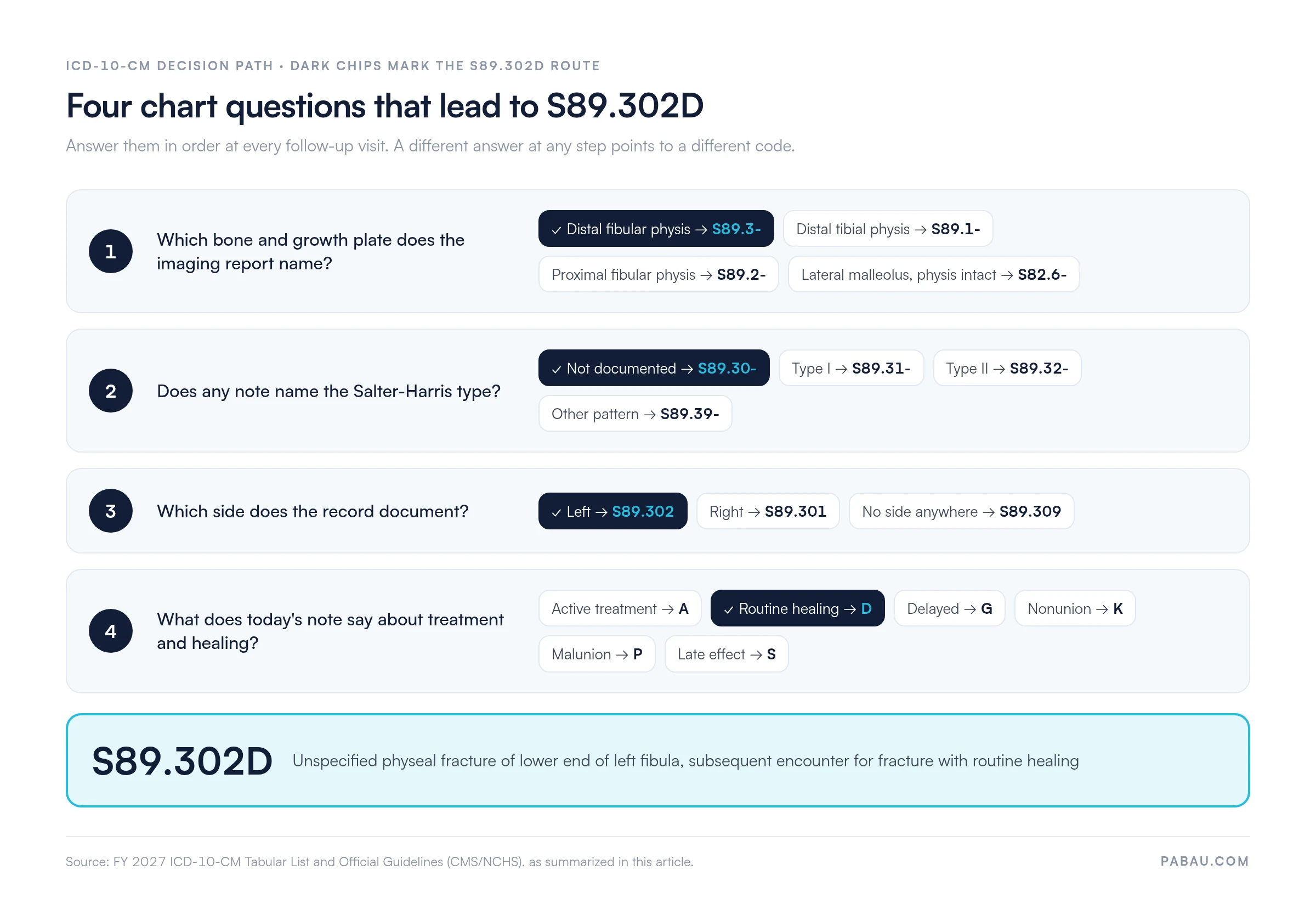
Decision path for S89.302D in four steps
A single changed note, such as a named Salter-Harris type or delayed healing, moves the claim off S89.302D. Paths follow the FY 2027 ICD-10-CM tabular list.

ICD-10-CM code hierarchy: Where S89.302D sits

  • S00-T88: Injury, poisoning and certain other consequences of external causes
  • S80-S89: Injuries to the knee and lower leg
  • S89: Other and unspecified injuries of lower leg
  • S89.3: Physeal fracture of lower end of fibula
  • S89.30: Unspecified physeal fracture of lower end of fibula
  • S89.302: Unspecified physeal fracture of lower end of left fibula
  • S89.302D: Subsequent encounter for fracture with routine healing

CPT codes typically billed with S89.302D

CPT codes paired with S89.302D describe aftercare, not the original fracture treatment. The first question is whether the visit falls inside a fracture care global period.

Closed treatment of a distal fibula fracture without manipulation, CPT 27786, carries a 90-day global period. Its with-manipulation and open-fixation counterparts, 27788 and 27792, do as well. Routine follow-up by the same provider inside that window is reported with CPT 99024 and is not paid separately.

CPT codeDescriptionWhen to pair with S89.302D
99024Postoperative follow-up visit, included in global serviceSame-provider follow-up inside the 27786, 27788, or 27792 global period
99212-99214Office or outpatient visit, established patientFollow-up visits outside a global period, or by a provider who did not bill the fracture care
73600 / 73610Radiologic examination, ankle; 2 views / complete, minimum of 3 viewsFollow-up ankle X-rays to check physeal healing
73590Radiologic examination, tibia and fibula, 2 viewsFollow-up imaging when the whole lower leg is filmed
29405Application of short leg cast (below knee to toes)Cast replacement during the healing phase
97110Therapeutic exercisesPhysical therapy during rehabilitation

Pair the imaging line, such as CPT 73610, with modifier LT so the procedure side matches the left-sided diagnosis.

Documentation requirements for S89.302D

A claim carrying S89.302D needs notes that support five elements. A missing element leaves the claim open to a medical necessity denial or an audit finding.

  • Fracture site: the note names the distal fibular physis or growth plate. “Ankle fracture” or “lateral ankle injury” alone does not support an S89.3 code.
  • Laterality: the record identifies the left side. S89.302D already reports left, so no laterality query is needed when the chart agrees. If any note says right, the correct code is S89.301D. If no note gives a side, it is S89.309D.
  • Salter-Harris type: S89.302D is correct only when no note names the type. If the radiology report says Type I or Type II, use S89.312D or S89.322D.
  • Encounter type: the note shows a follow-up visit after active treatment, such as “fracture check” or “return visit for healing review.”
  • Healing status: the provider’s assessment confirms routine healing. Phrases like “healing well” or “nontender at the physis” support D. Without a healing statement, the coder cannot confirm D over G.

A pre-submission review that checks these five elements is a core part of medical billing compliance for fracture aftercare claims.

External cause codes to pair with S89.302D

The S00-T88 chapter note asks for a secondary external cause code to show how the injury happened. An external cause code may be reported at each encounter where the injury is treated, using the matching seventh character D.

External cause codeDescriptorTypical scenario
W01.0XXDFall on same level from slipping, tripping and stumbling without subsequent striking against object, subsequent encounterA child rolls the ankle while running
W09.8XXDFall on or from other playground equipment, subsequent encounterA fall from a climbing frame
V00.131D / V00.141DFall from skateboard / nonmotorized scooter, subsequent encounterAnkle injury while skating or riding a scooter
W19.XXXDUnspecified fall, subsequent encounterA fall is documented but the type is not

Activity (Y93), place of occurrence (Y92), and external cause status (Y99) codes are different. Each is reported only once, at the initial encounter, so they do not belong on an S89.302D claim.

Common claim denial reasons for S89.302D and how to avoid them

Denials for S89.302D follow a few predictable patterns. Good denial management in medical billing starts with knowing which errors a pre-submission check would catch.

  • Wrong encounter character: S89.302A billed on a routine follow-up visit. Check the note for active treatment before keeping A.
  • Side conflict: the diagnosis says left, but the imaging or casting line carries modifier RT, or an earlier note says right. Confirm the side across every note on the date of service.
  • Unspecified type when the type is charted: S89.302D billed although the radiology report names Type I or Type II. Read the final imaging report, not only the visit note.
  • Wrong bone or growth plate: a distal tibia physeal fracture coded to S89.3-, or a non-physeal lateral malleolus fracture coded as physeal. Match the code family to the fracture site in the imaging report.
  • Billing inside the global period: a separately paid E/M visit by the provider who billed 27786. Report 99024 for those visits.
  • Missing healing status: the note does not record the provider’s view of healing. Without it, D cannot be supported over G. A one-line healing assessment prevents this denial.

A list of denial codes in medical billing helps a coding team match each rejection to the right fix.

Pro Tip

Run a monthly report of S89.302 claims that carry the seventh character A. For each one, confirm the note documents active treatment on that date. An A on a visit labeled “follow-up” is the clearest sign that D was missed.

Coding guidelines and official references

The governing reference for S89.302D is the ICD-10-CM Official Guidelines for Coding and Reporting, published each year by CMS and NCHS. Check code validity against the new tabular list every October 1.

  • Section I.B.13 (laterality): lets coders take the side from other clinicians’ notes and limits the unspecified-side code to records with no side at all.
  • Section I.C.19.a: defines the initial, subsequent, and sequela characters (A, D, S) and bars aftercare Z codes for injuries.
  • Section I.C.19.c: covers traumatic fractures, including the G, K, and P characters and the physeal fracture rule.
  • Section I.C.20: covers external cause codes, including the once-only rule for Y92, Y93, and Y99.
  • NCCI edits (CMS): govern CPT pairs that cannot share a date of service without a modifier.

Also check the clean claim criteria your clearinghouse applies before submission.

How Pabau keeps S89.302D follow-up claims clean

Most S89.302D denials start before the claim is built. A seventh character is keyed from memory, a side is copied from the wrong note, or a follow-up lands inside a global period. Catching those by hand means rereading every follow-up chart.

Pabau, the practice management and billing platform we build, checks each claim with its claims management software before submission. Claims then go out electronically through Claim.MD, Pabau’s US clearinghouse partner.

The result is fewer follow-up claims sent back for a missing character or a side mismatch, and fracture aftercare visits paid on the first pass.
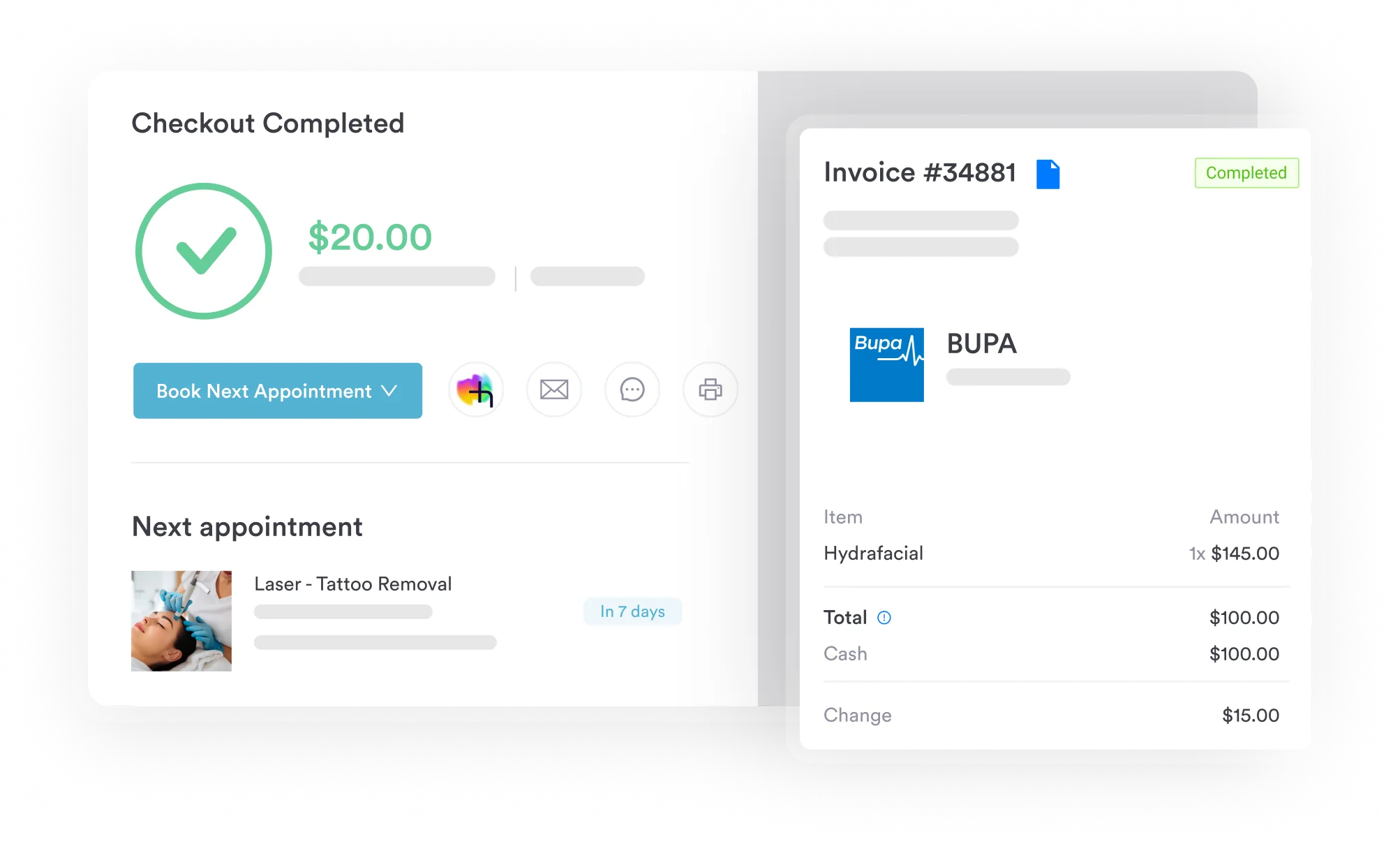

Pabau checkout screen with a completed insurer invoice and the next appointment booked
Pabau’s checkout screen raises the insurer invoice and books the next fracture check together, so each follow-up visit is billed before the patient leaves.

Streamline fracture follow-up billing

Pabau checks fracture follow-up claims before submission and sends them through Claim.MD, so seventh-character and side errors get fixed before they become denials.

Pabau claims management dashboard

Conclusion

Coding S89.302D correctly starts with the anatomy. A growth plate fracture at the outer ankle belongs in S89.3-, not in the distal tibia S89.1- family or the non-physeal S82.6- malleolus codes. Settle the bone and the growth plate first, and the remaining characters follow from the chart.

After that, the code only changes when the chart does. A named Salter-Harris type moves the claim to S89.312D or S89.322D. A change in healing status moves it to the G, K, or P character. Book a demo to see how Pabau checks fracture follow-up claims before they reach the payer.

Continue your research

Continue your research

Coding a growth plate fracture at the knee end of the leg? ICD-10 Code S89.002G covers an unspecified physeal fracture of the upper end of the left tibia with delayed healing.

Coding a lateral malleolus fracture that spares the growth plate? ICD-10 Code S82.65XA covers a nondisplaced fracture of the left lateral malleolus at the initial encounter.

Seeing the patient inside the fracture care global period? CPT Code 99024 covers how to report postoperative follow-up visits that are not paid separately.

Frequently asked questions

What is ICD-10 Code S89.302D?

ICD-10 Code S89.302D is a billable ICD-10-CM code. It covers an unspecified physeal fracture of the lower end of the left fibula, subsequent encounter for fracture with routine healing. It applies to follow-up visits after active treatment when the Salter-Harris type is not documented.

Is S89.302D a billable ICD-10-CM code?

Yes. S89.302D is billable and specific in the FY 2027 ICD-10-CM code set, and it is exempt from POA reporting. It can be reported whenever it matches the documented diagnosis and encounter.

Does “unspecified” in S89.302D mean the side is not documented?

No. “Unspecified” means the Salter-Harris type of the growth plate fracture is not documented. The sixth character 2 identifies the left fibula, while S89.301D is the right side and S89.309D is an unspecified side.

Which code applies when the Salter-Harris type is documented?

For the left distal fibula at a routine-healing follow-up, use S89.312D for Type I and S89.322D for Type II. Any other documented physeal pattern goes to S89.392D, other physeal fracture of lower end of left fibula.

What is the difference between S89.302A, S89.302D, and S89.302S?

S89.302A is for visits where the patient receives active treatment. S89.302D is for routine follow-up while the fracture heals as expected. S89.302S is for treating a late effect after healing, and it is sequenced after the code for that late effect.

Should I add an S82 fibula fracture code alongside S89.302D?

No. Guideline I.C.19.c.3 says to assign only the code for the type of physeal fracture. A separate code for the fractured bone is not added.

Can S89.302D be used for adult patients?

The code has no age edit, but physeal fractures need an open growth plate. Distal fibular physes close at around 12 to 17 years in girls and 15 to 20 in boys. For an older patient, the note should confirm the physis was still open.


Avatar photo
Anja Dodevska
Content Writer

Anja Dodevska writes about healthcare, dermatology, and the day-to-day realities of running a medical practice for Pabau. She enjoys breaking down complex topics into clear, accessible content and has a soft spot for the often-overlooked aspects of clinic life. When she's not writing, she's exploring cafes, walking her dog, or spending time with friends and family.
×

