ICD code S82.402H – Open left fibula shaft fracture with delayed healing
Billable Code•Specific Code
Code Definition
S82.402H is the billable ICD-10-CM code for delayed healing of an open type I or II fracture of the left fibula shaft. It applies at a subsequent encounter, where the fracture pattern is unspecified and the bone is mending more slowly than the surgeon expected.
The letter H is often mistaken for nonunion. That reading sends the claim the wrong way, because nonunion of this fracture is S82.402M. Two facts in the record settle the choice: the original Gustilo grade, and whether the clinician documents delayed healing or nonunion.
Related Information
Chapter
S00-T88 Injury, poisoning and certain other consequences of external causes
Category
S82 Fracture of lower leg, including ankle
Group
S82.402 Unspecified fracture of shaft of left fibula
Billable
Yes
Code also known as
Delayed union of open left fibula shaft fracture
Save time. Improve accuracy. Get paid faster.
Automate coding with Pabau
Let Pabau's smart automation suggest the right codes, reduce claim denials, and keep your practice compliant—effortlessly.
Open left fibula shaft fracture with delayed healing
Codes
Suggested by Pabau AI
S82.402HOpen left fibula shaft fracture with delayed healing
ICD Code Suggestion
AI
Suggested code
S82.402HOpen left fibula shaft fracture with delayed healingHigh match
Confidence score
98%
Why this code?
Matches patient diagnosis
Supported by clinical notes
Commonly used for this condition
Why practices choose Pabau
Save hours every week
Automate repetitive tasks and focus on what matters most—your patients.
Improve accuracy
Reduce coding errors and ensure compliance with the latest regulations.
Get paid faster
Clean claims, fewer denials, and faster reimbursements.
Grow with confidence
Powerful insights and reporting to help your practice thrive.
HIPAA compliant•SOC 2 certified•GDPR-compliant•Trusted by 4,000+ clinics worldwide
Key takeaways
S82.402H is a billable ICD-10-CM code for a follow-up visit on an open type I or II left fibula shaft fracture with delayed healing.
The 7th character H means delayed healing, so a documented nonunion of the same fracture moves to S82.402M instead.
The Gustilo grade decides the letter, with type I or II taking H and type IIIA, IIIB or IIIC taking J.
Only the initial-encounter letter B takes an ungraded open fracture. At an H visit, take the grade from the injury record or query the surgeon.
Nonunion repair codes such as CPT 27726 need a nonunion or malunion diagnosis, so they do not belong on an H claim.
ICD-10 code S82.402H at a glance
ICD-10 code S82.402H reports a follow-up encounter for an open type I or II left fibula shaft fracture that is healing more slowly than expected. The pattern of the break is not documented, which is why the code reads “unspecified fracture.”
Unspecified fracture of shaft of left fibula, subsequent encounter for open fracture type I or II with delayed healing
Billable
Yes, the 7-character code is the billable level
ICD-10-CM chapter
Chapter 19: Injury, poisoning and certain other consequences of external causes (S00-T88)
Category
S82 Fracture of lower leg, including ankle
Subcategory
S82.40 Unspecified fracture of shaft of fibula
Laterality
Left (the 2 in the 6th character position)
7th character
H, subsequent encounter for open fracture type I or II with delayed healing
Current ICD-10-CM release
Valid and billable
What does each part of S82.402H tell the payer?
Every character in S82.402H carries one clinical fact. Change any fact in the record, and the code changes with it.
S82, lower leg: The category covers fractures of the tibia and fibula, including the ankle.
.40, unspecified shaft fracture: The break is in the fibula shaft, and the notes do not name its pattern. A transverse, oblique, spiral, comminuted or segmental pattern has its own subcategory.
2, left side: The 6th character sets laterality. A 1 means right, and a 9 means the side is unspecified.
H, subsequent encounter: Active treatment is complete, and the patient is back for care during the healing phase.
H, open type I or II: The original fracture broke the skin and was graded Gustilo type I or II.
H, delayed healing: The fracture is mending, but more slowly than the clinician expected. Arrested healing is a nonunion and takes a different letter.
The 7th character decides the claim
S82.402 is not billable until it carries a 7th character. That letter combines three facts: the encounter type, whether the fracture was open or closed, and how healing is going. The full set for this subcategory follows.
7th character
Encounter
Fracture type
Healing status
A
Initial
Closed
Not applicable
B
Initial
Open type I or II
Not applicable
C
Initial
Open type IIIA, IIIB or IIIC
Not applicable
D
Subsequent
Closed
Routine healing
E
Subsequent
Open type I or II
Routine healing
F
Subsequent
Open type IIIA, IIIB or IIIC
Routine healing
G
Subsequent
Closed
Delayed healing
H
Subsequent
Open type I or II
Delayed healing
J
Subsequent
Open type IIIA, IIIB or IIIC
Delayed healing
K
Subsequent
Closed
Nonunion
M
Subsequent
Open type I or II
Nonunion
N
Subsequent
Open type IIIA, IIIB or IIIC
Nonunion
P
Subsequent
Closed
Malunion
Q
Subsequent
Open type I or II
Malunion
R
Subsequent
Open type IIIA, IIIB or IIIC
Malunion
S
Sequela
Any
Not applicable
Read the table by healing status first. The letters G, H and J cover delayed healing. K, M and N cover nonunion, and P, Q and R cover malunion. Within each trio, the letter moves from closed to open type I or II, then to open type III.
Gustilo type: The detail that moves H to J
The open-fracture letters follow the Gustilo-Anderson classification. The treating surgeon grades the wound at the original injury, and the grade has to appear in the record. Coders take the grade from the notes and never assign it themselves.
Gustilo type
Wound characteristics
Delayed healing character
Type I
Clean wound under 1 cm
H
Type II
Wound 1 to 10 cm without extensive soft-tissue damage
H
Type IIIA
Extensive soft-tissue damage, but adequate bone coverage
J
Type IIIB
Extensive soft-tissue loss with periosteal stripping, often needing flap coverage
J
Type IIIC
Arterial injury that needs repair
J
What if the notes say “open fracture” and give no grade? The Tabular List covers that case at the first visit only. Its “open fracture NOS” inclusion term sits under the initial-encounter letter B.
The later letters E, H, M and Q have no published default. So at an H visit, take the grade from the original injury record, or query the surgeon. Never assume it. If the wound description suggests type III, query the surgeon too, because type III moves the letter from H to J in this subcategory.
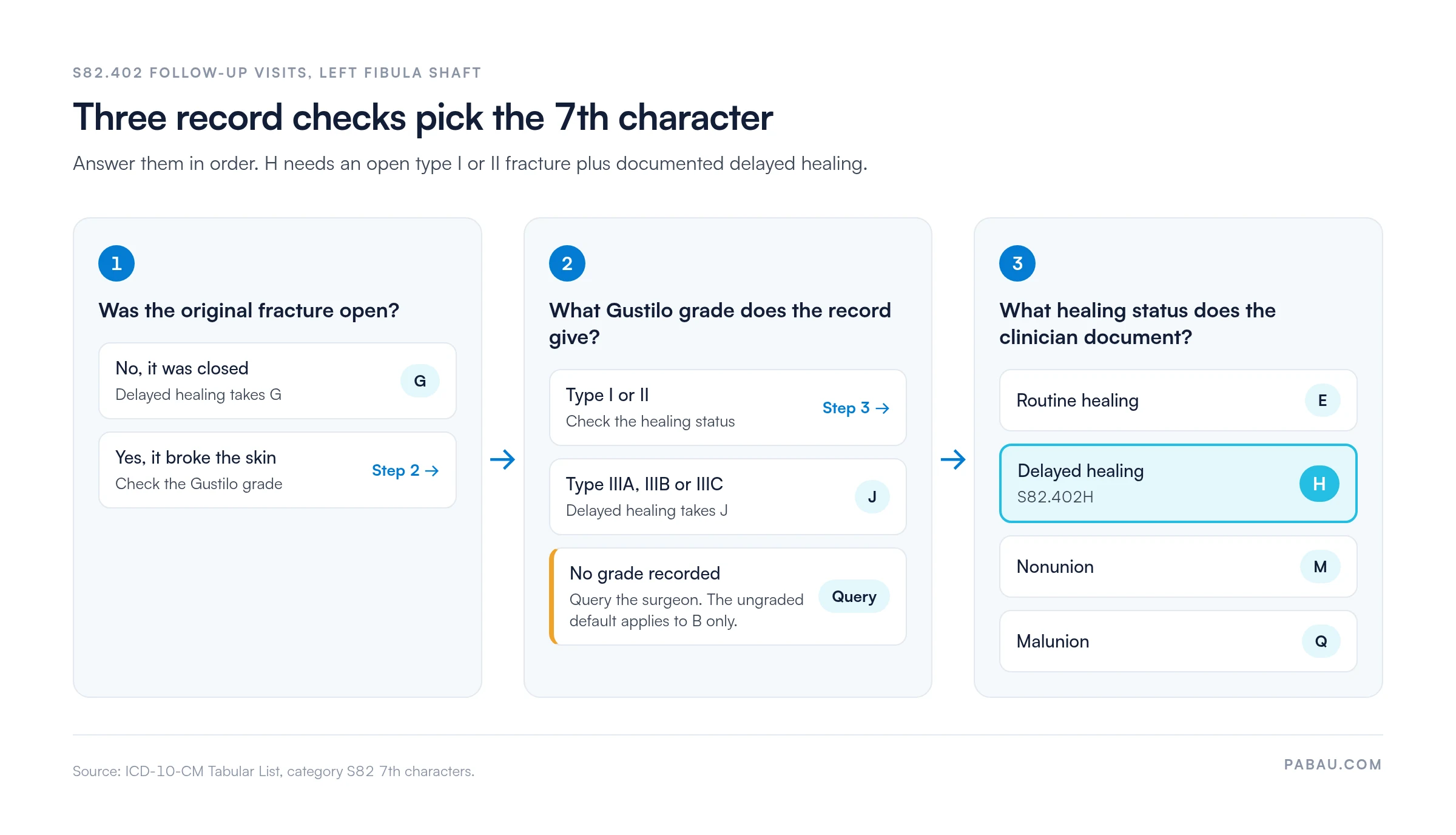
The flow below puts all three record checks in order.
Three facts from the record lead to H, and a missing grade sends you to the surgeon rather than to a default. Letters follow the ICD-10-CM Tabular List for category S82.
Delayed healing or nonunion? Picking the right neighbor
Most errors on this code come from the healing status. Delayed healing means the fracture is still progressing toward union. Nonunion means healing has stopped. The treating clinician makes that call in the notes, and the coder follows it.
Code
Fracture type
Healing status
Use when
S82.402E
Open type I or II
Routine healing
Follow-up on an open I or II fracture that is healing as expected
S82.402G
Closed
Delayed healing
The fracture never broke the skin and is healing slowly
S82.402H
Open type I or II
Delayed healing
Open I or II fracture, still progressing, but slower than expected
S82.402J
Open type IIIA, IIIB or IIIC
Delayed healing
Open type III fracture that is healing slowly
S82.402K
Closed
Nonunion
Closed fracture where the clinician documents nonunion
S82.402M
Open type I or II
Nonunion
Open I or II fracture where the clinician documents nonunion
S82.402N
Open type IIIA, IIIB or IIIC
Nonunion
Open type III fracture where the clinician documents nonunion
S82.402Q
Open type I or II
Malunion
Open I or II fracture that healed in a poor position
Pro Tip
Check three facts before you assign S82.402H. First, the visit is a follow-up after active treatment. Second, the original record grades the fracture as open type I or II, or the surgeon confirms that grade after a query. Third, the clinician documents delayed healing. If the note says nonunion, use S82.402M instead.
Which CPT codes belong on an S82.402H claim?
An H encounter is usually a monitoring visit, so the procedure side of the claim tends to be simple. Often that means an office visit and a CPT 73590 X-ray to track progress toward union.
The harder part is knowing which fracture codes do not fit. Check payer policy and the current CPT descriptors before you bill.
CPT code
Descriptor (summary)
Fit with S82.402H
99212-99215
Office or outpatient visit, established patient
Fits a delayed-healing visit that falls outside the global period of the original fracture care
99024
Postoperative follow-up visit included in the global service
Reports a follow-up inside the global period, which is not paid separately
73590
X-ray of tibia and fibula, 2 views
Fits the imaging that tracks slow healing
27780 / 27781
Closed treatment of proximal fibula or shaft fracture, without or with manipulation
Billed for the initial fracture care, so a later follow-up does not repeat it
27784
Open treatment of proximal fibula or shaft fracture, includes internal fixation when performed
Shaft surgery, so check whether the notes describe delayed healing or a nonunion (M)
27788
Closed treatment of distal fibular fracture (lateral malleolus), with manipulation
Distal fibula, so it never pairs with a shaft code like S82.402H
27726
Repair of fibula nonunion or malunion, with internal fixation
Needs a nonunion (K, M, N) or malunion (P, Q, R) diagnosis, not H
The global period trips up many practices. Fibula fracture treatment codes carry a 90-day global period. Follow-up visits by the same surgeon inside that window are included in the original payment. Report those visits with CPT 99024, which records the service at no separate charge.
Documentation that keeps S82.402H defensible
An audit of S82.402H looks for four facts in the record. With all four in place, the code holds up. For the wider claim picture, see this guide to a clean claim.
Delayed healing in the clinician’s words: The note or radiology report describes slow progress toward union. If the clinician writes nonunion, the code becomes S82.402M.
Open fracture and its grade: The original operative or emergency note records an open fracture, graded type I or II. If that note gives no grade, query the treating surgeon.
Left side, in this visit: The current note names the left fibula. Do not carry laterality forward from an old claim.
Follow-up status: The note shows active treatment is complete and the patient is back for healing-phase care.
Before you submit: A five-point checklist
The visit is a follow-up, and active treatment of the fracture is complete.
The record calls the original fracture open and grades it type I or II, or the surgeon has confirmed that grade after a query.
The clinician documents delayed healing, with no mention of nonunion or malunion.
The current note confirms the left fibula shaft.
The visit falls outside the 90-day global period, or you report it with 99024.
Five mistakes that put the wrong letter on the claim
Reading H as nonunion. H means delayed healing. A documented nonunion of an open type I or II fracture is M.
Reaching for G on an open fracture. G is delayed healing of a closed fracture. Open type I or II takes H.
Ignoring a type III grade. A IIIA, IIIB or IIIC wound moves delayed healing from H to J.
Using an aftercare Z code. Aftercare Z codes are not used for injuries. The fracture code with its 7th character carries the follow-up.
Pairing H with a nonunion repair. CPT 27726 needs a nonunion or malunion diagnosis on the same claim.
Why S82.402H claims get denied
Denials on this code follow a short list of patterns. Spotting them early is the cheapest form of denial management.
Denial trigger
What happens
Prevention
Initial-encounter letter (A or B) on a follow-up
The claim reads as a new injury and can clash with the original fracture claim
Confirm active treatment is complete before choosing a subsequent letter
H on a nonunion procedure
The diagnosis does not support the repair, so medical necessity fails
Code M when the clinician documents nonunion
Visit inside the global period
The E/M service is bundled into the fracture care payment
Check the global period and report 99024 where it applies
Laterality conflict
The side clashes with earlier claims and triggers an edit
Confirm the left side in the current note
No note on healing status
The payer requests records or denies the claim
Keep the note or imaging report that describes delayed healing
The instructional notes at category S82 apply to S82.402H too. Excludes1 means two conditions are never coded together. Excludes2 means the excluded condition is not part of this code, but both may be reported when both are present.
Includes: Fracture of malleolus.
Excludes1: Traumatic amputation of lower leg (S88.-).
Excludes2: Fracture of foot, except ankle (S92.-), and periprosthetic fracture around an internal prosthetic knee or ankle joint (M97.1-, M97.2).
Malleolus fractures sit inside S82: An isolated lateral malleolus fracture is coded to S82.6-, which belongs to the same category.
Category notes: A fracture not described as open or closed is coded as closed. The open fracture letters follow the Gustilo classification.
What the official guidelines say about slow healing
Section I.C.19 of the ICD-10-CM Official Guidelines sets the fracture rules that sit behind this code. Following them is a basic part of medical billing compliance.
Healing complications use their own letters: Delayed healing takes G, H or J. Nonunion takes K, M or N. Malunion takes P, Q or R.
No aftercare Z codes for injuries: Injury aftercare uses the injury code with the right subsequent letter, D through S.
Subsequent means after active treatment: Use a subsequent letter once active treatment is complete and the patient is in the healing or recovery phase.
No grade means no default at H: The Tabular List lets an ungraded open fracture take B, at the initial encounter only. The Official Guidelines set no default for later letters, so query the surgeon.
Related codes worth bookmarking
These codes share most of the S82.402H description. Each one differs in a single fact, so the record decides between them.
Code
Descriptor (summary)
Key difference from S82.402H
S82.401H
Unspecified fracture of shaft of right fibula, open type I or II, delayed healing
Right side
S82.409H
Unspecified fracture of shaft of unspecified fibula, open type I or II, delayed healing
Side not documented
S82.422H
Displaced transverse fracture of shaft of left fibula, open type I or II, delayed healing
Pattern documented as displaced transverse
S82.202H
Unspecified fracture of shaft of left tibia, open type I or II, delayed healing
Tibia shaft instead of fibula
S82.402M
Unspecified fracture of shaft of left fibula, open type I or II, nonunion
Healing has stopped
Pro Tip
When one injury fractures both the left tibia and the left fibula, code each bone on its own. Give each code the letter its own healing status supports, since the two bones can heal at different rates.
How Pabau gets fracture follow-up claims out the door
A slow-healing fracture can mean several follow-up visits over a few months. Each visit is another claim that has to reach the payer cleanly.
Pabau, the practice management platform we build, includes claims management for US practices. Claims go to payers through our Claim.MD clearinghouse integration. Your team submits from the same system that holds the patient’s appointments and notes.
The coding decisions above stay with your coders and clinicians. Pabau handles the submission step, so the documentation work turns into a sent claim without a second system.
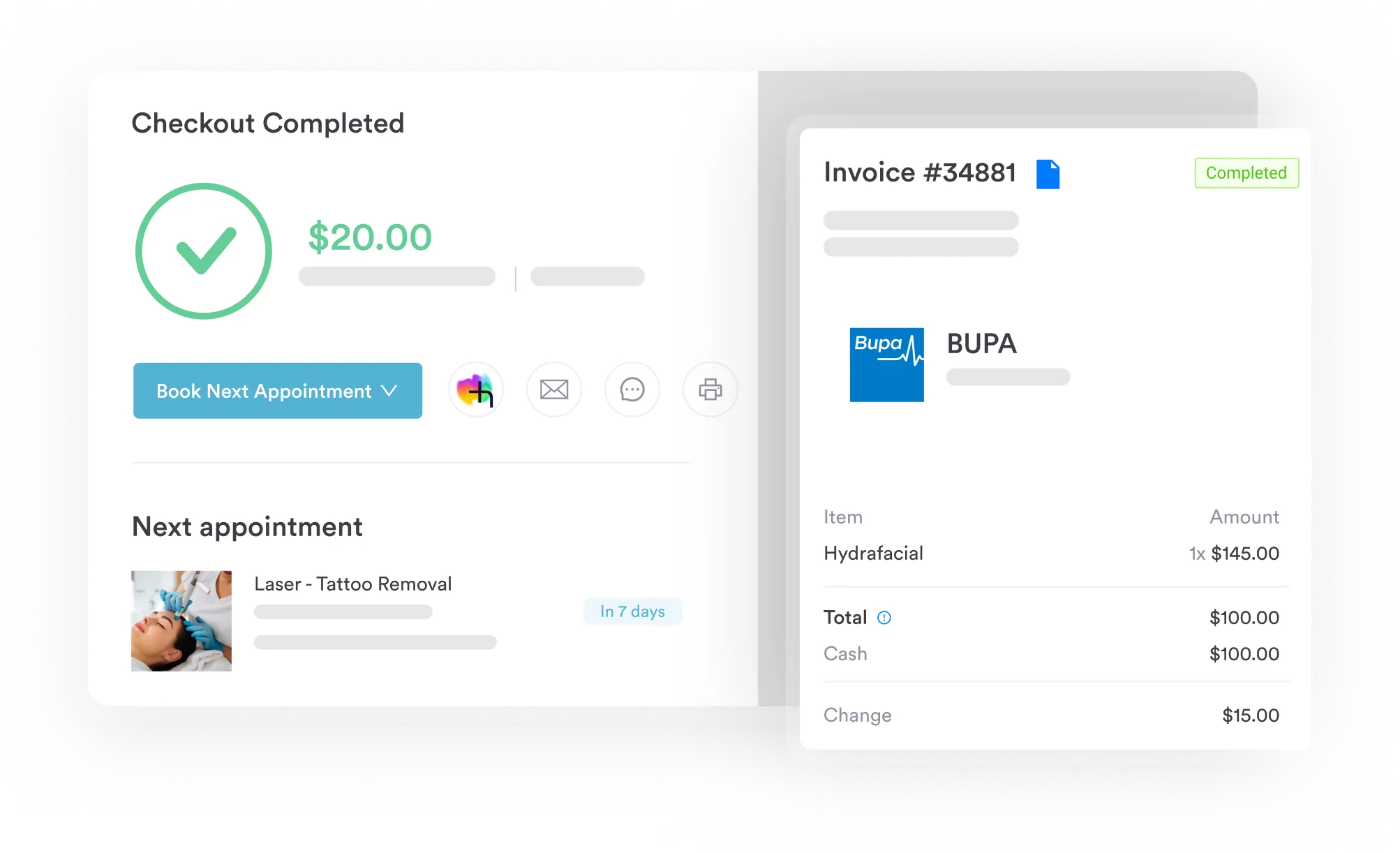
Pabau records each completed follow-up checkout against the patient’s insurer, so billing staff see the payer before an S82.402H claim goes out.
Send fracture follow-up claims from one system
Pabau’s claims management submits claims to US payers through the Claim.MD clearinghouse, from the same record that holds the visit notes.
Treat S82.402H as a healing-status code first. The letter H promises the payer an open type I or II fracture that is still mending. If the notes say the fracture has stopped healing, the claim needs M, and the procedures change with it.
So before you code, read the latest clinical note for the words the clinician used. Then match the letter to them, not to habit. Book a demo to see how claims management and Claim.MD submission fit around your fracture follow-up visits.
Continue your research
Need to understand how claims reach the payer?Medical claims clearinghouse guide explains how clearinghouses validate and route claims before adjudication.
Dealing with persistent fracture claim denials?Electronic remittance advice (ERA) explained covers how to read 835 remittance files and identify denial reason codes efficiently.
Want to verify patient coverage before the visit?Insurance eligibility verification outlines real-time eligibility checks that reduce subsequent-encounter billing surprises.
Frequently asked questions
What does ICD-10 code S82.402H mean?
S82.402H is the billable code for a follow-up visit on an open type I or II fracture of the left fibula shaft with delayed healing. The fracture pattern is not documented.
Does the H in S82.402H mean nonunion?
No. H means delayed healing of an open type I or II fracture. Nonunion of the same fracture is S82.402M, and nonunion of a type III open fracture is S82.402N.
What is the difference between S82.402G and S82.402H?
Both describe delayed healing at a follow-up visit. G applies to a closed fracture, and H applies to an open type I or II fracture.
What if the Gustilo type is not documented?
Check the original injury record, or query the treating surgeon. The Tabular List lets an ungraded open fracture take B, but only at the initial encounter. No default exists for H.
Do I need an external cause code with S82.402H?
Only if your payer or state requires one, since no national mandate exists. When you do report it, give the external cause code its own subsequent-encounter letter, D.