

ICD-10 Code S53.013D: Anterior subluxation of unspecified radial head
ICD-10 Code S53.013D: Quick reference summary Use the table below as your first ...

Last Updated: Nov 6, 2026
Billable Code Specific Code
S82.199M is the billable ICD-10-CM code for a follow-up visit for an open upper tibia fracture that has stopped healing. The official descriptor is other fracture of upper end of unspecified tibia, subsequent encounter for open fracture type I or II with nonunion. The record doesn't name the leg.
The 7th character does the heavy lifting. M means open type I or II with nonunion, while delayed healing takes H and a type III wound takes N instead. Most denials on this code trace back to the wound grade, the side or the healing status, and each one is covered below.
Let Pabau's smart automation suggest the right codes, reduce claim denials, and keep your practice compliant—effortlessly.
Automate repetitive tasks and focus on what matters most—your patients.
Reduce coding errors and ensure compliance with the latest regulations.
Clean claims, fewer denials, and faster reimbursements.
Powerful insights and reporting to help your practice thrive.
HIPAA compliant SOC 2 certified GDPR-compliant Trusted by 4,000+ clinics worldwide

S82.199M codes a follow-up visit for an open type I or II fracture of the upper tibia that hasn’t united, with the side unspecified.
The 7th character M means open type I or II with nonunion. A closed nonunion takes K, and a type IIIA, IIIB or IIIC nonunion takes N.
The 5th character 9 means the fracture isn’t a tibial spine, condyle, bicondylar, tuberosity or torus fracture, since each of those has its own code.
Use the unspecified side only when no document in the encounter names the leg. Otherwise, code S82.191M (right) or S82.192M (left).
Pabau, the practice management software we build, submits claims through Claim.MD, posts electronic remittance and tracks denials for orthopedic practices.
ICD-10 code S82.199M is a billable ICD-10-CM code for a follow-up visit for an open break near the knee that has stopped healing. Its official descriptor is other fracture of upper end of unspecified tibia, subsequent encounter for open fracture type I or II with nonunion. The record doesn’t say which leg, so the 6th character is 9.
“Other” has a narrow meaning here. S82.19- is the residual bucket after tibial spine (S82.11-), lateral condyle (S82.12-), medial condyle (S82.13-), bicondylar (S82.14-), tibial tuberosity (S82.15-) and torus (S82.16-) fractures. If the surgeon names one of those patterns, the fracture belongs in that subcategory instead. At the upper end of the right tibia, a buckle reviewed at a malunion follow-up codes to S82.161P. S82.199M stays behind only when none of those subcategories fits the documented pattern.
The code sits in Chapter 19 under category S82 and subcategory S82.1. It has no Excludes notes of its own, but it inherits the ones on category S82, as the CDC/NCHS ICD-10-CM web tool shows.
That means Excludes1 for traumatic amputation of the lower leg (S88.-). It also means Excludes2 for foot fractures (S92.-) and periprosthetic fractures around a knee or ankle implant (M97.1-, M97.2-).
Read the code left to right and it answers six questions about the injury. The table shows what each position adds, which is the fastest way to spot a miscode.
The 7th character turns on the Gustilo classification of the original wound. Type I is an open wound under 1 cm with little contamination. Type II runs 1 to 10 cm without extensive soft-tissue damage. Both take M for nonunion.
Types IIIA, IIIB and IIIC involve heavy contamination, soft-tissue loss or an arterial injury, and they take N instead. What if the note says only “open fracture”? The Tabular List treats an open fracture with no type as type I or II, so a missing grade points to the M suffix.
Still, query the surgeon when the notes describe major tissue loss or vascular repair.
S82.199M applies when a patient returns for ongoing care of an open proximal tibia fracture, type I or II, that hasn’t united. The first visit was coded with B, for example S82.191B for the right leg. From then on, the 7th character follows the healing.
Typical visits include an orthopedic follow-up where imaging shows no bridging bone, or a bone graft planned after conservative care failed. Physical therapy after the surgeon documents nonunion also qualifies. Even the nonunion repair surgery takes M, because the guidelines treat care for a nonunion as subsequent care.
Check both columns before you submit. Most miscodes on this code come from one of the swaps on the right.
Shaft fractures are the most common swap. If imaging places the break in the shaft, the code moves to S82.2-, as with S82.299K for a closed shaft nonunion in an unspecified leg.
Laterality is the most common audit flag in this code family. The table compares S82.199M with its nearest neighbors, including other 7th characters for the same site.
Guideline I.B.13 says to assign the unspecified side only when the record doesn’t identify it. Guideline I.B.14 also lets you take laterality from other clinicians’ notes, such as a radiology report. So if the X-ray reads “right proximal tibia,” S82.199M is the wrong code.
Every S82.199 code shares the same site and side. Only the 7th character changes, and it records three facts at once: the visit type, the wound type and how healing is going. The matrix below lays out all 16 options.
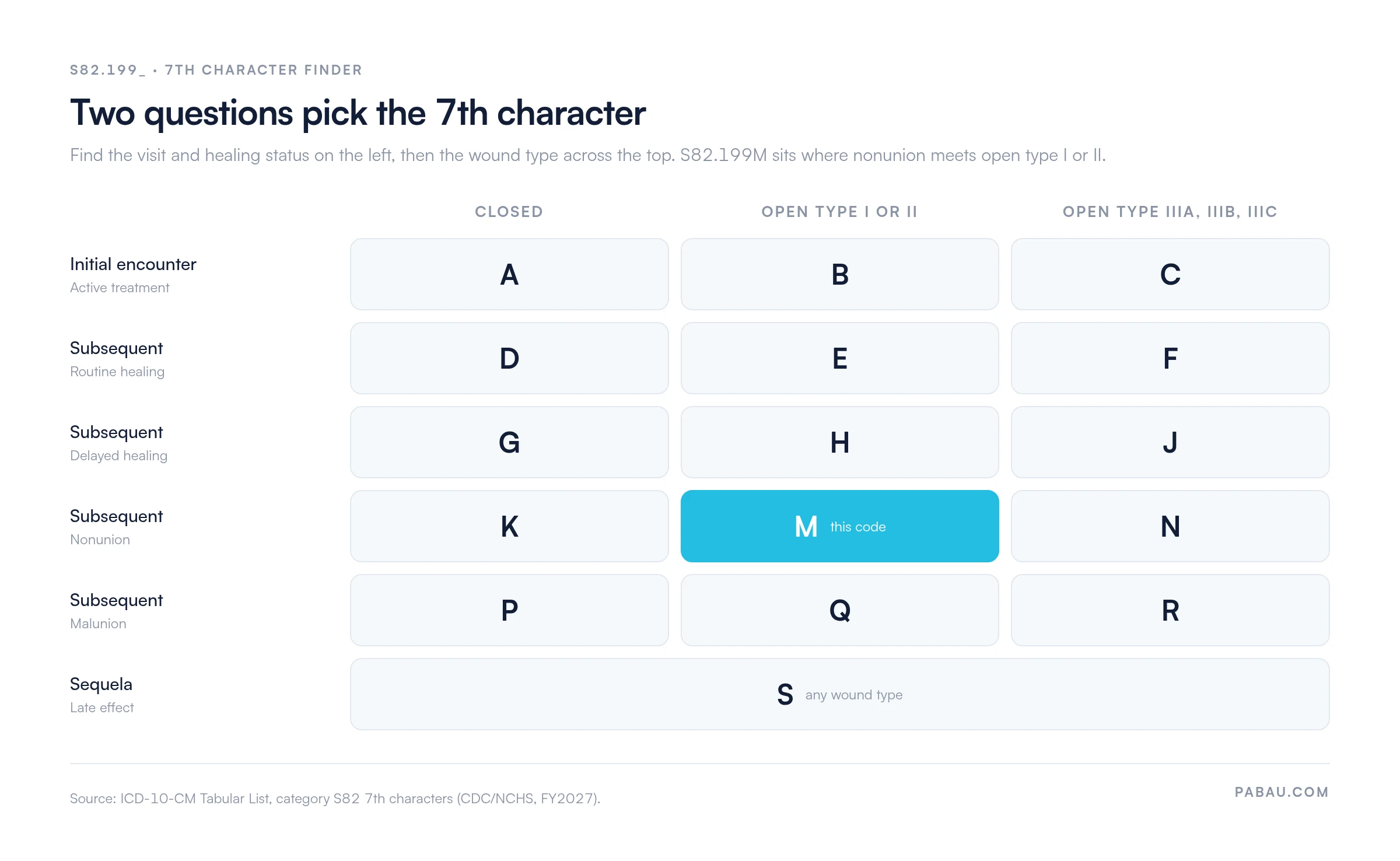
The same options appear row by row below. Per the CMS ICD-10-CM coding guidelines, open or closed always reflects the wound at the original injury.
Before you assign M, confirm two points in the record. The wound note should give a Gustilo grade, or say only “open fracture,” which defaults to type I or II. The surgeon should also state nonunion rather than delayed healing, because delayed healing in this wound type takes H.
Coders don’t diagnose, so every part of the code needs support in the record. Work through these six points before you assign it.
Nonunion care usually bills as a repair, a graft or an office follow-up. The table pairs each CPT code with S82.199M and flags what to check. For payer-specific pairing edits, use the AAPC Codify ICD-10-CM lookup.
CPT 27720, 27722 and 27724 link most cleanly to S82.199M, because each one describes repair of a tibial nonunion. Coverage varies, so check each payer’s prior-authorization rules before you schedule the surgery.
Denials on this code follow a short list of patterns. A structured approach to denial management catches most of them before the claim goes out. When one slips through, the medical billing denial codes reference maps each code to its fix.
ICD-10-CM guidelines encourage external cause codes for injuries, but there’s no national rule requiring them. Workers’ compensation and many commercial payers expect them anyway.
On a follow-up, report the original mechanism with 7th character D, for example W18.30XD. The ICD List code browser shows the full W, V, X and Y hierarchy.
Place (Y92) and activity (Y93) codes are reported only once, at the initial encounter. They don’t go on an M-suffix claim. External cause status (Y99) works the same way, so a work injury’s Y99.0 rides on the first claim only.
On a workers’ compensation claim, put the original injury date in item 14 of the CMS-1500, not the current service date. A follow-up date in that field creates a timeline conflict that automated payer edits pick up.
Most S82.199M claims follow the same five steps. Knowing where each one stalls tells you where to look first.
On nonunion claims, three claim adjustment reason codes (CARCs) come up most. CARC 50 means not medically necessary, and CARC 167 means the diagnosis isn’t covered. CARC 252 asks for an attachment, which usually means the imaging report.
A clean claim passes payer edits the first time. Run these checks before an S82.199M claim leaves the practice.
Keeping these records together also helps with medical billing compliance if a payer audits the claim later.
Many orthopedic practices track nonunion claims across a billing inbox, a clearinghouse portal and a denial spreadsheet. When a claim bounces, someone has to rebuild its history by hand.
With Pabau’s claims management software, the claim is submitted through Claim.MD, a US clearinghouse. Electronic remittance posts back against the patient, and each denial stays tracked until it’s resolved.
So when a CARC 252 lands, your team sees it the same day, attaches the imaging report and resubmits. Coding calls, like M versus H, stay with your coders.

Pabau submits claims through Claim.MD, posts electronic remittance and tracks denials in one place. See how it fits your orthopedic practice.

S82.199M holds up at audit when three facts are on paper. The wound has a type I or II grade or no grade at all, the surgeon has stated nonunion, and no note names the leg.
If one of those is shaky, fix it before the claim goes out. A query to the surgeon takes minutes, while a denied nonunion repair can take weeks to unwind. Often the fix is simply switching to S82.191M or S82.192M.
Want fewer nonunion claims stuck in limbo? Book a demo to see how Pabau tracks each claim from submission to payment.

Want claims to move without manual chasing? Claims management software from Pabau sends claims through Claim.MD and tracks each denial to resolution.
Need to read fracture claim denials faster? Electronic remittance advice explains how ERA files surface denial reason codes and how to act on them.
Looking for the bigger picture of orthopedic billing? Revenue cycle management covers the workflow from code entry through payment posting.
New to the billing side of a practice? What is medical billing walks through each step from charge to payment.
It’s the billable code for a follow-up visit for an open type I or II fracture of the upper tibia that hasn’t healed. It applies when the record doesn’t name the leg.
ICD-10-CM sets no time limit, so the surgeon’s diagnosis drives the code. Some payers borrow the Medicare bone growth stimulator rule: no visible healing on X-rays taken at least 90 days apart.
It can. Medicare covers a non-spinal electrical stimulator (E0747) for long bone nonunion when its coverage criteria are met. Keep the serial X-rays and the surgeon’s note on file.
ICD-9-CM used 733.82, nonunion of fracture. It carried no site, side or wound type, so older records don’t map one-to-one to S82.199M.
Medicare doesn’t require one, but workers’ compensation and many commercial payers expect it. Report the original mechanism, with 7th character D on follow-up visits.



