ICD-10 Code T31.77: Burns involving 70-79% of body surface
ICD-10 code T31.77: Quick reference and code details ICD-10 code T31.77 is the b...

Last Updated: Nov 5, 2026
Billable Code Specific Code
S82.161P is the billable ICD-10-CM code for torus fracture of upper end of right tibia, subsequent encounter for fracture with malunion. It applies to a follow-up visit after active treatment, once the provider documents that the buckle fracture has healed out of alignment.
Coders often confuse P with K (nonunion) or D (routine healing). Malunion means the bone has healed in a non-anatomical position, while nonunion means it has failed to heal. An incorrect 7th character can lead to a denial.
Let Pabau's smart automation suggest the right codes, reduce claim denials, and keep your practice compliant—effortlessly.
Automate repetitive tasks and focus on what matters most—your patients.
Reduce coding errors and ensure compliance with the latest regulations.
Clean claims, fewer denials, and faster reimbursements.
Powerful insights and reporting to help your practice thrive.
HIPAA compliant SOC 2 certified GDPR-compliant Trusted by 4,000+ clinics worldwide

ICD-10 Code S82.161P is a billable 7-character code, while the parent S82.161 is not billable on its own.
The 7th character P means a subsequent encounter for fracture with malunion, not nonunion (K) or delayed healing (G).
Coding P rests on provider documentation of malunion, usually supported by imaging.
Pabau, our practice management platform, connects to Claim.MD for electronic claim submission, eligibility checks and denial tracking.
ICD-10 Code S82.161P identifies a subsequent encounter for torus fracture of the upper end of the right tibia where the fracture has healed with malunion. The code is valid for use in the current fiscal year and is billable as a complete 7-character code under the CDC/NCHS ICD-10-CM classification system.
S82.161P sits at the bottom of this chain. Every level above it is a chapter, block, category or subcategory. As a result, none of them is billable on its own.
A torus fracture is an incomplete fracture in which one cortex of the bone buckles without breaking through the opposite cortex. The terms torus fracture and buckle fracture are synonyms in ICD-10-CM and in orthopedic texts. Both describe the same injury pattern.
These fractures occur at the tibial metaphysis, the flared region just below the growth plate at the upper end of the tibia. This is because cancellous bone there is softer than mature cortical bone.
Torus fractures mostly affect children because growing bone is more porous and flexible. The cause is usually a force along the length of the bone, such as a fall onto an outstretched leg. However, adults can sustain torus-type injuries too, though far less often.
The 7th character P means the patient is presenting for a subsequent encounter for fracture with malunion. Per CMS ICD-10-CM Official Guidelines Section I.C.19.c, a subsequent encounter covers any visit after the patient has received active treatment for the fracture. Malunion means the fracture has healed in a non-anatomical position, as documented by the provider and usually supported by imaging. Therefore, both conditions must be present before you select P over any other 7th character.
P, K, and G cause the most confusion in this code family. In particular, P (malunion) and K (nonunion) are often mixed up because both describe complications, yet they are clinically distinct. Malunion means the bone did heal, in the wrong position. By contrast, nonunion means the bone failed to heal at all. The flow below sets out the six options in the order a coder can test them.
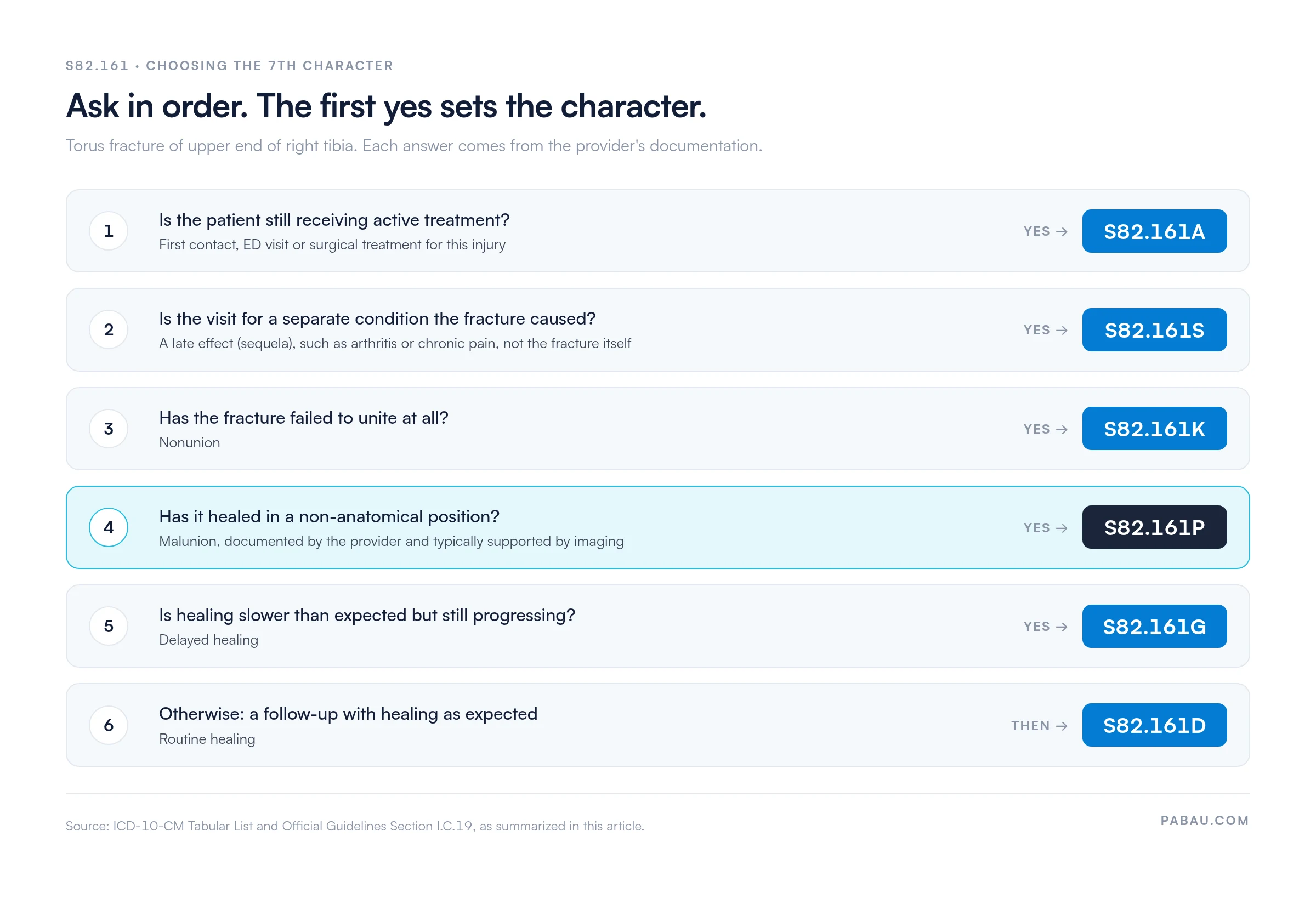
ICD-10 Code S82.161P is most often confused with its immediate siblings in the S82.161 family and with the left-tibia equivalent S82.162P. The table below shows the key differences.
When reviewing a chart note for malunion, look for the provider’s description of the healed alignment. Phrases such as ‘healed with angulation’, ‘apex deformity’ or ‘healed in varus/valgus’ are what you want to see. Imaging usually supports that language. A note that simply says ‘fracture healed’ does not support ICD-10 Code S82.161P. Request an addendum from the treating provider before coding P.
Supporting S82.161P on a claim takes the six elements below. If any one is missing, the claim is open to denial or audit recoupment. For this reason, a grounding in medical billing fundamentals helps coders read the record the way a payer reviewer will.
CMS ICD-10-CM Official Guidelines Section I.C.19.c governs fracture 7th-character assignment. According to CMS, a subsequent encounter is any encounter after the patient has received active treatment for the condition. For example, active treatment includes surgical treatment, an emergency department encounter, and evaluation and treatment by a new physician.
Good medical billing compliance means recording the basis for each 7th-character choice in the patient record. In particular, this matters most for the complication characters P, G, and K.
The CMS ICD-10-CM coding guidelines also clarify that providers should code the most specific diagnosis supported by the record. For that reason, using the non-billable parent S82.161 when S82.161P is the correct code is itself a compliance issue.
ICD-10 Code S82.161P most often appears at follow-up visits, alongside orthopedic evaluation, imaging, and sometimes corrective procedure codes. The table below lists CPT codes often billed with S82.161P, based on AAPC coding guidance and standard orthopedic billing practice. However, you should verify all pairings against the relevant payer LCD before submission.
For example, a typical malunion follow-up pairs an office visit, such as 99213, with a knee X-ray series such as 73560 to document the healed alignment.
ICD-10 Code S82.161P draws a predictable set of denial reasons. Most trace back to the notes or to a check that was skipped before submission. For this reason, a structured approach to denial management helps a billing team spot the pattern and fix it at the source.
Knowing the common denial codes helps billing teams read payer remittance advice and write targeted appeal letters. A 7th-character denial can often be fixed with a corrected claim, backed by the provider’s note of malunion. In fact, getting a clean claim out the first time takes far less effort than working a denial queue.
Medicare and most commercial payers do not require prior authorization for the follow-up office visit itself. However, authorization comes into play when S82.161P supports a procedure claim, such as corrective osteotomy for the malunion. Since requirements vary by payer and plan, verify them with each payer before scheduling any surgery.
Likewise, post-operative physical therapy claims after a malunion correction should carry S82.161P to support medical necessity.
For Medicare claims, consult the relevant MAC Local Coverage Determination for tibial fracture care. CMS does not publish a National Coverage Determination specific to tibial malunion correction, so coverage is set at the MAC level. Also, reimbursement amounts change every year, so always use the current CMS Physician Fee Schedule for rate lookups rather than prior-year figures.
Before any corrective procedure for malunion, document the functional impact in measurable terms. Record the degree of angulation on imaging, the loss of range of motion in degrees, and any reported gait abnormality. Payers reviewing authorization requests for surgical correction respond to measurable deficits, not narrative descriptions alone.
Without a connected system, an S82.161P claim passes through several hands. A coder first keys the diagnosis into a billing tool, and then someone uploads the claim to a clearinghouse portal. Finally, a denial surfaces weeks later in a remittance file.
In Pabau’s claims management software, the appointment, the chart note and the claim sit in the same patient record. Pabau also connects to Claim.MD for electronic claim submission, eligibility checks and denial tracking.
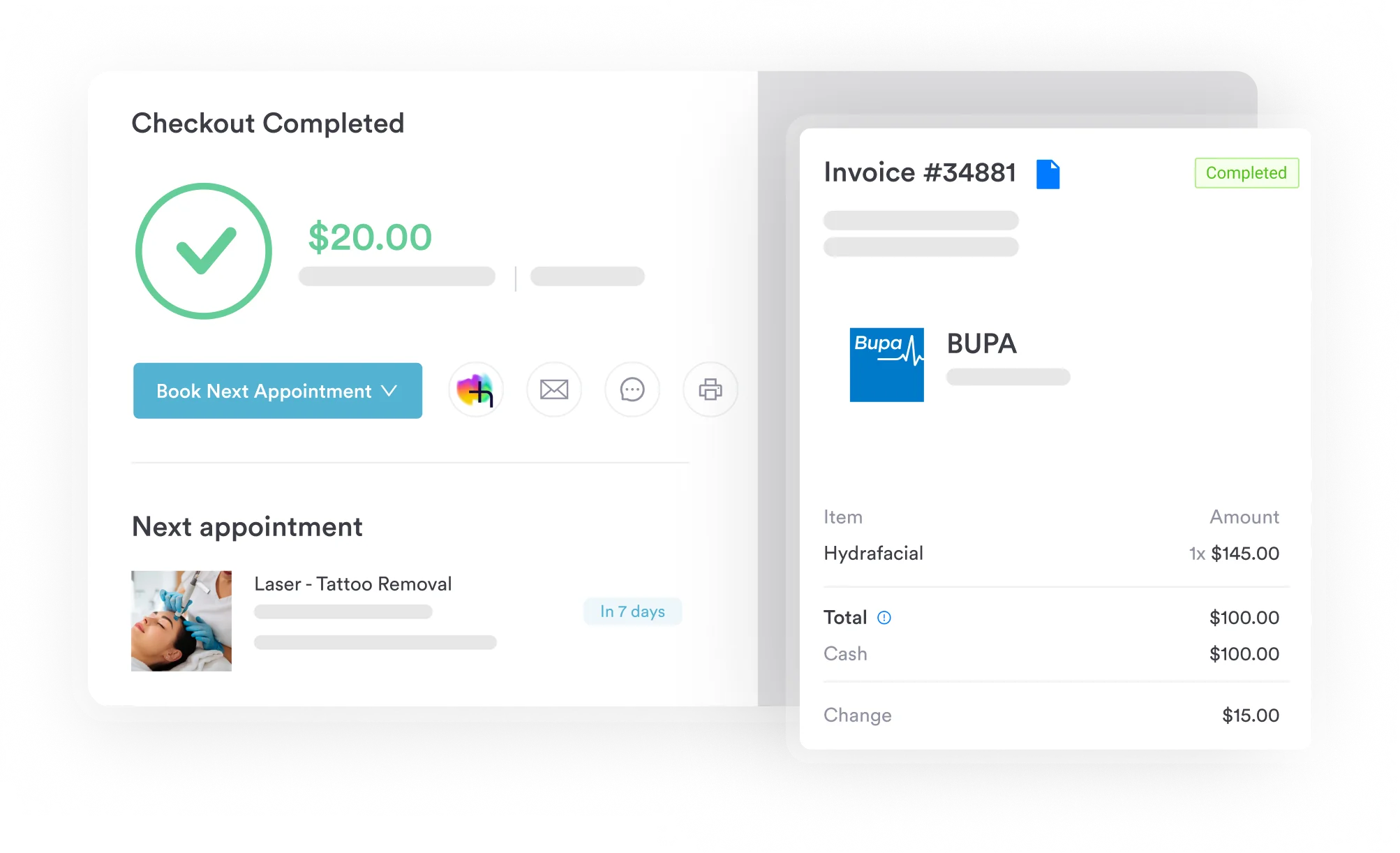
When a payer rejects a claim over the 7th character, the denial shows up against the visit it came from. As a result, your billing team can correct the code and resubmit from that record instead of rebuilding the claim by hand.

Pabau connects to Claim.MD for electronic claim submission, eligibility checks and denial tracking. Malunion follow-up claims leave from the same patient record as the visit note.

Before you assign ICD-10 Code S82.161P, the chart has to show three things. The provider documents malunion, the note names the right tibia, and the visit meets the ICD-10-CM definition of a subsequent encounter. If one is missing, query the provider before the claim goes out, not after the denial comes back.
Most of all, the call that matters is malunion versus nonunion. A bone that healed out of alignment takes P, while a bone that never united takes K instead. In the end, only the provider’s note can tell the coder which one applies.
Pabau connects to Claim.MD for electronic claim submission, eligibility checks and denial tracking. In addition, a corrected malunion claim goes back out from the same patient record. Book a demo to see how it fits your orthopedic follow-up billing.

Need to track denial patterns across your orthopedic claims? Denial management in healthcare covers the workflows billing teams use to track, appeal, and prevent recurring denials.
Want to understand the clearinghouse behind your electronic submissions? How the Claim.MD clearinghouse works explains real-time eligibility, ERA processing, and 837P submission through Pabau.
Looking for a framework to reduce claim errors before submission? What makes a clean claim outlines the checklist billing teams use to maximize first-pass acceptance rates.
ICD-10 Code S82.161P is the billable code for a subsequent encounter for a torus fracture of the upper right tibia with malunion. It means the fracture has healed, but in a non-anatomical position. It is a complete 7-character code valid for claim submission in the current fiscal year.
S82.161A is the initial encounter for closed fracture. It applies while the patient receives active treatment for the acute torus fracture of the upper end of the right tibia. S82.161P is used for a subsequent (follow-up) encounter where the fracture has healed with malunion. Using A for a follow-up visit, or P for the first presentation, is a 7th-character error that can lead to a denial.
Yes. S82.161P is a fully billable, complete 7-character ICD-10-CM code. The parent code S82.161 without a 7th character is not billable and cannot be submitted on a claim. Always include the full 7-character code on the claim form.
Use P (malunion) when the provider documents that the fracture has healed in a non-anatomical position, usually supported by imaging. Use K (nonunion) when the provider documents that the fracture has failed to heal at all, with no bridging callus across the fracture site. The two are clinically distinct and must not be used interchangeably. The provider’s documentation is the deciding factor.
No. S82.161P is not restricted to pediatric patients. Torus fractures occur mostly in children because growing bone is more compressible, but adults can sustain this injury type as well. The code is valid for any patient age when the provider’s documentation supports the descriptor.