ICD-10 code S42.152A: Displaced fracture of left scapula neck
ICD-10 code S42.152A: Quick reference ICD-10 code S42.152A identifies a displace...

Last Updated: Oct 21, 2026
Billable Code Specific Code
S82.299K is the billable ICD-10-CM code for other fracture of shaft of unspecified tibia, subsequent encounter for closed fracture with nonunion.
Coders frequently confuse this code with its malunion sibling S82.299P or choose it when laterality is actually documented, both of which trigger claim rejections.
Let Pabau's smart automation suggest the right codes, reduce claim denials, and keep your practice compliant—effortlessly.
Automate repetitive tasks and focus on what matters most—your patients.
Reduce coding errors and ensure compliance with the latest regulations.
Clean claims, fewer denials, and faster reimbursements.
Powerful insights and reporting to help your practice thrive.
HIPAA compliant SOC 2 certified GDPR-compliant Trusted by 4,000+ clinics worldwide

S82.299K codes a follow-up encounter for a closed tibial shaft fracture, leg not specified, where the provider has diagnosed nonunion rather than delayed healing.
The fifth character 9 means other fracture: a documented pattern with no dedicated tibial shaft code. If no pattern is documented at all, use S82.209K instead.
The K seventh character needs an explicit provider diagnosis of nonunion, backed by X-ray or CT. Coders cannot infer nonunion from elapsed time alone.
If the record documents the leg, use S82.291K (right) or S82.292K (left). S82.299K is only for records that omit laterality.
Pabau, the practice management platform we build, connects to the Claim.MD clearinghouse for electronic claims and real-time eligibility checks on these encounters.
ICD-10 Code S82.299K is a full seven-character billable code effective for encounters coded under the current ICD-10-CM fiscal year. It codes a follow-up visit for a closed tibial shaft fracture that has failed to heal, when the record does not say which leg.
Its official descriptor is Other fracture of shaft of unspecified tibia, subsequent encounter for closed fracture with nonunion.
The tibia, or shinbone, is the larger of the two lower-leg bones and carries most of the body’s weight. Its shaft (diaphysis) is the long tubular section between the proximal and distal metaphyses.
Tibial shaft fractures are the most common long-bone fracture. They usually follow a fall, a twisting sports injury, or high-energy trauma such as a motor vehicle collision.
The tibia is also one of the long bones most prone to nonunion. Its front inner surface sits just under the skin, so soft-tissue cover and blood supply are thin, especially in the lower third of the shaft.
High-energy injuries, open wounds, infection, and smoking all raise the risk further. Established tibial nonunion is often treated with exchange intramedullary nailing, bone grafting, or bone stimulation, so these encounters regularly carry procedure claims. Noninvasive low-intensity ultrasound bone stimulation, for example, is reported with CPT code 20979.
“Other fracture” in this code describes the fracture pattern. ICD-10-CM gives the tibial shaft dedicated codes for transverse, oblique, spiral, comminuted, and segmental fractures (S82.22- to S82.26-). S82.29- covers a documented pattern that fits none of those. If the record names no pattern at all, the unspecified code S82.209K applies instead.
Nonunion is a clinical diagnosis that belongs to the treating provider. It refers to a fracture that has failed to achieve bony union within the biologically expected window. Per ICD-10-CM Official Guidelines, nonunion must be documented by the treating provider and is typically supported by serial imaging showing absent or insufficient callus formation.
“Unspecified” laterality in S82.299K means the record does not document which leg is affected. If the provider documents left or right, the more specific code must be used.
A tibial shaft fracture often comes with a fibula fracture in the same leg. ICD-10-CM has no combination code for the pair, so a fibular shaft fracture is coded separately from S82.4-. For example, S82.409K covers an unspecified fibula shaft fracture that has also gone on to nonunion.
Each of the seven characters in ICD-10-CM S82.299K carries a specific meaning. Understanding the structure prevents selection of an adjacent wrong code.
The seventh character K applies only when both of two conditions are met. The encounter is subsequent, so the patient is not presenting for the fracture for the first time. The provider has also documented nonunion as the healing status. Neither condition alone is sufficient.
The most common selection error is using G (delayed healing) when the provider has gone further and explicitly diagnosed nonunion. If the notes say “nonunion confirmed on CT,” K is correct. If the notes say “healing slowly” without a nonunion statement, G is correct. R, by contrast, codes malunion of an open type III fracture, so it never applies to a nonunion.
Check the radiology report and the provider’s assessment together. Imaging findings alone do not drive the code selection. The provider’s documented clinical conclusion is the controlling source. Say the radiology report describes absent bridging callus, but the provider has not yet diagnosed nonunion. Code G (delayed healing) until the diagnosis is formally stated.
Several closely related codes share the same clinical territory as S82.299K. Each descriptor below is the official ICD-10-CM wording. Selecting the wrong one is a common cause of denials on these encounters.
Five documentation questions narrow the choice before you reach the table. Each answer either keeps you on S82.299K or points to the sibling code that fits better.
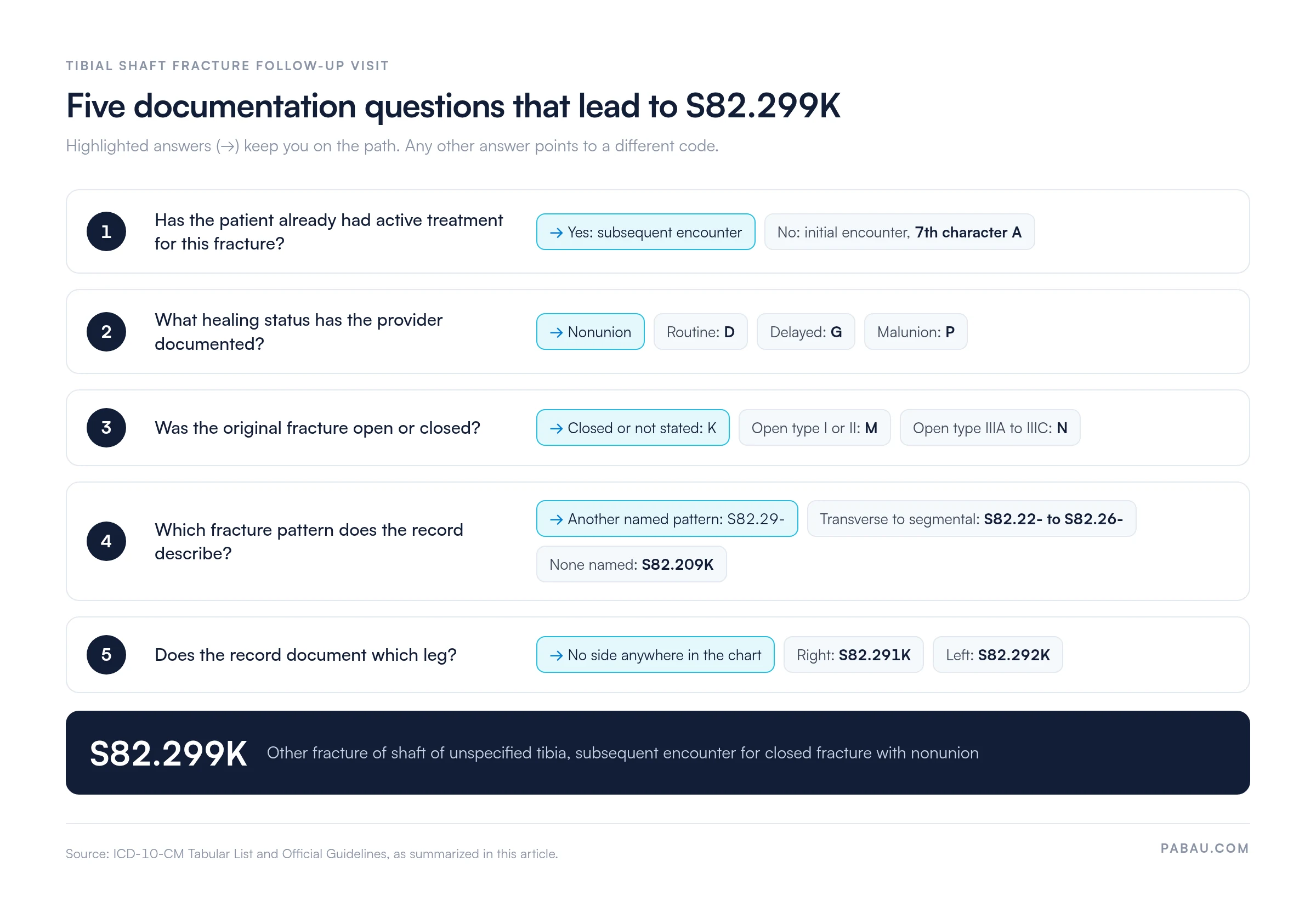
The ICD-10-CM Tabular List and Official Guidelines set out what S82.299K covers and what belongs elsewhere. Coders should review both lists before assigning the code.
Payer audits for fracture nonunion codes concentrate on two questions. Did the provider diagnose nonunion, rather than slow healing? And does the record show a subsequent encounter rather than an initial one? A claim that cannot answer both questions from the medical record will not survive review.
The ICD-10-CM Official Guidelines, published through the Centers for Medicare and Medicaid Services (CMS), define a subsequent encounter. It is one where active treatment is complete and the patient receives routine care during healing or recovery, or treatment of complications. The following documentation elements are required to support S82.299K.
Medicare coverage for fracture nonunion management is governed by Local Coverage Determinations (LCDs) issued by Medicare Administrative Contractors (MACs). These LCDs vary by region and are updated periodically. Coders should verify the applicable LCD for their MAC jurisdiction before billing.
Key payer considerations for S82.299K claims include the following points, though practices should confirm current requirements with their MAC or commercial payer directly.
When an authorization or coverage problem still turns into a denial, denial management guidance walks through the recovery workflow, from root cause to resubmission.
Claims for S82.299K denials concentrate around a handful of predictable errors. Identifying the pattern for your practice is faster than chasing individual remittances.
Reviewing medical billing denial codes alongside your ERA (electronic remittance advice) helps isolate whether a denial is a coverage issue or a coding mismatch. Practices that use electronic remittance advice workflows can typically identify denial patterns across a batch of fracture claims in a single pass.
Run a quarterly audit of all claims carrying the K, G, and P seventh characters for your S82 fracture encounters. Compare the denial rate by suffix. If K-suffix claims deny more often than G-suffix claims, look at two likely causes. Either the nonunion documentation is missing, or the chart named a side that never got coded. A targeted query template sent to providers before claim submission resolves most of these before they reach the payer.
External cause codes (V00-Y99) document the circumstances that produced the original tibial shaft fracture. For subsequent encounters such as those coded with S82.299K, external cause codes are supplementary. The ICD-10-CM Official Guidelines never sequence them as the principal diagnosis.
S82.299K is sequenced first, and external cause codes follow it. Common supplementary codes used alongside S82.299K include the following:
Not all payers mandate external cause codes on subsequent fracture encounters. Check your MAC or commercial payer policy. When in doubt about the clean claim requirements for your payer mix, include the mechanism code. Removing it after a denial is simpler than appealing a code-not-applicable rejection.
A nonunion follow-up often passes through three hands before it reaches a payer. The provider writes the assessment, a coder reads it for laterality and healing status, and someone keys the claim into a clearinghouse portal. Each handoff is a chance for an A to stay on a follow-up visit, or for a documented side to go uncoded.
In Pabau’s practice management software, the provider’s note, the diagnosis code and the claim sit on the same patient record. The claims software for practices connects to the Claim.MD clearinghouse. Eligibility checks run in real time, and 837P claims go out electronically.
The result is fewer surprises on remittance day. Coverage and authorization problems surface before submission, and posted ERAs make the quarterly suffix audit above far quicker to run.

Pabau integrates with Claim.MD to support electronic claim submission, real-time eligibility verification, and ERA posting for fracture nonunion encounters and orthopedic billing workflows.

S82.299K is a narrow code by design. It fits only when the chart confirms a follow-up, a provider-diagnosed nonunion, a closed fracture, an “other” pattern and no documented side.
That last condition is the one worth challenging on every claim. Before you submit, search the imaging report and therapy notes for a side. If one turns up, a one-line provider query moves the claim to S82.291K or S82.292K. The query takes minutes, while a specificity denial takes a resubmission.
Book a demo to see how Pabau keeps the provider’s note, the code and the claim on one record for your fracture follow-ups.

Submitting fracture claims electronically through a clearinghouse? 837 file format guide explains the EDI 837P structure used for professional claim submission.
Want to reduce eligibility denials before claims are submitted? Insurance eligibility verification walks through the pre-submission checks that catch coverage issues early.
Appealing a denied nonunion claim? Medical appeal form template gives you a ready structure for contesting a payer decision.
ICD-10 Code S82.299K is the billable ICD-10-CM code for other fracture of shaft of unspecified tibia, subsequent encounter for closed fracture with nonunion. The patient is returning for care of a closed tibial shaft fracture that has failed to unite, and the record does not say which leg. It falls under Chapter 19 (S00-T88) and needs explicit provider documentation of nonunion.
Yes. S82.299K is a full seven-character billable ICD-10-CM code, confirmed as such in the CMS ICD-10-CM Tabular List. It can be the first-listed diagnosis on a claim for a subsequent encounter involving a closed tibial shaft fracture with nonunion.
The seventh character K denotes a subsequent encounter for a closed fracture with nonunion. The patient has already received active treatment, and the fracture has failed to heal. It is distinct from D (routine healing), G (delayed healing), and P (malunion). Nonunion of an open fracture uses M or N instead. The code requires explicit provider documentation of nonunion rather than a coder inference from elapsed time.
Nonunion (seventh character K) means the fracture has not healed at all. There is no bridging bone formation. Malunion (seventh character P) means the fracture has healed but in an incorrect alignment or position, resulting in a deformity. Both require a subsequent encounter. The distinction must come from the provider’s documented diagnosis, not from the coder’s reading of the images.
S82.299K applies only when the medical record does not document laterality. The provider note, imaging report or nursing notes may identify the right or left leg. In that case, coders must use S82.291K (right) or S82.292K (left) instead. Using S82.299K when laterality is available constitutes undercoding and may trigger payer audits or denials.
External cause codes are not universally mandatory for S82.299K claims, but many Medicare Advantage and commercial payers require a mechanism-of-injury code (V/W/X/Y) on fracture encounters. S82.299K is always the principal or first-listed code. Any external cause code is sequenced as a secondary supplementary code. Check your MAC’s LCD or the commercial payer’s submission guidelines to confirm whether the external cause code is required for your payer mix.