ICD-10 code Y83.0: Surgical operation with whole organ transplant
ICD-10 code Y83.0 names the transplant as the cause, not the problem ICD-10 code...

Last Updated: Nov 19, 2026
Billable Code Specific Code
S82.143D is the billable ICD-10-CM code for a displaced bicondylar fracture of unspecified tibia, subsequent encounter for closed fracture with routine healing.
It sits in Chapter 19 of ICD-10-CM and is valid in the FY2027 code set. Use it at a routine-healing follow-up only when the record cannot establish which leg is fractured.
Let Pabau's smart automation suggest the right codes, reduce claim denials, and keep your practice compliant—effortlessly.
Automate repetitive tasks and focus on what matters most—your patients.
Reduce coding errors and ensure compliance with the latest regulations.
Clean claims, fewer denials, and faster reimbursements.
Powerful insights and reporting to help your practice thrive.
HIPAA compliant SOC 2 certified GDPR-compliant Trusted by 4,000+ clinics worldwide

S82.143D codes a displaced bicondylar tibia fracture, side not documented, at a follow-up visit for a closed fracture that is healing as expected.
The 6th character 3 means displaced with unspecified laterality. A left displaced fracture is S82.142D, and a left nondisplaced fracture is S82.145D.
Unspecified laterality is a query trigger. The guidelines say unspecified-side codes should rarely be used, so ask which leg before you settle on S82.143D.
The 7th character D fits routine healing only. For a closed fracture, delayed healing is G, nonunion is K, and malunion is P.
Pabau, the practice management platform we build, keeps the side, the displacement, and the healing stage in the visit note behind each claim.
ICD-10 code S82.143D is a billable ICD-10-CM diagnosis code that needs no further characters. It is listed in CMS’s 2027 ICD-10-CM files as a displaced bicondylar fracture of unspecified tibia, subsequent encounter for closed fracture with routine healing.
Confirm current validity each October 1 using the CDC/NCHS ICD-10-CM web tool, which carries the official annual code set release. Descriptors and instructional notes can change in any annual update.
Each character in S82.143D encodes one clinical detail. Position 6 carries two details at once, and that is where most errors with this code start. Other Chapter 19 injury codes use the same 7th-character logic, and you can look them up in our ICD-10-CM codes library.
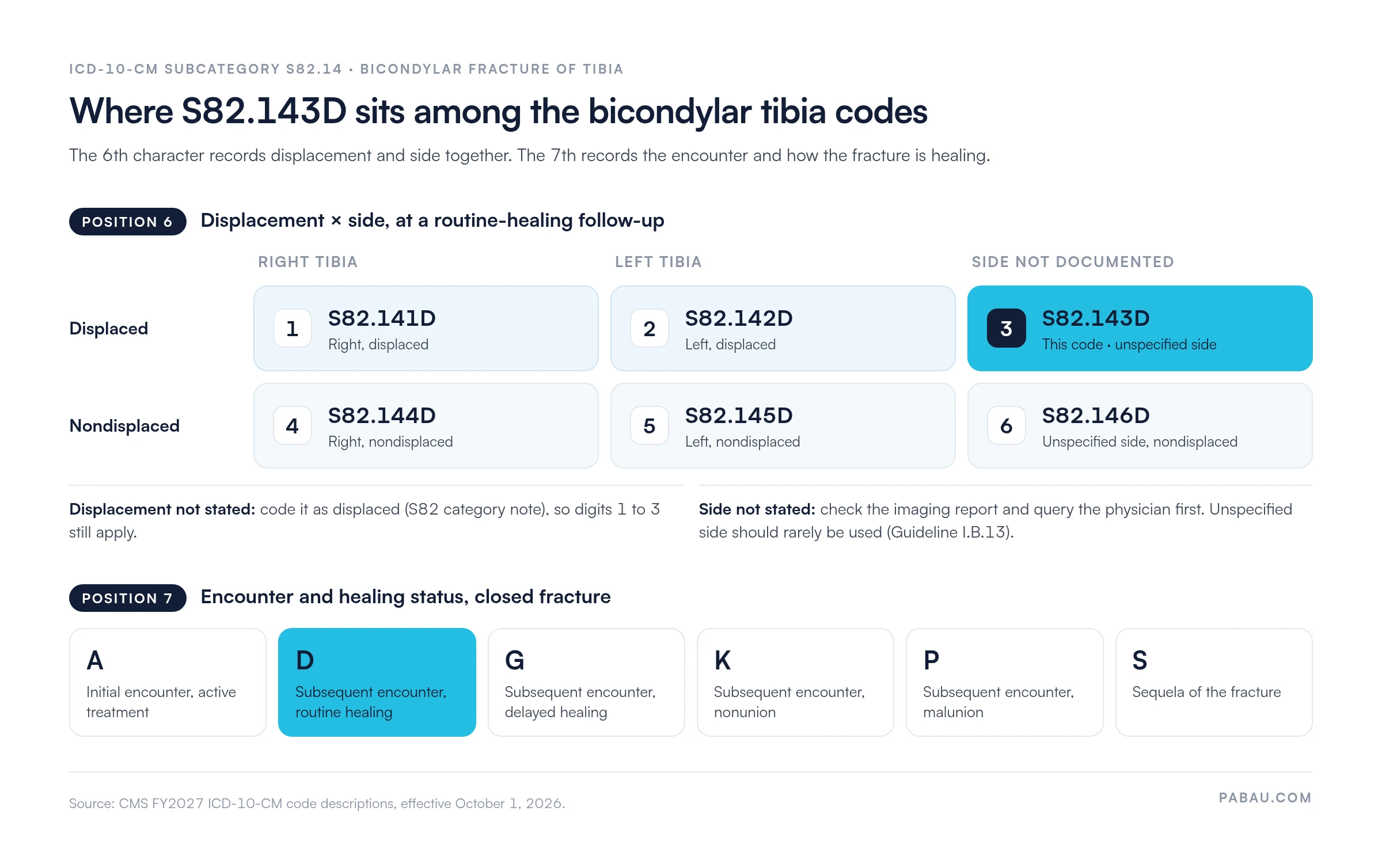
Position 6 reads displacement and side together. Digits 1, 2 and 3 are displaced fractures of the right, left and unspecified tibia. Digits 4, 5 and 6 are nondisplaced fractures in the same order. So the “3” in S82.143D means displaced, with no side documented. The grid below maps all six codes, plus the 7th characters a closed fracture can take.
A bicondylar tibia fracture runs through both the medial and the lateral condyle at the top of the tibia. Those condyles form the tibial plateau, the lower half of the knee joint. Displaced means the fragments have shifted out of their normal position.
“Unspecified tibia” comes from the paperwork. The record the coder works from does not state whether the left or the right leg is injured.
Three distinctions matter for coding accuracy:
The treating surgeon may choose closed management or open reduction and internal fixation (ORIF). That decision shapes the CPT codes on each claim, while the diagnosis stays in the S82.14 subcategory.
The 7th character D marks a subsequent encounter for a closed fracture during routine healing. Under the ICD-10-CM Official Guidelines (Section I.C.19.c.1), active treatment is complete and the patient is receiving routine care while the fracture heals.
S82.143 has 16 possible 7th characters in total, because fracture categories add separate values for open fractures, delayed healing, nonunion and malunion. The nonunion and malunion section below sets out when to move away from D.
A frequent tibial fracture coding error is 7th character A on a follow-up visit. Think of a cast change, a range-of-motion check, or a healing X-ray. Those are subsequent encounters. A is correct only while the fracture itself is receiving active treatment.
S82.143D sits inside a six-code grid for bicondylar tibia fractures at a routine-healing follow-up. Each code differs from S82.143D on displacement, side, or both.
Displacement and side work differently. A fracture not documented as displaced or nondisplaced defaults to displaced, so a silent note still supports the first three rows. Side has no default. A missing side leads to the unspecified code only after the record has been checked and the physician queried. When the imaging report names the left knee, the claim moves to S82.142D instead.
Several official tabular notes and guidelines govern what S82.143D covers and what is coded elsewhere.
Three guideline rules also steer cases away from S82. A physeal fracture takes only the physeal code, with no separate code for the bone. A patient with known osteoporosis whose minor fall would not usually break a healthy bone gets a code from category M80. A stress fracture of the tibia codes to M84.36-, so check the mechanism of injury before assigning any S82 code.
Audits of S82.143D cluster around four documentation points. The first one decides whether this code belongs on the claim at all.
Practices that build medical billing compliance checks into the pre-submission review catch a missing side before the claim leaves. A clean claim submission has every required element present on the first pass.
S82.143D is a diagnosis code, so it always pairs with a CPT code for the service performed at the follow-up visit. The CPT choice depends on that service, not on the diagnosis alone.
Reporting ORIF code 27536 with the subsequent-encounter diagnosis is a diagnosis/procedure mismatch that claim edits flag. Orthopedic practices that send electronic claims through a clearinghouse can run CPT/ICD-10 combination edits before submission. That catches the mismatch at validation rather than after a denial.
Outpatient follow-up visits billed with S82.143D and an E/M code do not usually need prior authorization, but payer policies vary. The medical billing fundamentals still apply, so verify coverage before each visit and not only at the initial encounter.
Key payer-specific considerations:
Reimbursement for S82.143D visits depends on the CPT codes billed, the payer, and the fee schedule year. Check current amounts in the CMS Physician Fee Schedule Look-Up Tool for the applicable year.
S82.143D claims fail for a predictable set of reasons. Most trace back to an initial-encounter record that was never updated for the follow-up visit.
Practices with structured denial management workflows ask two questions at every fracture follow-up. Has the encounter type changed since the last visit? Does the record name the side?
The 7th character D is correct only while the fracture heals as expected. When the physician documents a healing complication, the 7th character changes. The physician makes that clinical call, and the coder captures what the physician documented.
Open type IIIA, IIIB and IIIC fractures use their own set of characters (F, J, N and R) instead. Never switch from D to K or P on elapsed weeks alone. When in doubt, query the physician before changing the healing-status character.
Review open S82.143D cases on a regular schedule. Flag any case where months have passed since the injury but the healing-status character has never changed, then check the latest note. That is where a documented nonunion most often hides behind a routine-healing code.
In many practices the side of the injury lives in the radiology report, and the coder works from the visit note. When the two never meet, the claim goes out with the unspecified code, or with the wrong side.
Pabau keeps the visit note, the attached reports, and the billing record in one patient file. The coder sees the documented side and displacement status before choosing between S82.141D, S82.142D and S82.143D. Pabau’s claims management software then pairs the diagnosis with the CPT codes for the visit.
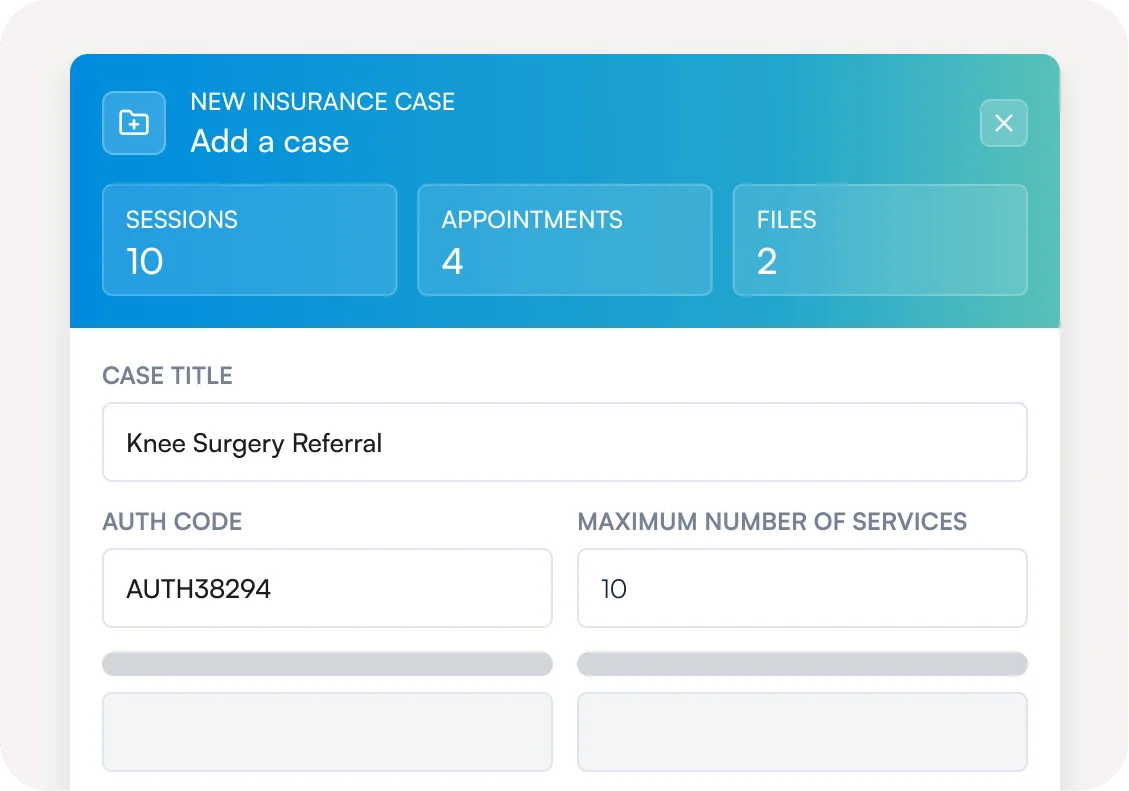
The result is a claim that matches the note it came from. Every Pabau subscription includes the full feature set, so documentation, billing, and reporting sit in the same record.

Pabau pairs ICD-10 diagnosis codes with CPT procedure codes and runs pre-submission edits, so S82.143D claims reach payers with the right documentation attached.

S82.143D is a narrow code built for an uncommon situation. It fits a displaced, bicondylar, closed tibia fracture at a routine-healing follow-up, when the record does not name the side. Because the guidelines say unspecified-side codes should rarely be used, the best S82.143D claim is often one that becomes S82.141D or S82.142D after a query.
Pabau’s revenue cycle management tools help orthopedic and physical therapy practices settle side and healing stage at the point of charting. Book a demo to see how the claims workflow handles S82.143D and the rest of the S82 fracture family.

Need a clearinghouse integration for orthopedic claims? Medical claims clearinghouse guide explains how EDI routing and claim validation work before a claim reaches the payer.
Getting repeat denials on fracture aftercare visits? Denial codes in medical billing maps the most common CARC denial codes to their root causes and corrective actions.
Want to verify eligibility before each fracture follow-up visit? Insurance eligibility verification covers how real-time eligibility checks flag an inactive policy before the patient arrives.
ICD-10 code S82.143D is the billable diagnosis code for a displaced bicondylar fracture of unspecified tibia, subsequent encounter for closed fracture with routine healing. It is used at follow-up visits after active treatment, when the record does not say which leg is fractured.
Yes. S82.143D is a billable code that is complete at seven characters. It is valid in the FY2027 code set, effective October 1, 2026. Confirm current status each October 1 using the CDC/NCHS ICD-10-CM web tool.
At a routine-healing follow-up, that is S82.145D, not S82.143D. In the S82.14 subcategory, 6th characters 1 to 3 are displaced fractures and 4 to 6 are nondisplaced. Each group runs right, left, then unspecified side.
Only when the side genuinely cannot be established. Guideline I.B.13 says unspecified-side codes should rarely be used. Check other clinicians’ notes, such as the radiology report, and query the physician before settling on S82.143D.
S82.143A applies while the patient is receiving active treatment for the fracture. S82.143D applies once active treatment is complete and the fracture is healing as expected. Carrying A forward to a follow-up visit is a common coding error.
For a closed fracture, nonunion is K and malunion is P, giving S82.143K and S82.143P. Delayed healing is G. For an open fracture type I or II, nonunion is M and malunion is Q.
The record should show both condyles involved, a closed fracture, and routine healing after active treatment. Displacement can be documented or left unstated, because the default is displaced. The record should also show why the side could not be established, ideally through a physician query.