ICD-10 code S61.201A: Open wound of left index finger without nail damage
ICD-10 code S61.201A covers a left index finger wound of unstated type ICD-10 co...

Last Updated: Oct 16, 2026
Billable Code Specific Code
S74.01XA is the billable ICD-10-CM code for injury of sciatic nerve at hip and thigh level, right leg, initial encounter.
The fifth character sets the side, so S74.02 covers the left leg and S74.00 an unspecified leg. The 7th character A means the patient is under active treatment. Switch to D once care moves into the healing phase.
Let Pabau's smart automation suggest the right codes, reduce claim denials, and keep your practice compliant—effortlessly.
Automate repetitive tasks and focus on what matters most—your patients.
Reduce coding errors and ensure compliance with the latest regulations.
Clean claims, fewer denials, and faster reimbursements.
Powerful insights and reporting to help your practice thrive.
HIPAA compliant SOC 2 certified GDPR-compliant Trusted by 4,000+ clinics worldwide

S74.01XA is the billable ICD-10-CM code for traumatic sciatic nerve injury at hip and thigh level, right leg, initial encounter.
Laterality sits in the fifth character. S74.01 is the right leg, S74.02 the left leg, and S74.00 an unspecified leg.
The 7th character A applies during active treatment, not necessarily the first calendar visit. Switch to S74.01XD once care moves into the healing phase.
Non-traumatic sciatica (G57.00) and femoral nerve injury at this level (S74.11XA) are excluded. The note must confirm a traumatic mechanism.
Pabau’s claims management software flags 7th-character mismatches before submission, reducing denials on injury codes like S74.01XA.
This table covers the core facts coders need before billing S74.01XA. Every field reflects the CMS FY2026 ICD-10-CM tabular list and the CDC/NCHS ICD-10-CM web tool.
S74.01XA means traumatic injury to the sciatic nerve at the hip and thigh level of the right leg, coded at the initial encounter. Each segment carries a specific coding instruction:
Two of those positions are the ones a coder actually chooses. The breakdown below shows which alternatives sit behind each of them.
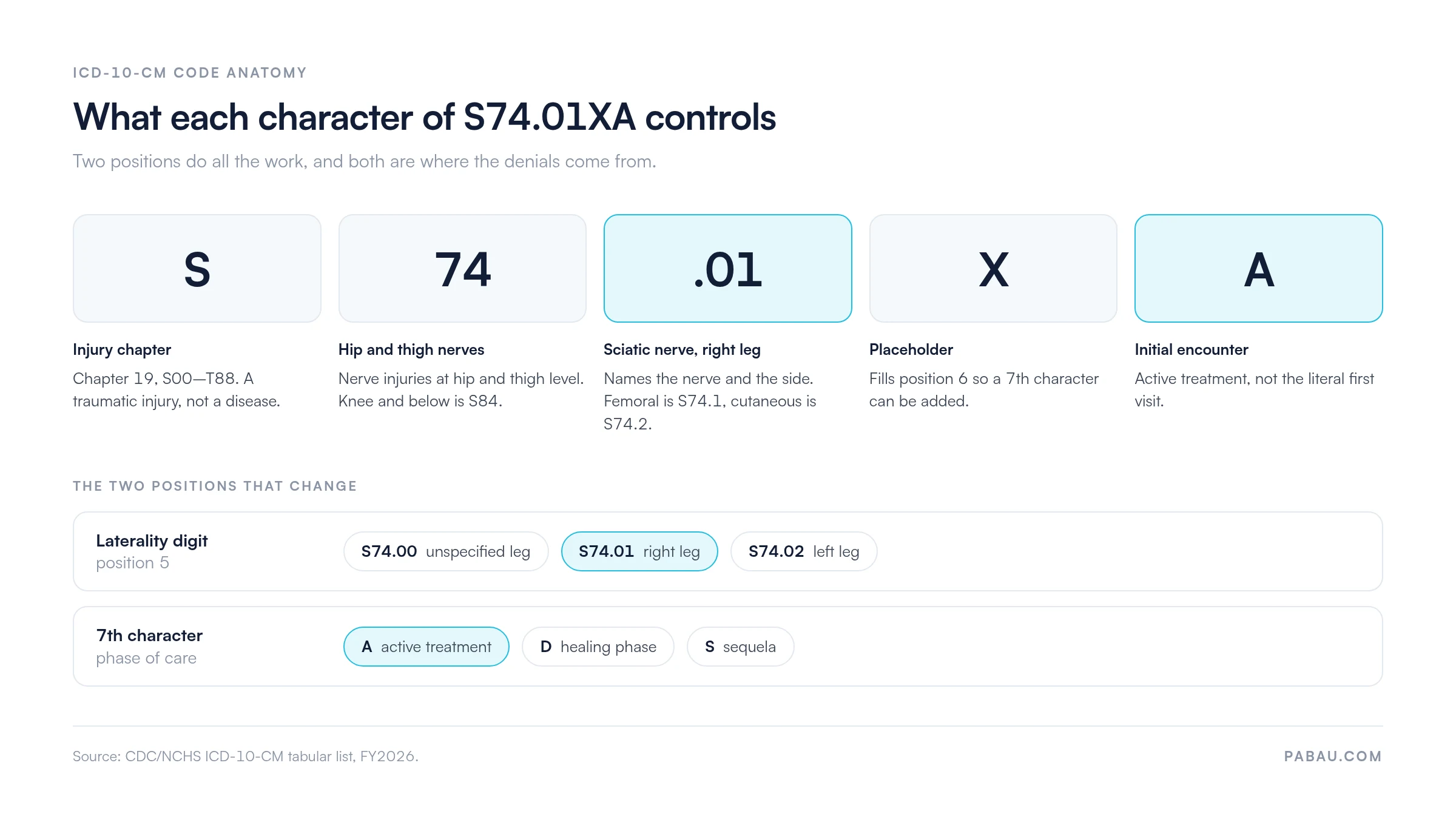
The anatomical scope matters. S74.01XA covers the sciatic nerve trunk through the posterior hip and proximal thigh. That span runs below the piriformis muscle and above the popliteal fossa. Injuries at the knee or lower leg fall under S84, not S74.
Laterality is specified at this subcategory, so the side belongs in the code rather than in the note alone. S74.01 is the right leg and S74.02 is the left leg. S74.00 covers an unspecified leg, and payers treat it as a specificity problem when the record names a side.
The 7th character in ICD-10 Code S74.01XA is the most frequently misapplied element of this code. Using the wrong encounter type is the top denial trigger for peripheral nerve injury claims. The same encounter-type rules run through every injury code in Chapter 19.
The most common error is a coder who keeps using S74.01XA at follow-up visits because the patient is still seeing the same provider. The ICD-10-CM Official Guidelines for Coding and Reporting (Section I.C.19) settle it. The 7th character must change to D once the injury moves from active treatment into healing.
Active treatment covers the ED visit, any surgical repair, and the acute inpatient stay. Routine wound checks, cast adjustments, and physical therapy for a healing nerve injury are subsequent encounters.
S74.01XA covers traumatic injury to the sciatic nerve trunk at the hip and thigh level of the right leg. Valid scenarios include blunt trauma to the posterior hip, hip fracture-dislocations with sciatic nerve stretch, penetrating injuries, and intraoperative nerve injury during total hip arthroplasty.
The diagnosis rests on a deficit that follows the sciatic distribution, confirmed by clinical examination and, where indicated, electrodiagnostic studies. Typical findings include:
The code classifies traumatic peripheral neuropathy, not degenerative or inflammatory conditions. A patient presenting with sciatica from disc herniation does not qualify. The documentation must state a traumatic mechanism explicitly.
The S74 block carries several inclusion and exclusion notes that define when S74.01XA applies and when a different code is required.
The table below covers the codes most frequently swapped with S74.01XA during chart review. Checking the sciatic and femoral entries side by side in the AAPC ICD-10-CM code lookup catches most of these swaps before submission.
Payers auditing S74.01XA claims look for documentation that confirms the traumatic cause, the side, and the sciatic distribution of the deficit. A missing element is enough to trigger a denial or a request for records. The wider medical billing compliance rules apply here too, including the MEAT criteria where HCC capture is in play.
Document EMG/NCS findings in terms of the specific nerve, not just ‘abnormal nerve conduction.’ A report reading ‘absent H-reflex and reduced sural nerve amplitude consistent with sciatic nerve injury at hip level’ will survive an audit. A report reading ‘peripheral neuropathy’ will not.
Payer requirements for claims carrying ICD-10 Code S74.01XA vary by plan and by setting. No single rule applies across all payers, but the patterns below reflect typical commercial and Medicare policies. Always verify with the specific payer before submitting. Claims software for coders like Pabau keeps payer policy checks and eligibility verification in one place, which cuts pre-submission errors.

Most denials on S74.01XA fall into five patterns. Understanding them before submission is far less expensive than working a remittance. Reading the denial codes alongside the remittance pins down the exact payer reason before you appeal.
The CPT codes in the table below are the most common pairings with ICD-10 Code S74.01XA. Pabau integrates with Claim.MD to submit claims to thousands of US payers. Built-in CPT and ICD-10 catalogs validate these pairings at the point of submission.
The approximate ICD-9-CM predecessor to S74.01XA is 956.0, injury to sciatic nerve. The mapping comes from the General Equivalence Mappings maintained by CMS, and it is approximate rather than a 1:1 equivalent. ICD-10-CM added granularity that 956.0 never carried, namely laterality and encounter type.
For legacy data migration or appeals that reference old claims, 956.0 maps to the whole S74 category in ICD-10-CM. Payer systems processing GEMs conversions may accept a 956.0 reference in an appeal for a claim originally submitted under ICD-9-CM. Current submissions must use the full code S74.01XA.
When ICD-10 Code S74.01XA appears as a secondary diagnosis on an inpatient claim, its DRG impact depends on two things. The first is the principal diagnosis. The second is whether the nerve injury qualifies as a complication or comorbidity. Under CMS MS-DRG v43.1 FY2026 definitions, a traumatic peripheral nerve injury at this level may act as a CC. That applies when the principal diagnosis is a hip fracture or a hip dislocation.
DRG weights and payment amounts change every year with CMS IPPS rulemaking. Verify the current grouping against the FY2026 MS-DRG v43.1 definitions manual before quoting a number. Prior-year DRG weights are not a safe basis for a reimbursement estimate.
When a hip fracture patient develops sciatic nerve palsy intraoperatively, code the fracture as the principal diagnosis and S74.01XA as an additional diagnosis. The CC designation on the nerve injury can lift the claim into a higher-weighted DRG. Confirm the result with your facility’s coding team and the current CMS grouper before estimating reimbursement.
A wrong 7th character usually surfaces after the remittance arrives. The coder submits S74.01XA at a healing-phase visit, the payer denies it, and someone works that denial three weeks later. Correcting the character takes a minute. Finding it is what costs the practice.
Pabau keeps the diagnosis code, the encounter note, and the claim in one patient record. The built-in ICD-10 and CPT catalogs validate the pairing as the claim is built, and submission runs through our Claim.MD integration. A code that disagrees with the documented phase of care is flagged before the claim leaves the practice.
For a practice carrying steady injury-code volume, that moves the work from appeals to prevention. Laterality and encounter type get checked against the note rather than against memory, so fewer S74.01XA claims come back at all.

Pabau’s claims management tools flag 7th-character mismatches, missing traumatic-cause documentation, and laterality errors on codes like S74.01XA before the claim leaves your practice.

S74.01XA is easy to look up and easy to get wrong. Two errors account for most of its denials. One is the 7th character left on A at follow-up visits. The other is a note that never names a traumatic mechanism. Laterality is the third, now that the side sits in the code itself.
All three are caught at the desk rather than in a remittance, and the check costs seconds. Put it where the coder picks the encounter character, not where the biller reconciles the month.
Book a demo to see how Pabau validates injury codes against the clinical note before the claim is submitted.

Need to understand how claims flow through a clearinghouse? Medical claims clearinghouse guide explains how EDI claims are validated and routed to payers.
Want to reduce injury-code denials systematically? Denial management in healthcare covers root-cause analysis for high-volume denial patterns.
Checking whether a claim is clean before it goes out? What makes a clean claim sets out the fields payers check first on injury claims.
Billing for therapy alongside a nerve injury diagnosis? What is revenue cycle management explains how injury codes sit inside the full RCM workflow.
Reading a remittance after an inpatient claim posts? Electronic remittance advice shows how to confirm whether the DRG grouper credited the CC.
ICD-10 Code S74.01XA is the billable diagnosis code for injury of the sciatic nerve at hip and thigh level, right leg, initial encounter. The segments read as follows. S is the injury chapter and 74 is nerves at hip and thigh level. The .01 is the sciatic nerve of the right leg, X is the placeholder, and A is the initial encounter. The code is valid for FY2026 reimbursement submission.
Yes. S74.01XA is a fully specified, billable ICD-10-CM code valid for claim submission in FY2026. It meets the specificity requirement because it identifies the nerve, the anatomical level, the side, and the encounter type. The parent code S74.01 without a 7th character is not billable on its own.
S74.02XA covers injury of the sciatic nerve at hip and thigh level, left leg, initial encounter. S74.01XA is the right leg. Where the record never states a side, S74.00XA covers an unspecified leg. Payers often deny that code for specificity when the note or operative report names the side.
The 7th character A designates the initial encounter, meaning the patient is receiving active treatment for this injury. It does not mean the literal first visit. Once the acute treatment phase ends and the provider is monitoring recovery, switch to 7th character D (S74.01XD). Use 7th character S (S74.01XS) only for a residual late effect of a past injury.
All three describe the same right-leg sciatic nerve injury at hip and thigh level, at different phases of care. S74.01XA is active treatment. S74.01XD is the healing or recovery phase. S74.01XS is a late effect or chronic sequela of a resolved prior injury. The 7th character must match the phase of care at each visit.
Five patterns account for most denials. The first is using 7th character A on a healing-phase follow-up visit. The second is missing documentation of a traumatic mechanism. The third is submitting the non-billable parent code S74.01. The fourth is a laterality mismatch between the claim and the operative note. The fifth is a missing modifier 25 when an E&M is billed the same day as a procedure.
No. S74.01XA requires a documented traumatic injury mechanism. Non-traumatic sciatica, lumbosacral radiculopathy from disc herniation, and degenerative sciatic neuropathy code to G57.00 or M54.4, depending on the clinical presentation. Using S74.01XA for a non-traumatic condition is a coding error and a payer audit risk.